Rhythm and Revolution
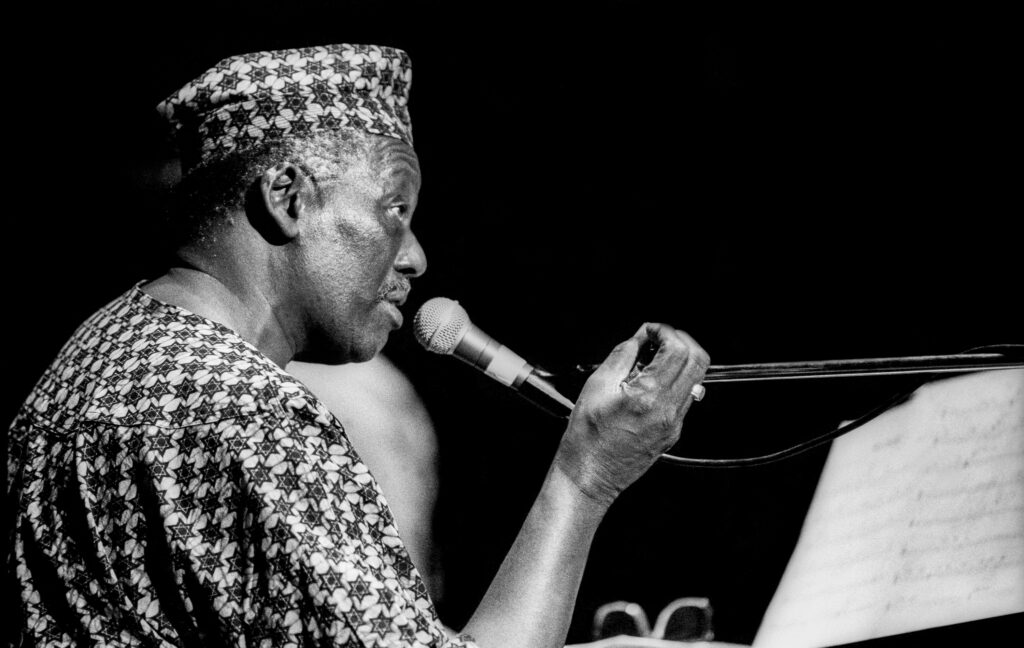
The pianist Randy Weston—who was born one hundred years ago—arrived in Tangier, Morocco, in April 1967, fresh from a tour sponsored by the US State Department of fourteen African countries and Lebanon. A sense of Weston’s ancestral heritage was woven into his upbringing. Born and raised in Brooklyn, he had been, as he put it in his autobiography African Rhythms, “thoroughly conditioned” toward Africa and the Pan-African ideas of Marcus Garvey by his father, Frank, who ran a Bed-Stuy luncheonette, the Panama Café, that had walls lined with portraits of African kings and tables frequented by musicians and educators. Frank taught his son to think of himself as “an African born in America,” and, as Weston recalled, set out the history of African civilization as an antidote to the Tarzan movies of his childhood: “Between the ancient Egyptians, the ancient Ethiopians, the great university of Fes, the Moors in Spain… we civilized them!” Street-corner teachers such as John Henrik Clarke and Yosef Ben-Jochannan, also known as Dr. Ben, helped deepen that Afrocentrism—as did Weston’s burgeoning engagement with jazz. As a young pianist, Weston was captivated by Duke Ellington’s evocations of Africa, especially in his Liberian Suite (1948). In the early 1950s, at the Music Inn, a cultural center in the Berkshires, Weston accompanied Marshall Stearns on piano and watched the jazz historian as he deployed a mixture of lecture and performance to map the music’s roots in the Caribbean and in West African musical traditions—polyrhythm, call and response, improvisation—challenging what Weston called the clichéd “up the river from New Orleans” narrative.
In 1960, the year that seventeen African nations won independence, Weston channeled these ideas into Uhuru Afrika, a musical tribute to African unity and self-determination orchestrated by Melba Liston and with liner notes by Langston Hughes. The album, which was openly aligned with the campaign in support of Patrice Lumumba in the Congo, was considered so politically incendiary that some American radio stations refused to play it. Apartheid South Africa banned the record altogether. In 1961, Weston paid the first of two visits to Lagos, where he met Fela Kuti. For Weston, Africa was rapidly moving from a site of imagination to lived experience. Then, in 1967, Weston embarked on the State Department tour, an offer he had considered rejecting due to the ongoing mistreatment of Black people in America.
Though steeped in Pan-African thought, Weston was unprepared for the ideological battles unfolding in Morocco and across North Africa. Between 1956 and 1961, Rabat had hosted a constellation of liberation movements; Nelson Mandela and the Martinican psychiatrist-philosopher Frantz Fanon both passed through training camps in Oujda. But Weston arrived in a Morocco that was moving fast to the right. The young monarch Hassan II was breaking from his father’s embrace of the Non-Aligned Movement, the bloc of postcolonial states that refused to side with either the US or the Soviet Union, and had begun appealing for French and American support in the battle against Algeria, Egypt, and malcontents at home. His regime unleashed a brutal crackdown on Marxists, Maoists, Pan-Arabists, and Pan-Africanists. Those suspected of sympathy for Fanon and the Algerian revolution were treated as especially dangerous.
North African Pan-Africanism tended to oscillate between two poles—at one end, there was Fanon, and at the other, the Senegalese poet-president Léopold Senghor. Each held a keen interest in Morocco, in North Africa more broadly, and in the relationship between “Arab and Negro.” Fanon admired Senghor, but was wary of his belief in a shared Black cultural identity and consciousness, or Négritude, which the Martinican thought risked recycling colonial stereotypes. He also believed Senghor’s emphasis on race at the expense of class helped to enable bourgeois rule, and, by extension, a form of neocolonialism.
The rivalry between the leftist, continental Pan-African camp and the Négritude-inspired, pro-Western camp played out in the pages of Souffles, a magazine launched in Rabat the year before Weston’s arrival by Moroccan writers who had cut their teeth writing for Présence Africaine in Paris. The Souffles collective largely sided with Fanon and took aim at Senghor’s division of Africa into a “Berber-Arab” zone, with its supposed “Bedouin virtues” on the one hand, and a “Negro-African world” on the other—a split many saw as merely an updated version of Hegel’s tripartite division of “European Africa, Asian Africa, and Africa Proper.” And the debate also began to play out at cultural festivals. In 1966, Senghor staged the First World Festival of Negro Arts in Dakar as what he described as a “defense and illustration” of Négritude. Weston chose to stay away, though his friends Duke Ellington, Amiri Baraka, and Langston Hughes all attended.
Cold War intrigue had crested in Tangier about a decade earlier, when Moscow and Havana both eyed the old International Zone. By the time Weston arrived, the city was being introduced back into the kingdom proper, though it still enjoyed more financial and media latitude than the rest of Morocco. (It was where Souffles was published.) Weston was introduced to Abdellah El Gourd, a young electrician at the Voice of America station who moonlighted as a maalem,for the Gnawa, a group with Sufi influence and with roots in slavery which uses music and prayer to heal those afflicted by spirit possession in a nightlong ceremony called a lila. Weston heard the music and was struck first by the register—that low, insistent bass throb of the group’s three-stringed instrument, the guembri. He began inviting El Gourd to take part in jam sessions in his apartment. Around this time, Weston also met Jacques Muyal, a Moroccan sound engineer and jazz deejay at Radio Tangier.
Through Muyal, Weston discovered that Tangier already had a jazz history of its own. Claude McKay and Josephine Baker had visited the city as early as the 1920s. Baker sang North African-flavored French jingles in Casablanca and Tangier. McKay, among the first American writers struck by Gnawa music, described movingly how the rites of those “Guinea sorcerers” echoed a ceremony he had known among peasants back home in Jamaica. In 1931, he made a prediction that is still quoted today: “Some day a wonderful new music is destined to come out of North Africa.” And after Congressman Adam Clayton Powell launched his jazz-diplomacy program in 1955 to counter Soviet propaganda about American racial discrimination, Tangier had become a regular port of call for touring American musicians. The same year, Albert Murray, then a young Air Force captain stationed at the Nouasseur base outside Casablanca, delivered a series of lectures to the troops in which he evoked jazz as an American art form that had, in a sense, come home to Africa. In 1959, Muyal was walking down the Boulevard Pasteur when he recognized the trumpeter Idrees Sulieman from a Thelonious Monk album cover, and invited Sulieman and his two companions to cut a session at Radio Tangier—likely the first jazz album ever recorded on African soil. (Muyal misplaced the tape, so the result, The 4 American Jazzmen in Tangier, didn’t appear until 2017.)
This was the foundation on which Weston, alongside Muyal and El Gourd, started to build. In 1969, Weston opened African Rhythms, a jazz club on the ground floor of the Cinéma Mauritania. He gave talks there on the history of Black American music and invited artists from across Africa and the diaspora. In the evenings, the musical alchemy would start: Weston on piano, El Gourd on the guembri, Weston’s son Niles on percussion, feeling their way toward something new—jazz composition anchored to the deep bass of the guembri. In 1972, Weston organized the First International Jazz Festival of Tangier—remembered simply as Tangier ’72—which took place at the storied Gran Teatro Cervantes, bringing in the saxophonist Billy Harper, Dexter Gordon, Odetta, Ahmed Abdul-Malik, and Pucho & His Latin Soul Brothers to share the stage with local Gnawa, Issawa, and Hamadcha Sufi troupes.
But beneath these acts of cultural celebration, the political undertow never really let up. In early 1967, Gamal Abdel Nasser had invited Senghor to Egypt, where Senegal’s president lectured at Cairo University on the foundations of Africanité. He argued that certain African leaders had made a strategic error in basing African unity in anticolonialism; true Africanité, he insisted, rested on culture—on what he called the “complementary symbiosis” of Arabité and Négritude. This could not have diverged more sharply from Fanon’s revolutionary vision of Black-Arab anticolonial solidarity, or the Pan-Africanism of Senghor’s political rival, the historian and father of Afrocentrism Cheikh Anta Diop. Diop, whom Weston held in great esteem, refused to draw any cultural boundary across the Sahara, and saw Egypt not as a separate civilization but as the wellspring of African civilization itself. “Egypt is to the rest of Black Africa,” Diop wrote, “what Greece and Rome are to the West.” Nasser’s response to Senghor’s project was lukewarm at best. The Egyptian president had his own vision of Arab-African-Islamic solidarity, built on anti-imperialism, not cultural essences and biological identities.
By the time of Tangier ’72, Nasser was dead, the Pan-African left had scattered, and Algeria was normalizing relations with the United States and expelling the Black Panthers in exchange for a natural-gas deal. North Africa’s broader turn to the right helped give rise to a distinctly American strain of Afrocentrism, one that was pushing back against Malcolm X’s Islam-friendly Black nationalism. In this newer telling, Islam had done as much damage to Africa as Christianity had, if not more, and Arabs were recast as “white invaders” on African soil—the moral equivalent of European settlers in the Americas. (The Nigerian novelist Wole Soyinka became perhaps the best-known proponent of this view.)
It was a minefield that Weston navigated with remarkable grace. After Tangier ’72 left him deep in debt, he sold the club and returned to New York. That same year, he released Blue Moses, a tribute to Sidi Musa, the Gnawa spirit of the ocean; the album distilled much of what Weston had lived and heard in Tangier, and its title track, “Ganawa (Blue Moses),” was built on the very chord sequence Gnawa musicians use to summon the spirit. In 1977, Weston was invited to perform at the Second World Black and African Festival of Arts and Culture, or FESTAC, in Nigeria. FESTAC ’77 was intended as a sequel to the Dakar festival of 1966, but from the start, Senghor insisted that representatives of North African states not be allowed to attend, or only partake as observers. His culture minister threatened a Senegalese boycott if the festival wasn’t restricted to Black countries. Nigeria’s leader General Olusegun Obasanjo pushed back, demanding that North African states be allowed to attend as full participants. Nigerian officials accused Senegal, The New York Times reported, of “racial bigotry in the most nauseating sense,” though Senghor’s defenders said his real fear was Algerian political agitation at the gathering. Weston went anyway, and performed alongside Fela Kuti.
The American jazz world of the 1970s was not always kind to a Pan-African pianist who insisted on invoking decolonization by weaving in African rhythms and Arabic verse. As neoconservatism and American Afrocentrism became more strident, so did suspicion of any jazz with affinities toward Islam, Arab music, or the Afro-Arab solidarity campaigns at the UN around South Africa and Palestine. The suspicion was reflected in jazz criticism—in Nat Hentoff’s writing on the Nation of Islam and “Arab slave traders,” or in Stanley Crouch’s tirades against Islamic slavery and Malcolm X’s purported naiveté. In 1974, Weston had moved to a small village in northeastern France, near the Swiss border, and remained there until 1985. Throughout that period, he continued to visit Morocco, and brought El Gourd and other Gnawa musicians to perform alongside him at festivals in Europe. He also returned to Egypt to perform and to visit his friend Salah Ragab, the Egyptian percussionist who had recorded Ramadan in Space Time with bandleader Sun Ra. In the end, the Afrocentrism that Weston embraced was, in effect, the Muslim-friendly Egyptocentrism of Diop, who fired back hard at American Afrocentrists and who dismissed the idea that Arab invasions had caused mass racial displacement into sub-Saharan Africa as “a figment of the imagination.”
Diop was responding to a particular strand of Afrocentric history—the idea that ancient Egypt and North Africa were originally populated by Black Africans who were then driven southward by the Arab conquests beginning in the seventh century. This interpretation allowed proponents to preserve the concept of a Black Egypt while portraying the modern Arab-Berber population of the Maghreb as the result of ethnic displacement and not centuries of gradual cultural transformation. Diop specifically rejected the idea of such a large-scale population displacement, even though he believed in an Arab conquest of North Africa. In his view, the claim of a “mass racial displacement into sub-Saharan Africa” was not supported by the historical evidence. Arab migration reshaped North African language, religion, and cultural identity far more extensively than it replaced its underlying populations. The distinction was important because it supported the view of Egypt as part of a broader ancient African civilization.
Senghor’s talk of spirituality, his Afro-Arab symbiosis, and his pro-Western orientation were warmly received in Morocco.By the late 1970s, when Moroccan officials launched an annual festival in Asilah, a small coastal town just south of Tangier, Senghor was selected as the event’s figurehead. The Afro-Arab Forum, as it came to be called, built directly on what Weston had started with Tangier ’72, bringing Gnawa and jazz musicians together and even releasing a Gnawa-jazz record, Asilah ’80. Weston was, in his own way, just as invested in the Morocco-Senegal relationship as Senghor. (When he died, his ashes were scattered off the coasts of both Dakar and Tangier.) But he steered clear of the Asilah festival itself. Senghor had dealt harshly with Diop, barring him from teaching at the Université de Dakar, dismantling his political party, and then imprisoning him.
In 1994, Weston and El Gourd released The Splendid Master Gnawa Musicians of Morocco, earning wide praise in jazz circles and a Grammy nomination. Gnawa-jazz had arrived as a recognized subgenre of international jazz, and was gaining ground even among the Moroccan bourgeoisie, who had long dismissed Gnawa culture as unsophisticated. In June 1998, the Gnaoua World Music Festival was launched in Essaouira; it has since grown into one of the largest festivals on the African continent, and Gnawa music into the most widely exported sound to come out of North Africa.
Senghor’s name is still occasionally heard in Moroccan intellectual discourse, but it is Weston who holds the warmer place in public memory. His face turns up on murals and portraits across the country: in downtown squares, in medina alleyways, in hotel lobbies, and in music cafés. His name surfaces at nearly every Africa-themed festival, or in any conversation about Morocco’s ambitions as a musical superpower.
Growing up in Tangier, I discovered Weston and Senghor at roughly the same time, in the late 1980s. My friends and I saw the Senegalese president every year at the Asilah festival. Weston had known my grandfather since the late 1960s, and would turn up now and then at our family’s restaurant, Hamadi’s, today the oldest standing restaurant in northern Morocco, open since 1953. His daughter Pamela was in the same class as my Aunt Batoul; his son Niles went to the same middle school as my Uncle Mohammed. As teenagers, we would see Weston at Dar Gnawa, the cultural center in the medina, sometimes with the beatnik and trumpeter Ted Joans or other musicians in tow, though we had no real idea who any of them were.
When I arrived in New York as a teenager in 1990, Weston’s brownstone on Lafayette Avenue—nicknamed “the Brooklyn Kasbah”—became a second home. Weston would host lilas, couscous dinners, and listening parties that ran late into the night. Among the regulars: Billy Harper, the trombonist Benny Powell, the pianist Eddie Palmieri, Dr. Ben, and Gil Noble, the host of the Sunday morning show Like It Is. Randy would slot in a battered cassette or sit at his Steinway and play something himself, then lean back and offer reflections. In February 1996, Weston and El Gourd were invited to the thirty-eighth Grammy Awards; on the red carpet, Weston playfully introduced El Gourd, dressed in a crimson-red djellaba, as the “Prince of Morocco.” In April 2011, the king of Morocco honored Weston and El Gourd with a royal medal, the al-wissam al-malaki, recognizing their contributions to Moroccan music. After Weston tearfully expressed his gratitude, El Gourd performed an original composition, a salutation to the Gnawa people living in America.
In May 2016, the Gnaoua World Music Festival invited Weston back as its guest of honor. Under a moonlit summer sky and in front of an audience of thousands, he performed, with his old comrades El Gourd and Harper, a concert that was broadcast live on Moroccan television. The next day, after lunch, Weston sat at L’Heure Bleue Palais to record an interview with Bilal Qureshi for NPR’s All Things Considered. A waiter approached Weston to say he had a visitor. An older man with long gray hair appeared, a crate of vinyl records tucked under one arm. “Monsieur Weston,” he said, “I saw your concert on television yesterday, and I drove three hours from my farm to see you.” His name was Abdelhakim. He sat down and pulled out a handful of black-and-white photographs of himself, decades younger, leaning against a piano beside Weston and his son Niles. “I used to come to your jazz club, back in the early seventies.” The two men embraced, and wept. “I just wanted to thank you,” Abdelhakim said. Then, after a moment: “Will you sign my records?”