Cold War Fixations
The American president sat before a large screen filled with the faces of dozens of foreign leaders. On the opposite end of the long table, socially distanced, sat the Secretary of State. It was 2021, and the entire world had shrunk inside of a Zoom call. The Biden administration’s inaugural “Summit for Democracy” was no different. What was supposed to have been a powerful show of democratic renewal, a declaration of the enduring power of the liberal democratic model, instead looked geriatric and feeble. It wasn’t just the pandemic arrangements or the very old president: The rhetoric itself was full of trite Reaganite platitudes, hardly updated since the fall of the Berlin Wall. Democracy’s leading lights had lost much of their once-youthful verve. At the turn of the millennium, they had touted a contagious ideology and rebellious energy that was as much political as it was cultural: Levi’s, Marlboro Reds, the Rolling Stones, and “freedom,” all packaged together in one shiny, irresistible export. Watching the Summit for Democracy in 2021, however, was like watching a boomer rock band kick off a reunion tour at the county fair: getting the band back together one last time, going through the motions. They expected the same uproarious applause they’d once gotten when the world was different, but the old magic just wasn’t there. Even the younger faces of the democracy faithful seemed to be playing covers of the old classics. Observing the entire Summit for Democracy spectacle unfold like a rerun episode of daytime television, one couldn’t help but feel a little ashamed.
Michael McFaul’s new book Autocrats vs. Democrats: China, Russia, America, and the New Global Disorder is the latest attempt to breathe new life into this stale worldview. His belief system demands the projection of twentieth century Cold War thinking into the twenty-first century, shorn of most of its compelling ideological content. In the place of the old substantive competition between communism and capitalism, only the hollowed-out shell—“autocracies” versus “democracies”—remains. McFaul’s fantasy is of a world in which countries can be easily sorted into a neat binary of good and bad, and wars both hot and cold can be understood as a grand contest between the forces of light and darkness, of liberty and tyranny, of freedom of speech and censorship, of free and fair elections and “irregular” or stolen elections. Predictably, his book comes up curiously lacking. Somewhat novel in the Biden-McFaul framework is the extension of the old fight—democracy versus autocracy, us versus them—to the homefront. Now, the leader of the Republican Party (and presumably his voters as well, though this part is a bit unclear) are as much the autocratic enemy as the man in the Kremlin. The implications are dark indeed: Both sides of the country’s riven political divide now believe that there is an enemy within.
Many readers will already be skeptical of McFaul. As President Obama’s ambassador to Russia from 2012 to 2014, he was the architect of the much-hyped “Russian reset”—in retrospect, a spectacular failure. His tenure was also marked by his embrace of Twitter as a tool of “digital diplomacy”—all the rage at the height of Arab Spring optimism about the supposed capacity for social media to bring democracy to the Middle East. Of course, this didn’t exactly work out either. Today McFaul is a professor of political science and the director of the Freeman Spogli Institute of International Studies at Stanford. One can’t help but ask why our foreign policy elite is composed of individuals whose careers are distinguished by such defeats, or why we should trust those who helped steer us into the current morass to begin with.
The book begins in 1991 in Moscow with the end of the Cold War and the collapse of the Soviet Union. The Golden Arches are rising over Red Square, and a young McFaul is doing PhD research while working at the newly opened National Democratic Institute (NDI). That heady time, McFaul writes, “was a glorious moment to be a democrat, liberal, capitalist, multilateralist, and American… I was treated like a rock star.” One gets the sense that this is what his personal investment in the ideology is all about: The longing to return to the zenith of Pax Americana is also the dream of perpetual youth. In those days, it was easy for the democrats to look fresh and exciting. It was the communist governments of Eastern Europe that appeared sclerotic.
Autocrats vs. Democrats is about the United States, Russia, and China. Other countries are mentioned only in passing. This means that what McFaul is really concerned with is great power competition. Coming from an avowed liberal internationalist, there is something discordant about this. The reemergence of great power rivalry itself suggests that post-Cold War liberal internationalism has failed. After all, a mass global conversion to liberal democracy as evangelized by the liberal internationalists was supposed to prevent this very outcome. McFaul’s autocrats vs. democrats paradigm is therefore an unwieldy attempt to force a liberal internationalist interpretation on what is effectively great power competition, a rivalry that is as much or more about resources and security as it is about “values.” McFaul’s framework applied to the actually-existing order therefore comes across as ill-fitting and awkward, like a baggy garment that also manages to be tight in all the wrong places.
The first section of Autocrats vs. Democrats offers a concise history of US-Russia and US-China relations over the past 300 years. This is a decent refresher, and it reminds us that history is long, with periods of both tension and thaw, but suffers once again from his insistence on imposing a restrictive framework on our understanding. He holds that three factors have dictated the course of US-China and US-Russia relations over time: power, regime types, and individuals.
These are surely important, but it’s an imprecise way of describing how relations can change. For example, US-Russia relations were strained by the 1999 US-led NATO bombing of Serbia. Though McFaul glosses over this history in Autocrats vs. Democrats, as a young man he saw it as pivotal in the evolution of US-Russia relations. “Although few in Washington have noticed, US-Russian relations have entered a new era with the NATO bombing of Serbia,” he wrote in a prescient 1999 op-ed, “If militant anti-Western forces sweep into power after the next elections, Russian democracy may falter, economic reform will halt, and US-Russian relations will take a dramatic turn for the worse.” Putin was appointed less than nine months later.
But in Autocrats vs. Democrats, McFaul writes that the NATO intervention against the brother Serbs “did not permanently alter US-Russia bilateral relations.” This is almost certainly untrue; the NATO intervention was one event (among others, to be sure) that contributed to a slow but steady deterioration of relations that has brought us to this day. Indeed, the NATO bombing of Serbia was a pivotal moment in both US-Russia and US-China relations. Just because it did not cause an immediate rupture does not mean it didn’t “permanently alter relations,” but McFaul doesn’t acknowledge that American actions can create fissures that don’t fully crack until later on.
In a section dedicated to “The End of American Hegemony,” McFaul laments the lack of American enthusiasm for democracy promotion and mounting popular support for what he calls “isolationism.” “In 2023, Morning Consult’s US Foreign Policy Tracker Index showed that 40 percent of Americans polled supported isolationism and only 17 percent favored engagement,” he writes. “In 2024, this same poll revealed that only 19 percent of Americans thought that democracy promotion should be a foreign policy priority.” McFaul does acknowledge American foreign policy catastrophes that may have contributed to such sentiment, albeit in the minimizing and self-serving terms we have come to expect from segments of the foreign policy elite. Therefore we get insufficient insight into why democracy promotion abroad lacks the support of the demos at home, and no curiosity about what a more “democratic” foreign policy—one with more popular domestic support—might look like.
Equally maddening, the words “isolationism” and “isolationist” are used throughout the book (27 and 21 times, respectively) to describe Donald Trump’s foreign policy. But this is contested, and for good reason. As political scientist Barry Posen has written, Trump’s approach is more accurately characterized as “aggressive unilateralism” or “illiberal hegemony.” McFaul therefore makes the same error that many liberal Atlanticists do, which is mistaking Europe for the world. While surely Trump does not treat alliances like NATO as sacrosanct, this does not make him an isolationist. This disproportionate focus on the Euro-Atlantic space can create blind spots. For one, many in McFaul’s cohort were surprised when countries outside the West did not follow NATO member states in privileging the war in Ukraine over other conflicts, something that was evident in successive votes on Ukraine-related resolutions before the UN General Assembly. The idea that Trump is an “isolationist” is rooted in a similar myopia. Surely many in Iran and Venezuela wouldn’t think America has retreated from the world stage.
McFaul is more honest when he writes about relative US economic decline. He acknowledges China’s unexpected strength in weathering the 2008 financial crisis, an event that damaged the reputation of American capitalism while making the Chinese model appear an attractive alternative, particularly among countries of the so-called Global South. Indeed, McFaul’s discussion of the relative strengths of the American, Chinese, and Russian economies and demographics (though I wish he would have spent more time on the latter), along with a lengthy itemization of their respective military capacities (including nuclear, AI, and satellites) is useful, and brings us to a convincingly measured conclusion: While the US faces a formidable rival in China, war is not inevitable, and the situation is not nearly as catastrophic as the most ominous predictions suggest. Indeed, McFaul writes that the main area of concern for the US is confined to the South China Sea and Taiwan, where the balance of power is shifting in China’s favor. He asserts that power asymmetry tends to produce periods of relative cooperation, while greater parity leads to increased tension.
So while Autocrats vs. Democrats is not without utility, it is nonetheless an exasperating book. One of the most frustrating things about it is that McFaul does not provide readers with any definitions. We don’t learn anything about what democracy and autocracy are. There is no philosophical discussion about the different systems and how the relationship between the individual and the state differ in them. We do gain a selective, ultimately self-serving understanding of the democracy versus autocracy framework, wherein qualities like “polarization” become implicated in our current malaise and therefore get lumped in as a feature of autocracy. (And is “polarization” really something we associate with the one-party state of Xi Jinping’s China?) We get the sense that “autocracy” has an elastic definition that can be stretched to accommodate anything that McFaul and his ilk don’t like; the word “democracy” here suffers from a similarly confounding imprecision. The list of countries invited to participate in Biden’s Summit for Democracy reflected this very slipperiness. Among the more eyebrow-raising countries to receive an invitation were Modi’s India, Duterte’s Philippines, Vučić’s Serbia, and Bolsonaro’s Brazil.
At times, McFaul’s Cold Warrior thinking leads him to make false or distorted claims. In a discussion of the Collective Security Treaty Organization (CSTO), the Eurasian military alliance comprised of ex-Soviet states, he writes, “the one major collectively endorsed mission [of the CSTO] was in Kazakhstan in 2022 to support the regime there being threatened by a coup, but Russian forces were the only ones involved.” Though McFaul’s broader point—that the CSTO is so weak and disunited that it cannot possibly be compared to NATO in any meaningful way—is certainly true, he is wrong that only Russian soldiers were involved in the mission in Kazakhstan; Armenia sent one hundred soldiers. Elsewhere, he claims “Russian officers” assisted the Serbian government in repressing protesters following contested parliamentary elections in 2023. While not impossible, this remains pure speculation on McFaul’s part.
There is also information missing that suggests that McFaul’s knowledge might be incomplete, which inspires further distrust. In the section about Chinese soft power, he describes the Chinese government’s global network of Confucius Institutes, the nonprofit educational institutions dedicated to the promotion of Chinese culture and language, operated by the Chinese Ministry of Education. However, he says nothing about the Chinese Cultural Centers set up around the world under the Chinese Ministry of Culture, which have arguably been more effective: While the Confucius Institutes have been met with suspicion from the beginning, the Chinese Cultural Centers have generated less controversy. There are now around 50 Chinese Cultural Centers open around the world, with more than 20 in Europe and 8 in Africa, including one on the site of the old Chinese embassy in Belgrade that was hit by NATO airstrikes in 1999. Xi Jinping travelled to Serbia to open the cultural center himself in spring of 2024, on the anniversary of the bombing of the embassy. McFaul writes about Xi’s trip to Serbia that spring but neglects to mention the opening of the cultural center or the anniversary. Instead, he interprets the Chinese leader’s visit to Belgrade as rooted in an autocratic affinity for Serbia’s leader Aleksandar Vučić who, like Xi, is also “very distant from Washington.” Here we see the weakness of McFaul’s worldview laid bare: his inability—or unwillingness—to view the world through anything other than his own rigid framework clouding rather than clarifying our understanding of events.
The lack of clarity around his conceptual framework leads to other kinds of confusion as well. At various points, McFaul appears to use the terms “democratic,” “liberal,” and “pro-Western” interchangeably, making it unclear what he is actually talking about. Sometimes, it appears that there is a deliberate ambiguity about this: “Democracy promotion” sounds far less inflammatory than “liberalism promotion.” It’s one thing to promote a system that allows people to choose for themselves (“a government of the people, by the people, for the people,” as Abraham Lincoln put it in his Gettysburg address) quite another thing to export or impose a dreaded -ism. The marriage of liberalism and democracy is not inevitable; indeed, they have often been in tension. Throughout history, liberalism has been an ideology associated with the elite. As Czech political scientist Pavel Barša put it, the liberalism of the twentieth century was a “one-sided defense of freedoms and rights against the state [that] helped de-regulate capitalism, which led to huge social inequalities and, ultimately, undermined democracy.” At worst, a singular focus on “democracy” risks fetishizing process—the act of voting—over results. Indeed, some would argue that the right to vote, even in a “free and fair election,” matters little to those who lack basic security and can’t afford to eat.
This prompts the question: Does Russian and Chinese leadership really object to “democracy” or liberalism? As conservative writers David Lloyd Dusenbury and Philip Pilkington recently wrote in American Affairs, “the actual ideological conflict between Western liberals today and the government of China has very little to do with democracy; it has everything, however, to do with liberalism.” To his credit, McFaul has given this some thought. He notes that at various points, Putin embraced “managed democracy,” “sovereign democracy,” or even “illiberal democracy”, emphasizing that it was only “liberal democracy that Putin allegedly rejected.” He even acknowledges that the Chinese and Russian ambassadors to the US wrote a joint op-ed titled “Respecting People’s Democratic Rights” ahead of the Biden administration’s Summit for Democracy. But he rejects the idea without offering a substantive rebuttal. McFaul’s approach rests on a liberal assumption that “the only legitimate democracy is liberal democracy.” In the liberal view, you can’t have real democracy without individual rights, but you can have democracy with massive wealth inequality—without economic and social rights.
McFaul’s autocracy-democracy dichotomy inevitably opens up the United States and its European allies to uncomfortable criticism, precisely the kind he dismisses as “whataboutism” throughout the book. If foreign countries can lobby lawmakers to shape American policies in accordance with their interests, is the United States really a government of the American people and for the American people? If NATO and EU member state Romania can cancel elections when the “wrong” candidate wins, is that an attack on democracy or a defense of it? Viewing the war in Ukraine as a war “for democracy against an autocracy” also requires a somewhat malleable notion of “democracy.” As Maiko Ichihara of Japan’s Institute of Geoeconomics writes, “framing the defense of Ukraine as a fight for democracy doesn’t necessarily entail safeguarding democratic institutions and values, such as free and fair elections, transparency and accountability…[or] supporting the media and nongovernmental organizations, which act as a check on government power…in the context of Ukraine, defending democracy means protecting the sovereignty of a democratic country, making defense, rather than political reform, the main focus.”
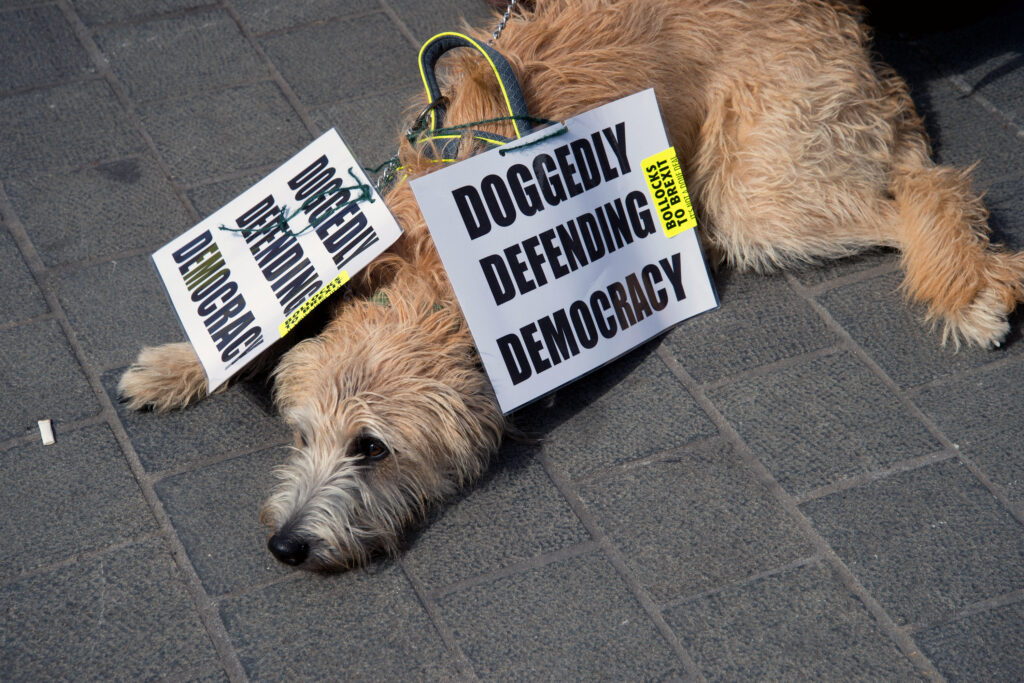
Perhaps this is why “defending democracy” can now imply something that sounds rather undemocratic. If a “democracy” is under threat, then extraordinary measures can now be undertaken to “save” it, including, apparently, the annulment of elections, censorship, and arrest. “Defending democracy” can now involve violating democratic principles and overriding democratic institutions—sacrificing democracy in order to save it.
The implications of McFaul’s extension of the autocrats versus democrats framework to the domestic realm (via his repetitive incantations that in Trump’s America “it’s no longer clear which side the US is on”) are perhaps the most disturbing of all. Since McFaul deliberately blurs the lines between autocracy abroad and autocracy on the homefront, he ends up legitimizing a beefed-up McCarthyism. If confronting autocracy abroad requires an increase in defense spending and ramping up democracy promotion efforts, then we can surmise that exceptional measures may also be undertaken to confront the enemy within. “Defending democracy” at home and abroad therefore means breaking taboos and establishing precedents that may come back to haunt those who place themselves on the democratic side of the autocrats-democrats divide. It may also be politically counterproductive. At that first Summit for Democracy, Biden spoke of the need to “heal our divisions.” Treating tens of millions in America as an autocratic fifth column, as McFaul does, would be antithetical to that idea.
However dangerous this kind of McCarthyite thinking is, it is also understandable that Cold Warriors would double down on them now. In a world riven by war and disorienting technological change, it makes perfect sense that many would cling to a comforting old model associated with past glory. But any clear-eyed assessment of recent decades would require acknowledging the relationship between the liberal triumphalism of 1989, the crimes and indulgences of the American unipolar moment, and the current state of global affairs. Surely an approach free of the Manichean enemy-seeking pathologies of Cold War bipolarity would be better suited to the emergent multipolar world. And a more expansive, less prescriptive notion of democracy would do much to renew the dignity of the concept and give it fresh imaginative life, something it needs much closer to home.
Lily Lynch is a writer and journalist. She is the co-founder and editor-in-chief of Balkanist Magazine.