Mexico’s Forever War on Drugs
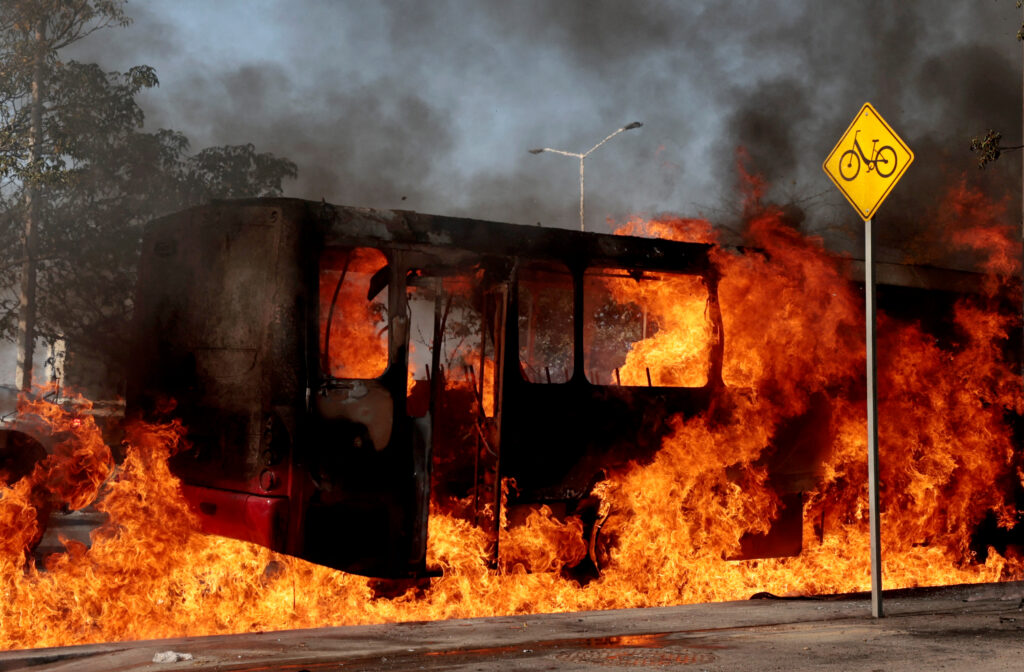
Sunday morning and the images are circulating across every screen in Mexico. The city of Guadalajara, in Jalisco—the third-largest in the country and a host for the upcoming World Cup—is shrouded in smoke. There are fires, and there are bonfires. Trucks are blocking avenues and highways. Military convoys are advancing relentlessly, as if heading everywhere and nowhere at the same time. These sights are a metaphor for a conflict we don’t know how to name: omnipresent, endless, and difficult to comprehend even for those fighting it—or perhaps for them above all.
On February 22, 2026, in the state of Jalisco alone, 661 cars, 130 businesses, and 62 banks were set ablaze. Even these numbers fail to capture the chaos, but they do help put in perspective the impact of a single name and a single nickname: Nemesio Oseguera Cervantes, aka El Mencho. The leader of the Jalisco New Generation Cartel (CJNG), he was for years one of the men most wanted and most searched for on the continent, perhaps in the world.
Eleven years earlier, in 2015, he escaped a similar raid. The Mexican Army had him surrounded in the mountains of Jalisco. He struck back. Not with an escape, but with a scene straight out of a movie. His men pulled out weapons rarely seen in these parts: an Iranian grenade launcher, a Russian rocket launcher. One of the rockets hit a military helicopter. The aircraft spun in the air, crashed, and exploded. Several soldiers were killed. That day El Mencho disappeared into the mountains.
This February 22, he was less fortunate. He was arrested. And the day’s toll was brutal. Fifty-eight dead: thirty alleged members of the CJNG, but also twenty-seven security agents and one civilian. The scenes were terrible, but also familiar, extraordinarily familiar. For two decades, the conflict against drug criminals in Mexico has been full of moments like this one. Again and again, spectacular operations and arrests are heralded as the beginning of the end. The problem is that we never know what end to which story.
Back in 2006, the federal government sent the army into the streets and launched a direct offensive against criminal organizations. Since then, the violence has continued to claim lives.
Between 2018 and 2020, the most lethal period on record in the country’s recent history, the National Institute of Statistics and Geography recorded more than 36,000 homicides per year—that’s nearly one hundred people killed every day, or one every fifteen minutes. To that must be added more than 130,000 reported missing persons and many internally displaced people—more than one million in 2023 alone. These levels of violence are more typical of countries that are at war than of one that is not.
Two decades have passed, with operations, clashes, and the arrest of drug lords. And yet the same questions remain. What is the true nature of this conflict? How can we understand a phenomenon that seems to repeat itself over and over? How might it change as the US attempts to assume a new role in the world?
Over the past twenty years, criminal organizations, the Mexican state, and the ways of governing territories ravaged by violence have changed. Mexico’s place in the hemisphere’s illicit flows has also changed. The world has changed. What began in 2006 as a strategy to combat drug-trafficking organizations—Mexico’s own War on Drugs—ended up revealing something much broader: a global network of illegal markets for drugs, money, people, and weapons in which Mexico plays a central role.
A Geography of the Illicit
To understand this, let’s look at a map. North of Mexico lies the largest drug market on the planet. In 2024, 73.6 million people in the US used some illicit drug, mostly marijuana. Some 4.3 million—more than the population of Uruguay—consumed cocaine. And about 550,000 used heroin. In 2024, nearly 7.6 million people in the US also misused prescription opioid painkillers. The US accounts for just 4.3 percent of the world’s population, but it is the world’s largest market for synthetic opioids. Its economy can absorb almost any illegal drug.
To the south, across Latin America, lie some of the main cocaine-production zones. The coca leaf has been cultivated for centuries on mountain slopes in the Andes. From that leaf comes the cocaine that then crosses dense jungles or island-hops by speedboat in archipelagos, sometimes transiting via makeshift airstrips in Central America. After that it enters Mexico. By land or by sea, cocaine reaches Mexico.
In recent years, another route has also emerged, one that begins much farther away, on the other side of the Pacific.
Chemical factories in China now produce precursor chemical compounds for synthetic drugs that then travel in containers, cross oceans—and arrive at Mexican ports. These are used to transform not drugs that are grown but drugs that are manufactured. Synthetic drugs. Methamphetamines. Fentanyl. Counterfeit oxycodone pills. Crystal meth. Substances that depend not on the ecosystems of crops or mountain climate but on laboratories anywhere.
From clandestine labs in Mexico—often little more than makeshift kitchens—the merchandise sets off north, toward the same vast market that has already been absorbing so much cocaine, heroin, and marijuana. But neither the drugs nor the guns distribute themselves. Their distribution depends on networks of brokers and transporters operating inside the US. These are perhaps less visible than the networks of producers and sellers, but they are no less essential.
For decades, Mexico was said to be merely a transit zone: a bridge between producers and consumers. Today, it is one of the most important logistics hubs in a broader global illicit market: As cocaine, heroin, and synthetic drugs travel north, thousands of weapons are moving south.
Some 392 million guns are in circulation in the US today; that’s more guns than people. (About 15 million are sold very year.) There are nearly 80,000 authorized firearms retailers there—six times more than Starbucks coffee shops and twice the number of post offices.
For decades, US federal regulations limited the circulation of certain firearms and restricted their production. But in 2004 a federal ban on assault weapons—a cornerstone of the US regulatory framework—expired. Since then, the market has expanded rapidly: more production, more sales, and more firearms in circulation. It was inevitable that many of those weapons would end up crossing the border, in private cars or cargo trucks. A recent estimate suggests that between 70,000 and 250,000 guns were smuggled from the US into Mexico in 2022. Using another estimate, model-based and weighted, that experts often cite—around 135,000 guns in a single year—that’s 369 per day. Fifteen per hour. One every four minutes.
At least two-thirds of the weapons recovered at crime scenes in Mexico can be traced back to the legal US market. These are not exotic contraband, nor were they stolen from military arsenals. Many were purchased in fully licensed stores by people with no criminal records.
Drugs to the north. Guns to the south. A mutually reinforcing trade system has evolved over the past two decades.
The Mutations
“It had been so many years since I’d looked up that I’d forgotten the sky,” says a character in Pedro Páramo, Juan Rulfo’s famous novel about a town populated by the spirits of the dead who are haunted by their pasts. Something similar has happened with drugs in Mexico: the years passed, the bodies piled up, and for too long we forgot to look up.
Two decades is a long time for any conflict. In that span, the economies that sustain it, the organizations that drive it, and the institutions that try to contain it all change.
The first transformation occurred in the drug economy itself. For much of the twentieth century, and even at the start of the twenty-first, drug trafficking was based on an agricultural economy. Production followed the rhythms of the land. But since then the focus of the business has shifted toward synthetic substances. These do not depend on harvests or specific terrain. As drug trafficking became increasingly based on a dispersed, flexible chemical industry and global supply chains, it became far more difficult to contain.
That’s not the only change. In many regions of Mexico, drug trafficking is no longer even the center of this criminal economy. With more weapons in circulation and more state structures captured by cartels, other side economies have emerged: extortion, the kidnapping of migrants, protection rackets, and the control of local markets, including those for everyday goods and transportation. Many drug traffickers have become administrators of territorial criminal orders, of systems of economic extraction sustained by the threat of violence.
The second transformation occurred within the criminal organizations themselves. For years, the map of Mexican drug trafficking seemed simple: A handful of large organizations dominated the routes to the US, and they were hierarchical organizations, with a clear leadership and more or less defined territories. That world has also fallen apart. The large organizations did not disappear, but they fragmented. Arrests, deaths, internal disputes, and new economic opportunities multiplied the number of armed groups. Once, there were a few cartels; today, there are dozens of organizations, cells, and factions.
The people leading them have also changed. Many of today’s criminal leaders were children when this conflict began in 2006. The generational shift has brought a different kind of violence—more improvised, more unstable, and almost always more brutal. Younger leaders, with a lot of power and little experience, and with short careers. The result is a dispersed and volatile criminal ecosystem, and more points of tension, more battles.
The map changed with them. In 2006, the violence seemed to be concentrated in a few northern cities: Ciudad Juárez, Tijuana, and some border towns where routes to the US were contested. Then the conflict shifted south and southwest, to Guanajuato, Jalisco, and Michoacán. New criminal dynamics, such as fuel theft, sparked other battles. In recent years, the map shifted again. The deeper south—Tabasco, Chiapas—began to experience levels of violence that for decades had seemed unthinkable there. What once seemed like a problem confined to a few border cities has spread across the entire country.
The latest and most significant shift occurred within the state itself. What began in 2006 as an exceptional measure—the deployment of the army in the streets—ended up becoming a permanent feature of the security system. The exception became the rule. The military ceased to be an emergency resource and took center stage in the Mexican state’s coercive apparatus.
The transformation did not occur solely at the highest levels of the state. It also unfolded locally. And in hundreds of municipalities, criminal organizations, in turn, learned to take over or neutralize local police forces, city councils, and administrative offices.
Where the state is most fragile, crime finds entry points. Sometimes that spells open confrontation. At other times, it means coexistence. Officials are co-opted, political campaigns are funded, local budgets become objects of control and extraction. The result is an uneven landscape. In some areas, the state retains command; in others, its authority competes with, or is subordinate to, criminal powers.
This expansion did not occur in an economic vacuum. Illicit money found ways to circulate within the legal economy, among companies and regional markets, via poorly monitored financial flows. The criminal world and the formal world learned, in many cases, to interact without too much fuss. The boundary between them has become increasingly blurred.
As the Mexican state has become more militarized and more present across the territory, its capacity to govern has also become more uneven. Its armed presence has increased. But justice not so much.
Different governments have adopted different strategies, promises, and words. Upon coming into office in 2006, President Felipe Calderón sent the army into the streets and declared a frontal war against criminal organizations—it was a bet on direct confrontation. Later, his political nemesis Andrés Manuel López Obrador, the president from 2018 to 2024, tried instead to address the social causes of violence. His intuition was that social policy could reduce the incentives that fuel criminal economies. It was an important insight, but in light of its results, it was also insufficient. Good social policy does not make for good security policy.
Today, President Claudia Sheinbaum is trying yet a different approach. She, too, wants to address root causes, but she pairs that effort with more intelligence gathering and more targeted operations. So far under her administration the homicide rate has fallen by more than 40 percent.
But by other metrics—extortion, more criminal activities—progress is less clear. Structural limitations remain. The burden of security continues to rest on a military sector that has grown stronger while the justice system, the weakest link in the Mexican state, has barely budged. Crime has mutated. So has the state. It has taken more time for our gaze to shift. For too long—as in Rulfo’s novel—we kept our heads down.

Lifting Our Gaze
El Mencho, militarization, the War on Drugs, the Sinaloa Cartel, Calderón, López Obrador, the Culiacanazo. Resorting to these phrases and these names falls short. They describe only part of the phenomenon. They capture the visible protagonists, but not the mechanism that connects them: The drug conflict in Mexico has never been solely Mexican.
For a long while, we thought the problem was criminal organizations. Over time, it has become clear that the issue lies not only with the actors, but with the system—a system that connects consumer markets, transit routes, global supply chains, and transnational criminal economies. Mexico is where these flows converge. It has not been merely fighting criminal organizations. It is situated, perhaps trapped, at the center of an architecture.
Trump and the Illusion of War
If this conflict is part of a global system of illicit markets, no purely national strategy can resolve it. Nor can one based on obedience to the US.
Early this month at an event in Miami, President Donald Trump announced his “Shield of the Americas”initiative, a plan to combat the Mexican cartels. The name says it all: a shield to protect the hemisphere from a threat imagined to be external.
For years, Washington has pointed at the south as the source of its problem. First at Colombia, then at Mexico. There was “Plan Colombia.” There was “the Mérida Initiative.” Both programs were based on the premise that the drugs came from outside, that the violence originated elsewhere, that the problem lay on the other side of the border. Meanwhile, another story was unfolding within the US. The opioid epidemic. Fentanyl.
This is a familiar, and convenient, form of scapegoating. It turns a domestic crisis into someone else’s failing. The problem moves away from the demand for drugs, from ineffectual regulation, from everything happening inside the US.
And so for two decades a notion persisted in diplomatic discourse as well as some programming: shared responsibility. Facing a common challenge, Mexico and the US should tackle it together. Cooperation, intelligence, strengthening institutions, justice systems. But that framing, which for years dominated the bilateral relationship, is beginning to evaporate. The US Drug Enforcement Administration and other agencies are still actively involved with the Mexican authorities. Yet there is less trust and they make more demands. Cooperation has given way to pressure, and at times, something closer to coercive leverage.
In Trump’s view, drug trafficking is simply a supply-side issue and the culprits are criminal organizations that produce and export drugs to the US. If those organizations are destroyed or their infrastructure is struck, the problem will disappear.
In fact, after so many years spent failing to curb the drug trade, we know that the system that sustains it only exists because there is massive demand. It exists because weapons, money, and chemical precursors circulate through global commercial networks. It exists because for decades illicit economies have been integrating into cross-border financial and logistical circuits.
Still, the new strategy rests on military rhetoric. Force. Force. Force. Washington casts cartels as narco-terrorist organizations and to combat them it leans on familiar tools: interdictions at sea, targeted strikes, the threat of more unilateral actions beyond US borders. The logic behind using this language and these methods is to turn a complex economic system into an identifiable military enemy. But it also radically oversimplifies the nature of the challenge.
Criminal organizations are very adaptive. They fragment, reorganize, and relocate. Fighting them as if they were irregular armies may yield tactical victories, but that rarely disrupts the system sustaining them.
Twenty years after the start of the war on drug trafficking—or whatever one chooses to call this long episode of violence—it should seem clear that it is not merely a confrontation between the state and criminal organizations. Nor is it solely a Mexican problem. It is the local manifestation of a global illegal economy.
Those images out of Guadalajara last month stand for something else than what they first seemed to show. For years we thought those scenes of smoke, burning vehicles, and military convoys represented a conflict between the state and the cartels. Today, we know they expose a point of friction in a much vaster system. Mexico did not create this, but it ended up being the place where an entire system confronts its failures. Here, the global economy of crime reveals its true face.
Carlos Pérez Ricart is a professor at CIDE in Mexico City and the author of La violencia vino del Norte (Debate, 2025). His work examines organized crime, arms trafficking, and security policy in the Americas.