Sanchismo’s Last Stand
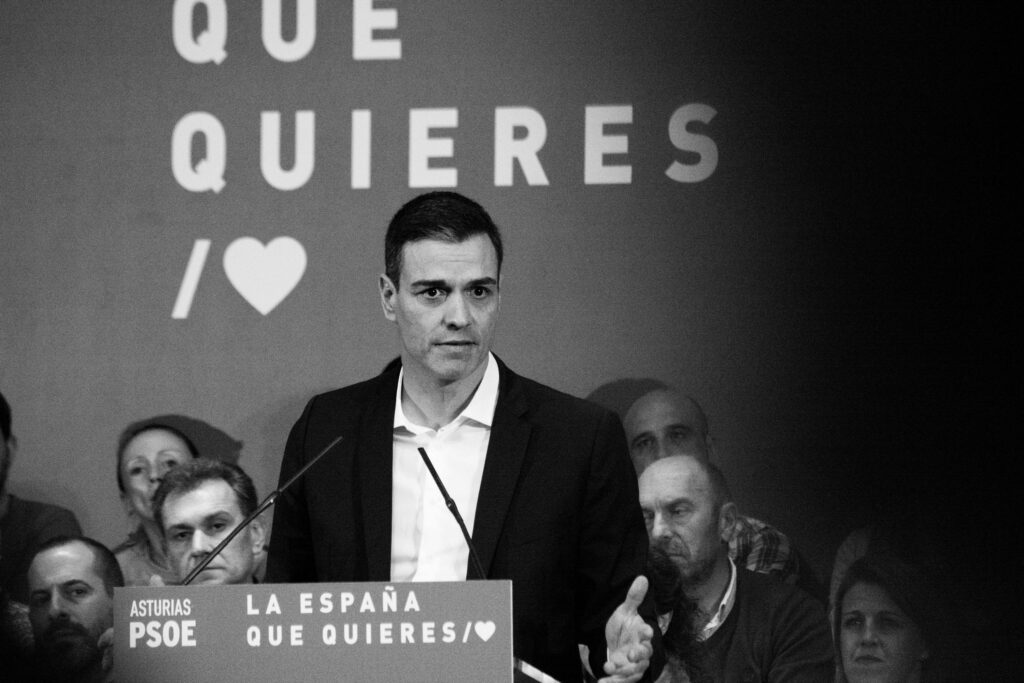
European social democracy is undergoing its deepest existential crisis in decades. The French Socialist Party is moribund. Keir Starmer’s Labour, despite its landslide victory in 2024, would now be defeated by Nigel Farage’s Reform UK. The far right governs in Italy, Hungary, Slovakia, the Czech Republic, and the Netherlands, and stands as the leading opposition force in Germany, France, Austria, and Portugal, where the far-right Chega party has become the country’s second-largest political force, burying the legacy of António Costa, now President of the European Council. Spain remains the sole holdout where European social democracy survives—and it does so in the improbable figure of Spanish Prime Minister Pedro Sánchez.
In a moment of accelerating systemic turbulence—compounded by the digital and green revolutions, a war economy, the crisis of the unipolar order, and the fracturing of the welfare state—national specificities are increasingly decisive in shaping political outcomes. The national consensus forged by Sanchismo is a product of this tension. His public image is thoroughly degraded at home, sustained only by the international reputation he earns as the antithesis of the far-right—a contrast his parliamentary adversaries have learned to exploit with increasing effectiveness.
The political career of Sánchez reads like a Hollywood script. From his appointment as general secretary of the Spanish Socialist Workers’ Party (PSOE) in 2014, his ascent was meteoric. He ran as the party’s candidate for prime minister in December 2015 and again in June 2016. After 609 days without an approved national budget, faced with the choice of abstaining to allow another government under Mariano Rajoy or pursuing an alternative, Sánchez refused to facilitate the investiture. He clashed with the party and resigned his seat in parliament.
A year later, in June 2017, Sánchez returned to lead the PSOE—lifted by the rank and file, reborn as a hero. “I’m not dead, I’m right here,” he declared in an interview on the country’s most popular political program, shot in a burger joint near La Moncloa, Spain’s seat of government. Sánchez presented himself to the public as the prophet of a creed with an “active” worldview—one that acts upon an atomized people to organize their collective will. He echoed the anti-establishment discourse of Podemos—the insurgent left-wing party that threatened to overtake the Socialists—and attacked the IBEX 35 (Spain’s main stock index), party grandee César Alierta (former CEO of Telefónica), and Prisa (the media conglomerate behind El País) for blocking a coalition government with Podemos.
Sánchez’s final rise to power came in 2018, following a court ruling that proved two decades of illegal financing within Rajoy’s conservative Popular Party. In Rajoy’s final cabinet alone, sixty corruption cases ensnared 1,236 public officials. Months later, Sánchez published Manual de resistencia (A Manual of Resistance), recounting his turbulent path from party leader to head of government, becoming the first sitting prime minister both to publish his memoirs and to attend Madrid Fashion Week. One critic compared him to James Dean: “Live fast, die young, and leave a good-looking corpse.”
After a successful motion of no confidence against Rajoy, Sánchez was sworn in as Prime Minister with support from a coalition to his left. He had capitalized on the social discontent accumulated over the previous decade: the institutional disintegration that followed the 2008 crisis, when the collapse of capitalist activity unleashed massive protests in the streets.
In the last general election, when a viral right-wing insult—“Perro Sanxe” (a derogatory pun on his name)—threatened his image, he appropriated the meme and used it to politicize young voters. A year later, when far-right leader Santiago Abascal filed a motion of no confidence, Sánchez transformed the public sphere into a debate spotlighting Vox’s Francoist lineage. When the right activated judicial lawfare against Sánchez’s wife, Begoña Gómez, he withdrew from public life for five days. “I am a man deeply in love with my wife,” he said. “I need to stop.” The country froze, waiting to learn if he would resign—until he returned with a letter to the nation, calculated and emotional, invoking the values of democracy. Spanish neoconservatives dubbed it “a teary-eyed comedy of strongman politics.” Even when he appeared before the Senate over a corruption case, a pair of vintage Dior sunglasses eclipsed the scandal and revived his early nickname: “Mr. Handsome.” If Sánchez completes his term in 2027, he will become the second longest-serving prime minister of Spain’s democratic era, after Felipe González. Yet the headlines repeat in unison: Sanchismo is symbolically exhausted. It is a ghost.
The alleged corruption network that emerged during the pandemic has not only landed the first sitting member of parliament in Spain’s history, José Luis Ábalos, in prison but also his former advisor, Koldo García, and forced the resignation of Santos Cerdán, the Socialist Party’s general secretary since 2021. Meanwhile, #MeToo has reached the PSOE, prompting the resignation of Paco Salazar—Sánchez’s right-hand man at La Moncloa—along with six other party officials, amid allegations of sexual harassment and abuse of power.
While the radicalized Spanish right has become increasingly male dominated, the left—and especially the PSOE—wins only through the progressive women’s vote. But the polls suggest that Sánchez’s charisma can no longer offset popular discontent. The right and far-right together command 48.4% of the vote (50.7% if one includes the party of agitator Alvise Pérez), while the left musters just 37.2%. Even uniting every current ally would not be enough to govern. In December, the Socialist Party suffered an electoral collapse in Extremadura, a rural region on the Portuguese border. In recent weeks, it has matched its worst-ever results in Aragón—a vast northeastern region where Vox has doubled its vote—and all signs point to the same fate unfolding over the coming months in Castilla y León, and Andalucía, the country’s largest regions by territory.
In his pre-Christmas address, Pedro Sánchez apologized to the feminists within the PSOE—a faction known for its hard line on sex work and trans rights—stood firm against demands for a cabinet reshuffle, and unveiled a nationwide €60-a-month public transit pass. But his legislative capacity now hangs by a thread: The party of Carles Puigdemont—the Catalan leader who declared independence through a referendum in 2017 and remains in self-imposed exile—has blocked the national budget and much of the government’s legislative agenda.
To maintain momentum, Sánchez asked his ministers to implement social measures that would not require a vote in Congress. Yet he faced another blow. In November 2025, Spain’s conservative-majority Supreme Court handed down a conviction against Attorney General Álvaro García Ortiz for unlawfully disclosing confidential information. So far, only the Public Prosecutor’s Office and the State Attorney’s Office have resisted the far-right assault. Democratic safeguards remain under threat.
Under Pedro Sánchez’s leadership, Spanish social democracy has exhausted social institutions and absorbed popular demands only to manage electoral markets. And markets, as we know, are volatile. Especially in times of war.
Sánchez’s political aura was forged with his first decision as prime minister, in June 2018. After Italy and Malta denied asylum to 629 migrants aboard the Aquarius, he ordered the rescue ship to dock in Valencia. He stood against the far-right’s Matteo Salvini—now Deputy Prime Minister of Italy—and defended freedom of movement. But four years later came the “Melilla massacre,” in which dozens of migrants died amid violent repression by Moroccan and Spanish forces in the country’s North African border enclave. The episode called into question the government’s asylum policy and its lack of accountability. Meanwhile, after championing the European migration pact—and personally lobbying Giorgia Meloni during a trip to Rome—it emerged that his government had opened two migrant detention centers in Africa, including facilities equipped with cribs for children.
But political contradictions do not always come at a price—especially when they escape media scrutiny. The Italian progressive weekly L’Espresso celebrated Pedro Sánchez as “person of the year,” and Italians respect him almost as much as they do the Pope. He has become the clearest custodian of the Old Continent’s liberal self-image—and of its foundational project: guaranteeing peace through commerce. “For the founding fathers, Europe’s military and security integration was as urgent as—if not more urgent than—its economic integration,” Sánchez declared before the European Council, invoking Jean Monnet and Robert Schuman. Its foreign policy has oscillated between denouncing the “genocide” in Gaza—calling Israel an “occupying power” before the International Court of Justice—and supplying Ukraine with €1 billion a year in domestically produced military equipment; between defending financial support for Volodymyr Zelensky “on moral grounds” and authorizing arms transfers to Benjamin Netanyahu just three months after approving an embargo, this time invoking “national interests.”
The dialectic of no to genocide, yes to war has elevated Pedro Sánchez to a first-rank political figure. Unlike much of Brussels’s technocracy, he does not believe that Trump’s revival of a “Monroe Doctrine” will benefit the European Union economically or militarily. His government has pursued a security policy intended to be more autonomous from Washington, backing national champions such as Indra (Spain’s leading defense and technology firm), investing in strategic sectors, and boosting domestic production of critical resources. Sánchez has confronted Donald Trump over trade tariffs and NATO’s push for a 5% increase in defense spending. At the same time, he has positioned himself as the “mediator” between Europe and China, promoted critical mineral mining, opened new trade routes to Africa through relations with Mauritania, and negotiated reduced dependence on Russian gas through agreements with Algeria.
The most prominent members of Sánchez’s cabinet have also helped steer the European technocracy toward a more geopolitical role. Nadia Calviño, the former Economy Minister who oversaw the post-pandemic recovery by absorbing EU funds at record speed while reinforcing financial stability, was appointed President of the European Investment Bank. Teresa Ribera, Spain’s former Minister for Ecological Transition and the architect of the Iberian “energy price cap”—the ceiling on gas prices that lowered electricity bills across Spain and Portugal—is now Brussels’s Competition Commissioner. Both have been central to the push for autonomy. Calviño pledged €6.5 billion in investment over two years to support defense firms, including Spanish ones, quadrupling the EIB’s defense spending and channeling nearly 5% of its total financing into the sector. “We have realized that we cannot depend entirely on the United States for defense, nor entirely on China for technology,” she declared at the Munich Security Conference. Meanwhile, Ribera has led the sanctions campaign against American tech giants, which has yielded €4 billion in fines in 2025. Following her decision to open an investigation into Google, she affirmed: “We will not accept any form of subordination in the exercise of our functions.”
Sánchez’s diplomacy has also assembled a new progressive constellation with Latin America, diversifying the EU’s trade relations beyond the United States and opening toward a multilateralism grounded in human rights. He has signed declarations with Colombia’s Gustavo Petro on climate justice, coordinated with Chile’s Gabriel Boric on constitutional reform strategies, aligned with Brazil’s Luiz Inácio Lula da Silva on industrial policy and Global South leadership—becoming one of the strongest European voices in favor of the Mercosur agreement—and mended ties with Mexico under Claudia Sheinbaum by agreeing to formally apologize for the colonial violence of the Spanish conquest.
Spain even joined the non-aligned bloc in its declaration on US intervention in Venezuela—a country with which he kept diplomatic channels open through former Prime Minister José Luis Rodríguez Zapatero until the very end—describing it as “an attempt at governmental control, external administration, or appropriation of natural or strategic resources.” To this same end, Sánchez’s foreign policy has expanded development cooperation budgets for the region, seeking stability and growth at a moment when many countries face electoral siege from the far-right. He has also pushed for a Latin American woman to lead the UN—signaling a broader effort to reshape multilateral governance.
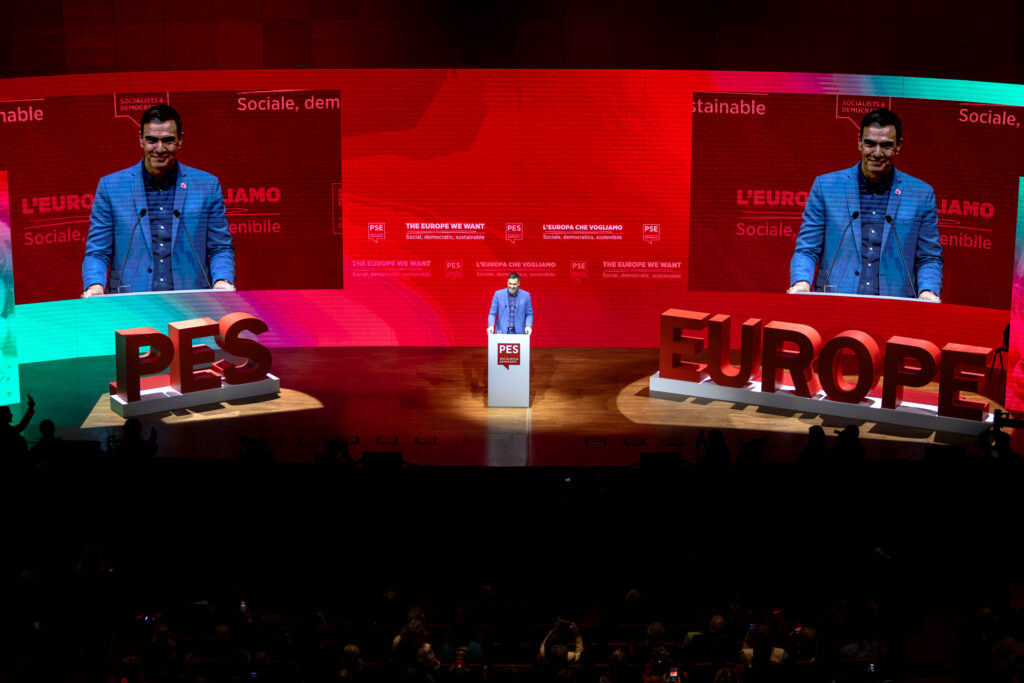
Despite half a century of privatizing pressure, which intensified after the 2008 crisis, the Spanish state allows for a certain degree of democratic command. In recent years, the country’s economy has grown faster than any other major eurozone country, all of which were battered by the energy crisis that followed the war in Ukraine. Spanish GDP expanded 3.5% last year, driven primarily by domestic demand and investment. The labor reform, meanwhile, has slashed the precarious temporary employment created by austerity—from 30% before this legislature to 13% today. Sánchez’s Keynesianism has translated into higher tax revenues for public policy, with spending breaking the historic €700 billion threshold in 2024 (most of it allocated to pensions), greater protection for vulnerable households, and increased savings capacity for families.
At a moment when authoritarianism is sweeping the Western world, Sánchez’s kitsch and melodramatic style of politics has consecrated a form of popular capitalism that has sustained nearly a decade of reformist politics: a Minimum Vital Income for households in severe poverty; a fiscal reform combining windfall taxes on energy companies, banks, and large fortunes; a pension reform that “guarantees sustainability without major cuts”; and a new framework for the self-employed ensuring that those who earn less pay less, championed by Yolanda Díaz, Minister of Labor and Second Deputy Prime Minister following Podemos’ exit from government.
In the era of transition from dictatorship to democracy, the PSOE’s predecessors folded their Communist counterparts into a new governing consensus, first to meet the requirements for EU membership, and later to secure NATO accession. Today, Sánchez has pulled off a comparable operation with the left parties that emerged from the social base built after the 2011 anti-austerity 15-M Movement, or Indignados, a precursor to Occupy Wall Street. This time, the goal was to lift Spain—the country hardest hit by austerity, alongside Italy—to the top of the eurozone. In December, the risk premium of both countries reached its lowest level in sixteen years, shedding the label of “European periphery” or PIIGS, the acronym coined during the debt crisis to designate the continent’s “fragile economies.” Nor do the indignados themselves any longer question the stability of the euro: the institutionalization of politics has emptied the public squares of their revolutionary purpose. We are all Eurocommunists now.
Sánchez’s historic bloc has effectively erased the remaining social forces that once triggered Spain’s gravest crisis of state legitimacy since the return of democracy: the 2017 Catalan independence referendum, known as el Procés. To normalize the fraught relations between his government and the parties that declared el Procés, Esquerra Republicana and Junts per Catalunya, Sánchez granted an amnesty pardoning the offenses committed. He has also pressured Brussels to recognize Catalan, Basque, and Galician as official EU languages.
The PSOE now shares power in the Basque Country and Navarra, with right-wing Basque nationalists in the former and left-wing Basque nationalists in the latter. The transfers of power to local rule set out in the Statute of Guernica—signed forty-six years ago—are nearing completion, handing over new administrative capacities, including control over Social Security, Basque language policy, and certain areas of immigration policy. Additionally, the government has ended the exceptional measures previously applied to prisoners convicted of terrorism during the decades of the Basque nationalist ETA’s armed campaign.
But as with Zapatero—who negotiated peace with ETA and passed LGBTQ+ rights before succumbing to austerity—the political management of an increasingly turbulent capitalism may yet derail the Sánchez project, exposing the organic limits of social democracy: the tension between guaranteeing the conditions for accumulation and ensuring social welfare.
Spain has grown thanks to energy policy miracles that lowered citizens’ utility bills, labor market improvements that boosted domestic demand, tourism revenues, and European recovery funds. But scratch beneath the surface and you find a model entirely dependent on market forces that are now evaporating as the world reconfigures along reactionary lines.
First, economic growth alone does not guarantee a transformation of the productive model capable of translating short-term gains into sustained improvements in living conditions. Such expansion remains constrained by chronic revenue deficiencies and the discipline imposed by European austerity frameworks. Policy becomes spectacle: headline interventions designed to boost revenue without breaking the spending ceiling. Sánchez’s regularization of more than 500,000 undocumented migrants—similar to Zapatero’s measure announced after the Madrid bombings in 2004—exemplifies this logic perfectly. As in the past, this is calculated fiscal management designed to bring informal workers into the system and secure pension sustainability against demographic aging. Yet the economy remains dependent on exploiting precarious work in care, hospitality, agriculture, and construction.
Moreover, after being heralded as the death of neoliberal ideology and a panacea for all structural problems, Spain’s Recovery, Transformation, and Resilience Plan—€160 billion in grants and loans from the Next Generation EU funds between 2021 and 2026—has only managed to bring private investment in high-value-added sectors (renewable energy, digitalization, industry) up to the European average. Because the Plan responded to the demands of domestic capitalists without protecting the most impoverished sectors, these funds more closely resemble a “passive revolution” designed to forestall potential social insurrection.
Brussels delivered funds to the heavily indebted, pandemic-ravaged countries of the European South to prevent the peripheries from returning to the streets and launching popular revolts even more intense than those of 2011. But Sánchez’s technocracy used the funds to bail out large corporations—a rescue that will ultimately cost as much as the 2008 bailout and perpetuate a state of budgetary exception. A report from a liberal think tank boasts that €29 billion of the €32.9 billion disbursed in 2024 went to private companies. When indirect subsidies are included, Spanish firms received 68% of the social spending allocated to cushion the crisis’s impact.
Meanwhile, funding for sectors essential to people living in poverty was drastically cut. Only 7% went to healthcare, education, and public transit. The welfare state now rests on spending caps imposed after the financial bailout. Family doctors with sixty patients a day, overwhelmed primary care systems, and emergency room collapses across the country are compounded by meager investment in public education and an exponential rise in public spending on private schooling. In housing policy, the government has empowered speculators over tenants: Home prices have hit historic highs, surpassing the levels of the real estate bubble, with a 12% year-over-year increase. This is the price of Eurozone integration: BlackRock, Vanguard, and Blackstone exploit the institutional architecture that forces states into debt markets, financing sovereigns while extracting rents. Add Spain’s 2% of GDP in military spending, and the conjuncture can only be resolved through a new form of austerity.
To justify the budget, the Sánchez method has mutated from pandemic Keynesianism to “military neoliberalism”, mobilizing the largest defense expenditure in the country’s history and presenting this sector as the sole path to national economic prosperity. In the two weeks of the Christmas holiday alone, the Defense Ministry awarded €15.8 billion to private contractors—whose revenues are breaking all-time records in Spain—to meet NATO commitments. When rearmament becomes the common sense of our time, humanitarian poses before the cameras matter little. Civil society is left bewildered, and the far-right politicizes the malaise. Like a self-fulfilling electoral prophecy, securitarian logic displaces democratic deliberation.
The underlying problem, as Evgeny Morozov warned years ago, is social democracy’s lack of institutional imagination since embracing the Third Way in the 1990s—an ideology that treats markets as the default mechanism for solving political problems. Today, technological solutionism serves as the contemporary expression of this exhaustion: the promise that apps, platforms, and AI-driven tools can depoliticize questions of redistribution and power. This is precisely the minefield any serious challenge to the far-right must navigate because when progressive parties abandon the work of building robust public institutions in favor of technocratic fixes, they cede the terrain of collective agency and democratic sovereignty that the right eagerly occupies with nostalgic mythologies and nihilist ressentiment.
No one embodies this predicament quite like Sánchez. The Almodóvarian aesthetic—that fusion of popular folklore’s camp sensibility with genuine artistic ambition—now survives largely through Netflix’s multimillion-euro investments in Spain’s cultural sector, a telling inversion. In an age of permanent austerity, when the dominant ideology preaches doing more with less, the transgressive narrative of post-Franco Spain has been reduced to promises of making public administration more efficient through Microsoft databases. What was once a political imagination rooted in cultural reinvention has become a public-private partnership.
The dream of an innovative, sustainable industrial policy that nurtures young talent is outsourced to Amazon and Google. Spain brands itself as a European hub for data centers, with investments poised to exceed €90 billion over the next decade. Since the pandemic, Big Tech platforms became the only gateways to education, healthcare, and mobility. Defense strategy now hinges on SpaceX military satellites, and Palantir software runs through the Armed Forces’ intelligence systems. The commanding heights of the Spanish state have been quietly handed over to Silicon Valley—and almost no one noticed.
The government’s response? Attack Elon Musk on his own platform and ban social media for minors under sixteen. This is Sánchez’s classic sleight of hand: regulating platform services and product access while surrendering the underlying infrastructure. That any teenager with a VPN can bypass the ban reveals digital populism’s operating logic: draw a binary, construct the villain, rally against him. The gesture is quixotic. Windmills become giants while the far right’s alliance with Silicon Valley goes unchallenged.
The tradition of fighting for the oppressed to which social democracy appeals will only endure if it wrests control of the future’s imagination from authoritarian capitalism. That means returning to progressivism’s roots: a project that dismantles hierarchies of race, gender, and class so that each individual can flourish through socially and institutionally mediated environments. Creativity, becoming, and discovery—these, Morozov argues, are its core values. Europe built and scaled them through the welfare state, but also through cultural and media institutions. If neoliberal forces are winning, it is because they have succeeded in positioning the market as the only institution capable of facilitating these processes. The task is to invent public infrastructures and social institutions that tap into a fundamental truth: all of us, at bottom, invent new techniques and forms of action to navigate genuinely unknown and pressing problems.
These more exhilarating debates—along with the arduous work of articulating a new historical formation capable of confronting the Bolshevism of Vox and MAGA on its own terms—still exceed the capacities of Spanish political language itself. The crisis of Sanchismo has returned the country to square one: strained by precarity, ungovernable. This time, however, it is the far right—not the left—that is penetrating rural areas and winning over the working class. Social conflicts will come. Will they prove powerful enough to reshape the political order, or will the bipartisan establishment engineer another false closure, weaponizing the fascist threat? Fifty years after Franco’s death, Spain is about to learn whether the transition was ever truly completed or simply paused.
Ekaitz Cancela is a writer and editor at The Syllabus. He is cofounder of Verso Libros and organizer of READ Convention.