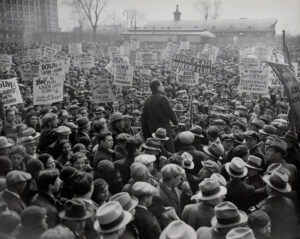
The Center and The Periphery
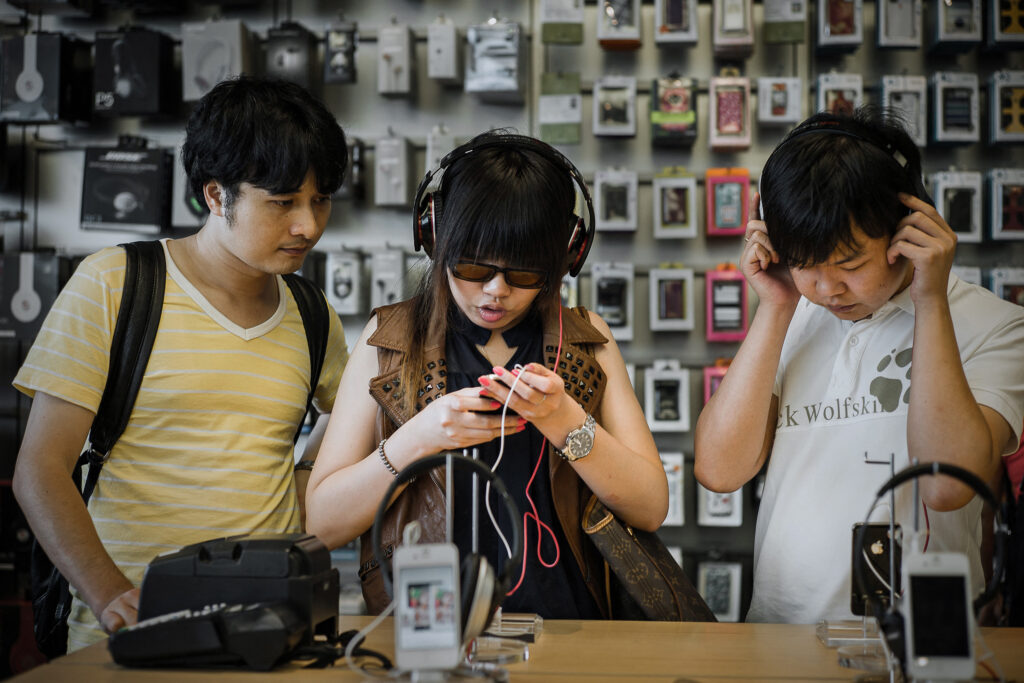
The summer I started high school in Shanxi, I learned that the world had a new texture. It was the early 2010s and I held in my hand for the first time an iPod Touch. I still remember dragging the unlock bar across the screen. The gesture was new—the whole paradigm of touch was new—and the device responded with a light, precise click, a sound as clean as some cosmic voice. I was holding a piece of the future in my hand, and the future had been designed somewhere else.
Apple had reached a particular kind of peak in China that inspired almost religious devotion. A notorious story that still lingers in people’s minds is that of a teenager who exchanged a kidney for an iPhone. (Even in 2026, “one kidney” remains an ironic term for an iPhone.) While the students in my high school weren’t trading their organs for iPods, those little devices conferred something much more important than a kidney: status. Roughly half the students carried iPods; the other half had feature-rich Nokias. I had both: Nokia N79 and iPod Touch, a hedge and a devotion.
The highest-status students were invariably from privileged families. Crucially, they were also tech-savvy, owning the latest Apple products and possessing the ability to jailbreak devices for themselves and their peers. In a province that didn’t have an official Apple Store yet, owning an Apple device was a symbol of worldliness, extending one’s status beyond the locality. This was also the era when America was still, unambiguously, China’s technological North Star.
Looking back, 2011 feels like a hinge moment. The mobile internet age had just begun. Xiaomi’s founder Lei Jun delivered a prophetic speech that has since passed into tech folklore. Xiaomi—an enormous consumer electronics corporation—had just celebrated its first anniversary, and Lei Jun stood before a small audience in Shenzhen and said: Apple is five years ahead of the market. The only question worth asking was how Xiaomi could claim a place in the future Apple had created, rather than disappearing into it the way Nokia and Motorola already were.
Back then, students exchanged Apple jailbreak tutorials the way they swapped exam prep notes. Once jailbroken, the whole world opened: pirated games, paid software, colorful customized icons, everything the App Store contained but priced out of reach. Between classes we played paid Doodle Jump or Fruit Ninja and competed obsessively for high scores, the leaderboard a minor social order running parallel to academic rank. Under the immense pressure of the Gaokao (China’s exacting national examination for all undergraduates), our little 30-min hacker-house subculture became a liberating escape.
The word itself deserves attention. In Chinese, jailbreaking was translated with unusual fidelity: 越狱 (yueyu)—to cross out of prison. The concept arrived in the language already carrying its moral charge. A jail implies a jailer. A break implies the confinement was unjust. In that era, jailbreaking was a no-brainer. Apple’s closed ecosystem, combined with the near-impossible cost of paid apps relative to a middle-income family’s budget, had created a moral situation with an obvious answer.
It helped that we had a ready mythography. Prison Break, a TV show of five seasons, was enormously popular in China—and loved in my high school. The protagonist Michael Scofield engineers an elaborate escape to rescue his innocent brother from prison, framed and condemned by corrupt politicians reaching all the way to the Vice President’s office. The wicked elite had built the system. The system had imprisoned the innocent. The only recourse was technical ingenuity in the service of justice. I was fifteen. My Apple device was innocent. The closed ecosystem was the apparatus. Who could resist this?
In my second year, I upgraded to a 32GB iPhone 4, purchased not from a sleek Apple Store but on Taobao, a popular online shopping platform. To save money I chose the Hong Kong model, priced 40% lower than the mainland version but carrier-locked to a Hong Kong network that the mainland couldn’t recognize. There was a simple hack to make it work: a metal sticker, installed beneath the SIM card, intercepted the carrier authentication and convinced the phone it was somewhere it wasn’t. But this hack was not so reliable. Occasionally the signal would glitch—drop without warning, the connection briefly lost before flickering back into existence. Inserting the metal sticker into that tiny SIM holder and repeating the same hack was my daily ritual.
Those classmates who couldn’t afford an iPhone had to be content with an iPod Touch, about one third of the price of an iPhone. But there was a more radical solution than my sticker hack called Apple Skin (苹果皮). Slipped over an iPod Touch, the Skin transforms it into an iPhone, giving the device full telephonic capabilities: a SIM card slot, an antenna, a microphone, an earpiece, and a battery. Suddenly, the iPod Touch could make and receive calls, pull mobile data, and pass for the real thing.
Apple Skin was invented—accidentally, the story goes—by two brothers from Henan province, working at the margin of the consumer electronics ecosystem with the specific, practical intelligence of people who understood what the market needed and didn’t wait for permission to build it. The device was a piece of folk engineering.
These practices, I now understand, were a catalog of the problems Apple had in China at the time. Carrier-locked, gray-market, modded, jailbroken: my classmates and I had tricked the entire Apple system, and at every step, we felt entirely righteous. If you grew up in China in the 2000s, you probably never encountered a complete, original, intact piece of commercial software in its intended form. You never stood at the unbroken end of a Silicon Valley distribution chain. I grew up with what I like to call “tech debris,” because my relationship with technology in that period was defined by adversity, openness, tinkering, and improvisation, with constant visibility of the system’s internal architecture.
My peers in the West, meanwhile, were raised on Silicon Valley’s doctrine of “smooth, seamless” user experience—the idea that technology “just works” after purchase. Devices for them were closed, complete objects for consumption. In contrast, I learned that technology is inherently incomplete and broken. Making it function required improvisation, reliance on informal markets, and the systematic, yet enthusiastic, violation of its intended use.
I think often about the Zhongguancun electronics market in Beijing my father used to take me to as a child: a crowded, fluorescent-lit ecosystem of hardware stalls, each run by a single person who was equally fluent in components and code, who could install obscure applications, repair a shattered iPod Touch screen for fifty yuan, and explain—with the proud grin of someone who has just fixed something the manufacturer declared unfixable—exactly how the device had failed and why the repair worked.
I think about the half-translated pirated software I downloaded in those years—foreign UI architectures with Chinese characters inserted at awkward angles, the fonts mismatched in size and weight, two systems forced into uncomfortable contact, the translation clearly done by someone working fast from incomplete documentation, or perhaps, as was often the case, by a clever ten-year-old. My friend Tianyu Fang told me that as an elementary schooler, he would go on internet forums to help localize Western software by volunteering his time to translate interfaces into Chinese for strangers he would never meet. For him, jailbreaking led him to discover a VPN that led him to Twitter, then a freer and politically charged platform. He wrote about it as a kind of political awakening.
If you go to Shenzhen’s Huaqiangbei, the world’s largest electronics market, today you can sense the same chaos at a bigger scale. Within a few hours you can source chips old and new, commission custom molds, arrange small-batch assembly, and acquire every component needed to build a drone, a robot, or a wearable device. After so many years living in the Bay Area, I find myself missing the heat and disorder of those electronics markets with a longing I didn’t expect. Earlier this year—after nearly seventeen years of Apple devotion, after purchasing countless devices—I finally made the pilgrimage to Infinite Loop, Apple’s headquarters in Cupertino, California. The campus was exactly what it promised: pristine, perfected, so complete that it seemed to have eliminated the possibility of accident. Even the apple trees on the hills had been trimmed into submission.
Standing there, I felt the religious awe it was designed to produce. And underneath it, something else: a faint homesickness for Huaqiangbei and Zhongguancun, for the solder smell and the shouting, for the stall owner who could fix anything, for a technology that wore its seams openly and didn’t pretend to have fallen from the sky.
But times have changed. Huanqiangbei was once the punchline. Now it is shorthand for Chinese innovation. Much of the AI hardware that generated excitement at CES 2026—the smart accessories, the early robotics prototypes, the AI-native wearables—passed through Huaqiangbei at some developmental stage, or was even born there entirely, inside the complete manufacturing ecology that Shenzhen has quietly assembled over thirty years of exactly this kind of improvisational, marginal, seam-visible production.
Jailbreaking, today and in the past
Today, China is recognized as a genuine technological power. But this doesn’t mean the “jailbreaking energy” has stopped. For teenagers coming of age in 2026, jailbreaking has nothing to do with Apple’s iOS. Now it refers to the act of circumventing a large language model’s safety architecture. The term has completed its own generational evolution.
In the US-China AI rivalry, Chinese labs distilling American LLMs is the contemporary form of the same act. OpenAI has accused DeepSeek of stealing reasoning traces by jailbreaking their API, while Anthropic has identified elaborate distillation campaigns against Claude conducted by Chinese labs with significant operational sophistication.
The engineers now at the center of China’s AI labs are from my generation. They were in middle school and high school in the same years I was, in the same system, with the same locked devices and the same gray markets and the same common sense that breaking the lock was the correct thing to do.
The AI researcher Nathan Lambert has observed that the benefits of distillation are “very jagged.” For specific capabilities, particularly when a full training pipeline isn’t yet in place, quickly distilling from a frontier model in that area can yield substantial performance gains. It’s also a shortcut to more compute power for resource-constrained AI labs. The current runs in both directions. Last December, the American tech giant Meta reportedly used the open-source AI model Qwen to develop its own LLM. Qwen is developed by Chinese tech giant Alibaba. Just days ago, Cursor, the $29 billion Silicon Valley coding startup, was caught having built its flagship model on top of Kimi K2.5, a model from the Chinese AI company Moonshot AI—and presented it, at launch, as an in-house breakthrough.
Is jailbreaking, copycatting, and distilling uniquely Chinese? I am not entirely sure whether I have been assembling this history in order to understand it, or in order to feel better about myself—to find, in the sweep of industrial precedent, some retroactive absolution for a teenager who jailbroke her phone and felt righteous about it.
The shame is real and specific. It still arrives reliably whenever a headline announces that a Chinese company has stolen something. I feel it on behalf of people I don’t know, for acts I didn’t commit, through some mechanism of collective guilt I have never fully reasoned my way out of.
Then I found Charles Dickens. Or rather, I visited his house.
I am staying in Farringdon, the London neighborhood where Dickens lived in the nineteenth century—where he wrote The Pickwick Papers, Nicholas Nickleby, and Oliver Twist. His study is on the second floor: a walnut writing desk of the kind every writer wants, set against walls lined floor to ceiling with books. Dickens wrote five to six hours a day out of financial necessity—maintaining his upper-middle-class London life required the words to keep coming. But part of what made the necessity so acute was that American publishers were stealing his work.
In Dickens’s era, the United States occupied the position that China holds today: jailbreaking, reverse engineering, hungry and not particular about tools or precedent. Victorian Britain, in this analogy, resembles the United States now—the incumbent, the aggrieved, the country that built its own prosperity on borrowed foundations and then became indignant when someone else did the same. I stood in Dickens’s study for a long time.
He was enormously popular in America. His novels traveled across the Atlantic and were reprinted in cheap editions that American publishers sold by the hundreds of thousands. Yet he received nothing from any of it. In 1842, he toured the US on a lecture circuit, performing before halls packed with people who had read pirated copies of his books, who knew his characters as intimately as he did, who loved him—and who would not pay him a cent.
Dickens vehemently criticized American literary piracy, claiming that individuals were making “a very comfortable living out of the brains of other men, while they would find it very difficult to earn bread by the exercise of their own.” Despite his condemnation, he failed to influence American copyright policy or public opinion. Instead of enacting change, he was branded as greedy and un-American. This situation prompted British elites to label the United States “a nation of literary pirates.”
The Dickens story reminds me of the Chinese lab’s distillation effort, as well as SeeDance 2.0, ByteDance’s AI video generation tool. The Motion Picture Association recently accused it of unauthorized use of US copyrighted material at a massive scale. Disney has alleged that ByteDance assembled a pirated library of its characters and packaged them into a generative tool that allows anyone, anywhere, to produce Marvel-adjacent content on demand. Hollywood will not recognize the “AI spirit” as a mitigating circumstance, any more than American publishers in the nineteenth century recognized that their piracy was, from a certain angle, a form of cultural distribution.
The same dynamic appears in engineering. British law in the early nineteenth century explicitly prohibited mechanical drawings from being exported out of the country. It also prohibited skilled workers from emigrating—an early attempt at export controls on human capital. But the American industrialist Samuel Slater got around these laws by memorizing the complete architecture of the Arkwright water-frame spinning machine, every component and its relationship to every other, and carried that knowledge inside his head across the Atlantic to Rhode Island, where he reconstructed the machine from memory. The British press called him a traitor. Americans called it Yankee ingenuity.
Speaking of Yankee ingenuity, Henry Ford did not invent the automobile at all—it existed, but it was seen as fragile and experimental and it was priced entirely out of reach for ordinary people. What Ford did was focus obsessively on optimization and scale: standardized parts, the moving assembly line, cost reduction repeated until the price broke through the threshold that separates a toy for the wealthy from actual infrastructure for ordinary people. This is precisely what China’s photovoltaic industry did with solar panels—producing them cheaply enough that the economics of renewable energy changed globally—and what China’s AI labs are attempting with the cost of inference, driving the price of a token toward zero with the same logic Ford applied to a Model T. The origin was not original. The scale was. Much of what is now canonized as authentic American invention had, at its root, an impure and derivative source that has been quietly forgotten.
“There is nothing new under the sun,” wrote the author of Ecclesiastes. Octavia Butler finished the thought: “but there are new suns.” The historian of technology never gets to say: this is where imitation ends and invention begins. The line does not exist. It is drawn retroactively, by the winners.
The center and the periphery of technology are temporary coordinates, sustained by incumbency and institutional memory and the story that the center tells about itself. What moves the center and the periphery is the accumulated pressure of small, repeated acts: a teenager dragging a lock bar across a screen, a little chip 贴片 improvising connectivity from underneath a SIM card, a machine blueprint rebuilt from memory in a country that was told it could not have one, a model weight distilled from a frontier system by engineers working at the margin with incomplete access and abundant ingenuity.
In my hand, that summer of 2011, an iPod Touch. A locked system. A light, precise sound.
咔—click.
Some cosmic voice. The universe, briefly, opening.
Afra Wang is a writer, researcher, and podcaster. Her newsletter, Concurrent, focuses on the tech and cultural currents shaping Silicon Valley, China, and beyond.