The Last Word in Russia’s Courts
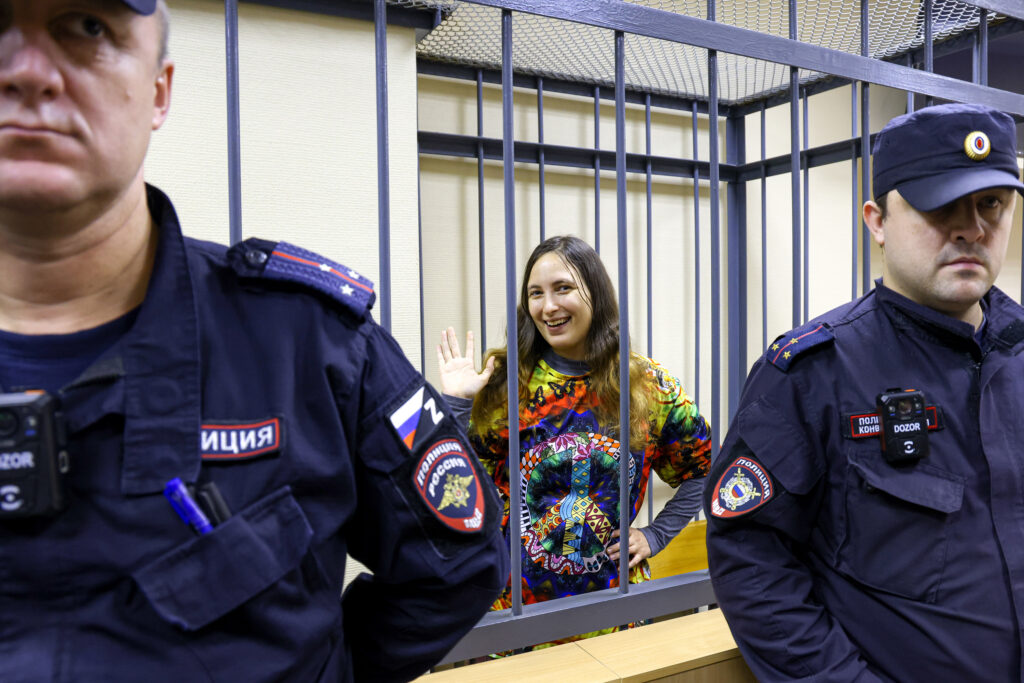
In 2024, the Russian medical student and activist Daria Kozyreva, now 20, was arrested in part for posting in the streets of Saint Petersburg verses by the nineteenth-century Ukrainian poet Taras Shevchenko that called for resisting the Russian Empire. In her final statement in court last April, just before receiving her verdict, Кozyreva said that she dreamed Ukraine would regain every inch of its land, including Crimea.
For the posters, she was sentenced to nearly three years in a penal colony—for those last words, she was sentenced to a substantial fine. Repression in Vladimir Putin’s Russia is endlessly perverse.
As of last year, the Russian authorities have been bringing charges—such as “discrediting the army” or “justifying terrorism”—against defendants in political trials for the statements they make before judges, including in their own defense.
The state seems to have understood that until then the glass box or the barred cage in which a defendant sits in Russian courts had been, paradoxically, one of the last places in the country where free speech was still possible.
Total censorship in the Soviet era did not allow defendants’ speeches to become publicly available. What did get out there from Stalin’s show trials were either subdued statements or forced confessions. In the 1970s, under Leonid Brezhnev and zastoy (the period of stagnation), secret transcripts were distributed by the underground press known as the samizdat. Repression under Putin today is both similar and different: It too is sweeping and self-serving, but it is taking place in a different context—politically and technologically.
When political trials first became common again in the 2010s, Russia still had a relatively free press. Proceedings were covered in detail, and defendants used their cage as a platform to speak the truth to a system that was persecuting them. Then, as censorship on traditional Russian news outlets increased, it was social media that took over relaying information about the trials.
But why was even that possible at all? Why not just ban all unpredictable speech that might come out of those courtroom cages or booths of bulletproof glass? Because for some time now, the political process in Russia has been something of an absurd theater, a performance that the authorities seem to be putting on primarily for themselves.
The government likes to pretend that the judicial process is intact, even though, in essence, it is completely subordinate to the will of the political authorities and the rulings in political cases are predetermined. Defendants’ sentences might vary slightly, but the verdict is always “guilty.”
This formalism and decorum may follow the personal wishes of Putin himself. He often talks about the importance he places in the integrity of the Russian court system. At every press conference, it seems, some journalist close to the government is given the opportunity to ask a question about some political trial or another—specifically so that Putin can respond that this is a matter for an independent court over which he has no influence. And then, inevitably, he jokes about all that.
As a result, Russian court proceedings can appear to differ little from those shown in American courtroom dramas, like Boston Legal or The Good Wife, which are still extremely popular in Russia. Prosecutors and defense attorneys make speeches; investigators present evidence; witnesses are questioned. And at the end of the trial—according to a tradition that has existed since the Russian Empire and is now enshrined in the code of criminal procedure—the defendant is given a chance to deliver their “last word.”
This is why in late 2024, judges and prosecutors and guards were forced to listen as the Moscow councilman Alexey Gorinov (charge: “justifying terrorism”; subsequent sentence: 7 years in prison) described the criminality of Russia’s invasion of Ukraine and as, last year, the journalist Artyom Kriger (“participation in an extremist group”; 7 years) called modern-day Russia a concentration camp.
Such staging in the courtroom fools no one on the outside. Even Russians who aren’t critical of the regime know that justice in Russia is done with “a phone call from above” (an established expression). And yet, all the obstacles notwithstanding, voices from those political trials do reach us and are sources of truth and deep reflection.
Some time ago a website called Final Statement was created to publish these courtroom closing pronouncements. Read these texts back- to- back and their shared essence becomes clear, united by a special pathos—extreme sincerity, even desperation. The tone of some recalls a religious sermon or a public political speech. Together, they are a literature of direct expression and make up a distinct genre.
“Last words” have already been canonized as literature by the theater director and poetess Zhenya Berkovich (“justifying terrorism in a play”; six years). She delivered her final courtroom statement in July 2024 in verse—and the form said it all. Precisely because verdicts in political cases in Russia today are predetermined, the defendants’ last words are disconnected from real consequences, and they can function as art and operate by art’s rules. Their purpose is not to change a verdict; it is to change an atmosphere in society by saturating it with molecules of truth. That’s how poetry works.
Berkovich’s poem-statement combined both general declarations (“I ask you, remember about the miracle and the law./They are nearly synonyms. That’s all. Thank you.”) and concrete details of her own situation:
Under investigation in Russia, here I stand,
And as much as I’d want to, I can’t get out of this net.
I still have two sick children,
Who are being deprived of their childhood.
16 years in orphanages, between the two.
And finally: a home, safety, a mother,
Can’t you at least spare me and them this torture?
Just no torture, that would be something.
Typically, however, defendants choose for their speeches either theory or practice, so to speak.
Many final statements are a kind of manifesto. So were, for example, the speeches of the activist and journalist Alla Gutnikova and the acclaimed opposition politician Vladimir Kara-Murza. Gutnikova spoke of living in the face of constant fear—about the ways this changes souls and about the ways to resist it. Kara-Murza described his faith that the people in Russia who now support Putinism and the war against Ukraine might eventually open their eyes and repent.
But no less important—and for me, even more important—are the public statements that bear witness. The ones that document what happens to a person caught in the clutches of Russia’s legal system, during arrest, in pretrial detention, at penal colonies—all the moments and places that capture the cruelty of modern Russia.
I want to quote from two such speeches, both by women.
Here is the artist and activist Sasha Skochilenko (“disseminating knowingly false information about the Russian Army”; seven years), who was arrested in March 2022 for replacing price tags on items in a supermarket with anti-war slogans. In her final statement she described what it means to be sick in a Russian prison: “Imagine what it’s like to live in pretrial detention with blood pressure of 90 over 60 or 80 over 50. You feel extremely weak; you constantly want to lie down. But you can’t—because in pretrial detention you’re only allowed to lie in bed between 10 p.m. and 6 a.m.”
And here is a less publicized account from 2019 by the Ingush activist Zarifa Sautieva (“participation in an extremist community”; seven and a half years):
“I was put in a cell where there was a woman with a child. The child was almost 11 months old then and he was basically born in jail, in the pretrial detention center—meaning he’d spent his whole life in that cell. Such cells are supposed to have better living conditions: like a washing machine, an iron, an ironing board, a drying rack, a rug, a decent crib, so the child can grow up in decent conditions. These are all laws of the Russian Federation; I’m not making anything up. But all I saw when I walked into that cell were hordes of cockroaches crawling over that baby.”
Both accounts are reportage-like descriptions of a reality hidden from the average person; they do just what journalism is supposed to do. Courtroom last words form a cloud of meanings, including by being an alternative source of information and opinion in an environment of near-total censorship. You could say that they are a new type of media—and befitting today’s norms, they are enabled by technological change. Defendants’ speeches are often brought out of the courtroom illegally: recorded on a phone that was turned on secretly, in a pocket. In a few cases, the hidden phone was even streaming live to Facebook or Instagram. That act is a perfect combination of activism and media work.
Or rather: It was. The Russian authorities are now also throttling this media of last words. Increasingly often, trials are closed to the public. When relatives are allowed to attend, their phones are checked as they leave the courthouse. Lawyer-client meetings take place under the watchful eye of cameras. Almost all conduits for deliveries are blocked.
But for a time, those metal cages and glass boxes in the courtroom brought reality and literature together—no: they pressed them together, and oh so close.
In April 2022, when most of my friends and I were still in a state of fresh panic and confusion after Russia’s full-scale invasion of Ukraine, one of them, Alisa Khazanova, an actress, sent me Gutnikova’s courtroom statement.
Gutnikova, then 23, had read it aloud just before she and other editors of the independent student magazine Doxa were sentenced to two years of corrective labor (a completely unlawful sentence but one that seems mild now, after three more years of Russia’s steadily tightening repressions). “Look at this incredible text,” Khazanova wrote to me then. “You think there are enough out there like this for a play?”
There was more than enough out there.
Our play “The Last Word,” based on speeches made in court by female Russian political prisoners, premiered in December 2022 on the stage of Berlin’s Gorki Theater. It ran for several months.
A few times, I came to the lobby at the end of the performance to hear what the audience was saying. The play was in English; the spectators were almost all Berliners. The playbill had my photo, and people occasionally recognized me as the “playwright,” the one who had put together this collage of last words. They would come up and ask which of the speeches were fiction, which had been stylized. “All of them can’t be real, can they?” “The one about Sasha Skochilenko being starved—that can’t be true, can it?”
At first, it was very hard for me to answer. The sadistic cruelty of Putin’s regime seemed so obvious, and the notion that anything would have to be created to illustrate that seemed absurd. Then I adjusted, and I explained.
Anna Narinskaya is a journalist, playwright, and activist from Moscow, who since 2022 has been living in Berlin, publishing in the Frankfurter Allgemeine Zeitung, and collaborating with German theaters.