The Long Civil Rights Movement
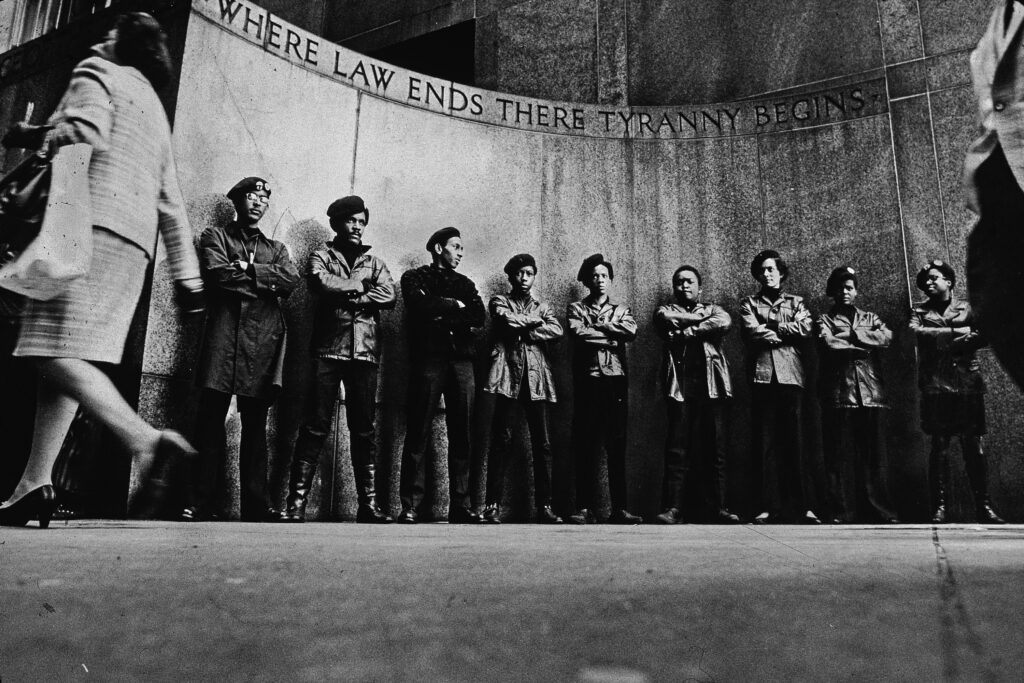
“The white cracker who wrote the national anthem knew what he was doing,” says the Black nurse Belize in Tony Kushner’s Angels in America, set in the 1980s, “He set the word ‘free’ to a note so high no one can reach it.”
This statement may sound overly despairing to someone keen to reconcile America’s high principles to the daily experience of living in the nation, as Belize’s (white) interlocutor Louis is. Whatever the turpitudes of the Reagan administration, whatever the horrors of the AIDS epidemic, for Louis the nation has kept its holdings in the sacred honor that carried the Revolution, twenty years after the fulfillment of Black civil and political rights.
Belize’s line could have been the epigraph for the scholar Brandon M. Terry’s new book Shattered Dreams, Infinite Hope: A Tragic Vision of the Civil Rights Movement, a powerful dissent from the romantic view of American history in general and the civil rights movement in particular. He tests the mainstream historiography of that struggle as an exemplary political action whose success incorporated “the excluded into this healthy political sphere and the mainstream of social life.”
In the romantic vision of the movement, the 1950s and 60s saw civic struggle, court rulings, and legislation defeat white supremacy in a reckoning with the past that would place the US firmly ahead of the Soviets in moral terms. It would also authenticate the promise of the Constitution, which in 1787 was “meant to mark the start of a new era, in which the course of history might be made predictable and a government established that would be ruled not by accident and force but by reason and choice,” as historian Jill Lepore wrote in her book, These Truths.
So ingrained is the belief in the constitution’s reflection of a political ideal, high above the facts on the ground, that no less a learned liberal commentator than Ezra Klein was surprised, in a 2019 interview with Lepore, to learn that today’s Electoral College was a byproduct of slavery. Through an eccentric formula, the Southern states were able to deny slaves the vote while leveraging their numbers to enhance the representation of Southern states in Congress and, through the Electoral College, the vote for the presidency. For the state population totals, Black slaves would count as three-fifths of a citizen.
Though he doesn’t discuss the three-fifths compromise, which was abolished after the Civil War, Terry gestures towards its legacy when he argues, “Diffuse exhortations to unity find no institutional soil on which a critique of those features that make the presidential elections, the Senate, and judiciary appointments biased towards largely white rural areas [can] flower.” If America was the only country in which a Black man with a funny name could rise to the top, as Barack Obama said in his 2004 keynote Convention speech, liberals have been slow to accept that the claim of an improbable rise to power applied with at least equal force for Donald Trump, who lost the popular vote by some 3 million.
Current Republican efforts to reverse the legislative gains of the 1960s, backed by a Supreme Court seemingly hellbent on dismantling Black voting rights, provides an easy target of liberal contempt and finger-pointing. To sincerely confront racial injustice in America, however, is to contend with the ways in which white supremacy has adapted to and recovered from its defeats in Democratic as well as Republican administrations.
When civil and voting rights laws formally ended segregation in the South, the old regime of second-class citizenship assumed less visible form. In The New Jim Crow, Michelle Alexander explored how mass incarceration, disproportionately affecting Blacks and accelerated by Clinton-era reforms, had let segregation in through the back door: “Once you’re labeled a felon, the old forms of discrimination—employment discrimination, housing discrimination, denial of the right to vote, denial of educational opportunity, denial of food stamps and other public benefits, and exclusion from jury service —are suddenly legal.” Terry doesn’t spend as much time on mass incarceration as he might have, but Alexander’s thesis—that the American justice system is not a neutral mechanism enforcing laws passed by the people’s representatives, but a “stunningly comprehensive and well-disguised system of racialized social control”—would have underscored his argument about how a vast architecture of racial domination remains intact.
As a philosophical intervention on how we use memory and history in debates over justice, Shattered Dreams isn’t short on jargon. Terry uses significant intellectual muscle to build his case and, in doing so, often overexerts himself. Early sections are devoted to deep readings of Kant, Rawls, Mill, Arendt, and others. These preludes are never uninteresting but their contributions to Terry’s core argument can escape the reader. A long chapter on Kant’s notion of judgment and the “aesthetic experience of beauty,” for example, seems an elaborate route to Terry’s point about how we think about the civil rights movement’s exemplarity.
Where the philosophical backdrop assumes more relevance is in the discussion of Rawls and civil disobedience. For Rawls, civil disobedience is justified when laws and practices violate a common “sense of justice”: segregation, denial of equal voting rights, and other forms of racial discrimination. But Rawls draws the line on economic inequality, which in a just constitutional order is the domain of representative politics. The assumption here is that economics is up for debate, fundamental rights are not. Standing in opposition to the narrow Rawlsian idea of civil disobedience is Martin Luther King, Jr., for whom that very order, as he wrote in 1967, is ridden with “the ‘congenital deformity’ of racism that has crippled the nation from its inception.” For King, a radical economic transformation was as legitimate a cause for mass agitation as desegregation or voting rights. Resource distribution wasn’t a matter of legitimate political difference but basic to democratic citizenship.
One contrasting vision to romanticism is a politics of despair that Terry refers to as “Afropessimism,” which sees the movement as a failure and civic struggle as therefore futile. If this most emblematic example of participatory politics yielded only superficial gains, the argument goes, and intergenerational poverty, mass incarceration, and de facto segregation in neighborhoods and public schools continue to be imposed on Black lives, what point is there in engaging with the system? The absence of redemption, however, doesn’t make this framework any less teleological. As Arendt said, “Progress and Doom are two sides of the same medal; that both are articles of superstition.”
Terry finds Afropessimism as unproductive as romanticism. The tragic vision that he advocates for instead is one that accepts the civil rights movement’s “splendid failures,” that antagonisms remain embedded in the body politic, without ever losing faith in the power of civic action. This vision draws together “the centrality of serious conflict, the potential significance of defeats, the contingency of history, and the responsibility of historical actors.”
To understand segregation and civil rights in economic as well as political terms is to get to the heart of Terry’s “tragic vision” of the movement. The “long civil rights historiography” he espouses takes as its origin not the fight for equality in the South, starting with the Supreme Court’s 1954 Brown v Board of Education decision that ruled segregation of public schools unconstitutional, or the Montgomery Bus Boycott a year later, but the Great Migration that began in the early twentieth century, which eventually saw some six million Blacks flee the American South to northern cities for political freedom and economic opportunity. The reshaping of the industrial workforce that followed enabled a new era of labor activism, led by figures such as A. Philip Randolph, that merged class and race interests. Moreover, the urban Black vote in the north became a new political dynamic that helped compel Franklin Roosevelt to ban racial discrimination by defense contractors in 1941 and Harry Truman to desegregate the military in 1948.
However, northern cities fought to contain the demographic and political earthquake of the Great Migration by devising more discreet forms of second-class citizenship. In the 2014 article “The Case for Reparations,” Ta-Nehisi Coates wrote of the ways that predatory white lenders replaced “the acquisitive warlords of the South” as the agents bent on seizing properties from Black owners in cities like Chicago, abetted by redlining and other discriminatory policies that denied Black migrants equal access to housing. It’s this systematic subversion of Black economic security and uplift that makes less defensible the view of civil rights as “a self-reflexive ethical transformation that restored the American creed to pride of place,” in Terry’s words.
An analogy can be found in post-apartheid South Africa. The country’s liberal 1996 constitution was once deemed the apotheosis of the country’s democratic transition. But the constitutional settlement, including strong protections of private property, failed to reverse fundamental features of class domination, leaving countless black South Africans without access to opportunity and true social emancipation.
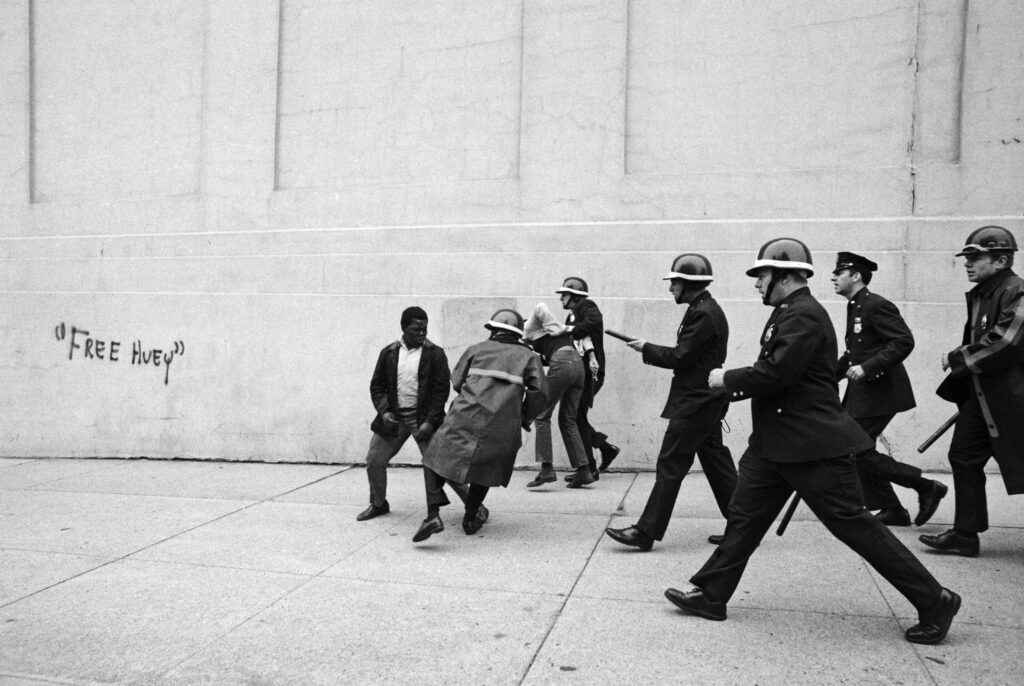
In the “master narrative,” the civil rights era peaked with the mid-60s legal victories and then, following King’s assassination in 1968, gave way to “a spasm of militancy and ‘identity politics’ that crested under the sign of Black Power [marking] the embittered denouement of the civil rights movement,” as Terry writes. The liberalism associated with King and civil rights has its foil in the Black nationalism of various political and intellectual programs, most prominently Marcus Garvey’s self-determinationist politics of the early twentieth century, the Nation of Islam’s separatist creed, and the revolutionary militancy of the Black Panthers. By the late 1960s and 1970s, the nationalists who accused integrationists of being Uncle Toms had replaced their ostensible rivals at the center of Black political struggle.
Terry contends that despite the resentments between Black nationalists and integrationists “the substantive positions on both sides after the legislative victories of civil rights grew remarkably similar on some fronts.” Once civil rights are framed to include economic justice, dignity, and political and democratic power, the disagreements over principled nonviolence between a Stokely Carmichael and a Reverend King appear less robust. Instead, they speak more to the complexity of Black political life than does a neat integrationist/nationalist dichotomy that saw one movement yield to the other. Similarly, King’s democratic socialism—which condemned capitalism’s failure to distribute wealth fairly and urged the state to pursue economic justice alongside racial equality—and Malcolm X’s “Black capitalism”—which emphasized self-sufficiency, Black entrepreneurship, and freedom from economic dependence on white institutions—ultimately converged in their pursuit of economic and political dignity.
In the liberal discourse, the binary between integrationism and Black Power is a moral one, between moderation and excess, respectively. Terry sees this as a product of narrative forms—in his words, “emplotment”—that assume false ethical clarity and flatten the intricate texture of Black political struggle by ignoring the civil rights movement’s own compromises and imperfections. One of the decisions he focuses on is that of using the children of Birmingham in a 1963 march for desegregation, where they were subjected to fire hoses and attack dogs. While televised images of brutal acts against children was a public relations win for the campaign, the deliberate exposure of kids to violence was ethically dubious at best and something that King agonized about. It’s easier to reconcile oneself to the decision when it’s seen as one in a chain of events towards a historic moral triumph, but less so if that triumph has ultimately proved incomplete.
Terry’s emphasis on the internationalization of civil rights politics is also important to his challenging of the “Montgomery-to-Memphis” narrative. He explores the links between Jim Crow at home and fascism abroad, noting that the Nazis were inspired by the American example of white supremacy and racial purity. He also illuminates how resistance to white domination embraced a vision extending well beyond America’s borders. Mussolini’s military campaign against Ethiopia in 1935 became a rallying cry for American Blacks, who rioted and clashed with Italian Americans on the streets of New York and boycotted Italian-owned bars in Harlem, forcing many to close. On the other hand, the anti-communist hysteria of the 1950s undermined the deep connections between class and race activism that Randolph and others had pioneered in the preceding two decades.
In the 1960s, the main foreign policy entanglement was Vietnam, which Malcolm X and eventually King denounced. Even here the reflex among many liberals, including Rawls (a critic of the war), was a rehabilitated faith in America’s moral purpose. Post-Vietnam, according to Terry, Rawls didn’t “fundamentally rethink his orientation to America’s history of settler colonialism, imperialism, and domination.”
Terry’s long civil rights frame encourages us to see the Black freedom struggle in a continuum with self-determination and anti-imperial movements in Africa and Asia—including in Indochina—demanding a global as well as domestic understanding. An entire chapter could now be devoted to the Gaza protests in the US, where state retaliation has assumed a very different scale.
Terry holds the Ferguson, Missouri protests following Michael Brown’s 2014 killing in high regard, because of the risks demonstrators took in confronting “a jarring display of militarized policing and violent repression” for over a year. There’s a novelty in the state’s response to the Gaza protests that would test and expand his framework for assessing the value and audacity of today’s activism. Rather than standoffs between demonstrators and law enforcers, the repression of the pro-Palestine protests has involved administrative, financial, and immigration-related coercion, including threats of deportation of permanent residents, that may be less lethal but is arguably more insidious—and successful—for its bureaucratic proceduralism.
Although several Black Lives Matter leaders have expressed solidarity with Palestine, it remains a question whether BLM and pro-Palestine mobilizations have or can cohere into a deeper, shared politics of resisting forms of settler colonialism that were integral to the founding and expansionism of both the United States and Israel. Nor is there, at present, a grassroots movement of significant scale that grapples with how American military engagements abroad shape civic liberties and public trust at home.
Terry leans on a large volume of existing literature around the tragic aspect of the civil rights movement. I closed the book wishing he’d delivered a heavier theoretical payload of his own. But in his robust endorsement of “the practice of tragic hope,” and his defiance of romantic and pessimistic discourses alike, Terry provides many important insights and a cogent and timely case to see the civil rights movement not as a moment in time, between the mid-50s and late 60s in which good ultimately triumphed before losing ground to a more militant, revolutionary alternative, but as a messy, ongoing, and century-long struggle full of defeats and successes.
The US wasn’t born into democracy, nor did its Constitution and Bill of Rights make it one. Blacks, through their agitation and successes and even their failures, made the polity more inclusive—a very different proposition to saying that democracy’s embrace eventually and inevitably spread to Blacks and women and sexual minorities. Terry’s long civil rights movement framework is much more useful to understanding what’s been achieved—economically and politically—in the century since the Great Migration, the setbacks, and the work still to be done.
For many white Americans, segregation—formal or otherwise—is perfectly consistent with the founding ideals. These constituencies have had the advantage for most of the country’s history. Supreme Court rulings, the passage of laws, and even the election of a Black president didn’t end that advantage even if they disrupted it.
Belize the nurse is correct: “Star-Spangled Banner” is notoriously difficult to master. But people need not stop singing it, they should just do so knowing they’ve yet to hit the high note. And that, meanwhile, some will still opt to hear the anthem on one knee.
Shehryar Fazli is a Program Manager at the Open Society Foundations. He is also author of the novel, Invitation (2011), which was runner-up in the Edinburgh Book Festival’s 2011 First Book Award.