Total Historian
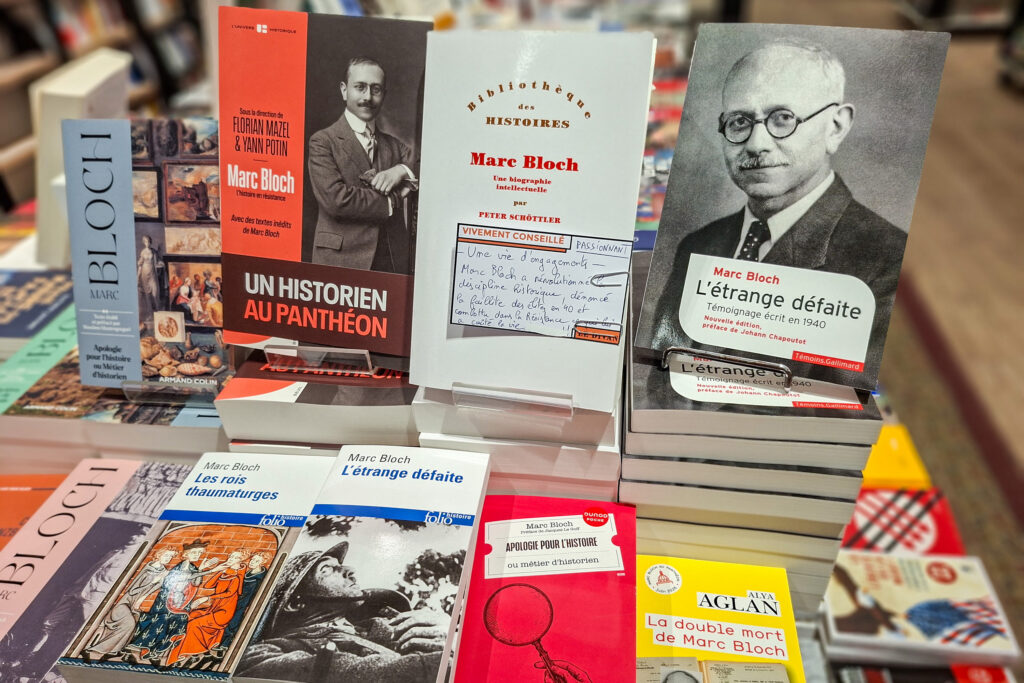
On June 23, choirs of French schoolchildren and a large crowd of dignitaries thronged around the Pantheon in central Paris during a heat wave. Under the glow of torchlight, President Emmanuel Macron spoke of the special courage that had earned the Sorbonne professor Marc Bloch a place in the nation’s most prestigious tomb. Since the French Revolution turned the erstwhile church in the Latin Quarter into a secular temple of civic virtue, France has laid to rest several dozen of its greatest citizens there, among them Charles de Gaulle, Victor Hugo, Marie Curie, and Simone Veil. To the sound of the Marseillaise, the caskets of Bloch and his wife Simonne were inducted into the Pantheon, making him the first historian to receive the honor.
Historians have often created heroes, but few have themselves become them. Bloch, however, has managed to rise to this status in France. Born in 1886, the child of secular Jewish scholars from Alsace, he studied at the École Normale Supérieure at the height of fin-de-siècle French theoretical innovation, he fought as an infantry officer in the trenches during the First World War, founded a journal that engendered an entire tradition of historical research, became an expert on feudalism and medieval agrarian history, wrote a sharp indictment of the fecklessness of the French elite in the face of Nazi aggression, and then took part in the French Resistance, until he was captured and executed by the Gestapo in June 1944.
Bloch’s career was short but prolific: Over the course of barely two decades of employment as a professor at the universities of Strasbourg, Paris, and Montpellier, he published seven books, including The Royal Touch, French Rural History, and Feudal Society, and over sixty articles on subjects ranging from watermills to gold coinage and slavery to medieval ideas of empire. And though he never left the firmament of the French intellectual world, there has been a strong recent revival of interest in his political activities. A comic book about Bloch’s wartime exploits is available in French bookstores. He is invoked across the political spectrum: socialists, in order to criticize the far right; centrists, to defend the republican middle ground; conservatives, to appeal to the deep identity of France. The urge to claim Bloch for one’s side has made it harder to figure out what he believed and stood for.
Peter Schöttler’s intellectual biography of Marc Bloch comes at the right time. It is the most complete record of the thinking and travails of the Third Republic’s greatest historian. Schöttler, a historian of Franco-German intellectual exchange, situates Bloch in the complex early twentieth-century landscape that formed him. It also offers a new view of how the historical discipline developed during the last century.
Bloch’s intellectual project revolved around three innovations, each of them concerned with the historical development of societies. He reoriented history away from its emphasis on individual leaders and nations, towards a focus on collective worldviews or mentalités. He gave concrete programmatic shape to this agenda by co-founding a new journal, Annales d’histoire économique et sociale, which became synonymous with a more structural and total approach to history-writing. And he led the way in applying this approach to the study of medieval Europe, formulating a more accurate concept of feudalism.
In the nineteenth century, European scholars had placed the study of the past on a more scientific footing. In the effort to distinguish their discipline from the alluring narratives of literature and the seductions of myth and religion, they emphasized that history properly so-called was the objective and dispassionate study of primary sources, aimed at recreating the true nature of eras long since passed. In the words of the German scholar Leopold von Ranke, widely seen as one of the initiators of this movement, history was a search for “how things actually were” (wie es eigentlich gewesen ist).
But in practice, the nineteenth-century historical profession produced a very selective understanding of what history was. In the age of nationalism, industrialization, and power politics, most historians focused on the great decisions that had produced the national states of the present day. Public documents about matters of state were easily available, and dominated the empirical work. Ranke was convinced that the modern world was the product of diplomacy and foreign policy above all, and coined the concept of “Great Powers” (Großmächte) to describe the prime agents of historical struggle. It was common for nineteenth-century historians to emphasize how every people and state had overcome collective challenges that awakened them to their national identity (Ernest Renan); how their institutions had matured slowly to develop this essence (Hippolyte Taine); and how eventually every state would become the carrier of this exceptional national spirit (Heinrich von Treitschke). Only a few major figures dissented from this view and thought that the struggle within polities had been as intense and formative as that between them, notably Karl Marx and the German historian of ancient Rome Theodor Mommsen.
By the turn of the twentieth century, the nationalist and elitist biases of much established history-writing were coming under pressure from the advancing social sciences. In France, Émile Durkheim and his collaborators François Simiand, Maurice Halbwachs, and Marcel Mauss examined both quantitative data and the dominant norms that governed social life. Social theorists such as Thorstein Veblen, George Herbert Mead, and Franz Boas in the United States, and Gustav von Schmoller and Max Weber in Germany were overturning old verities about national cohesion and cultural particularity. These scholars all studied societies in a more comparative and comprehensive fashion. They understood power as a question of violence and resources but also as working through potent symbols, and thus emphasized that historical change occurred through the interaction of rulers and ruled, a process both material and ideal.
Bloch came of age amidst these new intellectual currents and would apply them to great effect to renovate the study of academic history in France. After having his doctoral research, on medieval kings and serf laborers, interrupted by the First World War, he finished a dissertation in 1920. A few years later Bloch published his breakthrough study, Les rois thaumaturges, which examined how the popular belief in the healing power of the royal touch augmented the power of monarchs in England and France. A mixture of the history of politics, belief systems, and society, it demonstrated how the French kings had been raised to supernatural stature as commoners’ faith in magic reinforced the sacerdotal pretensions of French clergymen aligned with the Crown who sought to assert their autonomy from the Pope. It was a brilliant demonstration of the force of what Bloch called “la conscience collective” in shaping historical possibility.
Schöttler argues that Bloch did much more than just invert the study of history by shifting it from a largely top-down to a more bottom-up perspective. He also broadened the understanding of the social reality in question by bringing in interdisciplinary approaches. It was not simply that millions of peasants mattered as much as individual kings, but also that the high ground of politics could not be understood without examining the dominant legal institutions, the distributions of property and wealth, the lifeworld and work patterns of the masses, and the nature of their moral and religious beliefs. In this regard it was fitting that Bloch named the journal he founded with the historian Lucien Febvre in 1929 Annales d’histoire économique et sociale in homage to the great Roman work of history: Like Tacitus, they analyzed past societies in the round, threading the structure of politics, law, and authority together with the common pleasures and rhythms of everyday existence. History, as Bloch saw it, should go beyond the narrow preoccupations of the powerful and propound a more ambitious view of “the great hidden currents of human life.”
Anglophone collaborators included many of the best scholars at Cambridge and the LSE, such as R.H. Tawney, Eileen Power, and Michael Postan. But there were also contemporary trends of which the journal and its contributors steered clear. Bloch and Febvre regarded the emergent field of “geopolitics” practiced by scholars such as Karl Haushofer (an influence on the early Nazi movement), as well as the declinist civilizational histories of Arnold Toynbee and Oswald Spengler, as reductive, pseudo-scientific, and dangerous. These kinds of monocausal reductionisms and abstract narratives the Annales founders regarded as illusory and outright dangerous. As Bloch put it, “There is no homo geographicus any more than there is a homo economicus.”
As the Annales developed during the mid-century decades, it became a broad church of historical research programs fertilized by the social sciences. What made Bloch distinctive, however, was his strong commitment to studying different societies alongside one another. This was in part due to the influence of one of his doctoral supervisors at the Sorbonne, the historian Charles-Victor Langlois, whose mantra was that “who does not compare does not understand” (qui ne compare pas ne comprend pas). Indeed, Schöttler’s book is a welcome reminder that Bloch was nothing if not a comparativist.
Bloch’s recent mythologization in the French public sphere as a national patriot has obscured the profoundly transnational quality of his work. His book The Historian’s Craft, published posthumously in 1949 from a manuscript that Bloch composed from memory and without access to books in his final wartime years, is a moving statement of purpose. But the more essential statement of his overall project is the essay “Pour une histoire comparée des sociétés européennes,” originally delivered at the International Congress of Historical Sciences in Oslo in 1928.
It was impossible to understand a social order, legal system, or agrarian regime properly, Bloch argued, by looking at a single estate, village, or county. Only the entire geographical zone would suffice. In the case of medieval feudalism, this area encompassed most of Europe. Comparison was the essence of making generalizable claims and forming coherent concepts that could stand the test of time. This allowed Bloch to identify several institutions that were unique to medieval Europe, among others the specific regime of landownership by hereditary and hierarchical constellations of lords (seigneurs), the autonomy of self-governing urban centers, and provincial estates and parliaments that functioned as intermediate political bodies. Yet comparison was not “a hunt for resemblances” if this led to “forced analogies.” Rather, if done well, it would bring out true individuality; the challenge was “to determine not only broadly that two objects are not the same, but also by which precise characteristics they distinguish themselves – an infinitely more difficult task, but also a much more interesting one.”
This need for breadth was tied to another requirement of good historical analysis: depth. By this Bloch meant that within a specific domain, one must consider not a single cause but a range of factors and weigh them against each another. Was the social order in Carolingian France shaped by a caste-like system of aristocratic blood ties, or was it the haphazard result of landowning patterns that had resulted from the vagaries of partition, inheritance, and warfare? Such a question demanded a combination of legal, economic, and military history. Materialism was a necessary bedrock for Bloch. “That the context of a society remains unintelligible if one does not scrutinize its material foundations, no one would today deny,” he wrote in 1934. But this was a means to understand the whole, so that “the economic substratum enriches the analysis in depth of social life in its entirety.”
The first forays into such deeper socio-economic history focused their investigations on regions of a manageable size. Lucien Febvre’s 1912 study of the Franche-Comté in the sixteenth century—the early prototype for many later annaliste studies—had shown how regional analysis could generate insights about major historical phenomena such as feudalism, city politics, the Wars of Religion, the power of absolutism, and the spread of commerce. Later generations of annalistes widened the aperture to broader areas, culminating in Fernand Braudel’s famous two-volume study The Mediterranean and the Mediterranean World in the Age of Philip II. The book was only published in 1949, after its author had spent the entire 1930s immersed in research and then scribbled down the manuscript on cigarette paper and tissue rolls in a German prisoner-of-war camp. The annalistes thus acquired a reputation as tough-minded completists: Mike Davis described them as “archival Marco Polos, gone and out-of-sight for years at a time in order to produce monumental theses.”
Bloch’s final aim was to produce historical research that was not just broad and deep but also unified. In Schöttler’s telling, Bloch first saw the power of a unified perspective on display in the work of the Belgian historian Henri Pirenne. Famed for his theses on the transition from antiquity to the Middle Ages, Pirenne also wrote a seven-volume History of Belgium that spanned his home country’s development across two millennia. Upon reading it, Bloch wrote to Pirenne that he was struck by the “profound sense that the different orders of phenomena are all related…This is not an economic history, or a political one, or a religious one; it is history, simply put, a total history.”
Bloch’s last and greatest work, Feudal Society, published in two volumes in 1939-1940, was his own attempt at a unified, total history of the structural characteristics of medieval social formations. It was not intended as a definitive atlas, but a guidebook for exploration. Bloch hoped historians would bring their specific local findings back into contact with the overall trends affecting societies as a whole, asking whether the former were symptomatic of the latter, or if they contradicted them. Either outcome would be beneficial for history: The first would reinforce the validity of general arguments, while the second would provide space to recapture individual agency, dig deeper, and revise earlier judgments.
One of the historians who was inspired by this injunction was the Italian scholar Carlo Ginzburg, one of the pioneers of microstoria (microhistory), who died in June at the age of 87. Ginzburg described the comparative method put forward in “Pour une histoire comparée” as an “indispensable point of reference” for him. Sometimes misunderstood as a truffle-hunting quest for curiosities, microhistory was in fact about collecting evidence “according to an agenda which is already pointing towards a synthetic approach…one has to work out cases, which will lead to generalizations.” The point was to take the plunge but without getting lost in the depths of the local, and to always ascend back to the whole. This marked not just Ginzburg but his fellow Italian explorers of the field of microstoria, such as Edoardo Grendi, Carlo Poni, Giovanni Levi, and Simona Cerutti, all of whom were deeply interested in comparison, in the lives of the famous as much as in the fate of the obscure, and in economic as well as social history.
Surveying the bundle of approaches that Bloch and his colleagues bequeathed to the historical profession, it is striking how selectively they were adopted by the discipline in the late twentieth century. In one sense, the intellectual revolution that the Annales school began in the 1920s lives on in the dominance of social and cultural history across Western universities. Incorporating the perspectives of broad strata of society and elucidating meaning and experience rather than structure and explanation is now the norm in Anglophone history departments. Yet in many ways the ambitious interdisciplinary and synthesizing thrust of Bloch and his contemporaries has withered away. In this regard the spirit of the Annales school could help reinvigorate the field of history in the modern academy and in society at large.
The discipline of history often recounts its own recent development as a series of “turns.” Among US historians it is common to speak of a social turn that occurred in the 1960s, a linguistic turn in the 1970s, and a cultural turn in the 1980s, and an international turn in the 1990s and 2000s. These renovations produced many new insights. But their limits as guideposts for the field of history writ large have also become plain in an age of epistemic fracture, extreme politicization, and institutional demobilization. Above all, many historians have lost interest as well as faith in the project of relating specific studies of discrete groups of people to the totality of society. Group identities in historical writing often serve as their own justification, while archives are mistaken for real-world phenomena, the discovery of sources is equated with the making of arguments, and aims to build larger cross-disciplinary narratives frequently attract suspicion. Many major concepts and constructs that could help clarify historical analysis have been discredited as imposing a false coherence on the endless variety of real experiences and outcomes.
An illustrative case is the fate of feudalism, the concept around which Bloch wrote his magnum opus. Today the “f-word” is hardly mentioned by medievalists, who have broadly abandoned it in favor of more locally specific arrangements. The opposite has happened in the case of capitalism, which is now used all the time by historians, but often without a clear accompanying definition. Between a deconstructed, shattered feudalism and a vacuous, amorphous capitalism, the old periodizations and structural framings of how the modern world came to be during the last five centuries or so have also lost much of their force.
Symptomatic of the scaled-down ambitions of the history-writing that dominated from the 1980s to the 2010s was a broad concern with asking descriptive and subjective rather than explanatory and causal questions. Historians became masters of how: the academics to whom one turned to get a sense of how things felt at the time. They were less available as guides to understanding why specific things happened: That realm was rapidly taken over by quantitative social scientists, especially economists and political scientists. When the annalistes embarked on their project in the early twentieth century, neither of these fields existed in their current heavily quantified form. As a result, all-encompassing historical narratives could still persuade experts and the wider public alike.
But after the Second World War, the quantitative social sciences quickly developed more unified presuppositions about how the world worked: notions of general equilibrium, rational choice, median voters, knowable behavior, and utility-maximization. Equipped with models of reality that possessed remarkable coherence and intuitive appeal, political scientists and economists came to occupy a privileged position in explaining the social world. Historians, by contrast, became more geographically and thematically specialized. This produced a phenomenal growth of scholarship, but at the cost of losing a set of shared aims and interests.
Of course, profound integrative and comparative work continued, among others by scholars such as Charles Maier, Keith Thomas, Perry Anderson, Charles Tilly, and William Sewell, and more recently by historians like Chris Wickham, James Belich, Sanjay Subrahmanyam, Susan Pedersen, Pamela Crossley, and Francesca Trivellato. But these outstanding scholarly trajectories accentuate that the general trend in the field from the 1970s to the 2010s was towards greater specialization.
History never disappeared; but historians ceased to be the main purveyors of it, as others outcompeted them in the marketplace of storytelling about the world. Fifty years after Jean-François Lyotard diagnosed the postmodern condition as a state in which people had ceased to believe old metanarratives about God, reason, progress, and history, it has turned out that modern society cannot do without them. Making sense of the big picture is a necessity of social life. The problem is that as the historical profession became less interested in the provision of structural, synthetic accounts of how our world came to be, others less equipped to do so filled the gap. Today our world abounds in the mantras of technocratic discourse, the cant of pundits, the fearmongering of internet fora, and the nursery tales spun by populism. But these alternative stories lack the things that make history such a potent and sophisticated domain of knowledge: its appreciation for the interplay between chance and structure, the pervasiveness of interconnections, the irony of unintended consequences, and its interest in other places and eras, which requires the study of foreign languages and qualitative as well as quantitative data.
But there are signs that renewed ambition is belatedly returning to history. Just as the annalistes surpassed the old nineteenth-century paradigm in which history happened on the plane of high politics, so younger scholars are today developing stronger conceptual equipment and generating new forms of structural analysis. Economic history and the history of capitalism have been thriving subfields since the 2008 financial crisis. Environmental and energy history have provided a much-needed anchoring to a historical mainstream often preoccupied with discursive phenomena. Historians are finding their way back to perennially important topics such as infrastructure, technological change, bureaucracy, taxation, and war. The study of labor regimes and commodity supply chains is booming. And the history of comparative and international law, of the circulation of ideas, and of international order is being rejuvenated by a new generation of research.
Simultaneously, there are promising developments afoot in adjacent disciplines. Political economy has become a dynamic part of political science and international relations departments. In economics, heterodox approaches to the study of growth, development, and inequality offer new empirical foundations from which to reassess the past. As the intrepid annalistes who plowed through centuries of data on crop yields, property surveys, and court records understood, large datasets do not explain themselves. Hence historians have an essential role to play in identifying the dominant and the subordinate elements in the maelstrom that formed the present.
There is a palpable public hunger for historical perspective in the 2020s. How could it be otherwise? Most citizens grasp very well that they are witnessing changes of momentous significance right now and that historical change of a profound kind is taking place in our time. Yet this moment finds the academic profession of history ill-prepared to benefit. Many historians experience their discipline as being in terrible crisis. Thousands of promising graduates are unable to find sustainable positions, while those who do often have to work under institutional constraints and pressure from administrators or colleagues, making them likely to postpone or even abandon the kind of rich, bold, innovative synthetic work that would help refresh the field and reestablish its intellectual centrality to understanding the world in the eyes of the public.
All too often, the historical discipline shirks its naturally synthesizing impulses by casting such projects as secondary, since they remain parasitic on the painstaking work of specialists. It is true that specific studies are the essential feedstock for sweeping surveys. But the charge of derivation has its opposing counterpart: parochialism. Knowing where to harvest the grapes is critical, but the point is to produce good wine. Specialist historians need not always connect directly with the interested layperson, but they must think about how to relate their findings to Bloch’s “broad currents of human life” if they want their subfields to survive.
As Bloch wrote in his 1928 essay on comparative history, quoting the French medievalist Numa Fustel de Coulanges: “The old dictum is always true: years of analysis for a day of synthesis.” But Bloch added a crucial caveat. “Too often this dictum has been quoted without adding its indispensable correction: the ‘analysis’ can be used for the ‘synthesis’ only if it takes the latter into account and tries to put itself at its service from the beginning.” Historians have all the intellectual skills required to meet the needs of our confused and rudderless moment. But they must enlarge the scope, depth, and unity of their inquiries, and bring in tools from adjacent disciplines, if they want to function once again as one of the central social sciences and confront the greatest questions.