In West Africa, the Road to Legitimacy is Paved in Tarmac
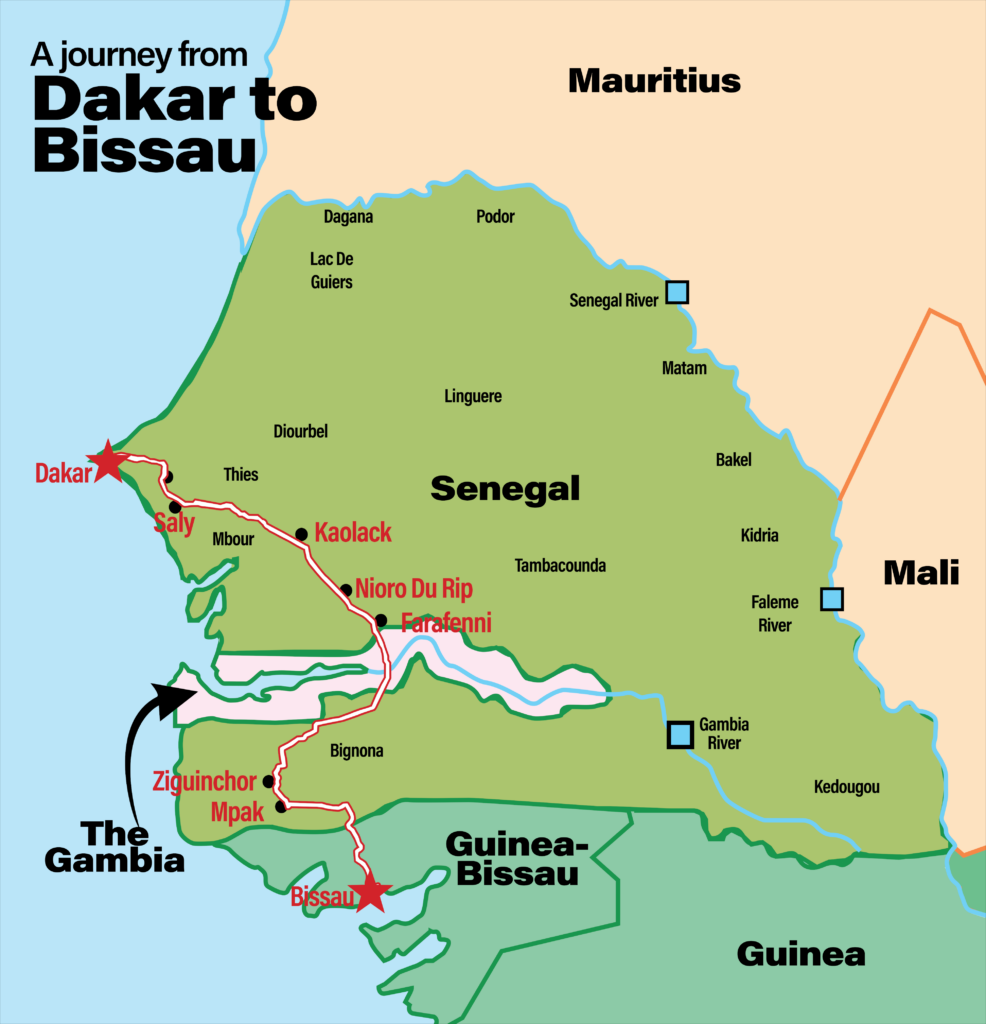
A journey across West Africa is rarely just a transit from point A to point B. It is an unfolding audit of the state, a kilometer-by-kilometer assessment of a fundamental political question: What, in tangible terms, do you provide in exchange for my allegiance? A road trip I undertook in September 2025 during a project on behalf of the Economic Community of West African States (ECOWAS) from Dakar, Senegal’s capital, to Bissau, the capital of Guinea-Bissau, became a stark examination of this very query, revealing not abstract policy failures but the lived reality of a social contract under severe strain.
West Africa is a region of profound distinctiveness and diversity. Its five hundred million people speak more than seven hundred languages. The countries in the region were carved by colonial powers with little regard for ethnic or economic logic. Senegal’s southern region, Casamance, is partly separated from the rest of the country by The Gambia, a narrow sliver of a nation that exists only because British gunboats once controlled the Gambia River. This is the landscape ECOWAS was created to manage.
Founded in 1975, ECOWAS began as an economic integration project of 15 states, a customs union meant to become a common market. Over time, it acquired a political and security mandate, intervening in brutal civil wars in Liberia and Sierra Leone in the 1990s and developing a reputation as a bloc willing to enforce democratic norms. Its protocol on democracy and good governance, adopted in 2001, explicitly condemns unconstitutional changes of government. In theory, ECOWAS today, now with 12 members, is the guarantor of a regional social contract, an organization that exists to ensure that the promises made by individual states to their citizens are backed by collective regional authority.
During my journey, I observed first-hand the state of infrastructure and cross-border movement in a region where ECOWAS has long proclaimed its commitment to free movement and regional integration. What I encountered was not merely poor roads and bureaucratic delays. The trip allowed an examination of the social contract itself. The evidence lies not in parliamentary debates but in the quality of the tarmac, the behavior of security officials in the three countries my team passed through, and the desperate choices of a young man by a riverbank. In the chasm between a state’s promise and its performance lies the story of West Africa’s democratic discontent. Across the region, surveys suggest that nearly seven in ten young West Africans are dissatisfied with democracy, even as most still say they prefer it in principle. Many express a growing openness to military rule simply because elected governments have failed to provide security or social protection.
Public trust in parliaments, presidents, and ruling parties has fallen sharply, and accusations that ECOWAS is hypocritical and applies double standards over coups and constitutional manipulation have become common in both media debates and expert assessments. What I saw on the road is what Afrobarometer and others are measuring in their data: People have not turned against democracy as an ideal, but they increasingly doubt that many West African states—or their regional bloc—can deliver it in practice.
Dakar to Farafenni: The Functional, If Fragile, Social Contract
The journey out of Senegal’s capital was reassuringly uneventful. Dakar has a metropolitan area of nearly four million inhabitants. It is a metropolis on the Atlantic Ocean where gleaming office towers sit alongside bustling markets. The road is paved, the signage clear. We passed businesses, then fields of millet. The police presence was visible but professional. Where we met them, officers waved us through after a perfunctory glance at documents. No money changed hands. No threats were implied. This was the social contract expressed in its most basic, functional form. The state, through its agents, provides a fundamental public good: security and orderly passage. In return, its authority is still accepted and its legitimacy is quietly reinforced. Citizens within this operational radius experience the state as a rules-based, if sometimes distant, entity.
But Senegal’s stability rests on foundations narrower than they appear. The country has never experienced a military coup. It has peacefully transferred power between rival parties. Yet its political class is drawn largely from a small elite, many of its members educated in France, with deep connections to Sufi brotherhoods that exercise enormous influence. The economy depends heavily on remittances, fishing, and the extraction of phosphates and gold. Inequality is stark, and youth unemployment is a persistent source of tension. The functional social contract I observed on the road from Dakar seemed real, even though it is fragile, sustained by the careful management of patronage networks, the absence of acute crisis, and consistent, non-intrusive performance. On the Senegalese side of the border post in Farafenni, procedures were followed efficiently and stamps were issued without theatrical hassle. This is the benchmark against which everything that follows must be measured.
A Gambian Interlude: Institutional DNA and the Extraction Racket
The transition was immediate and symbolic. The border between Senegal and The Gambia at Farafenni is not a natural boundary but a colonial artifact. The first thing that happened was that a Gambian border guard demanded 4,000 CFA francs (about $7) before we could enter his country. This was a blatant bribe, absent moments before, and it served as an introduction to a different governance paradigm. What in northern Senegal had been a tacit agreement on public goods here mutated into a naked transaction.
This shift is not accidental but institutional. The Gambia is a narrow strip of land on either side of the Gambia River, itself surrounded on all sides by Senegal but for a short coast on the Atlantic. Its population is only about 2.8 million. From 1994 to 2017, it was ruled by Yahya Jammeh, whose regime was characterized by rampant corruption and the systematic looting of state resources. Crucially, the Gambian security apparatus was largely trained and shaped by its Nigerian counterpart starting in the 1990s. The pervasive culture of the Nigerian police, notoriously synonymous with roadside extraction, has become woven into the institutional DNA of The Gambia’s own services. The request for a bribe was not merely the act of a rogue officer; it was the learned behavior of an institution whose foundational logic prioritizes rent-seeking over service.
The journey south from Farafenni confirmed this inheritance. The road deteriorated. The police checkpoints multiplied, appearing every few kilometers. At each one, the same ritual repeated: An officer flagged us down, peered into the vehicle, and then, with varying degrees of subtlety, indicated that a small payment would smooth our passage. These are the signs of a state that acts not as a facilitator but as an authorized obstacle.
This extractive logic extends far beyond the roadside and poisons the very relationship between the state and its youth. In December 2025, the Gambia Police Force intensified operations in the North Bank Region to curb irregular migration along the Barra-Ginack corridor, a known departure point for young people attempting the perilous Atlantic journey to Europe. The official communiqué spoke of targeted screening and a zero-tolerance approach. Yet the public reaction laid bare a devastating collapse of trust.
One comment on Facebook asked pointedly, “Even the police, soldiers, and immigration officers are secretly paying for themselves or their sons and daughters to embark on this journey. So what’s the point of all this heavy presence?” Another noted that the crossing point exists because “Jinack doesn’t have any proper road network.” The state’s punitive response is a substitute for the developmental provision it has failed to deliver.
As we crossed the Gambia River, one of my companions, a Nigerian trader who lives in Bissau and frequents The Gambia, told the story of a young man in Barra, the town at the ferry terminal where people used to cross the river before a bridge was built there. The town sits on the river’s northern bank, facing Banjul, the capital, across the estuary, and for generations the only connection between these two halves of The Gambia were unreliable, overloaded ferries. This young man had tried twice to reach Europe. Once, he was intercepted by the Spanish coast guard and returned and the second time was turned back by Gambian patrols. Between 2014 and 2019, about 40,000 young people left The Gambia for Europe.
“Why does he keep trying?” I asked. My companion gestured at the countryside around us as we drove through a town called Soma—at the unpaved streets and the open drains and the men sitting idle under trees. “What is here for him? The police take his money if he works. The government does nothing. At least on the sea, he has a chance.”
Here, the abstract notion of a failed social contract takes human form. The state, experienced daily as an extractive force on crumbling infrastructure, forfeits its moral authority to deter desperate journeys. Remittances account for more than one quarter of The Gambia’s GDP (and in West Africa as a whole, they far exceed the combined inflow of official aid and foreign direct investment). Youth unemployment is at about 21 percent. The message to young people is clear: Prosperity is earned abroad, not delivered at home. The state’s heavy-handed enforcement methods are seen not as protection but as hollow performance, even hypocrisy, especially when its own agents are suspected of using the very routes they patrol.
This dynamic is perfectly captured by theories of political economy that see the state not as a neutral arbiter, but as a concrete crystallization of underlying class power relations. Institutions are shaped to stabilize systems—including a corrupt border economy or a patronage network—that benefit a connected elite, often at the expense of providing universal public goods. The Gambia scores poorly in international assessments of corruption, and its police ranks among the institutions most associated with bribery and extortion, reinforcing the perception that public authority is a revenue-collection machine rather than a provider of security. The police checkpoint is less an arm of the state than a toll booth for a protection racket, evidence of a corrosive institutional model.
Casamance: The Painful Price of Negotiated Legitimacy
Upon re-entering Senegal at Digante, the road did not improve. It remained a rough, neglected track, a physical testament to decades of political marginalization. Cut off from much of the rest of the country by The Gambia, this southern part of Senegal is Casamance, a region separated from Dakar geographically and psychologically, and historically by a separatist conflict that began in 1982. Here the landscape is greener and lusher, watered by heavier rains. The savannah gives way to tropical rainforest, and cassava fields line the red earth roads. The people are predominantly Diola, an ethnic group with its own language and traditions that accounts for only about 4–6 percent of Senegal’s total population. Many Diola have long felt distant from the Wolof‑dominated state centered in Dakar, complaining that the region’s resources are siphoned north while its own roads, schools, and services are neglected.
The rebellion in the 1980s was, at its core, a violent rejection of a social contract deemed exclusionary. The Movement of Democratic Forces of Casamance (MFDC) demanded independence, arguing that the Senegalese state had systematically overlooked the region and exploited its resources—fertile land, fishing, timber, and the prospect of future oil, gas, and zircon projects—without providing commensurate benefits. The conflict that followed killed thousands, displaced many more, and left a legacy of landmines and mistrust that persists to this day.
A peace agreement signed in February 2025 and brokered by Guinea-Bissau’s then-president offered a fragile blueprint for rebuilding that contract from the ashes. The deal included promises of amnesty, the reintegration of fighters, and, crucially, a $88 million state investment plan to clear landmines and build schools, health facilities, and government offices. The prime minister of Senegal, Ousmane Sonko, whose father was from Casamance, called it a “very big step towards peace.”
However, the scars of conflict complicate this renewal. US-government advisories still warn travelers of separatist rebel groups, armed banditry, and the lingering threat of landmines in the region. The US Embassy restricts its personnel to main roads and daylight hours. For the Senegalese state, legitimacy in Casamance now depends on translating the peace agreement’s signatures into visible, material change, on making the state physically and beneficially present. It must prove that the social contract can be rewritten to include those who so far have been left on its periphery. The road here must be more than a path; it must become a symbol of political reintegration.
Bissau: The Vanished State and a Coup as Symptom
After Ziguinchor, we crossed the border into Guinea-Bissau at Mpak. From Mpak to Bissau, the audit concluded with a failing grade. Over about 130 kilometers, the road did not merely deteriorate; it vanished. What should have been a two-hour drive became a seven-hour ordeal through mud and craters. Our vehicle lurched and groaned and eventually lost its fuel tank to a spike on the dirt track. This is more than a poor road. It symbolizes the physical dissolution of the state.
Guinea-Bissau is one of the world’s poorest countries, with a GNI per capita income of less than $1,000 per year. Its economy depends almost entirely on cashew exports. Its politics have been defined by instability since independence from Portugal in 1973–74. There have been multiple coups, attempted coups, and assassinations. Aside José Marío Vaz, no elected president has completed a full term in office. The military, unpaid and undisciplined, operates as a parallel power structure.
The political consequence of this vacuum manifested just weeks after my journey. On November 26, 2025, Guinea-Bissau’s military seized power, dissolved electoral processes, and detained President Umaro Sissoco Embaló. Analysts spoke of regional coup-contagion and geopolitical rivalry, but from the ground, the precursor was unmistakable: the disappeared road. When the state evaporates from the landscape, it relinquishes its claim to a monopoly on legitimate force. The military’s intervention, however destabilizing, filled a void of authority and basic functionality, even as regional bodies and international observers overwhelmingly rejected its claim to legitimacy and demanded a rapid return to the constitutional order.
I thought of how tired the border guard who had processed our entry into Guinea-Bissau, at the crossing from Senegal, looked. His weariness was not personal; it was institutional, the exhaustion of a public servant whose employer has abandoned its responsibilities. Legitimacy cannot be sustained by ceremony or a constitution alone.
The ECOWAS Credibility Crisis
This journey through failing states is set against the backdrop of a failing regional safety net. ECOWAS, which was conceived to promote stability and integration in the region, is experiencing a profound crisis of credibility. The inconsistent application of its democratic principles has not only rendered it ineffective but has also actively fueled disillusionment and a yearning for alternatives.
Our own entry into Guinea-Bissau served as a perfect, if surreal, microcosm of this failure. Having left Dakar at 9 a.m., the interminable delays at extractive Gambian checkpoints meant we arrived at the Senegal–Guinea Bissau frontier over two hours later than our expected 5 p.m. ETA. By the time we got to the border, it had officially closed, at 6:30 p.m., due to rebel activity in the area. Since we were part of an ECOWAS-related mission, our last resort was a call to the organization’s secretariat in Bissau. After much waiting and negotiation, the gates were grudgingly opened.
The Guinea-Bissau border guard who processed our papers did so with a weariness that transcended the late hour. “You see this?” he said, gesturing to the dark, silent post around him. “They open it for you because you know someone in an office in Bissau. But tomorrow, the farmer whose goods will spoil will be turned back. ECOWAS talks of free movement, but here, movement depends on who you know.” He shook his head, stamping a passport with more force than necessary. “They make big declarations in Abuja. But did they stop the soldiers? Can they fix the road? They are quick to punish the people, but where were they to prevent the crisis? We are on our own.”
ECOWAS is caught in a cycle of reactive condemnation, often speaking out only after constitutional orders have been overthrown. More damning still, its actions appear selectively vigorous. Compare its responses to two crises in December 2025 alone. In Benin, when a coup attempt threatened President Patrice Talon, ECOWAS acted with remarkable speed. Nigerian Air Force jets struck rebel positions, and a standby force from Nigeria, Ghana, Côte d’Ivoire, and Sierra Leone was mobilized to defend the constitutional order. The bloc seemed to have learned a lesson from its dithering response to the Niger coup in 2023 and moved decisively. Yet, just days earlier, when the military seized power in Guinea-Bissau, ECOWAS’s response had been limited to condemnation and suspending the country’s membership. There was no talk of a standby force, no decisive military intervention.
This inconsistency is not lost on citizens. Some analysts reported “a palpable sense” that ECOWAS applies a double standard, allowing some countries with democratic deficiencies such as Togo to operate with impunity. Swift sanctions are imposed on Sahelian states following military takeovers, whereas, as the analyst Koffi Avoulete notes, ECOWAS often turns a blind eye when other member states engage in “less overt but equally damaging democratic deficiencies,” such as constitutional manipulations to extend presidential terms in Côte d’Ivoire or Togo. When the organization’s own Community Court of Justice issues rulings to protect human rights, some member states often simply ignore them. Nigeria alone has failed to enforce about 50 judgments. The promise of regional accountability becomes a mirage.
This perceived hypocrisy has devastating consequences. It erodes the bloc’s moral authority and fuels the narrative that it is more concerned with preserving the interests of a select group of incumbent leaders than with upholding universal democratic principles or addressing the profound governance failures that drive instability. Into this vacuum of credible regional leadership steps the allure of alternatives. The guard’s comment, “We are on our own,” echoes the founding sentiment of the Alliance of Sahelian States (AES, after the French, L’Alliance des états du Sahel), comprising the juntas of Burkina Faso, Mali, and Niger, which formally withdrew from ECOWAS in 2023. According to one commentator, they called the organization “an obstacle rather than a reliable partner.”
While the AES states grapple with severe challenges, including devastating insurgencies and partnerships with Russian mercenaries, a potent rumor mill operates across West Africa. Tales circulate about these states doing OK, asserting their sovereignty against former colonial powers, and pursuing integration on their own terms, including plans for a Sahel-wide passport, a joint military force, and a single currency to replace the CFA Franc as their currency. For a young person in Dakar or Accra facing unemployment, or for that border guard in Guinea-Bissau, these narratives, however oversimplified, represent a stark contrast to the perceived impotence and inconsistency of ECOWAS. They foster a yearning not necessarily for military rule, but for any form of governance that appears decisive, sovereign, and capable of delivering tangible results. ECOWAS’s crisis is not a crisis of policy; it is a crisis of perception. It belies the fact that the organization’s inability to act consistently and prevent crises has led many to stop viewing it as a relevant guarantor of their democratic future.
A Nigerian Parallel
This dynamic is not a Sene-Gambian peculiarity; it is a continental malaise with profound echoes in my home country, Nigeria. In early December 2025, I drove from Asaba, the capital of Nigeria’s Delta State, to Benin City, the capital of Edo State next door. This journey, once a brisk ninety-minute affair, is now a three-hour gauntlet of craters and congestion. Here too road decay is a national metaphor. But the failure of the social contract manifests in even starker terms.
Consider a report from Plateau State in December 2025, where kidnappers abducted 28 travelers and issued a 24-hour ultimatum for a $1,100 ransom per person. This incident is a grotesque inversion of the state’s duty. Where the state is meant to guarantee safe passage, non-state actors now control the roads, imposing their own brutal tariffs. The citizen’s plea for security is met with silence or impotence, while the kidnapper’s deadline ticks with terrifying efficiency.
A colleague I was traveling with then spoke by phone with a relative of one of the victims, a woman in Jos, in central Nigeria, whose brother was among those taken. “We are trying to raise the money,” she said. “The family is selling everything. The government? They send messages of sympathy. But what can they do? They cannot even secure the roads in broad daylight.”
This is the social contract in a state that displays unmistakable signs of deep erosion, where the government’s failure to provide the most basic public good—security—forces citizens into direct, horrifying negotiations with armed gangs. The kidnappers, whatever else they are, are rational actors. They have identified a space where the state is absent and have moved to fill it with their own brutal version of order.
Similarly, the reaction to recent US restrictions on migrants and travelers from Nigeria is instructive. While the Nigerian government and media commentators framed it as a diplomatic insult, the US cited as a justification tangible governance failures: weak identification and systems, poor information-sharing, and chronic visa overstay rates. The instinct to deny the problem rather than address its root causes, to treat the symptom of international stigma while ignoring the disease of institutional failure, is a tragic pattern. It represents a refusal to engage in the hard work of repairing the social contract, preferring the illusion of sovereignty to the substance of effective governance.
Paving a New Contract
My journey from Dakar to Bissau was a traverse through the escalating stages of political divorce: from the functional contract in northern Senegal, to the extractive racket in The Gambia, to the painful, negotiated reconciliation in Casamance, and finally to a complete rupture in Guinea-Bissau. The evidence of citizen discontent is not difficult to find. It is in the story of the young man in Barra who sees possible death at sea as preferable to life at home. It is in the frustration of the border guard who watches ECOWAS open its doors for the connected while leaving the farmers’ goods to rot. It is in the resignation of the woman in Jos who sells her belongings to pay kidnappers because the state cannot protect her brother. These are not the grumblings of a disaffected few. They are the accumulated testimony of many thousands who have concluded that the social contract is void.
Theories of social contract are also a lived reality, revealed in every pothole and at every checkpoint. The wave of coups and the simmering discontent across West Africa are not spontaneous events. They are the logical, if sometimes drastic, culmination of a long process that follows when the state, in the eyes of its citizens, ceases to be a credible partner in a mutual pact. Democracy falters not when people reject the ideal, but when the daily experience of it yields extraction, neglect, and danger, and when the regional body meant to safeguard it appears selectively engaged and institutionally hollow.
ECOWAS was created to be more than the sum of its parts, a collective guarantee that the failures of any one state would not destabilize its neighbors. But when the organization acts decisively to protect some incumbents while abandoning others, when its courts are ignored and its protocols are unenforced, it becomes part of the problem. The guard’s lament, “We are on our own,” is the epitaph of a regional ideal.
Restoring legitimacy will not be achieved through grand rhetoric, military treaties, or reactive suspensions alone. It must be rebuilt, as it was broken, kilometer by kilometer. It requires states to reappear physically, not as predators but as providers that pave roads, secure routes, and deliver basic services. It also demands that ECOWAS undertake the ambitious reforms necessary to restore its credibility: applying its principles consistently, closing the gap between protocols and enforcement, and proving itself a champion of people rather than a club of leaders. The alternative is not stagnation but a continued and violent renegotiation of the terms of the social pact, often at the barrel of a gun, with citizens increasingly looking past their own capitals and their regional bloc for salvation. The road to legitimacy must first be paved in literal tarmac, with tangible trust and consistent principle. Only then can it lead to a stable democratic future.
Cheta Nwanze is a researcher who specializes on politics and the economy. He works with SBM Intelligence, a Nigerian think-tank focused on West Africa and its relationship with the world.