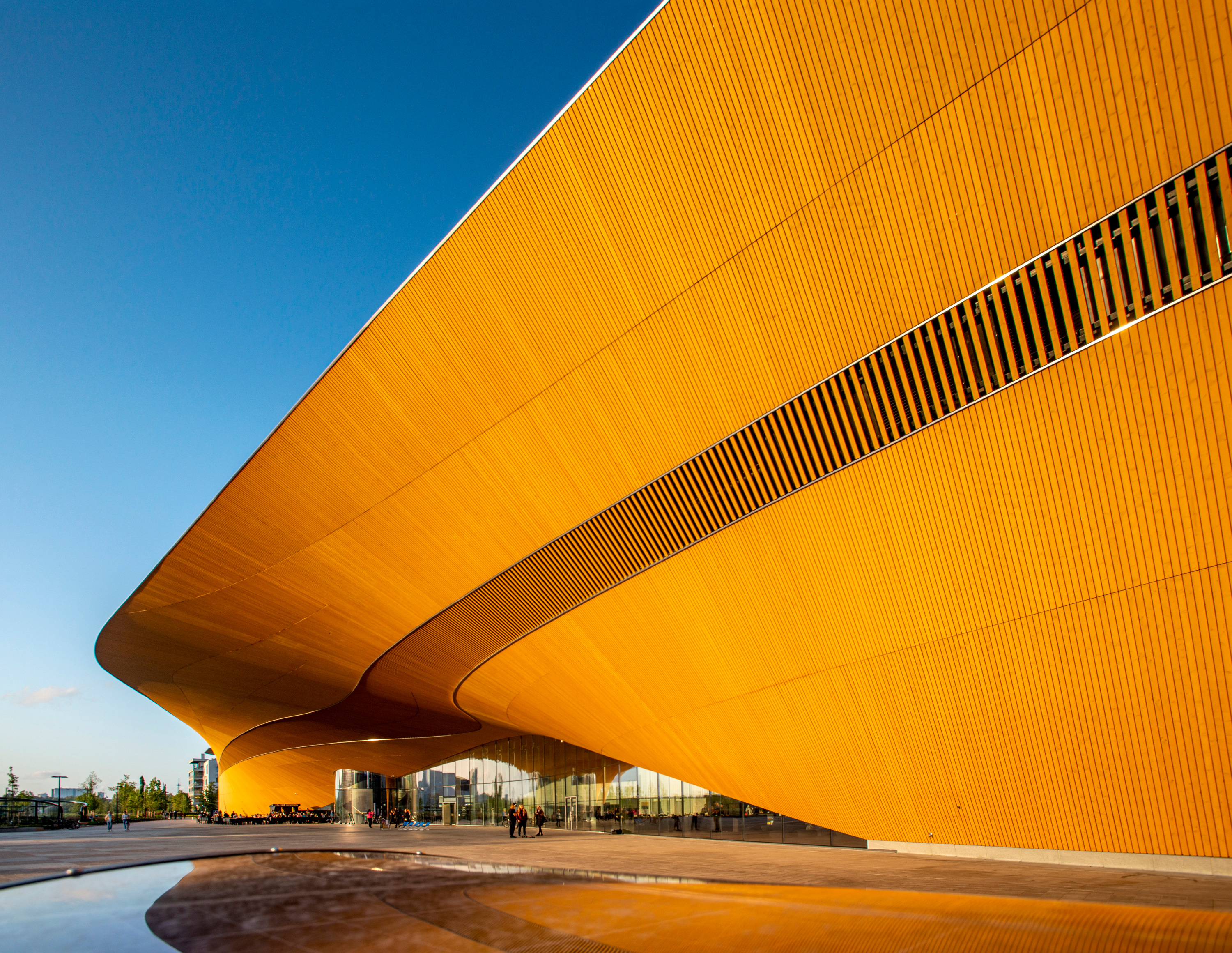
I once had the pleasure of visiting a rare Alvar Aalto structure in NYC, a closed-to-the-public conference room on the twelfth floor of the International Institute for Education across from the United Nations. It had all of Aalto’s hallmark qualities: a single, continuous aesthetic whole with warm, sculptural interiors and soft golden accents. As much as I admire the work of twentieth century form-givers like Aalto, I never did buy into the Modernist notion that great architecture and design can change social reality. Aalto features prominently in the curator and editor Daniele Belleri’s Ideas Letter essay, which returns to this hallmark Modernist conceit and animates it for the present global condition. Belleri argues that Finnish design—rooted in welfare-state modernism, ecological sensitivity, and a culture of preparedness—has long functioned as a political (even geopolitical) instrument and that today it offers Europe a model for resisting imperial pressures from the US, Russia, and digital platforms. Can Finland, a nation of fewer than six million people, deploy its singular aesthetic purpose in the service of a new European future?
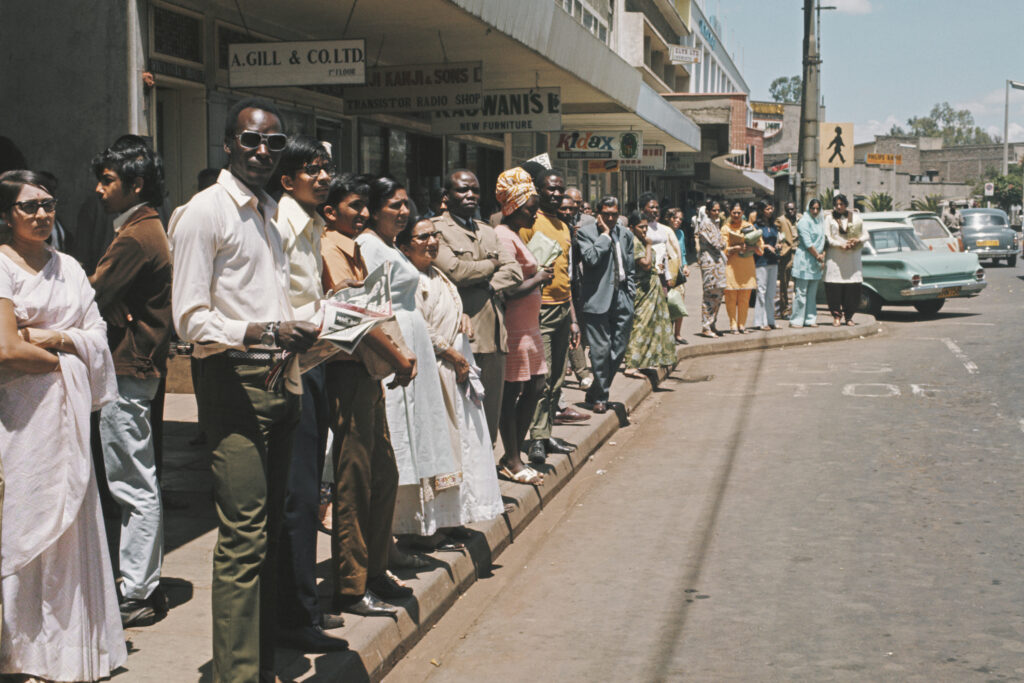
Mahmood Mamdani, the esteemed historian and father of New York City’s headline-grabbing mayor, has rethought in his new intellectual memoir, Slow Poison: Idi Amin, Yoweri Museveni, and the making of the Ugandan State, the expulsion of South Asians (including his family) during the Idi Amin era in Uganda and the vast political consequences in the decades since. The Kampala-based intellectual Kalundi Serumaga takes the measure of Mamdani’s book to make sense of what was on few proverbial bingo cards: Mamdani’s partial rehabilitation of Amin’s sordid legacy as head of state in 1970s Uganda. Serumaga finds Mamdani’s retelling riven by contradiction but revealing, both of Uganda’s postcolonial struggles and of the limits of Africa’s progressive intelligentsia.
We conclude with the Nigerian journalist Cheta Nwanze, who offers a ground-level critique of the West African social contract, arguing that both countries and ECOWAS are losing legitimacy because they fail to provide basic public goods, even as they proclaim democratic and regional ideals. Nwanze gives a tour d’horizon of the region using a road trip from Dakar to Bissau as an extended metaphor for an audit of the state, suggesting that checkpoints and borders reveal more about democracy than official speeches.
For our curated section, we lead with a penetrating essay from the Russian political theorist and activist Ilya Budraitskis, who analyzes how contemporary global politics has entered a “post-progressive temporal order.” Skepticism abounds about any linear narrative of progress. In its place, two broad sensibilities contend: a reactionary orientation longing for lost roots and an apocalyptic orientation that fears imminent collapse. From this sinister gumbo emerges ideological convergence between Russia’s religious nationalism and the dark enlightenment of the West.
We follow with an arresting lecture from the Belgian historian of political thought Anton Jäger framing his master concept: hyperpolitics. Jäger asserts, through dozens of sharp illustrations, that “extreme politicization without political consequences” has increasingly dominated contemporary politics. It marks a shift from the “post‑politics” era of the 1990s–2000s, when technocratic consensus held sway. Compare that to today, as politics saturates culture and private life but remains structurally weak. (For more on Jäger, we recently published an essay on his theory by Oliver Eagleton.)
Finally, the psychoanalyst and philosopher Daniel Tutt argues that contemporary anxieties about AI replacing creative and intellectual labor are ultimately mis-framed because they treat AI as an autonomous technical force rather than an instrument deployed according to the imperatives of capital. As any card-carrying Marxist would affirm, capital still depends on surplus human labor and uses automation selectively to restructure work and discipline workers.
For our musical selection we pay tribute to the great tenor player Joe Henderson. Although not as well-known as his famous contemporaries, John Coltrane or Sonny Rollins, he was very much their equal—his dark tenor sound and richly focused timbre are unmistakable. Henderson’s Blue Note recordings, of which there are many, are legendary, but here is something different: a live track called “Barcelona,” from 1979—a frenzied, extended avant-romp by the maestro.
—Leonard Benardo, vice president at the Open Society Foundations
Finland Is Designing Europe’s Sovereignty

Daniele Belleri
The Ideas Letter
Essay
Finnish architecture and design—exemplified by Alvar Aalto’s Paimio Sanatorium—have long functioned as instruments of nation-building, embedding social welfare, preparedness, and collective resilience into the built environment. Belleri argues that today this tradition offers a model for “strategic autonomy,” and for the rest of Europe, too, by linking ecological stewardship, welfare infrastructure, and civic spaces such as libraries to democratic resilience. The essay understands architecture as political infrastructure and suggests that as the continent faces renewed geopolitical pressure from Russia and a less reliable United States, Finland’s design culture could provide a blueprint for a broad anti-imperial project.
“Finnish architecture has long demonstrated its capacity to respond to geopolitical pressures, either within the framework of preparedness or by reinforcing nation-building objectives. But if these dynamics long unfolded under a flag of neutrality, the 2020s do not reward ambiguity. We should look at Finnish architecture as a repository of ideas for a culture war that ties in closely with a new geopolitical mission: not one seeking neutrality on a national scale, but one waging an anti-imperialism resistance at a continental level.”
Mamdani’s Blank Slate
Kalundi Serumaga
The Ideas Letter
Essay
Serumaga reads Mahmood Mamdani’s Slow Poison as a reinterpretation of Uganda’s postcolonial history through the contrasting political projects of two leaders, Idi Amin and Yoweri Museveni, presenting both as having failed to build a modern Ugandan state. In Mamdani’s account, Amin truly pursued a radical—if brutal—vision of national decolonization, while Museveni was a former revolutionary who ultimately abandoned that project and presided over a more cynical and fragmented order. Serumaga challenges Mamdani’s central claim that colonial rule politicized ethnicity and produced the idea of “indigeneity,” which Mamdani identifies as an important obstacle to building a coherent postcolonial citizenship.
“This raises a deeper question. Mamdani’s core contention is that the ethnic identities in Africa are simply inventions by the colonial powers so as to make it easier to govern their colonies. These ethnicities, so the argument goes, therefore become impediments to nation-building in Africa. But why doesn’t this argument apply to the states currently in existence in Africa, since they were also created by European colonists. Why is one (alleged) European imposition on Africa bad and the other good? Mamdani doesn’t say.”
In West Africa, the Road to Legitimacy is Paved in Tarmac

Cheta Nwanze
The Ideas Letter
Essay
Nwanze uses a road trip from Dakar to Bissau to make an infrastructure audit of the social contract in this part of West Africa: Where roads are paved and officials enforce rules predictably, legitimacy is quietly reinforced; where the state manifests mainly as a roadside extraction racket, popular allegiance curdles into resentment and yearnings for an exit. As the journey takes Nwanze through neglected peripheries and areas where the state seems entirely absent, he argues that democratic discontent and coups look less like ideological shifts than rational responses to governments and the regional organization ECOWAS, which cannot seem to deliver basic public goods on the ground.
“ECOWAS was created to be more than the sum of its parts, a collective guarantee that the failures of any one state would not destabilize its neighbors. But when the organization acts decisively to protect some incumbents while abandoning others, when its courts are ignored and its protocols are unenforced, it becomes part of the problem. The guard’s lament, ‘We are on our own,’ is the epitaph of a regional ideal.”
The Antichrist Today
Russian Conservative and Techno-Enlightenment Versions
Ilya Budraitskis
e-flux Notes
Essay
The political and social theorist Budraitskis argues that declining confidence in liberal progress is animating apocalyptic political imaginaries in which competing forces claim to be restraining the arrival of an Antichrist. He compares Russian conservative ideology, which casts Western liberal universalism and uncontrolled technology as a homogenizing threat, and American techno-reactionary thinking about the “Dark Enlightenment,” which portrays global governance and limits on technological growth as the real danger.
“…Both ideas of the Antichrist—the Russian conservative-civilizational (techno-pessimistic) one and the techno-optimistic Dark Enlightenment one—converge on this main point: the escalation of unpredictability and the non-calculability of the future, restraining the Apocalypse.”
Hyperpolitics, or Political Engagement in the New Century
Anton Jäger
Brussels Institute for Advanced Studies
Lecture
Why did the 2020 racial justice protests and the January 6, 2021, attack on the Capitol in the US both produce enormous political energy only to dissipate so quickly? This lecturedescribes the pattern as “hyperpolitics”: a new mode of engagement in which politics suddenly saturates everyday life, drawing in people who were previously disengaged. Unlike the durable mass politics of the twentieth century, this form of participation tends to be rapid, galvanizing, and short-lived—mobilizing huge numbers quickly but rarely sustaining long-term organization.
“When you then look at the institutional or let’s say the policy legacy of these movements, there’s a profound ambiguity. So you have the largest protest movement in US history and you see that five years after date, many of the social problems and questions that it actually mobilized around have actually become worse. And so as the New York Times indicated last year, since George Floyd’s murder, police killings have been kept rising, not falling. And the number of people killed by police has risen every year since the murder of Mr. Floyd by a Minneapolis officer in 2020. I think this indicates some of the normative ambiguity that you see in the story about hyperpolitics. So, of course, we do not need to buy into the nostalgia for apathy you find in Jan Ganesh, where he says, ‘I would like to return to a world in which no one shows up to vote and no one shows up to protest in which western politics was much quieter.’ At the same time, an unreserved enthusiasm for some of these recent protest movements just runs into the difficulty that their institutional achievements have become quite weak.”
Freud, Aesthetics, and the Limits of “AI”
Daniel Tutt
Daniel’s Journal
Essay
Tutt argues that contemporary fears about AI replacing creative labor stem less from any technological inevitability than from capitalism’s contradictory relationship to human labor. Drawing on psychoanalytic thinkers including Freud, Hanns Sachs, Theodor Adorno, and Ernst Bloch, he develops a theory of artistic creation centered on the daydream as a bridge between private fantasy and social life.
“If the contemporary AI apocalypse makes the artist obsolete this will have been driven by capitalist imperatives, not by the autonomous power of technology. As I have tried to demonstrate, the AI panic is a threat to the creative industries and to intellectual labor more generally, to be sure. But the basis of this threat is construed in an idealist framework because it cannot think what makes creativity itself novel, namely the embedded social link that the artist forges in the act of creative activity. Psychoanalysis identifies the subjective mechanisms that link the artist to social and political structure and in this connection, there is a social link formed in the very act of producing and consuming art.”