Hinge of the Modern World
A Response to William Shoki

1510: The Modern World’s Hinge
Begin not in 1994, with apartheid’s legal end; nor in 1948, with apartheid’s official implementation as policy; nor in 1910, with the Union of South Africa’s formation; nor even in 1652, with the first permanent European settlement at the Cape of Good Hope. Begin instead on March 1st, 1510, at Camissa—“the place of sweet waters,” as the Goringhaiqua Khoe people called their shore, which the Portuguese would later name Table Bay. It is here that the story that becomes South Africa first takes shape. Francisco de Almeida, the powerful Viceroy of Portuguese India, was sailing home in triumph. On that day, he anchored his fleet and came ashore in search of fresh water. His men did in miniature what the coming centuries of settler violence would do at scale to the indigenous peoples of the land: they tried to seize cattle and carry off two Goringhaiqua Khoe children. The next morning, the Goringhaiqua women sounded the war cry. When Almeida marched some hundred and fifty men into their settlement, the Goringhaiqua met him with fire-hardened spears, trained oxen and a military strategy the Portuguese had assumed no people without guns could possess. They drove his soldiers back across the sand, killing the Viceroy and sixty-five of his men. The first European attempt to take the Cape ended in the first European defeat. For a century and more afterward, Portugal gave the Cape a wide berth.
Camissa was no backwater; it was already becoming a hinge of the world. Thirteen years earlier, in 1497, Vasco da Gama had rounded this same Cape of Good Hope, opening the sea route to India and inaugurating oceanic capitalism: the long-distance traffic in spice and bullion, and, soon, in human beings, that would knit the planet into a single market. The traffic in captive Africans was not new even then. Portugal had opened it in 1441 when Antão Gonçalves seized twelve Africans from the Bay of Arguin, in what is now Mauritania. In the decades that followed, papal bulls licensed the enslavement of African people and the seizure of indigenous lands, so that by the morning Almeida stood on Camissa’s sands, the traffic in Africans was already nearly seventy years old. What the Goringhaiqua drove back into the Atlantic was therefore not merely an opportunistic raiding party that had overreached but the advance guard of an order two generations in the making—the modern racial-capitalist system at both its inception and its limit. Had they lost, the Cape might have become what Elmina Castle already was on the Gold Coast: a fortress of that trafficking. But they did not lose, and the refusal held. Almeida himself had just annihilated a combined Egyptian and Gujarati fleet at Diu in 1509 to seize the Indian Ocean for Portugal. The man the Goringhaiqua killed on the sand was the sharp end of the emerging world-system, and the Cape of Good Hope was the pivot between the Atlantic and the Indian oceans on which the whole apparatus swung.
This is the first thing Camissa tells us: Africa’s southernmost extremity was never peripheral to the modern world but central to its creation. The continent’s tip, where two oceans meet, is where the modern world was assembled. The continent’s edge was the axis of the globe—and the axis was forged through capital. Adam Smith, the 18th-century founder of the study of political economy, named the rounding of the Cape of Good Hope and the “discovery” of the “New World” as “the two greatest and most important events recorded in the history of mankind.” He meant this as an economic judgement: these were the fulcrums on which the modern commercial world had turned. But notice already what the judgement omits. Smith names the routes that made the “Age of Discovery,” but is silent on the human cargo in the hold: the enslaved Africans in the holds whose trafficking and toil made the voyages worth it, the human freight without which the two greatest events in the history of mankind are merely two long sea-passages.
The omission is not incidental. It is foundational to political economy, which learned from the first to only see the traffic and not the trafficked, the route and not the body in the hold. (We will meet Smith’s silence again.) The Cape kept the wheels of the new global system turning. This is why the Dutch East India Company (VOC) took the Cape in 1652 and why Britain captured it from the Dutch during the Napoleonic wars—not for the land but for the throat of the route to India. It’s why, a century later, Witwatersrand’s gold would anchor the world’s currencies on the gold standard. Three times across three centuries the global economy reorganized itself around this coast. This is what Stuart Hall meant when he wrote in 1980: “South Africa is clearly a ‘limit case’ in the theoretical sense, as well as a ‘test case’ in the political sense.” The country is not a place apart from the modern world but the place where its workings show. South Africa is not an exception to modern political economy but its purest expression.
To read South Africa is to read a world small enough to hold in the hand. It is all too easy to write a national morality play—South Africa’s shame, resolved in South African pathos. But South Africa is the modern world’s limit case: not the aberration but the place where the global order’s racial-capitalist logic is written. It is legible precisely because it refused to disguise itself. Read that way, Afrophobia is not a dispatch from a troubled country. It is the world’s tell.
1899–1902: The White World’s Hinge
On May 31st, 1910, almost exactly four hundred years after the Goringhaiqua defeated Almeida, the Union of South Africa was declared. In the four centuries between, the thing defeated at Camissa was attempted again and again until, at last, it took. South Africa’s story is usually narrated as beginning with the settlers’ arrival in 1652, as though the land held its breath and waited to be made. It did not. The land was defended from the first day, and the defeat of Almeida is the proof. The order consecrated in 1910 was never natural and never inevitable. It had to be imposed, over centuries, against people who from the very beginning resisted it. That is because South Africa was not a ‘pre-modern’ space awaiting colonial ‘discovery,’ but rather the keystone on which the world’s racial-capitalist system depended. To ask what South Africa is, then, is to ask what was assembled across those four hundred years—against what and against whom, for what and for whom.
Every country invites the question “what is it?” and answers with a story about itself—a founding, a people, a destiny. South Africa answers with a contradiction so total that the question refuses to settle. It is the continent’s most industrialized economy and its most unequal society. It is supposedly a miracle of racial reconciliation and yet a byword for racial rule. It produced both the gold that underwrote the modern world’s money and the man who became that world’s conscience. To ask what South Africa is, then, is not to ask for a description. It is to ask what kind of thing could hold those opposites together inside a single state. My answer is that South Africa is not a nation that happens to be racial. It is a racial-capitalist formation, a racial corporation, that happens to be a nation—and it first announced itself as such, in law, in 1910, four hundred years after Camissa.
When the global order that the Goringhaiqua had turned back finally came to stay in 1652, it did not come as a nation. It came as a company. The VOC that built the refreshment station at the Cape for ships bound to and from Asia was no trading house in the sense we would recognize today. It was a company-state, chartered by the Netherlands to rule subjects, coin money, sign treaties, raise armies, and wage war in its own name. What landed at Table Bay was racial capital already vested with sovereign power—capital and state not yet pried apart, because at the Cape they were never separate to begin with.
And this was no ordinary capital. The Dutch were the engine of the mid-17th-century traffic in enslaved Africans: the VOC monopolized the Indian Ocean trade, while its sister, the West India Company, dominated the Atlantic, holding the contracts to supply enslaved Africans to Spanish America. But it was not only the chartered companies. Capital has no flag, and Amsterdam’s private merchants lent to whoever paid: outcompeted in direct colonial production, they made a business of servicing their rivals’ slaving empires instead—supplying Spanish America with captives, financing its planters, provisioning the slave ships of Portugal, England and France, and moving their slave-produced goods through Curaçao and St Eustatius under cover of Dutch neutrality. The corporation that raised the refreshment station at the Cape of Good Hope was therefore a central force in the growing global enterprise of racialized chattel enslavement—the institution that Smith’s two greatest events pass over in silence. And when it came to the Cape itself, enslavement did not come late, as an afterthought to the labor supply. Within a month of establishing the settlement, the Company’s Commander at the Cape, Jan van Riebeeck, wrote requesting permission to import enslaved people, and by some accounts, even proposed selling the Khoe into slavery in Asia. Six years later, the ship Amersfoort put ashore its first shipment of 174 enslaved people from what is now Angola. From early in the 18th century until emancipation in 1834, the enslaved consistently outnumbered settlers at the Cape. The Cape did not become a slave society. It began as one.
From the Goringhaiqua Khoe’s defeat of Almeida in 1510 to their 1659–1660 war against the Dutch—the first major indigenous war of resistance against settler colonialism, begun when they rose against the farms the Company had planted on their grazing land and ended with a “peace treaty” they were compelled to sign—South Africa has been plagued by what white settlers in the 19th century would call the “Native Question.” That is, what to do with the indigenous peoples whom the settler economy sought to dispossess of their land, labor, and cattle—and who would not surrender them without a struggle that would last from 1510 to 1994?
The answer to the “Native Question” was warfare—centuries of Wars of Dispossession, waged first by the kommandos the Company authorized Dutch free burghers to form in 1673, raiding for land, cattle, and captives, and, after 1806, by British columns who introduced the logic of elimination to Southern Africa: whole peoples cleared from their territory, their herds seized, their ground annexed to the Crown. By the end of the 19th century Britain and the Boer republics had toppled Southern Africa’s last Black sovereign polities, transforming indigenous peoples into landless serfs obliged to seek work in the colonies that had taken their land. And that is what required the creation of the “pass,” the document on which South Africa’s anti-Black migration regime was built.
The architecture of the anti-Black migration regime so foundational to South Africa was first laid during the 1779–1879 Nine Wars of Dispossession—a century in which Boer kommandos and British soldiers fought the Khoe and isiXhosa-speaking peoples for their land, their cattle and their labor. It was the longest sustained period of warfare in the history of the European presence in Africa. The first passes arrived in the wars’ second decade, long before military conquest ended indigenous sovereignty in Southern Africa in the late 19th century. As early as 1797, two years before the Third War of Dispossession (1799–1803), in which the Khoe rose against the Boer farmers and made common cause with amaXhosa, the Cape’s first British governor, Lord Macartney, directed the magistrate at Graaff-Reinet to allow no Xhosa to cross the colony’s limits without “a Passport signed & sealed” by him, and ordered every colonist to discharge his Xhosa servants within twelve months. By 1809, Lord Caledon required every Khoe person to hold a fixed place of abode and a pass to leave it—and the fiscal whose plan it was justified the law by the dispossession that had preceded it: farmers had taken their lands, so that they possessed neither cattle nor any other means of subsistence and “could not but be servants.”
The emerging pass system effectively enslaved Khoe children as inboekelinge (“apprentices”). In 1775, the Dutch had legalized inboekstelsel—the “booking in” of indigenous African children orphaned by a century of kommando raiding, their names and descriptions entered in the landdrost’s register exactly as the pass would enter their parents’. Cradock’s proclamation of 1812 made it British law: every birth in service registered on penalty of a fine, every child so born apprenticed to the same farmer from the age of eight until eighteen. Between 1812 and 1823 the colony bound at least 2,295 Khoe children into indenture—nearly six of every ten born to parents already in service. And the child’s indenture bound the parent: a mother who had served out her own contract could not leave the farm without leaving her daughter on it. The pass constructed what would become South Africa as the white settler’s permanent place of abode and the Black indigene’s temporary place of work and servitude.
Following two successive wars that permanently expelled amaXhosa from their ancestral lands, the Cape’s Lieutenant-Governor signed Ordinance 49 in July 1828, admitting Africans from beyond the “frontier” of the aggressively expanding Cape Colony only if they were seeking work, and only on a pass that recorded name, sex, age, tribe, height, color, features and distinguishing marks. Three days later he signed Ordinance 50, which abolished passes for the Khoe and became one of the founding charters of the Cape Liberal Tradition—one of the world’s oldest and most consequential.
And it is here, in its response to the “Native Question” and the pass system, that Cape liberalism’s tacit requirement of Black and indigenous non-sovereignty as the precondition for “equal rights” becomes clear. Ordinances 49 and 50 were drafted as a pair, and the pair was a partition. By 1828, the conquest of the Khoe was complete: their land taken, their cattle gone, their children indentured, their sovereignty broken. The pass exemption was not liberal generosity toward them. The non-sovereign had become the subject, and a subject needs no pass, because a landless people has nowhere to go. Ordinance 50 was what a colony can afford to give a people from whom nothing further remains to be taken, whereas the isiXhosa-speaking peoples across the Cape Colony’s then-border at the Fish River—whom colonial nomenclature and the statutes themselves named “natives” and “kaffirs,” a term Black people already regarded as a slur—were still sovereign and still held their land. They entered the colony as “foreigners,” and the pass met them at the ever-expanding line the Cape Colony called its “frontier.”
As the colony expanded its “frontiers,” the pass followed landlessness and non-sovereignty. It arrived wherever a people had been stripped of the ground beneath them. In 1827, the Lieutenant-Governor of the Eastern Province explained why the colony could not get Xhosa labor: because Xhosaland remained “in a state of peace and space aplenty.” Peace and land were the problem. War and landlessness were the solution.
By 1857 both had been supplied. The Eighth War of Dispossession (1850–53) and the Cattle-Killing Movement (1856–57), which halved the isiXhosa-speaking population under colonial administration in a single year, broke the back of Xhosa sovereignty and emptied the lands. Governor George Grey then opened that land with great public works projects central to his “civilising mission.” Grey had told the Cape Parliament in 1855 the purpose of that mission: to make amaXhosa “useful servants, consumers of our goods, contributors to our revenue; in short, a source of strength and wealth for this colony.” On June 29th 1857, the Cape passed both the Kafir Pass Act, which made entry into the colony without a pass punishable by twelve months’ hard labor, and the Kafir Employment Act, which required a man whose contract had ended to find another job in fourteen days or leave. Eight weeks after the Acts passed, the Cape Colony used the Kafir Pass Act to imprison Inkosi Maqoma kaNgqika, the century’s greatest Xhosa military leader, for failing to carry a pass inside the ever-expanding colony’s borders—land it had annexed from his people in the preceding wars. It sentenced him to a year on that pretext and then, on a separate charge, to twenty-one years on Robben Island, where he died in 1873.
Maqoma was still on Robben Island when a fifteen-year-old boy named Erasmus Jacobs found a diamond the size of an acorn on the banks of the Orange River in 1867, and in so doing, kicked off Southern Africa’s Mineral Revolution, which catalyzed the end of sovereignty for his and all indigenous peoples south of the Zambezi River. Until then the Cape had mattered to the British Empire for one reason: it was the key to India. What lay beyond the Orange River was a restive, expensive frontier and an administrative headache. Britain had annexed its other colony, Natal, from the Boers in 1843 on the pretext that occupation was the only means of protecting “the natives of that part of South Africa from extermination or Slavery by the Boers.” Needing to pay for itself, Natal became a sugar colony, worked from 1860 by indentured laborers Britain shipped from India, the other end of the imperial circuit. It was the population against whom South Africa would shortly perfect modern immigration law. Neither colony was a prize like India itself, the empire’s crown jewel. Diamonds and, later, gold reversed that.
Capital from London, Berlin, and Paris came rushing in. In 1871 an eighteen-year-old Englishman named Cecil John Rhodes arrived on the diamond fields in search of a fortune. By 1881 Kimberley had Africa’s first stock exchange; a year later, it was the first city in the Southern Hemisphere with electric street lighting, and the second in the world after Philadelphia to have it municipally powered. Rhodes shored up his operations with capital gathered from speculators who played the London Stock Exchange. By 1888 he was a mining magnate and the founder of De Beers, the corporation that consolidated the emerging diamond industry into a single monopoly. In 1889 the Crown granted his British South Africa Company a charter to govern, police, tax and make war north of the Limpopo River, where it would conquer the land of the Ndebele and Shona peoples as Rhodesia and confine them to “native reserves,” later called “tribal trust lands.” The following year the Cape Colony elected him its seventh prime minister. Between 1890 and 1896, one man simultaneously controlled the world’s diamond supply, held a royal charter to rule a territory the size of France, and governed the Cape as its prime minister. The company was not close to the state. The company was the state, and both were Rhodes.
The mines that created Rhodes’s fabulous wealth fed their monstrous appetite for Black labor through the enslaving logic foundational to Cape society and the anti-Black migration regime the Wars of Dispossession had created. It was on Kimberley’s diamond fields that British industrial mining capital devised its latest answer to the “Native Question”: the infamous compound mining system, drawing on Brazilian slave-mining. Hut taxes and landlessness press-ganged Black men into barrack-like compounds. They came from the newly conquered territories of Southern and Central Africa, pass in hand, and the mines confined them for the term of their contracts, only spitting them back into the “native reserves” to conceive and to die.
Black women confined to the “native reserves” subsidized the mines by absorbing the cost of reproducing the migrant labor workforce. It was recognizing this that led South African Marxists in the 1970s to coin the term “racial capitalism”—among them Harold Wolpe, whose “Capitalism and Cheap Labour-Power in South Africa: From Segregation to Apartheid” (1972) reads the reserve as a mechanism internal to the apartheid state, the political economy of a twentieth-century regime. But the company-state’s capture of Black women’s reproductive capacity runs deeper, into a global political economy inaugurated in the fifteenth century. Through Black women’s wombs, racialized chattel enslavement structured anti-Blackness as a reproductive logic that mutated from the New World plantation to the “native reserves,” and later to the apartheid Bantustan: by refusing Black men the family wages it paid white men, Southern Africa’s violent migrant labor system extracted Black women’s unpaid reproductive labor in the reserves to subsidize mining and farming capital’s spectacular profits.
The pass multiplied with the diggings, extending what the Cape had begun. On the diamond fields a Black man needed a pass to be at the diggings, a certificate of registration to prove he was in service, his employer’s certificate to obtain an exit pass, and a special pass to be outdoors after nine at night—a shilling to enter, a shilling to leave. Under Proclamation 14 of 1872 the certificate was producible on demand not to a policeman but to “any registered holder of a claim”—the same clause as the Cape Colony’s Caledon Code of 1809, which required that “every one is to ask a pass from any Hottentot that happens to come to his place.” Sixty-three years apart, the same pass system deputized every white man—long settled or newly arrived—as a policeman over every Black person, whether native or “foreign.” In what would become South Africa, the category of “foreign” was never national. From 1872 it covered Black people on both sides of every border, because what it sorted for was Blackness, not nationality.
The instrument also traveled sideways. Natal demanded it of the Indians Britain had shipped in to cut the cane: Act 17 of 1895 levied a £3 annual tax on every ex-indentured Indian who did not re-indenture or return to India, on penalty of prison or deportation, and in 1900 extended it to children, boys of sixteen and girls of twelve. The 1896 Franchise Act removed the vote. And in 1906 the Transvaal’s Asiatic Law Amendment Ordinance—the Black Act—required every Asian from the age of eight to register name, residence, caste and age with a Registrar of Asiatics, submit to a record of the marks on their bodies, give finger and thumb impressions, and produce the certificate to any police officer, at any time, on demand. Jan Smuts re-enacted it as Colonial Secretary the following year.
Then living in the Transvaal, Gandhi called it hatred of Indians. On August 16, 1908, at the Hamidia Mosque in Fordsburg, Johannesburg, three thousand Muslims, Hindus, and Christians burned more than two thousand registration certificates in a three-legged pot—the first burning of passes in South African history, and the model for every pass-burning that followed, including those that swept the country after the Sharpeville massacre in 1960, when Albert Luthuli and Nelson Mandela burned their dompas before the cameras. What the Transvaal added was the fingerprint. Everything else—the register, the certificate, the production on demand—had been running for a century. And within a decade the same machinery would be turned on a third population: “American Negroes,” as the state called them, Black clergymen and seamen from America and the Caribbean, barred not for their labor but for the seditious ideas of Black religious and economic independence they might spread among the “natives” whose military resistance the state had spent three centuries suppressing.
The legal scholar Jonathan Klaaren argued in From Prohibited Immigrants to Citizens: The Origins of Citizenship and Nationality in South Africa (2017) that citizenship in South Africa was first forged between 1897 and 1937 through the administration of mobility across African, Asian and European populations—and that the decisive, least-recognized strand was the “prohibited immigrant,” a category devised in Natal in 1897 to exclude Indian arrivals without naming them. But as I have shown above, the category was in fact forged a century earlier, in the Cape Colony’s Nine Wars of Dispossession. Already in 1797 Lord Macartney required a “passport” of amaXhosa crossing into the colony. Ordinance 49 admitted them in 1828 only to work. And Act 22 of 1867 defined the “native foreigner” and deemed every African living in the districts of King William’s Town and East London—annexed to the Cape Colony the previous year—to be foreigners unless they held certificates of citizenship. The Cape did not regulate arrivals. It manufactured the native as alien. What Natal added in 1897 was not the operation but its concealment: where the Cape stated “native foreigner” explicitly, the Natal Act named no one, working instead through an education test in a European language — which is exactly what made it exportable, copied clause for clause into Australia’s Immigration Restriction Act of 1901. The “prohibited immigrant” was not invented for the Indians. It was perfected on them.
The revolution exploded in 1886 with the discovery of the world’s largest gold complex on the Witwatersrand reef, which has since yielded some forty percent of all the gold ever mined. It came just as the global economy consolidated around the gold standard. But the reef ran far deeper than anywhere else in the world, making the Witwatersrand the costliest mining complex on earth to drill. The price was fixed and so were the costs. The gold standard fixed the price of gold: the mines could not pass a shilling onto the buyer. The color bar and unionization fixed white wages at more than ten times Black wages. After decades of unofficial enforcement on the diamond fields and the Rand, the white miners’ union legally won the first color bar in 1893, and by 1911 the Mines and Works Act made the job reservation permanent, mentioning neither race nor color but issuing certificates of competency to whites alone. Nothing in this concerned skill. The government’s own commission found mine management employing white men “entirely ignorant of mining, whose principal and often only recommendation is their physical fitness,” while the Black men drilling the rock and setting the charges were classified as unskilled by law. And Paul Kruger, the Boer president of the South African Republic, fixed the price of explosives through a dynamite monopoly the mining houses loathed.
There was only one input Southern Africa’s mines could control and compress. Profitability on the Rand depended, from the beginning, on a vast supply of landless and therefore rightless Black labor, sent deep underground for next to nothing. More than fifty thousand died on the Witwatersrand in the decade after 1902.
But it drew white men too. The very same Mineral Revolution that produced Southern Africa’s infamous Black migrant labor system saw the largest white migration in the region’s history, drawing them from across the Anglophone world’s “white men’s countries”—Britain, Australia, New Zealand, the United States—and more than doubling the white population from 250,000 in 1870 to 600,000 by 1891. The influx of these Anglophone white migrants, and their competition with Boer settlers for control of the Rand and of the “natives” who would work it, produced the first great migration crisis—and that crisis created South Africa.
In the Boer republic of the Transvaal, these white migrants were called uitlanders: outlanders, foreigners. Under the republic’s Franchise Law of 1890, a white foreigner could be naturalized, wait two years, and then vote for the Second Volksraad (people’s council)—a chamber created to give the uitlanders a vote without giving them power, subordinate in everything to the First Volksraad, for which uitlanders could not vote for another twelve years. Fourteen years to citizenship. Kruger was unbending, even though by the mid-1890s uitlanders made up three-fifths of the Witwatersrand’s population and outnumbered enfranchised burghers five to one. To give them the vote was to hand the republic to the mines.
Britain used the exclusion of the white uitlanders from citizenship as the pretext for the 1899–1902 South African War. Four years earlier, the mining interest had already tried to take the Transvaal by force: in December 1895 Leander Starr Jameson rode in from Bechuanaland with six hundred men of Rhodes’s British South Africa Company, expecting an uitlander rising in Johannesburg that never came. He surrendered within five days, and Rhodes resigned the Cape premiership. On May 4, 1899, Sir Alfred Milner, the British High Commissioner, telegraphed London that the case for intervention was overwhelming because thousands of British subjects were being “kept permanently in the position of helots” (ancient Sparta’s enslaved caste). He was describing white migrants who had to wait fourteen years to vote as citizens. And yet, on the same Rand, there was no number of years, no period of residence, and no place of birth that would qualify a Black man—indigenous to the land, or from beyond the Limpopo—for citizenship in the Transvaal, and he could not be on the diggings at all without four separate papers. The franchise was the pretext. The gold was the reason. But the asymmetry is the thesis: the white foreigner’s exclusion from citizenship was a casus belli. The Black foreigner’s non-citizenship was the law of the land.
A month after Milner’s telegram, at the Bloemfontein Conference, he demanded a five-year franchise; Kruger offered seven; the talks broke down in five days. Kruger issued his ultimatum on October 9th, and the war began two days later.
Across the Atlantic Black people nderstood that what was at stake in the South African War was not local but global. Alice Victoria Kinloch, a Black woman who had lived on Kimberley’s diamondfields, had come to London in 1895 and toured Britain for the Aborigines’ Protection Society, lecturing audiences about the compunds’ slave-like conditions. In a 1897 pamphlet titled Are South African Diamonds Worth Their Cost? she wrote that on the diamondfields “the very soul must be held in bondage,” and argued against Natal’s pass laws. With the Trinidadian law student Henry Sylvester Williams—who would soon become the first Black person called to the bar in South Africa—she founded the African Association that year, and became its first treasurer, though its membership was formally restricted to Black men. It was that association that convened the first Pan-African Conference in London in July 1900—a meeting its own report attributed, in part, to the Rhodes’ wars of conquest and to the compound system in the mining districts of South Africa.
They understood that the war was a referendum on whether the post-slavery British Empire would honor its promise of imperial citizenship to newly freed and colonized Black people, or mark them once again as slaves. Its settlement, sealed in the 1909 South Africa Act, gave the answer: Black citizenship was sacrificed for a unified white laager—the wagon-circle Boer settlers once drew against attack, and the word ever since for white political solidarity—just as, across the Atlantic, the post-Reconstruction United States betrayed its own promise of citizenship to Black freedpeople. This is the turn-of-the-century foreclosure I have called the Transatlantic Nadir: the moment when the post-slavery world decided, at imperial and transatlantic scale, that the free Black person would not be a citizen.
Writing to the British pro-Boer journalist W. T. Stead in January 1902, Jan Smuts—future South African Prime Minister, and the architect of two postwar world orders, the League of Nations and the UN alike—saw the whole shape of what was coming: not just in South Africa, but, though he did not say so, in the entire post-slavery world:
“The war between the white races will run its course and pass away and may, if followed by a statesmanlike settlement, one day only be remembered as a great thunderstorm, which purified the atmosphere of the sub-continent. But the native question will never pass away.”
The war between the white races did pass away, and the statesmanlike settlement did come: the 1910 Union of South Africa. But the “Native Question,” like the “Negro Question” in the American South, did not go away, exactly as Smuts foresaw—and he built the machinery to keep it that way. Two decades on, the League of Nations mandate system he helped design preserved racial hierarchy under the language of self-determination.
In 1910, the Union welded four colonies—the Cape, Natal, the Transvaal, the Orange River Colony—into one state. We are taught to read this as the birth of a country, but it is more precise to see it as a treaty: an agreement between two white peoples, the English and the Afrikaner, who had spent the previous decade at war with each other. Black dispossession was the price of white reconciliation.
The 1909 South Africa Act—the Union’s birth certificate—fixed the indigenous Black majority outside the franchise, outside citizenship, outside the very political community the Union existed to serve. But the franchise was never the substance of the thing. A state is a claim of sovereignty over land, and three years later the Natives Land Act of 1913 made clear what the Union had been constituted to hold: seven percent of the country for the indigenous Black majority, who made up two-thirds of the population, and ninety-three for the white settler minority, who made up one-fifth. The 1909 Act made the sovereign state; the 1913 Act showed who that sovereignty was for. A people denied the land were denied everything the land carries—and the vote, when it eventually came in 1994, could be granted precisely because “the land question” had already been answered. The founding question of South Africa was never “Who are we?” but “Who is the state for?”—and the answer, agreed by former enemies as the price of their peace, was: for whites. Everything else is commentary on that one sentence.
The Natives Land Act criminalized Black landownership and tenancy in the Union of South Africa at the stroke of a pen. Three years after the Act, Sol Plaatje—journalist, linguist, novelist, and founding member and first General Secretary of the South African Native National Congress, the organization that would become Mandela’s African National Congress—opened his seminal Native Life in South Africa: Before and Since the European War and the Boer Rebellion (1916) with the truest one-line definition of the country: “Awaking on Friday morning, June 20, 1913, the South African native found himself, not actually a slave, but a pariah in the land of his birth.” The Union took the land so that Black labor would have nowhere to go but the mine and farm. South Africa is a land question in the costume of a nation.
None of this was a local peculiarity, and this is the part most often missed. The Union was conceived with a transatlantic gaze, as a self-conscious member of a global project. Its architects understood themselves to be founding a “white man’s country.” The phrase is theirs, and the category, as Marilyn Lake and Henry Reynolds have shown, circulated across the Anglophone world, binding South Africa to the American South, to Australia, to any polity reorganizing itself around the color line in the aftermath of the abolition of slavery. This is the Transatlantic Nadir made into law: the foreclosure the South African War settled, written now into a constitution. And what it forecloses is not only Black citizenship but Black land, for the “white man’s country” was never merely a franchise reserved for whites but a territory reserved for them: the settlement of 1910 and the Natives Land Act of 1913 were two halves of a single act of dispossession. South Africa is not the exception to that transnational project. It is its purest expression.
What the Union assembled, the world studied. The techniques rehearsed here—influx control, the pass, the reserve, the racial census, the legal fiction of the “prohibited” person—did not stay here. This was a laboratory of modern racial governance. Apartheid after 1948 was less an invention than an intensification of a structure already fully present in 1910—which is why the transition of 1994, triumphing over a specific administrative machinery of white supremacy, left the deeper blueprints of property, capital and territory untouched. To call South Africa “exceptional” is therefore to get it exactly backwards. Its exceptional visibility—the openness with which it wrote race and capital and land into a single constitution—is precisely what makes it representative. This is Hall’s limit case at work: other modern states wore the arrangement as a disguise. South Africa wore it as a constitution.
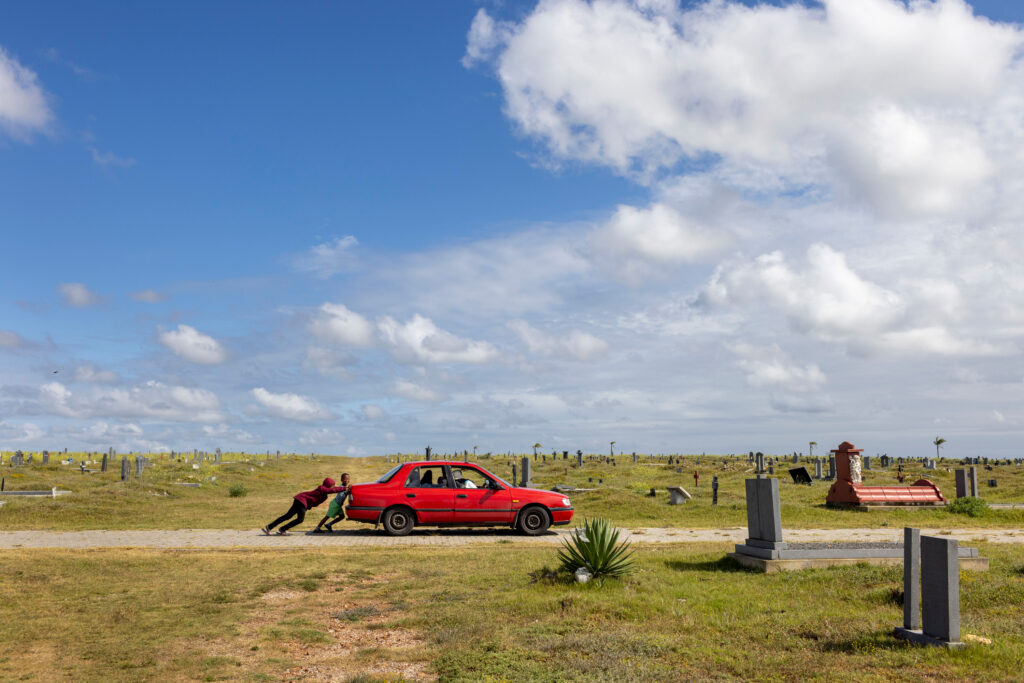
1900–1994: The Black World’s Hinge
If the founding centuries of settler violence—beginning at Camissa in 1510—sought to answer the “Native Question” by dispossessing indigenous peoples of their land, labor and cattle, the Union of South Africa sought, after the National Party took it over in 1948, to answer it by making the “native” vanish altogether. And in those same years, the Black world rose against the country, making it the hinge of twentieth-century Black internationalism.
It began with independent Black churches, founded after the end of Black sovereignty in late nineteenth-century Southern Africa. From down in the furnace of the Mineral Revolution, where Black men were sent into mines, emerged the Ethiopian prophetic fire of African redemption through Black independency and unity, and the flame leapt across a region of Black peoples facing dispossession and collapse. Psalm 68:31 was its text: “Princes shall come out of Egypt; Ethiopia shall soon stretch out her hands unto God.” In 1892 Mangena Maake Mokone, denied equal standing by the Wesleyan Methodists, walked out and founded the Ethiopian Church in the Marabastad location outside Pretoria. His niece Charlotte Manye Maxeke—the first Black South African woman to hold a university degree, taken at Wilberforce in Ohio, and a founder of the African National Congress—wrote home from Wilberforce about the African Methodist Episcopal Church, Black-led and self-funded; in 1896 the two churches agreed to merge, and by 1898 an AME bishop was ordaining ministers in Cape Town. Mokone founded his in November 1892; Rhodes’s company took Lobengula the following year. With every sovereign Black polity south of the Zambezi destroyed, the church became the one institution Black people could still establish and control—and it spread like a tidal wave across Southern Africa, inspiring the founding of the African National Congress in 1912, a conference an AME reverend opened as chaplain and that was heralded as a watershed in African regeneration, hastening the day when “Ethiopia would stretch forth her hands unto God, and when princes shall come out of Egypt.”
The fire had already crossed the water. Although the South African War prevented any South African from attending, more than half the papers presented at the first Pan-African Conference addressed the “South African native question.” The Conference’s own Report records that the meeting was brought about in part by concern over “the Matabele and Bechuanaland wars” and “the compound system in vogue in the mining district of South Africa.” Its delegates petitioned Queen Victoria against the compound system at Kimberley, against the indenture they called “legalized bondage of African men, women and children to white colonists,” and against “the ‘pass’ or docket system used for people of colour.” The first gathering of the Black world put South Africa’s anti-Black migration regime on trial—and did so without a single South African in the room.
Then it came back. Cape Town, as Victoria Collis-Buthelezi has shown, was a nexus for Black people from across the British Empire—a central node for global Black political ambition. Following the Pan-African Conference, Henry Sylvester Williams came to the Cape in 1902 and became the first Black person called to its Bar. Following it too came Francis Peregrino—born in Accra to the family of a woman who had been enslaved and trafficked to Brazil—founded the Cape’s first Black newspaper, the South African Spectator, on the anniversary of emancipation. And Clements Kadalie came from Nyasaland, present-day Malawi, by way of Mozambique and Southern Rhodesia. Garveyism had reached the Cape by sea—Robert Trent Vinson traces the earliest UNIA chapters in South Africa to the West Indian–American Association, made up of Caribbean and American sailors who had found work on the city’s docks—and in January 1919 Kadalie founded the Industrial and Commercial Workers’ Union among the men who had carried it, largely Coloured and Caribbean sea workers, before it exploded into South Africa’s first Black mass movement, with branches across Southern Africa and a membership between a hundred thousand and a quarter of a million, transforming the region’s labor politics for a generation.
The settler states understood the fire and moved against it. Since the AME had arrived in Rhodesia with Black South African migrants in 1900, Rhodesian authorities banned, deported, harassed, and detained its ministers, just as their South African brethren had done since the merger of 1896. Most Ethiopianist leaders preached self-help, the Protestant work ethic and bourgeois respectability; they were persecuted anyway. After the 1906 Bambatha Uprising, the Rhodesia Herald reported: “Ask the man in the street what is the cause of present native unrest throughout South Africa, and he will unhesitatingly reply, ‘Ethiopianism.’” And in 1909 the South African Native Races Committee set down what the Union was to be built against: “This close connection between the Ethiopians and the negroes of the Southern States is viewed with grave misgiving by many South Africans, who fear that, by stimulating the spirit of racial jealousy and exclusiveness, it may have a sinister influence on the future of South Africa.”
The Union of South Africa feared the Black Atlantic and legislated against it. The Immigrants Regulation Act of 1913 barred anyone deemed unsuitable “on economic grounds or on account of standard or habits of life”—a clause that named no race and needed none. As Vinson shows in The Americans Are Coming! Dreams of African American Liberation in Segregationist South Africa, it had already become standard policy to deport Black Americans living in the country and to refuse entry to any Black person arriving from abroad; when the Department of the Interior turned back two Black American missionaries at Cape Town in 1917, it explained that “under a Ministerial order, no coloured person is permitted to land in the Union of South Africa.”
Black people on both sides of the Atlantic—the freedpeople of the American South betrayed at the end of Reconstruction, the West Indians of an empire that would not make them citizens, the “natives” of a Union about to write them out of its constitution—had all been refused citizenship by the nation-state, and each had discovered separately that no nation was going to give it to them. So they refused to let the nation-state confine the horizons of their political imaginations. It was this structural foreclosure of Black citizenship, both within the nation-state and within empire, that fostered the global Black solidarity and political vision of the turn of the twentieth century.
The Black world was never coming to South Africa. It was always in it. And South Africa was clamping down on it from the beginning, because South Africa was constituted by anti-Blackness—not a country that later became racial, but a structure built on the negation of Black independence, and everything it has done since has been the maintenance of that structure. What the Union could not defeat by statute, it set about defeating by category.
A state that exists for some and not others must first decide who is who. The Union did not inherit a population; it manufactured one. Through the census, the statute, and the pass, it produced the very racial subjects it would then rank: the “European,” the “native,” the “Coloured,” the “Asiatic”—categories with no existence in nature, invented and policed so that rights, land, movement, and labor could be apportioned, and fixed in law by the Population Registration Act of 1950, and entered in a register. To be South African was to be assigned a race and issued a life calibrated to it. Personhood became a function of classification: the state decided not merely what you could do but what kind of person you were permitted to be.
Then, in 1964, the word itself went. Through section 100 of Act 42, the state substituted “Bantu” for “native” wherever it occurred in the statute book. One clause deleted the indigenous from South African law. The settler historiography then decreed that Bantu-language speakers—nearly eighty percent of the population—had crossed the Limpopo at precisely the moment the Dutch landed at the Cape, so that, as the Afrikaner nationalist project came to put it, “we are all settlers.” Black people rejected the term and knew exactly why it had been chosen. As the newspaper Bantu World explained in a September 1949 editorial: “The Government wants Africans to be officially known as ‘Bantu,’ and neither as ‘Natives’ nor ‘Africans.’ One University professor objects to ‘African’ because it makes the Black folk so patriotic as to say of Africa, ‘This is my own, my Native Land.’”
From people to places, Bantu then came to mark both everyone and every place that was non-South African. The Promotion of Bantu Self-Government Act of 1959 declared that South Africa contained not one nation but several—“Bantu national units,” each entitled to its own self-governing territory—and the Bantu Homelands Citizenship Act of 1970 made every Black South African the citizen of one, assigned by the ethnicity the population register had given them, whether or not they had ever set foot in it: Transkei and Ciskei for the Xhosa, Bophuthatswana for the Tswana, KwaZulu for the Zulu, Venda for the Venda, Lebowa for the Pedi, Gazankulu for the Tsonga, QwaQwa for the Southern Sotho, KwaNdebele for the Ndebele, KaNgwane for the Swazi. Ten nations on thirteen percent of the land, for three-quarters of the population, their boundaries drawn on ethnic lines defined by white ethnographers—one people, the Xhosa, receiving two of them, which tells you what the national principle was for. Black South Africans called them Bantustans.
The state was doing at home what it had been doing at the port. Since 1913 it had refused entry to any Black person arriving from abroad; now it manufactured ten abroads inside its own territory, so that the Black majority could arrive from somewhere else without ever having left. The Immigrants Regulation Act and the Bantu Homelands Citizenship Act are the same instrument at two scales—one keeping the Black world out, the other keeping the Black nation from ever having been in.
Bantu became the spatial marker of foreignness. The 13 percent that the 1913 Natives Land Act had left as “native reserves” became the “Bantu homelands”—the irony of the word. South Africa declared the barren, overcrowded fraction it had already reduced them to the true home of the Black worker it permitted, temporarily, into its cities.
The sleight of hand was complete. In 1867 the Cape had deemed a man born in King William’s Town a foreigner unless he held a certificate. A century later the Republic of South Africa had built ten countries so that no Black person needed deeming at all: their foreignness was now a fact of geography, written into a map the state itself had drawn. After four centuries, South Africa had resolved the native question by abolishing the native.
By the time the long-standing rejection of the Bantu Education Act erupted into the Black Consciousness Movement’s June 1976 Soweto Uprising, which brought global attention to the apartheid regime, the word “Bantu” had become politically untenable. The Black Laws Amendment Act of 1978 substituted “Black” for “Bantu.” One law passed in 1953 to govern African workers accordingly carried three names in twenty-five years—Native, then Bantu, then Black—while the men it governed and the work it compelled stayed exactly where they were.
And so, in apartheid South African legislation, Blackness became the antithesis of nativeness and indigeneity. “Native” is a claim on a place. “Bantu” was invented to deny that claim. “Black,” in the statute book, was to be neither: not a claim on any place at all.
But Black was not the South African state’s word to take. Long before the state reached for it, the indigenous peoples of the land had been claiming Blackness for themselves. As I show in my forthcoming book, The World Is Dead: Ubuntu as an Ethics of War and Conquest under the Nine Wars of Dispossession, 1779–1879, this naming ran through the nineteenth century. By 1914, the great Xhosa poet S.E.K. Mqhayi could set it down plainly in Ityala Lamawele, the first isiXhosa novel, under the heading Inkqubela Phambili, “Progress”:
Singoobani na? — Thina bantu bamnyama bale Afrika iseZantsi sithe kule minyaka ikufuphi nje sazifumanela igama lokuba “Silusapho lukaNtu.” Uya buza ke omnye uthi: “Ngubani na uNtu?” Impendulo ithi: Zonke ezi ntlanga zikule Afrika iseZantsi, noko zingadibeneyo ngentetho zidibene khona ngeli gama lokuba umntu ngumntu.
[Who are we? We, the Black people of South Africa, have said in recent years that we found a common name for ourselves, which is: we are the Family of Ntu. Another will ask and say: Who is Ntu? The answer is: all of these Black nations in South Africa—although they are not united by language, they are united by the word that identifies umuntu as umuntu.]
What Black South Africans had made the name of their shared humanity across every linguistic border, apartheid pluralized into Bantu and turned into the legal category of their dispossession—and then used the very language differences Mqhayi had dismissed to cut ten separate countries out of them.
Biko and the Black Consciousness Movement inherited this unifying claim to Blackness. They made Black the name Black people collectively and politically gave themselves—a state of mind, as Biko had it, and a state of solidarity against the balkanizing of Bantustans and the tribalization they enforced. Black Consciousness drew its political theology from all over the Black world: the uprising spirit of the nineteenth-century Xhosa prophets uNtsikana ka Gaba and Makhanda ka Nxele; Ethiopianism; Marcus Garvey’s Back to Africa movement; the African nationalism of Anton Lembede, founding president of the ANC Youth League, and of Robert Sobukwe, who founded the Pan Africanist Congress; the African humanism of Zambia’s Kenneth Kaunda and the Ujamaa of Tanzania’s Julius Nyerere; the négritude of Martinique’s Aimé Césaire and Senegal’s Léopold Sédar Senghor; the revolutionary nationalism of Frantz Fanon and Malcolm X; Kwame Ture’s Black Power; James Cone’s Black liberation theology and John Mbiti’s African theology. The state adopted the Black Laws six months after killing Biko in police custody in September 1977.
The apartheid state understood the danger Black solidarity posed to South Africa precisely: it is no coincidence that the immediate cause of the longest terrorism trial in the country’s history was the Black Consciousness Movement’s solidarity with Mozambique’s liberation movement. In September 1974, celebrating FRELIMO’s victory over Portuguese rule, SASO and the Black People’s Convention held Viva FRELIMO rallies in Durban and at Turfloop in defiance of a police ban. Thirteen were arrested. Nine were charged under the Terrorism Act, and their trial ran from January 1975 to December 1976, at the end of which all nine went to Robben Island. Not for the first time since it had banned and jailed the leaders of the Ethiopian movement, the settler state put Black solidarity itself on trial. Young Black South Africans went to prison for cheering Mozambique.
And the solidarity only grew. Within a decade the whole Black world was answering. The Frontline States—Mozambique, Angola, Zambia, Tanzania, Botswana, Zimbabwe—took the exiles, housed the camps and absorbed the raids, and Pretoria bombed Maputo and Maseru and Gaborone and Harare, armed RENAMO and UNITA, and wrecked two economies. The countries around South Africa were ruined so that South Africa could be free.
The diaspora had answered earlier than the periodization usually allows. On 2 July 1959 the Daily Gleaner ran the front page: “Jamaica bans South African goods.” Norman Manley’s government called apartheid revolting to the conscience of decent people. Jamaica was still a colony, with no responsibility for its own external relations—the first polity in the Black Atlantic to impose an embargo, and the first anywhere to do so without the sovereign standing to do it. The London Boycott Movement had held its first meeting six days earlier. Barbados, Grenada and Dominica followed within the month. And after Soweto it became a mass movement in the United States. TransAfrica was conceived in September 1976 at a Black Leadership Conference convened by the Congressional Black Caucus, and founded the following July. On 21 November 1984 Randall Robinson, Mary Frances Berry, Eleanor Holmes Norton and Walter Fauntroy refused to leave the South African embassy in Washington until their demands were met; by the end of 1985 more than three thousand people had been arrested in the protests that followed. Congress passed the Comprehensive Anti-Apartheid Act over Reagan’s veto on October 2nd 1986. The Special AKA released “Nelson Mandela” in March 1984, the Sun City album followed in 1985, and in June 1988 the concert at Wembley was broadcast to sixty-seven countries and six hundred million people.
South Africa concentrated the mind of the Black world because it made the arrangement legible. While apartheid stood, Africa and the diaspora could see that their fortunes were one thing. When it fell, they stopped being able to see it. And then South Africa was admitted to the liberal international order that had watched all of this—on terms: the vote in exchange for the land. This is what 1994 delivered to the Black majority: citizenship without land, which is to say citizenship without sovereignty. The Natives Land Act of 1913 allotted the Black majority seven percent of the country, raised to thirteen in 1936. In 2017 the state’s own land audit found that of individually owned farmland, white South Africans—seven percent of the population—held 72 percent, and African South Africans—81 percent of the population—held four. A century on, by this measure, the majority holds less than the Land Act gave them. In other words, without a reversal of Black landlessness, Black people remain what conquest made them. Non-sovereign. Foreign. The vote did not restore the land, and a people who do not hold the ground they stand on hold nothing a state is made of.
The negotiated transition delivered a political settlement without an economic one: the franchise changed hands and the structure did not. That South Africa can be at once a multiracial democracy and the world’s most unequal society is not a contradiction the country has failed to resolve. It is the original 1910 sentence—the state is for some and not others—surviving the fall of the regime that first spoke it. The legal answer to who belongs was rewritten; the material answer was left standing. Plaatje’s pariah is still a pariah in the land of his birth.
And it was this nominal citizenship, more than any defeat, that dissolved the solidarity the settler state had never managed to break. Independence turned out to be a short century. The promise was cut down one leader at a time: Lumumba shot in 1961, Malcolm shot in 1965, Nkrumah deposed in 1966, King shot in 1968, Bishop executed in 1983. What Pan-Africanism had imagined as Black sovereignty arrived instead as a flag, a seat at the United Nations, and an economy someone else still owned. Nelson Mandela’s release in 1990 looked like the culmination of a century of Black solidarity. In fact, it marked its end. The horizons of our Black political imaginations shrank from Pan-Africanist visions of self-determination to citizenship within the nation-state.
A citizenship that confers no material claim leaves its holder only one thing that is genuinely and exclusively theirs: the right to exclude somebody else. And so, as predatory racial capitalism spread scarcity across the globe, it set Black against Black in a desperate clamor for the crumbs of citizenship within the nation-state. And there is worse. To be incorporated as a citizen in South Africa is to inherit the fear of the Black person that constituted its making. The 1994 settlement admitted the Black majority to a citizenship that had been built out of a fear of them, and left the fear in place.
And so it was that fourteen years into the post-apartheid, in the winter of 2008, a crowd of men in the Ramaphosa settlement east of Johannesburg beat Ernesto Nhamuave, a Mozambican, doused him in gasoline and set him alight. That year more than sixty people taken to be “foreign” were killed and tens of thousands were driven from their homes. It was not an aberration. Seven hundred and three people have been killed in xenophobic incidents since the end of apartheid. The killings returned in 2015 and in 2019, and in smaller waves almost every year since. What had looked like an eruption hardened into an institution.
Operation Dudula (“to force out”) was founded in Soweto in 2021 and registered as a political party in 2023; March and March followed in 2025. They patrol workplaces and turn the sick away from clinic doors demanding papers. In July 2025 a one-year-old Malawian boy died in Alexandra after Dudula members refused him entry to two clinics because his family had no South African identity document. In November a court ordered them to stop. In April 2026 they marched through Tshwane and Johannesburg with a former mayor of Johannesburg at their side, and set 30 June as the date by which every undocumented person was to be gone. In June the President announced a crackdown and fast-tracked deportations. Local elections are due in November.
The people killed and driven out are, almost without exception, Black Africans and South Asians. It is filed under xenophobia, but the name is a euphemism, and the euphemism does work: the violence does not fall on the German engineer, the British expatriate, or the American executive. It falls on the Zimbabwean, the Mozambican, the Malawian, the Somali, the Nigerian, the Congolese—the “makwerekwere,” in the slur, the supposedly unintelligible foreign African—on the Pakistani and Bangladeshi shopkeeper—and on dark-skinned South Africans, Venda or Tsonga or Shangaan, whose complexion or accent marks them as insufficiently national.
This is the anti-Blackness foundational to South Africa announcing itself. The state was constituted against the Black person, and four centuries later the violence still finds its way to the same body—now in the street rather than the statute book, and now at the hands of Black citizens rather than white ones. The accurate word is therefore not xenophobia, but Afrophobia: not a general fear of foreigners but a specific reflex against the Black African.
The temptation is to read Afrophobia as a failure of solidarity, Africans forgetting that they are kin, the poor turning on the poorer. But it is not a failure of feeling. It is a fact about the structure of sovereignty, and about how sovereignty was made. The ready answers—poverty, joblessness, a broken economy—are true, but they are not enough. They name the fuel but do not explain the fire: why it runs along the line of the Black foreigner and never the white one, why belonging in a free Black nation should be rationed at all, in gasoline and passbooks and the demand for papers. The Black Africans hunted through the streets of this democratic country are the descendants, juridically and imaginatively, of the “native” the Union manufactured as disposable in 1910. Afrophobia is the afterlife of that operation. The pass has become the demand for papers; the compound has become the burning barricade.
South Africa does not have a monopoly on Afrophobia. Across the post-independence Black world, wherever Black people were admitted to a citizenship that gave them nothing material, they were sooner or later set against other Black people. It is no small irony that the twentieth century’s most important Pan-Africanist was deposed three years before his country began expelling Africans en masse. Ghanaian traders and chiefs had pressed for it throughout Nkrumah’s rule, and Nkrumah, who deported his own political opponents readily enough, would not give them the mass expulsion they wanted. A CIA-backed coup removed him in February 1966. On 18 November 1969, as the cocoa price collapsed and youth unemployment rose, Kofi Busia’s Aliens Compliance Order gave undocumented immigrants a fortnight to leave. Some two hundred thousand went, most of them Nigerian. Nigerians called it Nigeria Must Go. Fourteen years later, as the oil boom collapsed and tanked the Nigerian economy months before an election, Shehu Shagari expelled some two million West Africans, most of them Ghanaian — “Ghana Must Go,” a phrase now attached, without irony, to the cheap woven bags people flee with. Nigeria had signed the ECOWAS protocol on free movement four years earlier. In 2013 the Dominican Republic’s highest court retroactively stripped citizenship from roughly two hundred thousand Dominicans of Haitian descent, creating the largest stateless population in the Americas. And in the United States, four decades after the Voting Rights Act, the African Descendants of Slaves movement offers a narrow nationalism as the answer to real labor-market disparities between African Americans and Black immigrants.
This is what the two hinges tell us — the South Africa whose war convened the 1900 Pan-African Conference, and the South Africa where apartheid’s end in 1994 collapsed the global Black solidarity it had made. Denied citizenship in empire and nation-state alike at the turn of the twentieth century, Black people looked across the borders and reached for each other. That came apart once we were admitted into the nation-state — into citizenships that gave us a vote and no ground to stand on, and left us competing for the crumbs the nation could offer. Afrophobia is not a failure of solidarity. It is a function of the change in our structural position when the foreclosure of national citizenship that had produced our international solidarity was lifted, and nothing material was put in its place. In a word, Afrophobia is structural, not sentimental.
South Africa is the sharpest instance of what citizenship without sovereignty does because its inequality is the most obscene and its liberation the most recent and the most betrayed—but it is an instance, not an aberration. That makes it worse, not better. It means the problem is the form. The nation-state does not merely tolerate an outsider; it requires one that it can name as not-the-nation in order to feel like a nation at all. And the deepest, most portable name for that disposable outsider is Blackness. This is why anti-Blackness gives the nation-state its coherence even where there are almost no Black people to be found.
Race has always been the grammar of standing. It is what the Indian elite grasped when it consoled itself that it was, at least, not Black. It is what Japan confronted at the founding of the League of Nations, when it fought and failed to have racial equality written into the covenant—the same League that encoded racial hierarchy into the mandate system, sorting the world’s peoples into the sovereign and the wards “not yet able to stand by themselves.” And it is what Ethiopia discovered in 1935, when a sovereign African member of the League was invaded by another, because African sovereignty had never been recognized as the real thing.
Race is sovereignty. At the scale of the world it fixes the African, and the African nation, as the ultimate non-sovereign—the ground of unbelonging against which every other claim to standing is measured, the raw material from which citizen and alien are everywhere cut, the disposable outside that consoles and coheres all nationalisms alike. It is why the same logic can run in a white-minority settler state and a Black-majority republic, in Pretoria and Accra and Santo Domingo alike. The perpetrator changes. The target does not. Afrophobia is simply the name that reflex takes when the hand that strikes is itself Black.
2026: A New World Beyond the Limit
William Shoki’s essay offers a powerful and sophisticated reading of all this, which takes the crisis to be internal to the post-apartheid nation-state. He argues that the political order built in 1994 has ended, that anti-migrant politics is the first mass politics native to the period that has succeeded it, and that its engine is an economy which has turned from producing goods to allocating scarcity, so that the first question in every contest becomes not the worker’s against the boss but the claimant’s against the claimant. The question is who may stand in the queue.
Much of this I share: “Afrophobia” is indeed a euphemism; “the migrant” is manufactured as a category to carry grievances that are not his doing; the anger and violence denied its true object upward, is turned downward and sideways, as Fanon said; and the cheap-labor machine is the ground beneath all of it.
But the account is limited in two directions. Spatially, it is national to its foundations: it reads the crisis inside the borders of one country and looks for its causes and its remedies there. Temporally, it is captured by what I have called the apartheid paradigm—the assumption that South Africa’s racial order begins with the National Party’s victory in 1948 and ends with the franchise in 1994; that apartheid was an aberration within an otherwise ordinary modernity rather than the intensification of a structure already complete in 1910 and four centuries in the making; and that dismantling it therefore completed the work of liberation. The two limits are one limit. A crisis read from 1948 forward can only be read within the nation, because the nation is what 1948 and 1994 are about. Push the frame back to 1652, or 1510, or 1492, or 1441, and the nation is no longer the unit of analysis.
As Shoki’s account shows, the apartheid paradigm rests finally on Mahmood Mamdani’s contention that settler and native are political identities the colony made by law and set against each other, and that what political effort made, political effort can unmake—which is what 1994 nobly tried to do. In his account of the global political economy’s making of those categories, Mamdani is right to move political modernity’s birthdate back from 1648 and Westphalia to 1492, following Sylvia Wynter to the “discovery” of Hispaniola and the Alhambra Decree’s expulsions. But Mamdani, too, inherits Smith’s silence on the enslaved. He stops short of the trafficking in enslaved Africans that preceded 1492 and licensed everything after it: Antão Gonçalves seizing the first captives off the Mauritanian coast in 1441; the opening of the commercial slave market at Lagos in Portugal in 1444; and the papal bulls that authorized the whole design—Dum Diversas in 1452, Romanus Pontifex in 1455—all before Columbus ever sailed. The papal authorizations of conquest, the birth of the transatlantic trade and the “discovery” of the New World are a single interlocking architecture, and Blackness bound to slave-ness was its foundation.
This is why Blackness bound to slave-ness cannot be unmade inside a nation. We saw the mechanism at the Cape: the pass followed landlessness and non-sovereignty. The Khoe were released from it in 1828 precisely because nothing further remained to be taken from them; amaXhosa were subjected to it because they still held their land. Sovereignty and the paper were always the same question. Blackness bound to slave-ness is the ground the colony was built on across the long fifteenth century, before a settler and a native were ever set against each other, structuring the modern world at the scale of the society of states and not the single colony. And Mamdani’s own founding insight turns against his optimism: the modern state was born through the act of creating an outsider. Which is why the migrant at the barricade is not the survivor-nation’s demographic afterthought but the constitutive outsider returning—and the proof that the unmaking, if it comes at all, must come at the scale the nation was built to foreclose.
There is also, at just this point, another confident answer waiting, argued recently with real force by the political economist Ken Opalo. “So far the rainbow nation has been a sterling example of reconciliation and peaceful decolonization,” he writes. “Now the hard work of doing normal bare-knuckle pro-growth politics must begin.” The post-apartheid innocence is spent; migrants are not the cause of South Africa’s misery, the lack of broad-based growth is; and South Africa “can and must escape the small-minded politics of redistribution (either for or against)” and become the gateway to Africa.
On one thing Opalo is right: the migrant is not the cause. But every other clause is offered as “maturity,” and every other clause mistakes the disease for the cure. Begin with “peaceful decolonization.” Nothing beyond the vote was truly decolonized. Opalo half concedes it himself, writing that “mostly white South African beneficiaries of colonial expropriation (especially of land) and apartheid-era state largesse kept their property … while the Black majority took a bet on future growth.” That is not decolonization. It is a wager the Black majority was required to make and has lost, and the land audit is the evidence.
Take the argument on its own chosen ground and it collapses. By the growth advocates’ own figures, South Africa has run a growth-first strategy for three decades—real growth averaging some 2.3 percent, per-capita income flat for a decade—and it holds first place among the 164 countries in the World Bank’s database of Gini coefficients (measuring inequality). Thirty years of growth has not touched the wealth distribution. This is not an argument for more of it. It is the proof that output raised on top of the racial-capitalist arrangement cannot reach the people the arrangement is built to discard, because their disposability is structural and not a shortfall of GDP.
Look, too, at what “become the gateway to Africa” actually asks. It asks for the free movement of South African capital northward—for South African firms to muscle into African markets, take the contracts, own the supply chains, as Opalo’s admired Turkish competitors have done. The continent is being integrated for goods and for capital—the free-trade area advances, the firms cross freely—and sealed for people: the companion protocol on the free movement of persons, drafted in the same years, sits barely ratified and not in force. Capital may cross the border; labor is set alight at it. And it is not languishing for want of political will. It is the one protocol the order cannot honor, because the order was built on the non-recognition of Black bodily and territorial sovereignty, and the free movement of Black labor is exactly the recognition it was constituted to withhold. Afrophobia is the violent domestic enforcement of that settlement, and “gateway to Africa” is its boardroom form—the same hierarchy, the continent as market to be captured rather than kin, expressed in a share price rather than a match.
So the redistribution the growth-first consensus refuses is not a vague leftism. It is specific, and it has a name: land. Until the figures I have given are reversed, the reserve army remains a reserve army, and the Black foreigner remains a rival for a wage the structure has deliberately kept scarce. Against every appeal to kinship and every workshop on tolerance, the man with the match and the man whose shop he burns are not failing to love one another. They are being set against each other over a livelihood that has been manufactured scarce, by a structure that profits from their enmity and would profit from their reconciliation not at all. To ask them for feeling is to wave at the smoke. The fire goes out when the scarcity is undone. Redistribution at national scale is not merely resisted in South Africa. It is foreclosed, structurally, by the global order.
Across the region the liberal international order subverted the land question through the protection of ill-gotten property rights, and in so doing ratified centuries of settler colonial conquest in constitutional law. Zimbabwe’s Lancaster House constitution of 1979 bound the new state to willing-seller-willing-buyer for its first decade. Namibia’s was drafted in Windhoek, but on principles the Western Contact Group—the United States, Canada, Britain, France and West Germany—had written in 1982, eight years before Namibians voted; SWAPO won that election with 57 percent, just short of the two-thirds it would have needed to revise them. And South Africa’s property clause was drafted by the de Klerk government in 1991 and carried intact into 1994’s settlement. In every case the land was locked into the market by the document that founded the nation. When the post-apartheid state at last reached for it, it reached through the World Bank’s own instrument, the willing-seller-willing-buyer model, which converted the undoing of conquest into a market transaction at market prices and guaranteed, by design, that little would move.
This is the racial corporation’s last and most elegant form. The VOC took the Cape by charter and kommando; Rhodes’s British South Africa Company took the land north of the Limpopo by charter and by force. Each conquest was then held in place by statute. The liberal international order needed neither charter nor gun, because it had only to declare that what four centuries of war had seized was now property, and that property was a right the new Black state was bound to respect. The company-state had always been capital vested with sovereign power. What the settlements of 1980, 1990 and 1994 delivered was not the transfer of that state to Black majorities. It was the transfer of its administration. The flag changed and the franchise changed; the corporation did not. Which is why a foreign president can summon a South African head of state to Washington, lecture him on the treatment of white farmers, offer them refuge as persecuted men, and threaten the country’s economy over an expropriation act that has expropriated nothing. A sovereign state cannot be summoned. A subsidiary can.
Njabulo Ndebele named the mechanism in his 2000 Steve Biko Memorial Lecture: the global sanctity of the white body, the international whiteness under which any violation of white persons or white property draws down a retribution that Black dispossession never will. The nation, in this order, is precisely the container within which the land cannot be given back.
Which turns the conclusion inside out. If the redistribution that would end Afrophobia is land, and if land cannot be returned inside the nation because the global order forecloses it there, then Black internationalism is not the sentimental supplement to a material program. It is the material program’s only available scale. The solidarity the settler state feared in the Ethiopian churchman, and put on trial in the SASO Nine, was never a mood of continental fellow-feeling. It was, and is, a political economy: the pooling of sovereignty at the scale where livelihood is actually determined, so that self-determination might have economic content and not merely a flag—the ambition of the federal moment that Adom Getachew recovers, of the West Indian Federation and the mooted Union of African States in Worldmaking after Empire: The Rise and Fall of Self-Determination (2019). These were defeated, by metropolitan self-interest and by the gravitational pull of the sovereign form, and their defeat is precisely why the land could then be foreclosed nation by nation, each small enough to be told to wait.
The national scale is foreclosed structurally and by design—the nation is a container built precisely so the land cannot be returned. The continental scale was foreclosed contingently and by force: the global order did not build the federations of the independence era to fail; it had to defeat them. That distinction is the hinge. The larger scale is not immune to foreclosure, but it is the only scale where foreclosure requires the constant, violent exertion of imperial power rather than the mere administrative inertia of the state. It is precisely there—in the shared numbers and material interests of the discarded—that we find the leverage the nation was engineered to starve.
The thing being integrated is capital; the thing being burned is labor; and a serious politics integrates people and redistributes at the scale where the racial-capitalist distribution was set. The levers already exist, half-built and starved: the stalled protocol on the free movement of persons; the fights over regional redistribution and social policy; the possibility of pooled rather than competing industrial strategy, so that the continent stops being a set of small economies bidding down each other’s labor. And the agent is not the elite the growth-first consensus trusts to choose wisely, nor the change of heart the tolerance workshop hopes for, but the constituency with a material interest in exceeding the nation-form: the migrant and the unemployed citizen who are being spent by the same structure.
What South Africa is cannot be separated from who it is for, because the structure was built by making the persons: the white citizen and the Black laborer, the belonger and the prohibited, invented together in a single Act of Union. And this opens not the question of who belongs and who must be expelled, but the question of whether the nation, in its particular, recent, ravenous form, is the only house we were ever going to be permitted to build. This is why South Africa is the miniature and not the exception. The burning at the barricade is not a South African disease; it is global Afrophobia made legible at readable scale, shown here in a single frame because South Africa, alone among modern states, wrote it down. Its crisis is the world’s crisis brought close enough to read, and its cure—the land, returned at the one scale the order cannot foreclose by form alone—is therefore the world’s cure, not a local repair. The refusal that would make it possible is not new. It is as old as the imposition. It began on the shore of Camissa in 1510, when the Goringhaiqua drove the order back into the sea at its inception, and it has never once ended. Beyond that limit is the work.