Obfuscations of Populism
We might call the last ten years since 2016 the “populist decade,” not so much because it was actually dominated by the real phenomenon of populism, as many imagine, but because of the way in which the term itself has dominated our political debates. In my view it has also distorted them. In particular, the concept of “populism” has largely displaced the term “far right” in mainstream media and policy debates—that is, far-right figures, movements, and parties were no longer described as such, but rather as “right-wing populists.” Yet instead of helping us understand the far right, this has created confusion about what it actually is—in particular, it has shifted the focus away from its policy positions to its political style, as if that were its essence.
This displacement of the concept of the far right by “populism” in mainstream media and policy debates obscured the way the far right was evolving, at least in Europe, during the last decade. The former Hungarian prime minister Viktor Orbán had long seemed to embody what was often called the authoritarian or populist “playbook.” But by the early 2020s, he had been replaced as the paradigmatic figure of the European far right by Giorgia Meloni. She was clearly a far-right figure—indeed her party, Fratelli d’Italia, had a genealogy that went back to the original fascist party.1 But because she does not seem to embody many of the characteristics that had come to be identified with “populism”—in other words because she does not follow the “playbook”—many analysts no longer think of her as far right at all.
The consequence of these two developments—the shift in terminology away from “far right” to “populism” and the evolution of the European far right away from the Orbán model—has been to mainstream far-right rhetoric and policies on immigration. Since the refugee crisis in 2015, centrist parties in Europe have mimicked the far right, adopting their language and policies, in a desperate attempt to win back voters. But the confusion about what the far right is, created by the concept of “populism,” has apparently made it hard for many people to see that this is what they are doing. As long as it is not done in a “populist” way, an approach to immigration that would once have been instantly recognizable as far right is now seen as moderate, sensible policy.
The political functions of “populism”
During the last decade, the term “populism” has been used in all kinds of ways. Academics like Cas Mudde and Jan-Werner Müller came up with tight definitions of “populism,” which centered on rhetoric that contrasted the idea of a pure people with a corrupt elite. Meanwhile, figures on the far left (like Chantal Mouffe) and the far right (like Steve Bannon) used the term in a looser but more positive way: roughly in opposition to elitism. But in the mainstream media and policy debates, the term was simply used as a synonym for far left and far right alike—in other words, in opposition to centrism. While there has been much debate about how the term should be used, there has been less analysis of how it has actually been used in practice—that is, what its political function has been during the last decade.
Looking back over the last decade, it seems to me that, in mainstream media and policy debates, the concept of “populism” has had two functions. First, the term was central to a reframing of politics around the idea of a struggle between liberalism and illiberalism – a conflict that was widely seen as being more significant than, or even having replaced, the traditional left-right divide. The term suggested the far right and the far left were similar in important ways, or even identical—in other words it revived the “horseshoe theory,” which held that the far left and the far right were closer to one another than either was to the political center. Thus in equating far right and far left, the concept of populism has played something like the role that the concept of totalitarianism played during the Cold War.
This function of the concept of populism was especially important in the first half of the 2010s, during the euro crisis. Radical left-wing parties were then emerging in Europe’s debtor nations: Syriza was founded in Greece in 2012 and came to power in 2015; Podemos emerged in Spain in 2014 from the anti-austerity Indignados movement. Centrist parties saw these far-left parties as a threat to themselves and to the stability of the euro and by extension to the EU itself, as the German Chancellor Angela Merkel suggested when she said that “if the euro fails, Europe fails.” Equating them with the far right through the concept of populism was a good way to attempt to discredit them.
The second function of the concept of populism, which became more important in the second half of the 2010s, was to allow the center right to differentiate itself from the far right even as it began to mimic it and adopt its rhetoric and policies, especially on issues around identity, immigration, and Islam—what political scientists call a strategy of accommodation. After the refugee crisis in 2015, far-right parties in creditor nations in Europe like the Alternative für Deutschland (AfD) in Germany—which during the euro crisis had opposed bailout packages for debtor nations and the idea of a “transfer union”—increasingly focused on these issues. Meanwhile, support for far-right parties also surged in debtor nations like Greece and Spain, while radical left-wing parties declined.
The European People’s Party (EPP), the center-right group in the European Parliament, pursued a clear—and increasingly openly articulated—strategy of adopting far-right positions on these issues through which right-wing parties were increasingly defining their profiles. At the same time, however, it was important for these center-right parties to convey the impression that they were fundamentally different from such far-right parties or, by reframing politics as a battle between liberalism and illiberalism, to suggest they were the antithesis of the far right. Center-right parties expressed sympathy with the far right’s policy positions, but opposed its “populist” style.
Whatever the value of the term “populism” as an analytical concept, when it was used in the tight way suggested by academics like Mudde and Müller, it has functioned in practice as a tool for center-right parties to differentiate themselves from far-right competitors even as they mainstreamed and normalized their politics—that is, as they themselves moved further to the right. In this way, the concept of populism deliberately obscured an important development in European politics in the second half of the 2010s and the 2020s: the convergence between the center right and the far right. Instead, European politics was imagined as a struggle between a clearly defined and stable center on the one hand and the extremes on the other.
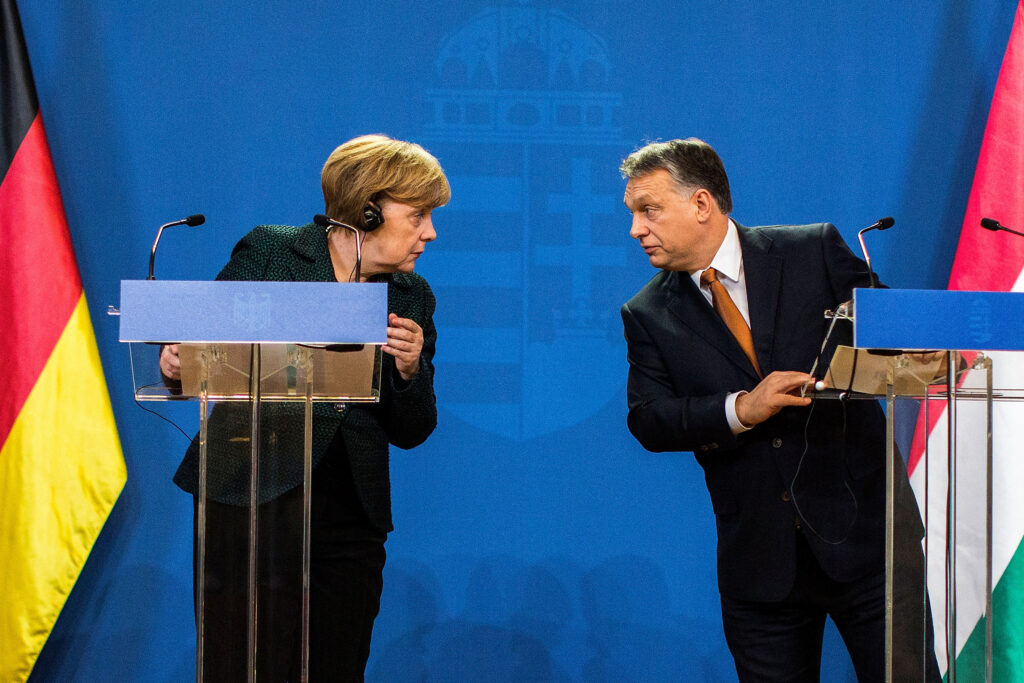
Perhaps the best illustration of this dynamic between the center right and the far right was the somewhat theatrical battle between Merkel and Orbán in the second half of the 2010s. From the time of the refugee crisis in 2015, they were widely imagined as political opposites: Merkel as the figurehead of liberalism and Orbán as the figurehead of illiberalism. After the election of Trump, some even imagined Merkel as “the leader of the free world.”2 Yet throughout this period, Merkel’s Christian Democrat party and Orbán’s Fidesz party were both part of the EPP. In other words, far from being political enemies, they were political allies. (Fidesz finally left the EPP in 2021.)
Merkel and Orbán were also more aligned in ideological terms than the liberal/illiberal opposition suggested. Although they disagreed about one specific aspect of immigration policy—the idea of a system of mandatory quotas to “relocate” asylum seekers from one EU member state to another—they were in agreement about the need to do whatever was necessary to stop the flow of migrants to Europe in the first place. Merkel was widely imagined to have “opened Germany’s borders” in 2015, but what actually happened was that she had simply been unable to stop over a million asylum seekers arriving in Germany. In any case, she subsequently negotiated a deal with Turkey that outsourced the management of the EU’s borders to what centrists themselves saw as an authoritarian state.
Merkel and Orbán were also aligned on economic issues. Both spoke the language of “competitiveness”—that is, although Orbán was seen as being illiberal, he was actually quite liberal in economic terms. Underlying this ideological alignment was a shared economic project centered on the German automobile industry, which since the 2000s had increasingly outsourced production to central and eastern European countries in order to regain competitiveness—for example, Audi was the biggest investor in Hungary. As Kyle Shybunko has recently put it, Orbán’s time in power during the 2010s was “defined by an industrialization drive led by integration into German supply chains.”3
What the concept of “populism” did was shift the focus away from the content of politics—the policy agenda that the center right and far right increasingly shared—and towards its form. After 2015, the battle between the center right and the far right increasingly centered on the issue of the rule of law—that is, on the way that Orbán was undermining the freedom of the media and the independence of the judiciary in Hungary. Meanwhile, however, led by European Commission President Ursula von der Leyen, herself a German Christian Democrat, the EU took further steps to stop migrants reaching Europe and framed migration as a civilizational threat to the “European Way of Life.” Orbán was quite right when he said that he had won the argument on migration.4
From Orbán to Meloni
When Orbán was defeated in the election in Hungary this past April, ten years after the Brexit vote and the first election of Trump, it was tempting for some to imagine that the populist decade—in the sense of the real phenomenon rather than the concept—was over. Even though the new Hungarian prime minister Péter Magyar was a defector from Fidesz who largely shared Orbán’s position on immigration and differentiated himself from Orbán mainly by opposing corruption, many centrists hoped that his election showed that, after ten years of madness, people had finally returned to their senses—that is, to centrism. After all, because populism was imagined as a “wave”—another flawed but frequently used metaphor, like the idea of the “playbook”—it must at some point break.5
What this overlooked was that, by the time he was voted out of office, Orbán had long ceased to be the paradigmatic figure of the European far right. He may still be a kind of hero or role model for the MAGA movement in the US—Vice President J.D. Vance even visited Budapest in the days before the election to campaign for Orbán. But in Europe, the far right had already moved on from him. The new paradigmatic figure for the European far right was Giorgia Meloni, who had become Italian prime minister in 2022 and developed a much smarter and more effective way of pursuing far-right policies in the European context that in turn took advantage of how the EU had itself been moving to the right since 2015.
Whereas Orbán had had an antagonistic relationship with the EU, even as his party remained in the EPP, Meloni had a much more harmonious relationship with it and especially with von der Leyen, even as her party remained outside the EPP. (Fratelli d’Italia is part of the European Conservatives and Reformists group in the European Parliament.) Meloni’s relationship with the EU was embodied by the refugee deal with Tunisia that she negotiated on behalf of the EU in 2023, which further developed the model of outsourcing border management created by the EU-Turkey deal.6 The coziness reflected Meloni’s skill—but also how far the EU itself had moved in the direction of the far right on immigration.
It had long been assumed that the EU and the far right were incompatible. But Meloni showed that it is possible to be “pro-European” and far right at the same time—and, conversely, that the EU is capable of accommodating the far right as long as it is not too Eurosceptic. As David Broder put it: “The pro-EU center-right looked at the post-fascist leader Meloni, a longtime proponent of defending Europe from rising civilizational threat, and found her agenda compatible with theirs.”7 Not all European far-right parties have followed the Meloni approach—for example, Germany’s AfD, which has become more popular even as it has become more extreme, is an important outlier. But many others like Marine Le Pen’s Rassemblement National have—a party which could be in power in France after next year’s presidential election. If anything has ended with Orbán’s election defeat, it may just be the European far right’s performatively Eurosceptic phase.
A further factor in normalizing Meloni even though, as Cas Mudde put it, she “has lived her whole life in a truly fascist subculture,” was the war in Ukraine.8 It had been widely assumed that both left-wing and right-wing “populists” were “pro-Russian”—even though some parties that political scientists categorized as “populist”, like the Law and Justice Party in Poland, were clearly anti-Russian. Moreover, the war in Ukraine was itself widely seen as part of, or even as the front line of, the global struggle between democracies and authoritarianism—and support for Ukraine became, as Mudde put it, a “proxy for being liberal democratic.” Meloni was supportive of NATO and, when she became Italian prime minister eight months after the Russian invasion, she immediately indicated that, unlike Orbán, she would not seek to undermine support for Ukraine.
Some analysts think Meloni is simply pretending to be moderate and it is only a matter of time before she follows the Orbán “playbook”—that is, becomes more Eurosceptic and seeks to undermine the rule of law in the way that he did.9 But because she has not yet done so, many commentators argue that we should not think of her as being far right. For example, Gideon Rachman wrote in The Financial Times that what differentiated the far right from the center right was its attitude to democracy: “If a party pushes policies that liberals regard as unpleasant, reactionary or even racist but does that within the framework of democratic politics and the rule of law, the term ‘far right’ may no longer be appropriate.”10 Similarly, John Lloyd wrote that parties should not be called “far right” unless they were “totalitarian.”11
What these takes illustrate is how much confusion the concept of “populism” has created, over the last decade, about what the far right even is. These commentators seem to be unaware that, within the umbrella concept of the far right, political scientists distinguish between the radical right and the extreme right: The radical right pursues far-right policies on issues like immigration but is basically democratic; the extreme right, on the other hand, is anti-democratic.12 This distinction also exists in German law: The Office for the Protection of the Constitution (BfV) categorizes a party as “right-wing extremist” when it represents a threat to the freiheitliche demokratische Grundordnung (“free democratic basic order”).13 (Last year, the BfV classified the AfD as “right-wing extremist.”)
However, many people have now come to believe that we can only call parties far right if they are clearly anti-democratic—that is, if they are extreme right. In other words, it is as if the category of the radical right has disappeared altogether—and the only parties that many now seem to think we can call far right are extreme-right parties. Radical-right parties, meanwhile, have been rebranded as “national conservative”—a term of their own choosing which many centrists have now embraced. Thus what began at the start of the populist decade as a strategy by the center right to borrow from the rhetoric and policies of radical-right parties while differentiating themselves from the parties themselves has now produced a normalization of those parties.
The mainstreaming of far-right thinking
The real-world consequence of the normalization of radical-right parties has been the mainstreaming of their rhetoric and policies, especially on migration. What a decade ago would have been seen as contrary to “European values” is now seen as common sense. Since 2014, almost 35,000 people have died in the Mediterranean—around five times as many as have died on the southern border of the US during the same period.14 In Europe, as the Irish journalist Sally Hayden put it in 2023, mass death has become normal.15 It is important to emphasize that these deaths did not simply happen but rather were the consequence of policy decisions taken by the EU. According to Human Rights Watch, EU policy can be summed up in three words: “Let them die.”16
This common sense is now shared even by center-left parties which, following the example of Mette Frederiksen’s Danish Social Democrats, have concluded that the only way to win back the working-class voters they had lost is to copy the far right’s rhetoric and policies on migration. In 2023, for example, the German Chancellor Olaf Scholz, a Social Democrat, appeared on the front cover of Der Spiegel with the quote: “We must finally deport people on a large scale.”17 This sent a message that was remarkably similar to the pre-printed “Mass deportation now!” placards that delegates held up at the Republican National Convention the following year—and more broadly to identitarian rhetoric of “remigration”. But many on the center left, it seems, can no longer even recognize this as far-right thinking.
- On this genealogy see Broder, Mussolini’s Grandchildren. Fascism in Contemporary Italy (London: Pluto Press, 2023). ↩︎
- On Merkel as “the leader of the free world”, see for example Timothy Garton Ash, “Populists are out to divide us. They must be stopped”, Guardian, 11 November 2016, https://www.theguardian.com/commentisfree/2016/nov/11/populists-us; “In Merkel, Europe Loses a Leader”, New York Times, 29 October 2018, https://www.nytimes.com/2018/10/29/opinion/in-merkel-europe-loses-a-leader.html. ↩︎
- Kyle Shybunko, After Orbán, Sidecar, 1 May 2026, https://newleftreview.org/sidecar/posts/after-orban. ↩︎
- See Jacopo Barigazzi, “Orbán wins the migration argument”, Politico, 15 September 2017, https://www.politico.eu/article/viktor-orban-migration-eu-has-won-the-argument/. ↩︎
- On the idea a populist “wave”, see Larry Bartels, “The ‘wave’ of right-wing populist sentiment is a myth”, Washington Post, 21 June 2017, https://www.washingtonpost.com/news/monkey-cage/wp/2017/06/21/the-wave-of-right-wing-populist-sentiment-is-a-myth/. ↩︎
- On the deal, see Monica Pronczuk, “In a Bid to Curb Migrants, Europe Strikes a Deal With Tunisia”, New York Times, 17 July 2023, https://www.nytimes.com/2023/07/17/world/europe/eu-tunisia-migrant-deal.html. On its effects in Tunisia, Vivian Yee, “Europe Pushed Tunisia to Keep Migrants Away. The Result Is Harsh”, New York Times, 20 July 2023, https://www.nytimes.com/2023/07/20/world/africa/tunisia-african-migrants.html. ↩︎
- David Broder, “Giorgia Meloni’s Europe,”, Dissent, Spring 2024, https://dissentmagazine.org/article/giorgia-melonis-europe/. ↩︎
- “The 2024 European Elections: How Far Right? with Cas Mudde”, 26 March 2024, https://www.youtube.com/watch?v=GnDgRj-_ERU. ↩︎
- See for example Nathalie Tocci, “Meloni was on her best behavior — now her mask is starting to slip,” Politico, 22 June 2024, https://www.politico.eu/article/giorgia-meloni-mask-starting-slip-italy-europe-uk-ursula-von-der-leyen-europe-commission/. ↩︎
- Gideon Rachman, “From France to America, the far right is on the march”, The Financial Times, 17 June 2024, https://www.ft.com/content/f83146fd-2dcf-44a0-a85c-a993757832ea?syn-25a6b1a6=1. ↩︎
- John Lloyd, “It is misleading to tar all Europe’s ‘new right’ parties with one brush”, Financial Times, 5 January 2025, https://www.ft.com/content/dbd88075-b241-4a4b-8573-99f539b4bcad. ↩︎
- See Andrea Pirro, “Far right: The significance of an umbrella concept”, Nations and Nationalism, Volume 29, Issue 1, p. 101-112. ↩︎
- See Bundesamt für Verfassungsschutz, “Protecting the constitution”, https://www.verfassungsschutz.de/EN/about-us/mission-and-working-methods/protecting-the-constitution/protecting-the-constitution_article.html. ↩︎
- Missing Migrants Project, https://missingmigrants.iom.int/region/mediterranean. ↩︎
- Sally Hayden, “Welcome to Europe, Where Mass Death Has Become Normal”, New York Times, 16 August 2023, https://www.nytimes.com/2023/08/16/opinion/europe-tunisia-migration.html. ↩︎
- Human Rights Watch, Europe’s “Let Them Die” Policy: Daily Brief, 14. September 2022, https://www.hrw.org/the-day-in-human-rights/2022/09/14-0. ↩︎
- Spiegel, 20 October 2023, https://www.spiegel.de/spiegel/print/index-2023-43.html. ↩︎