Finland Is Designing Europe’s Sovereignty
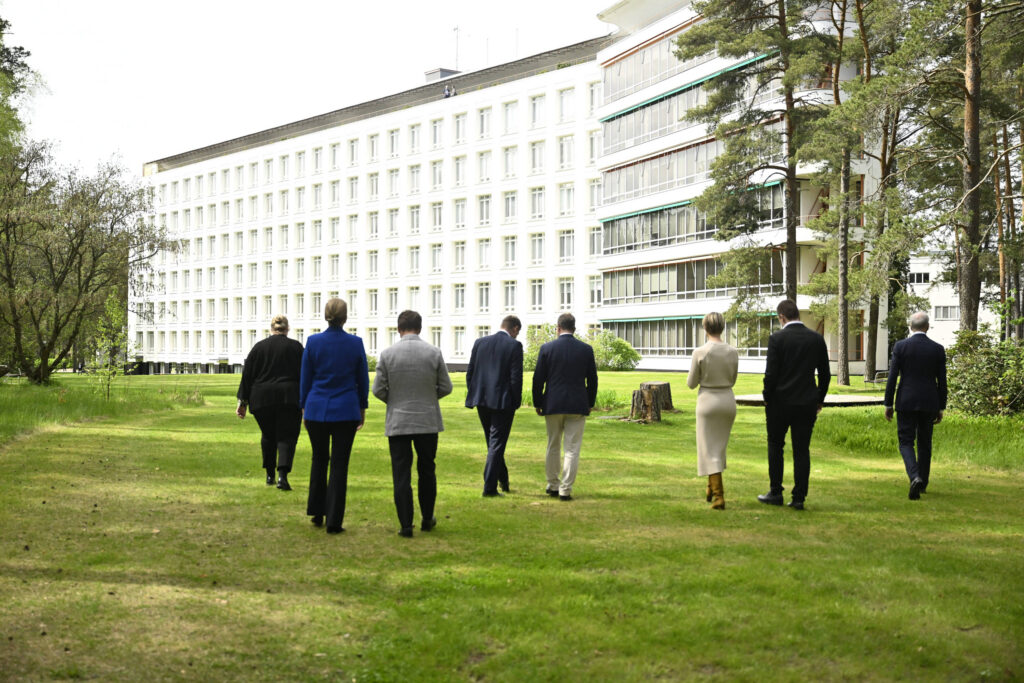
Late last May, the prime ministers of Europe’s Nordic countries gathered in a former tuberculosis sanatorium hidden among the pine forests of southwestern Finland. It was an unlikely venue for a high-level diplomatic forum: Most parts of the building had been in disuse for a decade and needed restoration. But the symbolism was hard to miss. As the hybrid war waged by Vladimir Putin against the Old Continent loomed large over the talks, the Finnish government hosts were suggesting that healing and care can be political tools, too.
The venue, the Paimio Sanatorium, was designed in the early 1930s by Alvar and Aino Aalto and is widely regarded as a masterpiece of Modernist architecture. Erected when tuberculosis had no pharmacological treatment and was a leading cause of death, the building has been described as a “medical instrument” in itself. It distilled some of the principles that would define Finnish design in the following decades: functional restraint, social purpose, and quality accessible to all. From its noiseless sinks designed not to disturb patients to customized, easy-to-clean lamps and seats (now sold as fashionable objects), it stood out as a gesamtkunstwerk,a total work of art, that embedded empathy and efficiency down to the smallest details. Rooms were oriented so that patients, who might spend months or even years in the sanatorium, could be exposed to the outside forest and find relief in at least some contact with nature.
Last spring, the security agencies of northern Europe may have found this backdrop unexpected. But for more than a century, Finnish architecture and design has functioned as an instrument of nation-building. It supported the country’s independence process, then its consolidation as a highly functioning trust society, and finally the development of its comprehensive defense strategy. Local design has demonstrated the underlying political, even geopolitical, dimension of the built environment. Today, as Europe faces imperial pressures from both Russia and the US, that legacy is acquiring continental significance. What Finland developed to preserve its sovereignty may now serve as a spatial blueprint for Europe’s autonomy.
Connected Histories
It took decades for this Baltic frontier to become central to Europe’s response to the recent return of war on the continent. Finland, which for centuries was a province of Sweden or the Russian Empire, became autonomous in December 1917. During the Cold War, it avoided major territorial capture and maintained its sovereignty—while bordering the USSR and even sharing a track gauge across their 1,340-kilometer border.1 During the 26 years of Urho Kekkonen’s presidency, it strategically avoided siding with either the Soviet Union or the West and at the same time discreetly built up one of the best armies on the continent.
Finland can speak the human-rights language of social democracy, shared with Stockholm or Copenhagen, while also demonstrating a command of defense strategies that resonate with priorities in Tallinn, Vilnius, and Warsaw. It joined the EU in 1995 and adopted the euro in 1999. When it joined NATO in 2023, in response to Putin’s invasion of Ukraine, it emerged as one of the most authoritative advocates of a strong reaction against the Kremlin. Its current president, Alexander Stubb, has taken part in peace negotiations with Donald Trump and President Volodymyr Zelensky of Ukraine, and his “values-based realism” mantra was cited by Canadian Prime Minister Mark Carney at Davos in January. This periphery of Europe has become pivotal.
Over the course of Finland’s history of diplomatic prowess, the relationship between architecture and politics has displayed several unique features. Even before the country achieved independence from the Russian Empire, it used architecture to foster its own collective identity. That happened via the emergence of a style of national romanticism that in the late nineteenth century merged the floral motives of Art Nouveau with tributes to the nature-rich Kalevala mythology. Finland’s pavilion at the 1900 Exposition in Paris displayed a “Section Russe” panel above the building’s entrance. But despite the obligatory nod at imperial submission, the architecture, the paintings, and the music presented expressed an expansive nation-building creative act, which then shaped the Finns’ artistic spirit for decades.
When the Finnish state was finally born, shortly after the Russian Revolution, Modernism in architecture was reaching the zenith of its intellectual elaboration. The Bauhaus was founded in 1919, and Le Corbusier published the first issue of L’Esprit nouveau in 1920. The Finnish people, who out of necessity had for centuries pursued modesty and functionalism in their material culture, wholeheartedly embraced the new promises of rationality and industrial efficiency as tools to pursue progress and unity. In the following decades, major Finnish architects helped erect a network of public buildings to sustain a generous education and social security system: libraries and theaters, schools and health centers, swimming pools and mass housing. By the end of the twentieth century, this formerly agrarian society had turned into a highly educated innovation powerhouse, especially relative to the size of its population.
But Finland never took its autonomy for granted. Attacked by Stalin’s troops during WWII, it developed the concept of preparedness, or varautuminen: the idea that defense is a broad concept that should mobilize the entire social body. To this day, National Defense Courses are run by the military in Helsinki. Over the last few months, I spoke with people ranging from library managers to art museum directors who were invited to join the intense, three-week program and performed simulations on how to withstand foreign attacks.
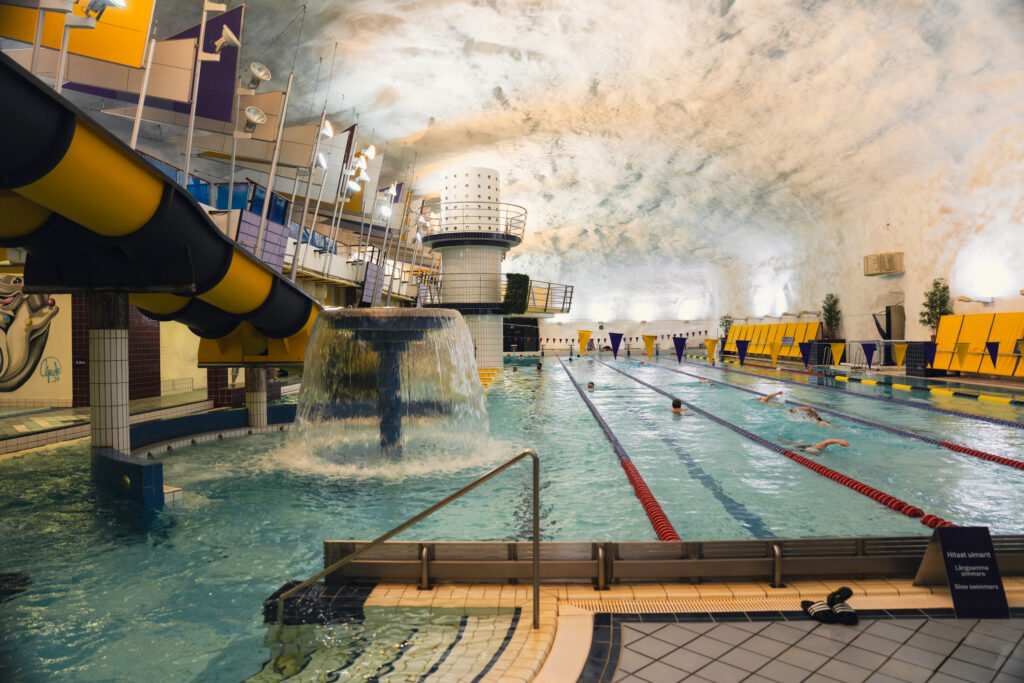
The most evident manifestations of how geopolitics extend into daily urban life are the country’s thousands of defense bunkers, which double as places for social gatherings, like playgrounds and swimming pools. But the game of mirrors among nation-building, architecture, and safety concerns has acquired further dimensions in the last two decades. Even as Finland accelerated its integration with the EU, it started to confront threats—digital misinformation, climate change, political polarization—that risk eroding solidarity across the continent (particularly for Ukraine, Denmark, and Greenland). Can Finland’s architecture update its areas of action and elaborate a response to the new political challenges?
How Not to Change the World
When I was living in Moscow between 2013 and 2015, the city was experiencing an urban renaissance. Streets were pedestrianized, parks renovated, and waterfronts reimagined, and international firms like OMA and Diller Scofidio + Renfro designed new cultural landmarks. Spearheading many of these transformations was the reason for my move to Russia, namely to the Strelka Institute for Media, Architecture, and Design—a paradoxical hybrid of research center, planning bureau, and gay-friendly bar, funded with oligarch money and directed by the Dutch architect and maître à penser Rem Koolhaas. Its glamorous venue was a former chocolate factory on an island in the middle of Moscow River. In 2013, the celebrated Danish urban planner Jan Gehl gave an uplifting public lecture there: “Moscow. Towards a Great City for People.”
At that time, a word that many foreigners had in mind, though few dared to utter it, was “normalization.” After decades of communism and the chaos of the 1990s, Moscow appeared to be re-joining a (Western) European trajectory. Its public spaces and cafés resembled those in London, Berlin, or Paris. Some believed spatial change would usher in social openness.
It did not. Living conditions did improve substantially, but Russian society moved down an even quicker path of democratic degradation. The contrast soon started to feel oppressive. In February 2015, Putin’s opponent Boris Nemtsov was murdered next to Red Square, a stone’s throw from the building site of the highly Instagrammable Zaryadye Park. I left Moscow a few weeks later. The Strelka Institute carried on, even though the Koolhaas crew took off, and then the project’s original interest in public space veered toward esoteric meditations on technology and planetary terraforming. The center suspended its activities indefinitely in February 2022, shortly after the start of the war in Ukraine.
This small parable from Moscow encapsulates the long-recurring oscillation between faith and disillusionment experienced by generations of designers who believed their work might have a political impact on the world.
In the mid-twentieth-century classic The City in History, Lewis Mumford underlined how Darwinian theories had had a dramatic impact on Western urbanism, so much so that in the Victorian era, “without design” was a laudatory term.2 The early growth of the first industrial cities followed a laissez-faire logic. But the result was an “uncouth disorder” of pollution and overcrowding. It was in reaction to such extremes that the Modernist architects stepped in, armed with a confidence in their ability to change the world that, in retrospect, shuttled somewhere between that of the Übermensch and the delusionist. This was the era of what scholars in the field call the “hero-architect,” when nineteenth-century utilitarianism flipped into its opposite. Everything was design, could be redesigned, and it could reshape reality.
But “the future didn’t quite work out like that,” the architecture critic Edwin Heathcoate wrote in the Financial Times in October, somberly expressing how so little of that faith remains: “That social purpose which accompanied the birth of design as a profession quickly dissipated, hijacked by capitalism as a sales schtick, a way of selling newer, more fashionable, more expensive products.” Isolated and powerless, design and architecture lost their social purpose. For Heathcote, “Modernism became marketing.” The optimistic ethos of the first half of the twentieth century has not disappeared, but it has hollowed out.
Even so, is it all really just a disingenuous tradesman’s ploy? In his 2012 book Architects Know Best, Simon Richards ruthlessly dissected the traps of “environmental determinism”—the idea that “the right kind of building can transform us into happier, healthier, better people.” He called that position an “ethical fallacy” of the design disciplines.3 Yet Richards’s ultimate verdict was less harsh than Heathcote’s: “As the arguments are sometimes skew-whiff, the claims often outrageous, and the motives usually muddy, there is little doubt that they enrich the discourse of architecture and planning.”4 In other words, we can still find hope in exploring the impact of architecture on politics, as long as we acknowledge the slippery entanglements of ideological and market interests. In this realm, too, we need new categories for action.
The Agency Spectrum
In Five Ways to Make Architecture Political (2017),the sociologist Albena Yaneva suggested that “at a time marked by […] the crisis of legitimation of party-based and national politics,” the first step to understanding the relationship between politics and architecture is to reject any ontological separation between them. “To accept that buildings and architectural projects can miraculously legitimize or embody power is a form of anachronism.”5
The boundaries are blurred. Politics is not performed only by politicians, and when architects design, they do not passively obey an impersonal “base,” to use a Marxist category. Urban development issues are increasingly handled by public officials, for instance to advance competition among international metropolises—what the geographer Sami Moisio has called the “city geopolitics of knowledge-based economization.”6 If Modernism became marketing, marketing assumed political characters, too.
As a substitute to the deterministic theory, Yaneva introduced the concept of a “dance of agency.”7 It implies that a building’s politics is determined by a multitude of actors: designers, authorities, media, activists, construction companies, daily users, and neighbors. Their dance helps establish various domains of remit—creating what I would call an “agency spectrum.” On matters almost purely about design, architects can decisively shape reality and influence people’s behavior. But as soon as a project’s complexity increases and the number of actors involved multiplies, political outcomes become fuzzy. That is why formal tropes such as “openness” or “transparency”—the latter a recurring argument in contemporary architectural jargon, from Norman Foster’s 1990s Reichstag renovation project onward—cannot in themselves do much to improve the state of democracy. Adding a bunch of pedestrian streets or a new contemporary art museum in Moscow will hardly discomfort the Kremlin.
The Geopolitics of Alvar Aalto
If the agency spectrum spans from designing private spaces to influencing a country’s geopolitics, the most ambitious architects are those who strive to climb as high as possible up that range, embracing non-design methods of advocacy the higher they rise. That is what Alvar Aalto did, leveraging his ascent into national influence.
Aalto was a seductive character with a strong network, in a position to both exploit and be exploited by the Finnish state’s highest political interests. He understood there was a gap in how Finland wanted to project itself physically as a nation. He pursued persuasive writings and intellectual exchanges, while benefiting from the (long-underappreciated) design contributions of his two partners in business and life, Aino and then Elissa. By the mid-1950s, when he helped found the Museum of Finnish Architecture, he had consolidated the correspondence between his country and a gentle, nature-connected form of Modernism, and that became his own form of expression.8
In 1998, the New York Times critic Herbert Muschamp qualified Aalto’s defining feature as “an assault on binary thinking, the tendency to see things either-or.” Aalto had an extraordinary ability to reconcile opposites in design. At different phases in his career, but sometimes at the same time, he drew from the International Style and Nordic vernacular, bridged functionalism and humanism, and blurred city and landscape. Because Aalto could be both forward-looking and psychologically reassuring, the architecture doyen Kenneth Frampton called him “the most important architect of the 20th century, in terms of the 21st century.”
He was equally flexible about ideology, the Finnish professor of design and culture Pekka Korvenmaa has argued. “Aalto was the foremost Finnish advocate of an architectural idiom and ideology that originated in a hotbed of revolutionary aesthetic and political ideas, yet became one of the most trusted architects of his country’s capitalists.” Eeva-Liisa Pelkonen, a professor of architecture, tried to relate that attitude to the international affairs of the times, and in Alvar Aalto: Modernity, Architecture, and Geopolitics, concluded that Aalto’s “open-ended design method reflected the Finnish Cold War political atmosphere, which was marked by its own share of conceit, ambiguity and double play.” His malleability and lack of dogmatism matched the country’s quiet resistance to Soviet pressure deftly disguised as neutrality, while imbuing it with inspiring ideas and noble images. In 1949, in an article titled “Finland as a Model for World Development,” Aalto argued that architecture, urbanism, and national planning should all be centered on nature, the most authentic “source of the concept of freedom, and its maintainer.”
Aalto built Villa Mairea (1937-39), a house for his industrialist patrons, but he also accepted commissions like Helsinki’s House of Culture (1952-58), funded by the Communist Party, and a dormitory on the MIT campus (1947-49). His last major work was the elongated Carrara-marble-clad convention center where the 1975 Helsinki Accords were signed—a historic achievement of Finnish multilateralism. In the summer days when the world’s top political leaders walked the halls of this majestic building, significantly christened Finlandia Hall, Aalto’s landmark appeared to achieve the perfect overlap between domestic identity and foreign policy. Although far from being his best design, it was nonetheless a peak of architecture’s contribution to Finland’s nation-building.
Out of Time
What happens if we apply Pelkonen’s lens to the contemporary world? Is there any Aalto in sight for Finland’s post-2023 geopolitical status?
This is a story about unexpected continuities. In his 2020 book Foundations: How the Built Environment Made Twentieth-Century Britain, Sam Wetherell traveled across the UK, observing how the country’s transition from social-politics stalwart to neoliberal pioneer left behind cities “exhibiting the decrepit and shabby remains of prior means of capital accumulation along with obsolete visions of society.”9
Such rupture feels much less acute in the easternmost Nordic country. Over the past two decades, Finland’s urban centers have experienced highly visible cases of land privatization and large-scale, capital-driven real estate operations. Yet even Helsinki remains distant from the aggressive financialization of the built environment that dominates many European capitals. It also appears to possess antibodies against those forces. Aside from a handful of architectural companies that have achieved scale by combining design with engineering services, most firms remain small and operate under economic conditions reminiscent of a pre-globalization era. Although the number of commissions allocated through the country’s 150-year-old system of public bidding competitions has been declining, they still constitute a substantial part of many companies’ business. Competitions are strictly anonymous, which has made marketing or PR strategies secondary. Foreign firms are rarely entrusted with major public projects.
In the early 2000s, the architecture critic Roger Connah described Finland as being engaged in “a permanent exercise in nation-building”; he called this “unfinished Modernism.”10 He meant that architectural culture had barely adjusted its direction since Aalto’s era. But why oppose a practice of cultural inclusiveness, nature-friendliness, and formal restraint? That hardly sounds objectionable. After so many years, however, it does produce a downside: an aversion to risk and a weakened capacity for innovation, which only intensify the longer the same formula is reapplied.
Most importantly, since Connah’s diagnosis, architectural tools for communications and advocacy have expanded dramatically. Reductionist claims that any form of social commitment has collapsed into marketing overlook something fundamental: namely, that design leaders can build value by stepping into terrains that are somebody else’s prerogative—and some of the most influential architects of this century have learned to absorb those terrains within the remit of design. The core of these activities falls to the architect as public intellectual, but others extend well beyond that persona alone: curating major exhibitions and biennials, advising NGOs or businesses on urbanism, giving keynotes at corporate forums, contributing opinion pieces to the general media, editing magazines. In these and other arenas, the cultural and commercial sides of the design professions converge and amplify one another.
Firms that can afford to neglect this emerging dimension—as many in Finland still do—are likely to drift toward the lower ranks of the agency spectrum, where a focus on formal or technical matters offers the illusion of autonomy while actually signaling political irrelevance.
That something can function from a background position is a fitting definition of “infrastructure.” The term is widely cited in the Finnish government’s latest Security Strategy for Society document. Preparedness is about choosing the kind of physical and social infrastructure that society wants to defend. The concept of varautuminen, first used in the late 1970s, has become a pillar of Finland’s lobbying within the EU. It resonates with the recent assertions, from Brussels to Berlin to Paris, that amid the aggressiveness of Russia and the waning reliability of US support under Trump, the Old Continent must step up to accelerate its autonomy.
While the task might feel new among other Western states and Southern nations, Finland arguably has practiced it longer than any other country, using the built environment as one of its levers. To achieve that again, this time on a continental level, its agents of architecture need to operate a double shift in mindset. First, overcome a certain self-representation of Finland as a humble, self-reliant country that does not have the means nor the interest to teach something to the rest of Europe. Second, understand that the new geopolitical scenario requires architects to handle many more tools than in the past in order to move higher up along the agency spectrum. To say this is not to discard the representation gap or public intellectual role that Aalto filled. It is to argue that it must evolve into something more attuned to today’s challenges.
An Anti-Imperial Mission
On May 9, 2019, the historian Timothy Snyder gave a speech in Vienna that is one of the most comprehensive defenses of the EU in this century. After rejecting the founding myth of the bloc as a coalition of grieving nations seeking peace after 1945, Snyder reframed the EU as something completely different: a post-imperial creation. Because it is “the largest economy in the history of the world” and “a series of contiguous functioning welfare states and democracies,” he claimed, it alone is capable of resisting the resurgence of aggressive empires.
Presenting WWII as the result of Hitler’s imperial aggression against Europe, Snyder argued that the violence that culminated in the Holocaust was born of three factors—and that those again will now define the future of the EU project. The first was ecological panic, and the belief that survival required seizing resources from others. Second, state destruction: The erosion of institutions and the rule of law created a vacuum in which authoritarianism could take hold. Finally, dehumanization reduced people to expendable instruments—and far from having disappeared since 1945, it is now propagating, Snyder claimed, via an eerie “digital empire.”
“For those of us on the outside, you are also a source of hope; perhaps the only source of hope for the future,” said Snyder, his voice close to trembling as he spoke from a podium in Judenplatz. “You in Europe have the tools, the intellectual tools, to handle this.” This is where the Finnish approach to architecture reappears.
Finnish architecture has long demonstrated its capacity to respond to geopolitical pressures, either within the framework of preparedness or by reinforcing nation-building objectives. But if these dynamics long unfolded under a flag of neutrality, the 2020s do not reward ambiguity. We should look at Finnish architecture as a repository of ideas for a culture war that ties in closely with a new geopolitical mission: not one seeking neutrality on a national scale, but one waging an anti-imperialism resistance at a continental level. Snyder’s three causes of empire also are the three fronts on which this mission can now be pursued.
Ecological Hopes
It is not difficult to recognize the threat of ecological panic in our present of climate change. Finland offers a long-cultivated architectural tradition that strikes a balance with nature, seeing human-made creations as part of the landscape. It includes a vernacular style strictly linked to the country’s ubiquitous forests, which has been advanced in recent decades with experimentations in programs for wooden construction. Some of its most significant counterbalances to the zero-sum reasoning of ecological panic are philosophical, and they anticipated tenets of the more recent post-Anthropocene turn in sociology and the arts.11
In this alternative genealogy of ecological thinking there is jokaisenoikeus (every person’s right): the version of a principle widespread across the Nordic and Baltic states according to which anyone may freely roam the land and respectfully harvest products such as berries and mushrooms, in some cases even on private property. A society overwhelmingly rural until a few decades ago has carried this ethos of openness into the urban sphere.
Similarly, in the post-WWII decades, Raili and Reima Pietilä advanced the concept of “forest space” as an organizing principle that deviated from the straight lines of rationalist design. This is visible in Espoo in the stunning campus building of Dipoli (1966), whose plan, split into two halves, stages a clash between Cartesian discipline and organic growth patterns. Though it caused outrage at first, the project was fully accepted over time, so much so that two decades later, the Pietiläs were entrusted to design the official residence of Finland’s head of state.
In its mission to de-Russify its energy supply, Finland has been employing strategies ranging from calling for experimental “moonshot” ideas to decarbonize the metropolitan capital’s centralized heating system, to inaugurating one of Europe’s largest nuclear reactors, and digging a subterranean facility to store nuclear waste for 100,000 years. Contradictions remain, such as an excessively liberal demolition policy. But even if Finland needs to extend its current 2040 deadline for reaching carbon neutrality (as some studies have recently suggested), it would still be a leader on this front.
Infrastructure of Care
The threat of state destruction is keenly felt in Finland, one of Ukraine’s most steadfast supporters. Yet the erosion of civic institutions does not necessarily translate into war.
Despite growing fragilities, such as the increased risk of poverty or social exclusion, Finland’s welfare state and its brand of Nordic neoliberalism have been coexisting for three decades. The built environment still celebrates care, whether in health centers, playgrounds, or community venues for children, teenagers, and older adults, or even in the agrarian tradition of talkoot, collective and voluntary labor that today takes the form of seasonal repairs in urban compounds.
These practices also relate to the critical reinterpretation of the Aaltos’ work. Thirteen Aalto-designed sites were submitted for inclusion in UNESCO’s World Heritage List for how they “supported community well-being in ways of universal significance.” Among these is the Social Insurance Institution Main Office in Helsinki (1956). And Paimio Sanatorium, which deeply informed the Aaltos’ early design philosophy.
In their recent book We the Bacteria: Notes Toward Biotic Architecture, the professors of architecture Beatriz Colomina and Mark Wigley quote Thomas Mann, who in his 1924 novel The Magic Mountain described the experience of the sanatorium as a “horizontal manner of life.”12 In Paimio, the Aaltos refocused architecture on the horizontal person. In a revolutionary shift away from the healthy Vitruvian Man of Western tradition, they acknowledged the human being “as a vulnerable figure who spends most of its life in the ‘weakest position’: as a baby or when old, sick, breaking a leg, pregnant, dying,” according to Colomina and Wigley. Such a political proposition was all the more relevant given how far Paimio stood from the elite aura of Mann’s Alpine sanatoria. The institution was publicly subsidized and offered free beds to patients of limited means. The surrounding flat landscape of pine forests seemed to reflect the sanatorium’s efforts to flatten social hierarchies.
The sanatorium was decommissioned as a regular hospital in the mid-2010s and recently received a pledge of 10 million euros in government funds to launch a restoration. The chair of the Paimio’s foundation, Mirkku Kullberg, has said she wanted to update the building’s original mission into a form of “social healing,” making it the site for soft-diplomacy gatherings, a “Davos of the North.” The Nordic Prime Ministers’ summit of Spring 2025 was the first instance that spoke to that vision.
Digital Dehumanization, Physical Libraries
If the threat of dehumanization is advancing today, as Snyder has argued, it is because of its powerful digital arms: “from the way that China evaluates its citizens according to a point system, from the way that Silicon Valley makes available to people around the world tools of manipulation, from the way that the Russian Federation intervenes in other people’s elections.”
While Russian-sponsored digital misinformation has spread across Europe, Finland has proved resistant to foreign infiltrations. Its digital literacy programs are widely credited. But beyond formal education, Finland invests heavily in a building typology that represents a counterweight to digital manipulation.
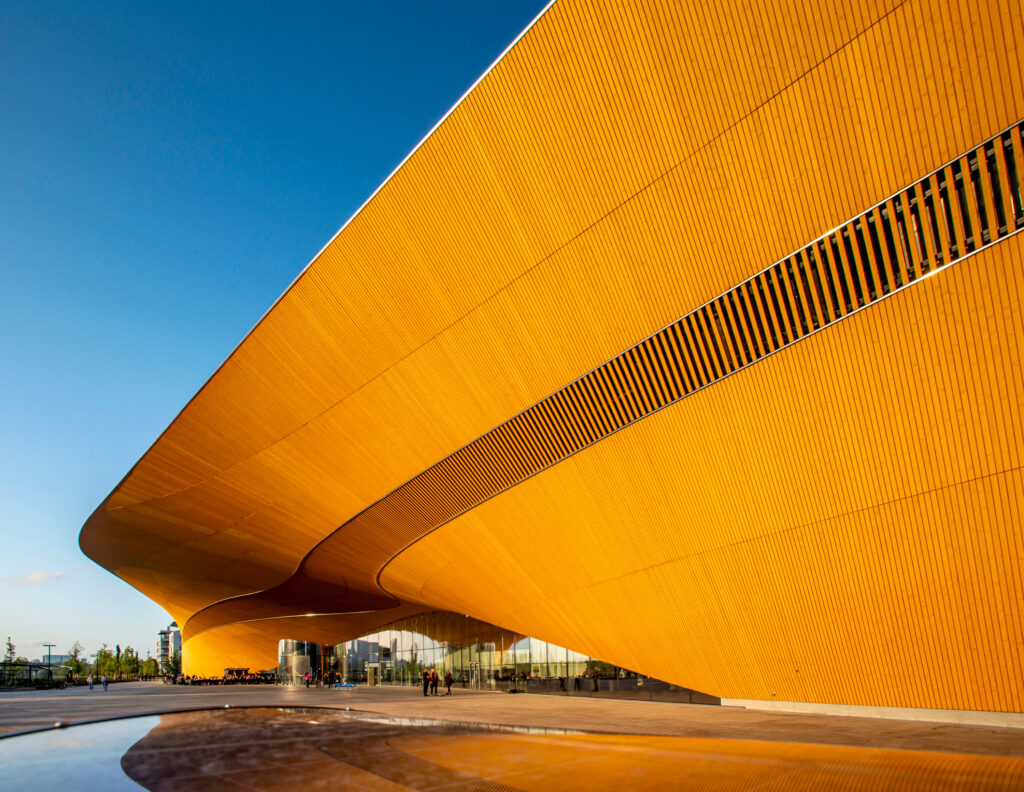
Libraries have played a pivotal role in Finland’s nation-building. Even before independence, they laid the basis for the political project of establishing an educated, autonomy-seeking people. The earliest case is Rikhardinkatu Library in Helsinki (1882), with its fascinating central spiraling staircase. Fast-forward to the present: Libraries are a pillar of the government’s Security Strategy for Society, in its objective to preserve “psychological resilience,” and they have not withered in the digital age. The most striking expression of their high status in public life is Finland’s monument to the 2017 centenary of its independence: Oodi Central Library, designed by ALA architects and built directly opposite Parliament, a wave-like “common living room.”
Books and reading are only one component of Oodi’s programming, which includes 3D-printing rooms, sewing workshops, musical-instrument lending, and climbing areas for toddlers. “At this point, the name ‘library’ is just a legacy,” Hossam Hewidy, a lecturer in architecture who has studied the library system across the Nordic countries, told me last January. “While their historic role has been to realize the project of social equality, what we have seen in recent years is that they have started to fill the gaps opening up in the welfare state.”
Oodi is a place of radical inclusivity that shows how smooth service can co-exist with social frictions. Parents of young children flock there, but they know the third-floor bathrooms are preferable to those in the basement, where they might stumble into heroin addicts. Socially marginalized individuals doze on couches. Far-right activists from the Sinimusta Liike movement stormed the place in January 2025, to read aloud a book titled A Minority in One’s Own Country? They clashed with counter-protesters. Yet the space remains comfortable and desirable, attracting international tourists.
The first time I visited Oodi, in Spring 2019, a librarian handed me a leaflet listing house rules. One said: “Hanging out at Oodi without a reason is allowed and even recommended.” The rules quietly reject the notion of “loitering”—and the old policing practice in some US cities of prosecuting people for idling in public spaces. Finnish libraries, from flashy Oodi to local neighborhood branches, also challenge the there-is-no-alternative proposition, first put forward by Koolhaas and echoed complacently by his disciples, that “shopping is arguably the last remaining form of public activity.”
If digital space is where the nefarious consequences of new forms of empire spread most ominously, libraries demonstrate that physical space need not surrender to the logics of extractivism or consumerism. It can still serve as an antidote to those forces, and as a civic firewall against dehumanization.
Can the Periphery Hold?
Finland looks well prepared to counter Russia from a conventional defense perspective, but also to use architecture as an intellectual tool to help the rest of Europe navigate these uncertain times. It does face challenges to its stability from within. Economic growth is sluggish, the unemployment rate is the highest in the EU, and population ageing threatens the long-term sustainability of the country’s social security system. The far-right holds critical ministers in Petteri Orpo’s government and has been deploying familiar attacks toward the EU, Muslim migrants, and what it calls “the climate hysteria”— “the devil’s invention.” And yet the Finns I have spoken with tend to remain unconcerned about polarization. They invoke democracy’s self-correcting rhythm and are waiting for the next elections, scheduled for April 2027.
Finnish architecture can play a part, but it will need more resolute agents if it wants to positively influence the country’s politics and geopolitics in Europe: figures with strong ambition and persuasive talent, capable of reclaiming a higher place on the agency spectrum. Many of the intellectual tools and design solutions currently in use were developed more than half a century ago, during Aalto’s time. The new agents will have to introduce innovations beyond the inherited repertoire.
An aggregator of forces might be the new Architecture and Design Museum, a 60-million-euro project in Helsinki. In a series of programmatic statements, its director Pilvi Kalhama described the industry’s aversion to risk and promised that the museum “will rise to meet global expectations,” including in “its civic mission” of “justice, empathy and transformation.” She brought in the former MOMA curator Carson Chan. To see whether this pledge is fulfilled, we will have to wait until 2030, when the organization moves into a waterfront building that the Helsinki-based office JKMM has designed, with a facade of recycled bricks and poetic triangle slits.
2030. Is architecture too slow to fulfill these social and political objectives? The built environment evolves through gradual accretion, not overnight shifts. How can it respond to the daily shocks unleashed by Trump or Putin? One could reply that the years 1918–21 in Europe were no less chaotic than 2022–25 have been. The first months of Finland’s independence were marked by a civil war between the Reds and the Whites, memories of which still haunt the country today. And yet as soon as peace was restored, Finland began building something, many things, and they have been immensely beneficial for decades.
Europe now stands on the edge of a similar founding chapter. Can Finland help it?
Daniele Belleri is an editor and architecture strategist based between Finland and Italy. A partner at the design firm Carlo Ratti Associati, he led the curatorial team of the 2025 Venice Architecture Biennale. He serves on the board of directors of Paimion Parantola Oy, the company overseeing the renovation of Paimio Sanatorium in Finland.
- Henrik Meinander, Helsinki: The History of a Nordic City (H. Hurst & Company, 2025), 121. ↩︎
- Lewis Mumford, The City in History: Its Origins, Its Transformations, and Its Prospects (Harcourt, Brace & World, 1961), 452. ↩︎
- Simon Richards, Architects Know Best: Environmental Determinism in Architecture Culture from 1956 to the Present (Routledge, 2012), 1. ↩︎
- Richards, Architects Know Best, 157. ↩︎
- Albena Yaneva, Five Ways to Make Architecture Political: An Introduction to the Politics of Design Practice (Bloomsbury, 2017), 5. ↩︎
- Sami Moisio, Geopolitics of the Knowledge-Based Economy (Routledge, Taylor & Francis Group, 2018). ↩︎
- Yaneva, Five Ways to Make Architecture Political, 30. ↩︎
- Juhani Pallasmaa, preface in Kirmo Mikkola’s Aalto in Context: An Insider’s Perspective, eds. Aino Niskanen, Juhani Pallasmaa, and Gareth Griffiths (Routledge, 2025), xvii. ↩︎
- Sam Wetherell, Foundations: How the Built Environment Made Twentieth-Century Britain, (Princeton University Press, 2020), 15. ↩︎
- Roger Connah, Finland. Modern Architectures in History (Reaktion Books, 2006), 246. ↩︎
- Bruno Latour, Facing Gaia: Eight Lectures on the New Climatic Regime (Polity Press, 2017). ↩︎
- Beatriz Colomina and Mark Wigley, We the Bacteria: Notes Toward Biotic Architecture (Lars Müller Publishers, 2025), 239. ↩︎