In the Comfort of Apocalypse
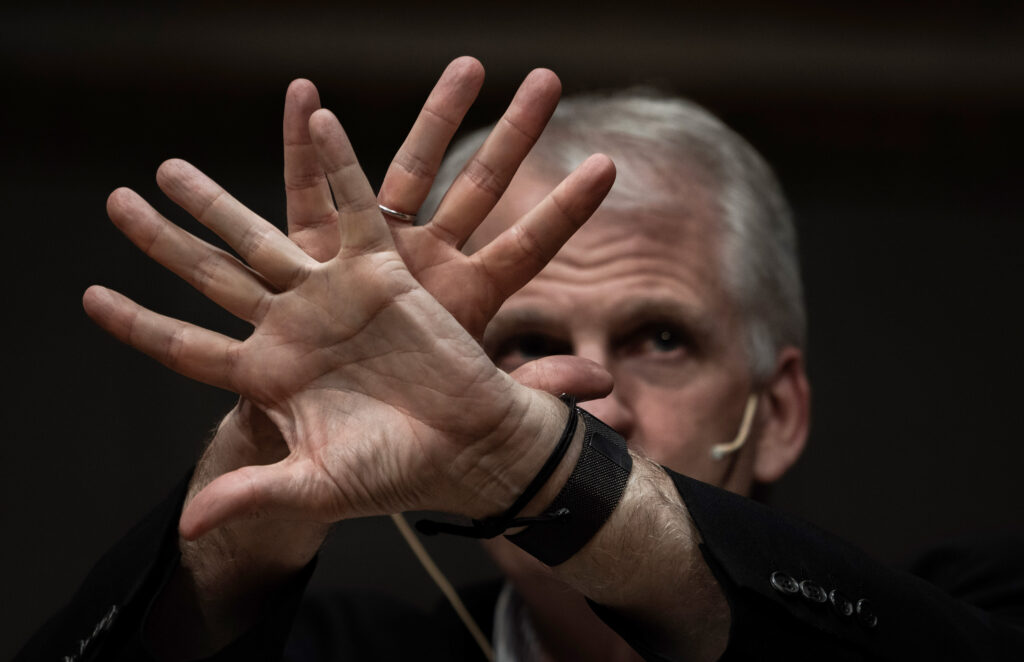
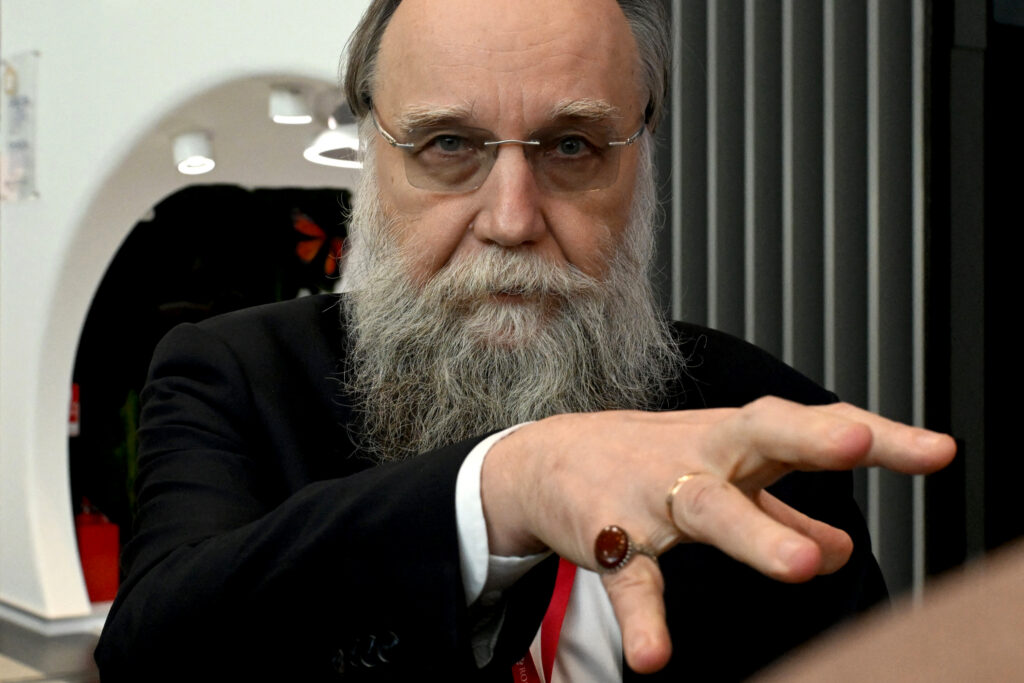
On paper, Timothy Snyder and Alexander Dugin should have nothing to say to each other. Snyder is an American historian and a longtime history professor at Yale, now at the University of Toronto, whose authority rests on the years he spent studying the different forms of state violence that shaped Eastern Europe under both the Nazi and the Stalinist regimes. Dugin is a Russian political philosopher and self-taught esoteric thinker, more at home with occult speculations than archival footnotes. He is also a disciple of the so-called Traditionalist School of Julius Evola and René Guénon, an anti-modernist philosophy that seeks the return to a metaphysical order.
The distance between them is not only intellectual but also political. Snyder became one of Donald Trump’s most insistent critics and a vocal advocate for Ukraine’s defense against Russia’s aggression, starting with the annexation of Crimea in 2014; Dugin spent the same decade as the man whom many Western journalists have called, mostly out of intellectual laziness, “Putin’s brain.”
So yes, the two should have nothing to say to each other. And yet when their claims are placed side by side, the similarities become hard to miss. Despite their opposing politics, Snyder and Dugin often rely on the same underlying way of thinking. Both offer a master concept that promises total clarity, divides politics into moral absolutes, and frames Russia as an atemporal civilizational entity.
They also write posturing in the vein of prophecy. And they cultivate a kind of apocalyptic thinking that locates the crisis abroad rather than at home. Each of their master concepts is grand enough to explain an epoch and is wielded as a decoder: Whoever has not grasped it looks, at best, naive.
The Search for Totalizing Clarity
Snyder’s device, laid out in On Tyranny (2017) and refined in The Road to Unfreedom (2018) and On Freedom (2024), pits the “politics of inevitability” against the “politics of eternity.” For him, inevitability comes with the post-1989 Western conviction that history runs on rails: Markets produce democracy, democracy produces prosperity, and the only sensible posture toward the future is to wait for it to arrive—this is Snyder’s contribution to the debate launched by Francis Fukuyama’s “end of history” theory. Eternity is what happens when that conviction collapses. A society stops believing in any future at all and retreats into a cyclical story-telling in which its own nation is eternally innocent and eternally besieged.
For Snyder, the binary is an all-purpose theory of political breakdown, at times approaching what I have described elsewhere as reductio ad Hitlerum. I mean this not in the crude sense that every opponent is simply called “Hitler” but in the subtler sense that the present is systematically staged inside the moral theater of the 1930s. Trump begins to look like Hitler, Putin like Stalin, liberal democracy like the Weimar Republic waiting to collapse. The analogy compresses time and space, and it shrinks any cultural context. In Snyder’s reading, Brexit, Trump, and Putin all rely on the same conceptual apparatus, and very different crises flatten into a single drama in which Russia serves as the key to everything.
Dugin’s device is grander still. In The Fourth Political Theory, he claims not merely to critique liberalism but to simultaneously supersede liberalism, communism, and fascism, folding all three into a single discredited “modernity,” which only a new, fourth path can transcend—namely a culturalized revisitation of Heidegger’s notion of Dasein, “being-in-the-world.” Where Snyder’s binary diagnoses the West’s loss of self-confidence, Dugin’s diagnoses a wrong turn in Western philosophical thinking that stretches back to the Enlightenment, even to the Renaissance. He characterizes radically different moments in history as episodes in a single, vast anti-liberal drama: Ancient Greece, Christianity, America, postmodernism, what he calls “gender ideology,” and the fighting in and over Ukraine all become signs of liberalism’s metaphysical crime—that is, radical individualism and nihilism.
Snyder reverses the moral polarity but performs the same operation in the opposite direction. The road to unfreedom runs from Moscow into the West, as Russia spreads its “politics of eternity” to societies whose faith in “inevitability” has collapsed. Dugin reduces the world’s trajectory to a fall from tradition; Snyder, to the return of cyclical totalitarianism. Both theories share the rhetorical structure of revelation. Each declares the prevailing framework for understanding contemporary politics inadequate: Dugin claims that the three political theories of modernity (liberalism, communism, fascism) are exhausted, while Snyder argues that the post–Cold War “politics of inevitability” has left us unable to recognize the “politics of eternity.” Each then offers a new master concept through which apparently disparate political developments become understandable.
What both theses finally reveal is a failure of belief. Snyder’s societies fall into eternity because they stop believing in progress; in Dugin’s view, the West is collapsing because it stopped believing in tradition. Both visions, in other words, are idealist theories that bypass the harder question of which institutional and economic arrangements in the first place produced the despair or the decadence they describe. And a theory that explains everything through a crisis of belief never has to ask whether the believers had good reasons to stop believing.
Darkness and Light
From there, the arguments quickly turn moral. Both men return, in different registers, to one of the Bible’s oldest oppositions: light against darkness.
Dugin has built an explicit cosmology out of it. His decades-long project Noomakhia, or “wars of the mind,” organizes the history of civilization around three competing logoi (the Light Logos of Apollo, the Dark Logos of Dionysus, and the Black Logos of Cybele), arranged along an axis running from heaven to earth, from transcendence to matter. In his lectures on Christianity’s place within these logoi, Dugin describes European civilization before de-Christianization as having lived “in the victory of light over darkness,” as the child of a kingdom of light that was later shattered by the rupture of de-Christianization. His recent Substack post “Civilization or Utter Darkness” translates this spiritual history into a civilizational geography. Since the eleventh century, the modern and postmodern West has been receding ever deeper into “the outer twilight,” forsaking its Christian path—which Russia never abandoned.
Snyder’s vocabulary is less metaphysical, but it depends no less on a moral drama about sight and blindness, truth and spectacle. As Sophie Pinkham notes in her review of his book Black Earth (2015), Snyder treats functioning state institutions as a source of “moral illumination” that ward off the darkness that follows state collapse. In On Tyranny, propaganda appears as false illumination: When truth disappears, politics becomes spectacle, and “the biggest wallet” can purchase “the most blinding lights.” Snyder’s phrase “dark globalization” extends the imagery into geopolitics, a world in which domestic weaknesses become visible to hostile powers and are exploited from outside. This is not a worked-out cosmology like Dugin’s, but it too is an optics that sees democracy and authoritarianism as absolute moral essences rather than as forms of governance that vary by institution and practice.
Despite their opposed politics, both men relyon a Manichaean grammar of evil. For Snyder, institutions, facts, and democratic responsibility provide the light; Putin’s spectacle and lies represent the darkness that spreads when that light fails. For Dugin, the Orthodox, Eurasian tradition is the light; liberal modernity is the darkness produced by a civilization that has abandoned its sacred order. The polarity is reversed, but the structure remains the same. In this sense, Snyder offers something close to a theology of liberalism. By recasting liberalism as a moral essence more than a contingent political achievement, he makes it easier to defend prophetically but harder to examine historically. The problem becomes especially visible when these moral continuities are projected backward through history. Here another unexpected parallel with Dugin emerges: Very different normative commitments produce a similar tendency to treat political regimes as surface expressions of something deeper and more enduring.
Seventy Years For Nothing?
For Dugin, that enduring substrate is civilization itself. In his logic, civilizations are ontological entities whose identity persists beneath the political orders that come and go. They are defined by a distinctive metaphysical principle, which draws on Evola’s notion of “spiritual races” and on his own culturalized reading of Heidegger. Russia appears within this framework as a transhistorical civilization embodied successively in five empires: Kievan Rus, Muscovy, Romanov, Soviet, and today’s Russia.
For Dugin, a civilization is the vessel of a logos—that is, a metaphysical principle anterior to and independent of any of its historical incarnations. Political regimes do not matter, and this is why the Soviet interval can be absorbed into Russia’s imperial identity. Although he was very anti-Soviet in the 1980s, he gradually reconciled with the USSR, arguing that it was defending Russian civilization against Western imperialism and continuing its autocratic and messianic traditions. Yet he has remained contemptuous of its bureaucratic materialism and spiritual emptiness, and unlike many official intellectual and cultural Russian figures, he was never nostalgic for the late Soviet Union’s way of life. What has attracted him in the Soviet experience is a mystical National Bolshevism understood as an aesthetic of violence and geopolitical defiance, as well as the continuation by different means of a nationalist revolutionary energy.
Snyder should, on the face of it, be a staunch opponent of any civilizational reading. His 2003 book The Reconstruction of Nations rests on a constructivist account of national identity. And in a 2018 NYRB essay that became the first chapter of The Road to Unfreedom, he attacks Ivan Ilyin—the early-twentieth-century reactionary philosopher whom Snyder presents as Putin’s direct inspiration (but whose influence other Russia specialists have found far smaller than Snyder allows)—precisely for creating a civilizational myth around Russia. Yet the essay itself comes close to the thing it denounces. Snyder describes Ilyin’s expulsion from Soviet Russia in 1922 and follows him in emigration, but only picks up the story again with Putin’s rise to power. He thus steps over seventy years as if nothing had happened to Russia in the interim.
And so the historian of the bloodlands vaults over the Soviet regime to install a continuity between imperial and post-Soviet Russia that his own archival sources cannot support. He does not analyze the Soviet experience so much as he dissolves it into a supposed Russian essence of autocracy, and with that goes the sociological depth that would have made his argument stronger. One might have expected, especially from a historian of his range, an account of how the Stalinist experience broke with imperial Russia precisely through its totalitarian ambition, how post-totalitarian society was subsequently rebuilt from the ruins of that rupture, and how Soviet culture came to constitute a civilizational world of its own. One might also have expected some engagement with the longstanding debates over the Soviet Union as both an imperial and a colonial formation.
It is striking that a historian would pass over the archives of the very century on which he built his authority. This is Snyder’s paradox: He exposes the Kremlin’s civilizational construction while asking his readers to accept an equally expansive historical continuity in his own interpretation. Dugin annexes the Soviet century to Russia’s trajectory, Snyder subtracts it, and yet both arrive at the same civilizational conclusion: Russia is an autocratic entity without politics and whose society is stuck in a “politics of eternity.”
Each has also drawn a similar objection from scholars who study the societies being theorized. Russia specialists have argued (as I have) that Snyder overstates the role of fringe thinkers such as Ilyin and Dugin in order to make Putinism appear more philosophically coherent than the bureaucratic record suggests. Eurasianism specialists make a similar point about Dugin: His arcane language is less a guide to how Russian power actually works than a private cosmology the Russian state occasionally borrows from but mostly ignores. The confidence that sells each theory to general readers is exactly what should make both suspect, especially to the people closest to the material.
Self-Styled Prophets
Another convergence is the persona each man has built to carry his system, and here the mirror becomes biographical rather than textual.
Both men are routinely described, by admirers and critics alike, more in the vocabulary of prophecy than scholarship. Dugin’s fans treat him as a geopolitical visionary, and his pronouncements are parsed for hidden meaning and then adopted by parts of the Western far right as the sayings of a transgressive icon. His enemies grant him the same stature in reverse: Some call him “the most dangerous philosopher in the world,” whose ideas have directly shaped Kremlin policy and have provoked Putin’s attempt to fully invade Ukraine in 2022. Admirer and enemy thus agree on the essential point: Dugin matters enormously—even as I and other Russia specialists (see here and here) have spent years patiently arguing that his actual influence on decision-making in the Kremlin is far smaller than his reputation as “Putin’s brain” suggests.
Snyder garners a similar split. His admirers have explicitly cast him as a prophetic figure, reading his pronouncements as predictions of political transformations to come. A 2019 profile in The Chronicle of Higher Education called him an unofficial prophet of totalitarianism, and last year The Free Press framed its own profile around the question of whether this historian is a prophet, as his supporters claim, or a man who has emptied the word “fascism” of meaning. On Tyranny began as a Facebook post written days after the 2016 presidential election in the US, it spent over a year on The New York Times bestseller list, and it sold more than a million copies. Since then, the text has passed hand to hand and has been performed aloud: Its twenty lessons have been reissued as a graphic edition and have been recited on film by John Lithgow.
The prophecy has also been expanded retroactively. What began as a warning about Trump was re-credited, after February 2022, as foresight about Russia. The Globe and Mail reported in 2024 that Snyder had predicted both the Russian invasion of Ukraine and Trump’s role in the January 6, 2021, insurrection. Snyder has not resisted that mantle. Asked by his Chronicle profiler how he navigated the transition from academic historian to secular prophet, he answered not by rejecting the premise but by describing a presentiment, formed while he tracked Russian disinformation about Ukraine, that “bad things are coming.” After January 6, he cast the attack on the Capitol as confirmation of a warning he had already made explicit: In an article titled “The American Abyss,” published three days after the riot, he wrote that it had been clear to him as early as the previous October that Trump’s behavior “presaged a coup.” The prophet keeps a ledger of his prophecies fulfilled.
Both men also let private experience confirm their theories. Snyder opens The Road to Unfreedom with an account of the difficult birth of his son in Vienna in 2010 and then connects that private scene to the plane crash in Smolensk, Russia, the same year, that killed a large part of the then Polish government, including a person he had just contacted. Dugin’s response to the killing of his daughter Darya Dugina in the summer of 2022—one of the first suspected politically motivated killings of pro-war figures in Russia, likely by Ukrainian secret services—presents her as a martyr and performs a darker version of the same movement. For both men, personal life becomes evidence for world history; one confirms the other.
Liberalism’s Alibi
The parallels I trace here concern rhetorical structures and explanatory habits; I am not drawing an equivalence between Snyder’s and Dugin’s political commitments or moral responsibilities. And yet: What to make of the fact that two men committed to opposite political projects, working from incompatible evidentiary bases, keep arriving at the same theological argument? The easy answer is that apocalyptic binaries are simply what cultural anxiety produces, on whichever side is anxious. And there is something to that.
But the more uncomfortable point concerns what these binaries allow each side to not see. Liberalism as a political order did not arrive at its current crisis because Putin discovered Ilyin, or because Dugin’s obscure cosmology seeped, however indirectly, into the Kremlin’s foreign policy. Liberalism arrived there through decades of its own choices: financialization that hollowed out the wage structures of the societies it promised to lift; a triumphalism after 1989 so complete that it stopped treating democracy as something that needs permanent care and improvement; a foreign policy record that has made the US the manager of the global order, which many outside the West have seen less as liberal universalism than as coercion and market discipline; a widening gap between what liberal elites say democracy delivers and what a large share of their own populations actually experience.
None of this requires a Russian villain. And almost none of it features prominently in the genre of writing that Snyder, as liberalism’s most prophetic defender, has come to exemplify—a genre in which the explanatory weight falls overwhelmingly on an external corrupting agent. If Snyder does name some weaknesses with the US (inequality, gerrymandering, the invasion of Iraq), they are always marginal, never central in his storytelling.
What Snyder denounces as “fascism” did not come from the East; it has a deep American genealogy, one that the historian Steven Hahn’s Illiberal America, for instance, helps identify. Trump learned his political instincts not from Ilyin or Carl Schmitt but from reality television, professional wrestling, cable news, and the direct-mail politics of the American right. He arose from the merger of business and celebrity that New York tabloid culture perfected in the 1980s. Behind him stand lineages that are entirely homegrown, from the John Birch Society to George Wallace’s grievance populism, from the Southern Strategy to the longstanding fusion of evangelical Christianity with nationalist politics. In the end the Republican Party turned a real-estate entrepreneur into a plausible avatar of success.
None of this needed to be smuggled in from anywhere. Yet in Snyder’s prophetic register, these lineages recede and the explanatory weight shifts to what arrived from outside: Russian disinformation, Ilyin’s fascism, and “the politics of eternity” radiating from the East to the West. The analogy to the 1930s performs a similar displacement in time. If Trump is Hitler returning, then he is an eruption of European history into America rather than a culmination of American history itself. And if Putin is Stalin returning, then Russia’s current catastrophe becomes the reawakening of an old totalitarian essence rather than the product of the country’s failed liberalization and democratization in the 1990s, or of the role the West played in shaping that failure. Either way, the diagnosis spares the patient. A comparable story runs for Dugin, who casts the West and its fifth column of Russian liberals as the only parties responsible for Russia’s shortcomings—a far easier story to tell than the one about Russia’s own decades of institution-building gone wrong.
Both stories pre-empt self-examination: They make the enemy so absolute that looking inward begins to sound like weakness, even betrayal. Defenders of militant democracy tend to interpret every discussion of liberal democracy’s failures as a concession to populist forces and as serving Putin or normalizing illiberalism. But a liberal democracy that cannot tell the difference between self-critique and surrender has already accepted part of the apocalyptic logic it claims to resist. Snyder and Dugin need each other to exist, because an enemy cast in absolute terms is the best possible alibi for not looking hard enough at what has been missing at home.