Martin Jay’s Habermas
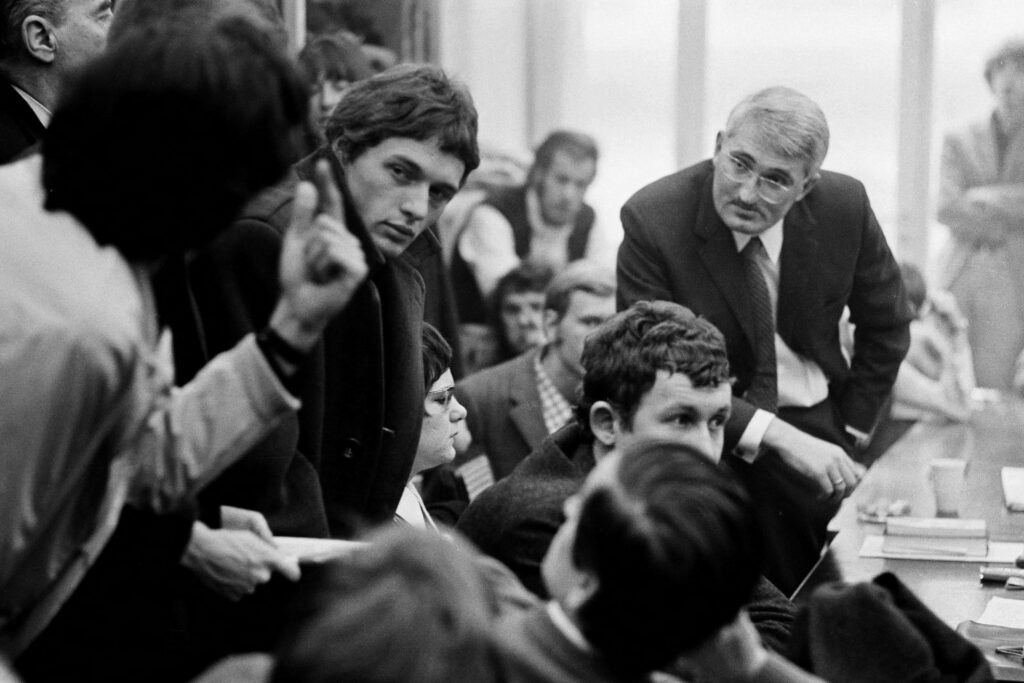
I first met Jürgen Habermas in January 1969, when I went to Frankfurt to do research for my doctoral dissertation on the Institut für Sozialforschung. Although not a protagonist of my story, which dealt with its history until 1950, he was generous with his time and advice. There was as yet no talk of a “second generation” of the Frankfurt School, whose most illustrious figure he was to become. In fact, the leading figures of the first generation—Max Horkheimer, Theodor W. Adorno, Herbert Marcuse, Leo Lowenthal, Friedrich Pollock—were very much alive and still intellectually kicking.
Although his work was only beginning to find its way into English, Habermas, not yet forty, had become a formidable presence in Germany. He was, in fact, already an embattled public figure, as Critical Theory’s tortured relationship to emancipatory practice was being tested by students demanding their teachers support a radical agenda. Habermas attempted repeatedly to engage with them, as did Marcuse, challenging the image of the Frankfurt School as aloof mandarins languishing in a “grand hotel on the edge of an abyss” in Lukács’ often-cited words.
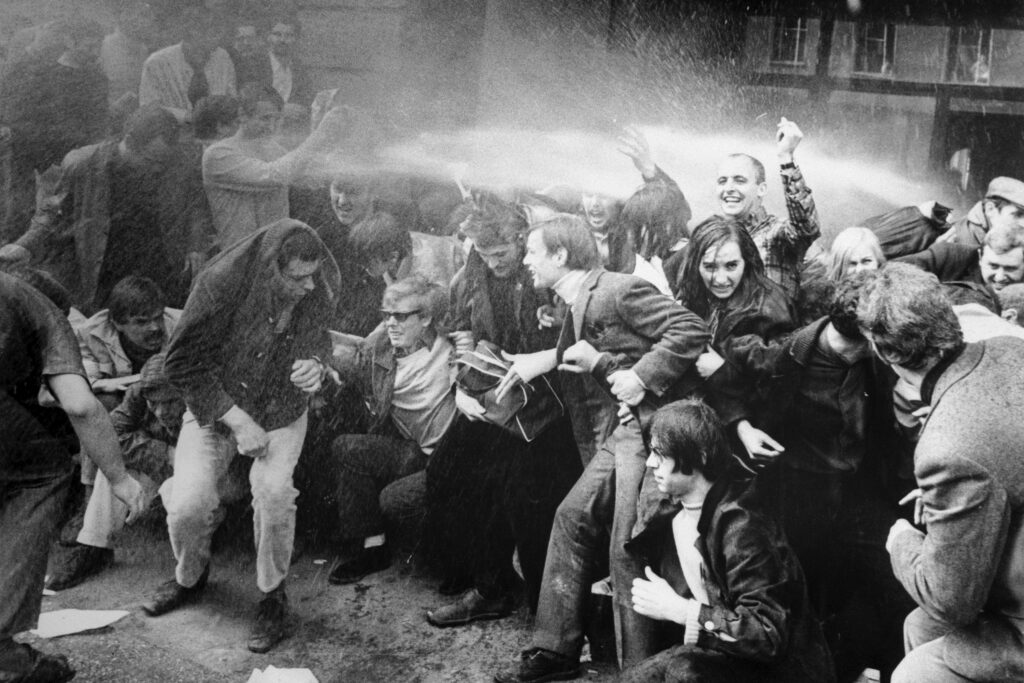
On a spectrum from Horkheimer, who was wholly unsympathetic to the student rebels, to Marcuse who urged solidarity with their cause, Habermas hovered uncomfortably somewhere in the middle. What he came to call Adorno’s “strategy of hibernation,” Habermas realized, was no longer the only option in an era when the “one-dimensionality” of the system was challenged by meaningful protest. And yet, there were dangers in assuming it was on the verge of collapse, he cautioned, or that nothing of value deserved to be retained from Germany’s ongoing recovery from its Nazi past. In June 1967, in the aftermath of the murder of the student Benno Ohnesorg during demonstrations against the Shah of Iran, Habermas had warned against the voluntarist impulses of radicals like Rudi Dutschke, who wanted to trigger a revolution before objective conditions were ripe. The German SDS was, however, unwilling to soften its uncompromising militancy, leading Habermas in his frustration to lash out at them with the stinging insult “left fascism.”
This is not the place to revisit the controversy that followed this incendiary charge, which soured Habermas’s reputation on the radical left for a generation. It may, however, be worth acknowledging that as imprudent as it seemed at the time, it did capture the “aggressive nationalist subtext”1 that anticipated the later rightward, even antisemitic turn of certain radical leaders. There is also a larger point to make about Habermas’s willingness to wrestle with his opponents in public forums, no matter the hostility of his audience. His outburst came, it should be noted, during his second speech of the day, after he had returned at midnight to continue his efforts to dissuade the students from their maximalist agenda and the temptation to use political violence to achieve it.
What Habermas exemplified then and in the many, many public debates that followed was the ideal of an “engaged intellectual.” This was not in the conventional sense that Sartre had made famous after the war in his demand that intellectuals should be engagé. That version meant unqualified, partisan commitment to a progressive cause, even to the point of subordinating the independent thought of the intellectual in its service. It was this conclusion in particular that Adorno sought to refute in his attack on “pseudo-activism” and the fetish for praxis in the defiant essay “Resignation” he wrote shortly before his death, where he uncompromisingly defended the autonomy of theory.2 Habermas shared his mentor’s resistance to being bludgeoned by those who incessantly invoked Marx’s “Eleventh Thesis on Feuerbach” as justification for disrupting the status quo “by any means necessary.” But unlike Adorno and Horkheimer, he was hopeful of at least narrowing the gap separating theory from praxis, and to that end he argued directly with his activist opponents. Significantly, he retained the militant Marxist Oskar Negt as his Scientific Assistant, even after the latter edited a collection of essays in 1968 called Die Linke antwortet Jürgen Habermas (The Left Answers Jürgen Habermas) and developed, along with Alexander Kluge, a notion of the “proletarian public sphere” to rival Habermas’s bourgeois version. Negt later admiringly wrote that “I have never again in my life met a person who, in trying to find the truth, attaches as much weight to the exchange of arguments as Habermas.”3
There was, to borrow one of Habermas’s own favorite polemical ploys, no “performative contradiction”4 between his theory of “communicative action” and his own role as a public intellectual. The former placed enormous value on the intersubjective exchange of ideas without regard for the status or power asymmetry of their proponents in the hope that the better argument would prove persuasive. The latter manifested in a lifetime of interventions in the most urgent issues of the day, where the continuity between his most refined theoretical work and his advocacy of specific political positions can be readily discerned.
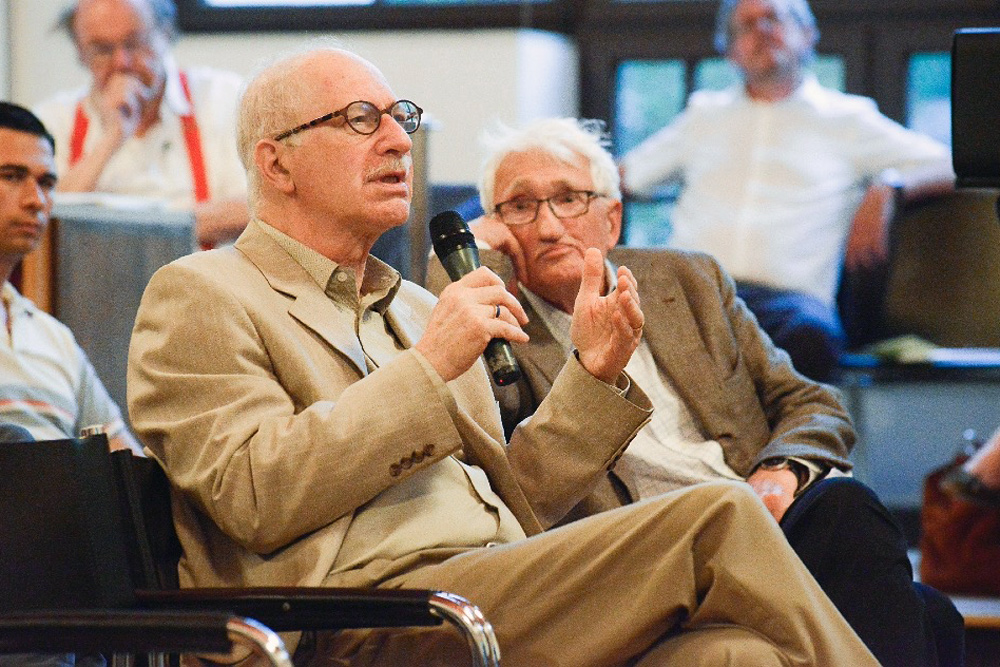
All of this will be well known to followers of Habermas and has often been invoked to exemplify the communicative rationality that he defended over his long career. At its heart was the obligation to give reasons and justifications for one’s opinions, rather than falling back on authority, intuition, or revelation. It was the basis of his political faith in deliberative democracy or what might be seen as the equiprimordiality of reason and will in generating legitimate political action. It was also the source of chagrin on the part of critics who lamented any hint of a liberal or neo-Kantian reimagining of Critical Theory, whose roots in Marxist historical materialism they insisted should be more explicitly acknowledged.
Habermas was, indeed, a powerful advocate of expanding what Wilfrid Sellars had called the discursive “space of reasons,” and never gave up on the public realm even when his arguments failed to win the day. He held out hope, regressions notwithstanding, for a long-term “learning process” involving not only technological and scientific progress, but political and even moral improvement. A child of the Nazi era, he came of age when Europe in general and Germany in particular had survived its “civilizational break” and finally cast its lot with the “uncompleted project of modernity.” Horkheimer and Adorno’s bleak reading of its dialectical inversion, in which reason has been reduced to its instrumental variation, Habermas resisted as itself undialectical.
Much can be said about the fundamental optimism, perhaps even naiveté, that informed Habermas’s dogged adherence to the legacy of the Enlightenment. When the euphoria that followed the end of the Cold War and expansion of the European Union as an engine of cosmopolitan post-nationalism faltered, it seemed as if his moment had passed. Among those on the left who enjoyed competing with their rightwing counterparts in “owning the libs,” he became an inviting target. Habermas’s respect for America as the beacon of deliberative democracy and upholder of human rights was discredited, his belief in the pacifist credo “nie wieder Krieg”—never again war— shattered. The cynical realists who knew all along that power always trumps reason ironically found common cause with the morally outraged champions of the Palestinian cause who bridled at his stubborn support of Israel’s right to exist.
Habermas himself was painfully aware of the gravity of the global situation and its implications for the realization of his hopes. During my last visit to Germany in September 2024, he lamented a missed opportunity to get together because of his ill health: “I would have liked so much to talk about the depressive state of our countries—and even the world in general. I am more pessimistic than any time so far.”5 It cannot have been easy in his tenth decade to wonder if his life’s work, which he had pursued so vigorously and saw greeted with such extraordinary interest around the world,6 had been in vain.
Now that he is gone and a concluding balance sheet of his remarkable career can begin to be compiled, it would be foolish in the extreme to measure his abiding legacy by the vagaries of the moment, or to cancel seven decades of theoretical work and political interventions because of one misstep in his mid-nineties on the war in Gaza. Not only will Habermas’s voluminous writings remain a valuable resource for anyone concerned with the many philosophical, political, and social questions he addressed, but so will the example he set as an “engaged intellectual.” One aspect of his practice of communicative interaction, which I personally experienced in many ways, stands out as worthy of special mention. Jürgen Habermas knew that offering justifications and making arguments was only one facet of a discursive deliberation, which was more than a polemical, zero-sum contest of unchangeable positions; equally important was knowing how to listen to the reasons and justifications of others in the conversation and to be open to learning from them. The legal and political theorist Cass Sunstein said it well in his obituary tribute to Habermas: “He was so curious, and so generous. He was a bit formal, but so kind. He seemed like the world’s best listener.”7
I first became aware of Habermas’s special talents as a listener at the international conference organized in the fall of 1980 at the Max Planck Institute in Starnberg by Wolfgang Bonß and Axel Honneth on the theme of “Social Research as Critique.”8 By the time the conference took place, Habermas was ending a somewhat rocky tenure as co-director of the Institute and was not listed on the official program as a speaker. At the end of two days of very intense papers given by several of the rising stars of Critical Theory—including Seyla Benhabib, Axel Honneth, Jean Cohen, Moishe Postone, Helmut Dubiel, Alfons Söllner, Giacomo Marramao, and Douglas Kellner—Habermas took the floor. To our astonishment—or at least of those who had not been his direct students or colleagues—he proceeded to provide a twenty-minute summary and critique of all the talks that had gone before. Not only had he been listening with sustained attention, but he had also somehow figured out how the arguments were related and what larger pattern tied them all together. It was a virtuoso performance in what can be called “structural listening.”
My second direct experience of his astuteness as a listener came in 1984, when Habermas replied to a series of essays in Praxis International by Richard Rorty, Thomas McCarthy, Joel Whitebook, and myself, which appeared a year later in a book edited by Richard Bernstein with additional contributions by Albrecht Wellmer, Anthony Giddens, and Habermas himself.9 My contribution, titled “Habermas and Modernism,” explored the complicated role aesthetic rationalization played in his account of the differentiation of value spheres in the modern world. I pushed him to clarify what he meant by validity testing, rationality, and a learning process in the aesthetic sphere as well as what its mediation with the other spheres, cognitive and ethical, might mean in relation to the lifeworld out of which they came. The other critics asked probing questions about various aspects of his theory, and the challenges to it posed by postmodernists like Jean-François Lyotard. His response, significantly titled “Questions and Counterquestions,” was a model of patient, careful, open-minded, non-defensive interaction, in which he wove his reply to my concerns into the fabric of a sustained reflection on the most fundamental issues raised by his interlocutors. Here, as in many other instances, he engaged with critics, hearing their objections and coming up not with discussion-ending, clinching rebuttals but counter-questions of his own to keep the conversation going.10 No other thinker of his eminence was as dedicated to intellectual intersubjectivity as Habermas, performatively enacting his substantive critique of “consciousness philosophy” as a limited exercise of the individual mind reasoning alone.
To appreciate the larger implications of Habermas’s art of listening, it’s worth recalling an influential essay Adorno wrote in the Zeitschrift für Sozialforschung in 1938, “On the Fetish-Character of Music and the Regression of Listening.” Drawing on Marx’s critique of the fetishism of commodities for failing to situate exchangeable products in the larger relations of production that created them, he argued that hearing music in late capitalism had also regressed into a fetishization of isolated parts—repeated melodies, instrumental or vocal acrobatics, coloristic arrangements, and the like—that undermined the ability to hear the composition as a whole. In addition to being aesthetically debilitating, atomistic or reified listening, unlike its holistic or structural alternative, also thwarted the critical power of music to challenge the status quo: “Not only does the musical synthesis preserve the unity of appearance and protect it from falling apart into diffuse culinary moments, but in such unity, in the relation of particular moments to an evolving whole, there is also preserved the image of a social condition in which above those particular moments of happiness would be more than mere appearance.”11
I cannot vouch for Habermas’s skill as a musical listener, but when it came to attending to the immanent structure of the arguments of others and their place in a larger discursive context, he had few rivals. Not only did his talent in this regard make him a remarkable interlocutor in the public sphere, but it also helps explain two other important dimensions of his work. It is often noted, if rarely with admiration, that Habermas felt obliged to prepare his own arguments by plodding through those of his theoretical predecessors. Mammoth tomes like The Theory of Communicative Action, Between Facts and Norms, and Also a History of Philosophy include extensive accounts of an enormously wide range of earlier thinkers—philosophers, theologians, political, legal, and social theorists—who formulated and addressed the questions Habermas was himself endeavoring to answer.
Unsympathetic readers often invidiously compared the labored results of these reviews of his predecessors to the more concise, eloquently crafted aphorisms in Adorno’s Minima Moralia and Horkheimer’s Dämmerung. Aphorisms have a long and honored history among German intellectuals from Lichtenberg and Nietzsche to Karl Krauss and Ernst Bloch. Although they often make for much more enjoyable reading and were easier to reproduce on coffee mugs and t-shirts, Habermas seems never to have been tempted to try his hand. Perhaps his allergy to confusing philosophy with literature, which was manifest in his disdain for post-structuralism in The Philosophical Discourse of Modernity and elsewhere, was one reason.
A more suggestive explanation would be Habermas’s commitment to structural listening in which the final product of an ongoing process of argumentation is not isolated from its genetic origins. Aphorisms, in fact, have sometimes been called authoritarian in their hiding of the preliminary steps taken to reach the lapidary conclusions they deliver with such rhetorical force. No weighing of contrary arguments, no sustained presentation of confirming evidence, no admission of uncertainty. As Alexander García Düttmann points out in his analysis of Minima Moralia, they operate with the force of “so ist es,” or “that’s the way it is.”12 When they click, the reader gets the point in a flash of recognition, as if the whole is crystallized in a telling detail that opens a world of meaning. But if they misfire, the reader is left wondering what nuggets of wisdom can be taken away from a gnomically uttered pronunciamento. In contrast, no one is left with the impression that Habermas came to his conclusions without listening to and learning from the efforts of his predecessors. In a way, his commitment to situating his own ideas in an ongoing dialogic or better plural-logic conversation embodies the values of deliberative democracy in which the art of attentively hearing the arguments of others is as necessary as the skill of making persuasive arguments of one’s own.
There is one significant way in which Habermas’s practice of structural listening differed from the model Adorno introduced in musical terms. The latter assumed that the music itself was composed with the intention, in the words cited above, of producing a “unity of appearance… in an evolving whole,” and so the skilled auditor was expected to discern and appreciate what was already there. Habermas, in contrast, listened to prior arguments with the hope of integrating them into what he called a “rational reconstruction” in which his own retroactive efforts were necessary to locate the pattern immanent in the material to which he was responding. There was, in other words, a more intersubjective balance between present and past in discursive listening than in its aesthetic counterpart, a need to fuse horizons, as Hans-Georg Gadamer put it, rather than passively discern the holistic structures latent in the material heard. As such, it was more emblematic of the dialogic interaction of deliberative democracy than the expert listening of a musical adept.
The second insight that comes from appreciating his listening skills concerns a distinction I had not fully grasped until I recently reviewed the second volume of Habermas’s Also a History of Philosophy.13 I sent a copy to him in May 2025, with a note of admiration for his mastery of centuries of medieval theology. A day later, he graciously replied: “I have immediately and with great curiosity – and satisfaction – read your review of the second volume. This part of the book was for me the most difficult and took the longest time, as you will imagine – I am not a historian after all. But you have hit my intention. I am very grateful that you again took pains to read the stuff and to write this wonderful piece.”14 I cite these words, the last I have from Habermas, not only because they movingly express the mutual warmth of our decades long friendship, but also because of the significance of his italicized disclaimer for the larger point it supports about his listening skills.
When he entered the fraught debate over the relativization of the Holocaust that became known as the Historikerstreit, Habermas had been chastised by leading professional historians such as Ernst Nolte, Michael Stürmer, Andreas Hillgruber, Joachim Fest, and Klaus Hildebrand for daring to trespass on their territory. He freely admitted that he was a layman when it came to historical research but insisted that as a citizen of the Federal Republic he had a right to intervene. The revisionist accounts of his opponents, he charged, had trivialized the crimes of Nazism and undercut the still urgent need to come to terms with its legacy. They were intended to resurrect German ethnonationalism and thwart efforts at replacing it with the “constitutional patriotism” he had tried to promote with the American experience in mind.
Much can be said about the still reverberating implications of the debate, for example, on the highly fraught issue of the uniqueness of the Holocaust. Ironically, Habermas had originally defended it against right-wing nationalist efforts at exculpating relativization but then later fell back on the same defense when leftists challenged its function in the very different debate over genocide in Gaza. That he continued to deny—and in italics!—his right to be called a historian is, however, what interests me now. For it reflects the difference, broadly speaking, between the way he “listened” to the past and the way historians are trained to do so. Normally, the latter are warned against excessive presentism and “precursoritis” in which the original context of ideas and actions is ignored, and a teleological narrative is imposed on the past. They are trained instead to craft more “objective” or “dispassionate” representations that bracket as much as possible current concerns and values.
Habermas’s more intersubjective rational reconstructions, in contrast, were always driven by a critical function in the present. When he acknowledged my grasping his intention, what I think he meant is that it was right to read his journey through medieval theology as a way to ground the origins of communicative interaction in the religious practice of a second-person, I-Thou dialogue between God and sinner rather than the third-person attempt to know God’s metaphysical attributes. In other words, the legacy of religion should be understood in performative terms rather than the substantive ones favored by political theology, which reduces secularized ideas to old wine in new bottles.
There is, it seems to me, enough reward in both styles of listening to preclude choosing one over the other. Now that Habermas has himself passed into history, professional historians can complete the preliminary work of biographers like Stefan Müller-Doohm, Matthew Specter, Martin Beck Matuštík, and Philipp Felsch, and place him in the multiple contexts in which his ideas were generated, interpreted, and applied. Following the model of attentive musical listening advocated by Adorno, this will involve interpreting the entire career and the milieux in which it developed rather than fetishizing only one moment in it in the manner of the regressive, atomized listening of the modern culture industry (as some critics of his unfortunate Gaza intervention have been wont to do). But even more fruitful would be to “listen” to Habermas’s legacy in the mode of active attentiveness that he practiced, which will mean placing it in post-facto rational reconstructions yet to come. Rather than relegating Habermas to a past that can be contemplated from afar and turning his ideas into mere expressions of the Geist of his particular Zeit, it will honor his example of avoiding authoritative conclusions that terminate discourse by instead posing counter-questions that keep the conversation going. To do so may be the best way to relax the grip of the pessimism that overwhelmed him at the end of a life that was dedicated to critique as an interminable, intersubjective exercise with an emancipatory practical intent.
Martin Jay is Sidney Hellman Ehrman Professor Emeritus of History at the U. of California, Berkeley. His most recent book is Magical Nominalism: The Historical Event, Aesthetic Disenchantment and the Photograph.
- Elliot Neaman, Free Radicals: Agitators, Hippies, Urban Guerrillas, and Germany’s Youth Revolt of the 1960’s and 1970’s (Candor, NY: Telos Press, 2016), p. 223. ↩︎
- Theodor W. Adorno, “Resignation,” Telos, 35 (1978). ↩︎
- Cited in Stefan Müller-Doohm, Jürgen Habermas: A Biography, trans. Daniel Steuer (Malden, Mass.: Polity, 2016), p. 317. ↩︎
- See Martin Jay, “The Debate over Performative Contradiction: Habermas vs. the Post-structuralists,” in Zwischenbetrachtungen: Im Prozess der Aufklärung, eds. Axel Honneth et al. (Frankfurt: Suhrkamp, 1989) and Philosophical Interventions in the Unfinished Project of Enlightenment (Cambridge, Mass.: MIT Press,1992). ↩︎
- Jurgen Habermas to Martin Jay, September 24, 2024, in private email. The opposition of optimism and pessimism is, of course, dependent on the possibilities being considered. For his critics on the left, Habermas had long since shown unremitting pessimism about the overcoming of capitalism, the possibility of direct popular sovereignty, the democratization of money, etc. For one example of many, see Perry Anderson, “Norming Facts: Jürgen Habermas,” in Spectrum: From Right to Left in the World of Ideas (London: Verso, 2005). ↩︎
- If there be any doubt of this fact, see Luca Corchia, Stefan Müller-Doohm, and William Outhwaite eds., Habermas Global (Frankfurt: Suhrkamp, 2019), which has almost 900 pages of essays covering his reception around the world. ↩︎
- Cass Sunstein, “On the Death of Jürgen Habermas: A Day to Mourn, A Day to Celebrate,” Cass’s Substack, March 14, 2026, https://casssunstein.substack.com/p/on-the-death-of-jurgen-habermas
The importance of listening in democratic deliberation has recently been explored in Matt Qvortrup and Daniela Vancic, eds., Complementary Democracy: The Art of Deliberative Listening (Berlin: De Gruyter, 2022); “Listening as a Power in Political Communication,” Political Communication, 42 (2025): https://doi.org/10.1080/10584609.2025.2498524 ↩︎ - The proceedings appeared as Sozialforschung als Kritik: Zum sozialwissenschafltichen Potential der Kritischen Theorie, eds. Wolfgang Bonß and Axel Honneth (Frankfurt: Suhrkamp, 1981). ↩︎
- Richard J. Bernstein, ed., Habermas and Modernity (Cambridge, Mass.: MIT Press, 1985). ↩︎
- For other examples, see John B. Thompson, and David Held, eds., Habermas: Critical Debates (Cambridge, Mass.: MIT Press, 1982); Craig Calhoun, ed., Habermas and the Public Sphere (Cambridge, Mass.: MIT Press, 1992): and Craig Calhou, Eduardo Mendieta, and Jonathan VanAntwerpen, eds., Habermas and Religion (Malden, Mass: Polity, 2013). ↩︎
- Theodor W. Adorno, “On the Fetish-Character of Music and the Regression of Listening,” in The Culture Industry: Selected Essays in Mass Culture, ed. J.M. Bernstein (London: Routledge, 1991), p. 28. ↩︎
- Alexander García Düttmann, So ist es. Ein philosophischer Kommentär zu Adornos ”Minima Moralia”
(Frankfurt: Suhrkamp, 2004). ↩︎ - Martin Jay, Review of Also a History of Philosophy, Vol: II: The Occidental Constellation of Faith and Knowledge, Notre Dame Philosophical Reviews, May 6, 2025,
https://ndpr.nd.edu/reviews/also-a-history-of-philosophy-vol-ii-the-occidental-constellation-of-faith-and-kno
wledge/ ↩︎ - Jürgen Habermas to Martin Jay, May 18, 2025, in author’s private email collection. ↩︎