Materials Conditions
“All that is solid melts into air,” Marx and Engels wrote in the Communist Manifesto in 1848—a lyrical opening to a blistering sentence that indicts life under capitalism. For architects and urban planners, though, most solid stuff does not melt at all, and that, too, is a political matter.
Take the eventful history of the construction materials of Bulevardi 21, a palatial building at one of Helsinki’s most elegant addresses. Erected in 1899, it took on the honorable role of housing the Soviet diplomatic mission in 1922. During World War II, when the USSR attacked Finland and dropped explosives on its capital, Finns witnessed what might be the only case in the history of aerial bombing in which a foreign army hit its own embassy—not once, but twice. First in 1939, causing modest damage. Then in 1944, inflicting severe harm (though all diplomats had already vacated the building by then).
When peace returned, the Soviets received a new plot of land. The Finnish government ordered the demolition of the dilapidated structure on Bulevardi 21, and in the resource-hungry postwar years, all the materials were donated to the Helsinki University of Technology, whose new campus was being built on the outskirts of the city. Young people flocked to the site, sifting through the rubble—“the world’s largest voluntary student effort,” according to Aalto University. Some 800,000 bricks were transferred to Espoo, west of the capital, where they were used to erect a group of four- to five-story buildings designed by the architects Heikki Sirén and Martti Melakari.
Helsinki hosted the Olympic Games in 1952, and amid Cold War tensions, Eastern Bloc athletes were housed separately from the other athletes in the main Olympic Village. The Communists were sent to the student village built with material from the destroyed embassy. A photo from that year shows the Soviet delegation near a tidy modernist building. On the facade of familiar red bricks hung a portrait of Stalin, almost as large as a window. It is unknown whether the guests were aware of the bricks’ origin.
I walk near that site, on what is today the Aalto University campus, quite often. I learned about this odd story, with its whiff of geopolitical mockery, in September 2025, just a few days after another architectural project also featuring a facade of recycled bricks had hit the headlines. That’s the Architecture & Design Museum Helsinki, one of the most significant public–private cultural investments in the Nordic countries, not to mention a symbol of Finland’s efforts to enhance its soft power and turn its back on Vladimir Putin’s bellicose Russia. Designed by the Finnish firm JKMM, the museum reflects one of the most influential ideas in the built-environment debate of the last decade: circularity—the tenet that current practices behind the built environment, which are notorious contributors to atmospheric emissions and resource consumption, need to adapt to climate change by focusing on material ecology at large. Concerns over environmental damage and concerns over the waste of building materials are, effectively, joined at the hip.
Circularity holds that architects must question the very idea of erecting new structures and should instead reuse, repair, and transform existing buildings. When something does need to be built from scratch, as much recycled material should be employed as possible. The theory applies to all buildings that are structurally sound, not just those protected by heritage conservation because of their historical value or those that have market appeal, such as industrial warehouses turned into fashionable lofts.
The principles of circularity have now come to enjoy extraordinarily broad support. Beyond a near consensus in the progressive wings of academia and among avant-garde architectural firms, they are embraced by design firms of all sizes and major municipalities. Even building-materials companies and real estate developers, nudged by stricter environmental regulations, have started to praise reuse against the usual cycle of demolition and new construction. The COVID-19 pandemic inadvertently lent a hand: After much office space became unnecessary, those half-empty towers could be converted into housing. In 2024, Kristiaan Borret, then the chief architect of Brussels, said that roughly 40 percent of building permits for large-scale housing in the city concerned the conversion of former offices. In 2021, the most coveted accolade in the discipline, the Pritzker Prize, went to Lacaton & Vassal, a French architecture firm whose founders learned a resourceful approach to design in Niger in the early 1980s and spent the following decades championing the low-carbon restoration of existing buildings in Paris, Bordeaux, and Dunkirk, including modernist social housing complexes at risk of demolition.
Circularity is not a prerogative of the Old Continent, of course, but it is there that this sensibility has gained the most ground. It has been further strengthened by the efforts of charismatic activists, before taking on a political dimension. The Lausanne-based architect Charlotte Malterre-Barthes, advancing a scorching critique encompassing economics and critical theory, has called for “a moratorium on new construction”(the title of her 2025 book).
Last year,the nonprofit HouseEurope! organized a signature-gathering campaign to encourage EU regulations that favor preserving and adapting existing buildings “over demolition and rebuilding driven by financial speculation.” Signs at its booth at the 2025 Venice Architecture Biennale, which I co-curated, cried out: “We are fucked! You can change it!” The group fell short of gathering the one million signatures it sought for its petition, but this year it, along with the transnational and federalist party Volt Europa, launched a new initiative dedicated to the right to housing that emphasizes the need to make better use of empty dwellings.
Some of today’s most talked-about projects explore reuse and circularity in various forms. In Copenhagen, there is Thoravej 29, a mid-century factory that Pihlmann Architects overhauled into a community center, acrobatically tilting its horizontal concrete slabs to turn them into stairs. The firms Architecten Jan De Vylder Inge Vinck and AgwA stripped to the bone the colossal Palais des Expositions in Charleroi, Belgium—a project the critics Andreas and Ilka Ruby call “an archeological excavation.” The Chinese curators of next year’s Venice Architecture Biennale, Wang Shu and Lu Wenyu, established their reputation two decades ago with a museum in Ningbo made with waste from demolished villages.
Demolitions remain the industry’s norm, however—in Europe, one building is destroyed every minute—even as boasting about them has become less acceptable. Recycling processes are far from fully efficient environmentally, and many self-styled circular actions are little more than symbolic, with limited impact on CO2 production or energy consumption. It’s one thing to recycle facade tiles or window frames. It’s a very different one, and much more complicated in terms of regulatory compliance and short-term costs, to preserve load-bearing structures made of concrete, the number-one polluting material, or to come up with ways to reuse entire buildings otherwise deemed obsolete. Still, a pan-European progressive environmental activism has emerged.
What are its chances? Those depend in part on the current geopolitical upheaval worldwide, which is calling established categories of environmentalism into question.
Circularity Meets the War Ecology
The story of those two brick facades in Helsinki reveals that circularity is nothing new in Europe. In fact, it has existed for a very long time, under different names, driven by concerns that had little to do with environmental awareness in the contemporary sense. Reuse practices of yore typically were a response to scarcity, and often were tangled up with the effects of coercive rule, imperial seizure, or war.
Take spolia, the term antiquarians and artists have used for centuries to refer to repurposed architectural fragments in buildings or sculptures from the Classical era to the Middle Ages. (The original Latin word simply meant spoils, as in the booty of war.) In parallel, scholars of “urban metabolism” have long documented extensive recycling practices, including of construction materials, in the world’s largest human settlements, that blur the boundaries between traditional ideas of waste and useful resources. The economy of reuse thrived in nineteenth-century Paris, when Georges-Eugène Haussmann’s sweeping plan to redesign the city triggered massive top-down destruction. In 1883, the contractor-salvager Achille Picart demolished the burned-out Palais des Tuileries and quickly sold off the reclaimed material. One of the buyers was a Corsican aristocrat whose family had had a feud with the Bonapartes; moving stone from the Tuileries to his villa was a form of revenge.
In the twentieth century the so-called linear economy gradually emerged, first in the US, where local building owners and managers invented the principle of obsolescence. The paradigm’s adoption across the Atlantic was slowed down by the destruction brought about by the two world wars and the imperative to systematically manage the rubble.
In the aftermath of World War II, the peoples of Europe got busy reusing on a large scale bricks, concrete, and metal from bombed-out buildings: The Polish historian Adam Przywara recently described this as “wartime circularity.” But given the overwhelming destruction, not everything could be processed. Tons of debris were moved away and buried, resulting in the grassy urban hills Germans call Trümmerberge and other features around various European cities, from Milan to Warsaw. By the 1950s and 1960s, as the physical reconstruction of the continent spurred economic growth—the construction industry in West Germany expanded by 600 percent between 1950 and 1965; cement sales, by 300 percent—the resort to rubble gradually disappeared.
The ecological strand of architecture that informs reuse theory today is usually thought to have emerged in the 1960s, and it was often inflected by the anti-capitalist stance of the era’s avant-gardes. From that niche, it has become somewhat mainstream this century thanks to popular books like William McDonough and Michael Braungart’s 2002 Cradle to Cradle: Remaking the Way We Make Things and the recent advocacy of NGOs such as the Ellen MacArthur Foundation. Although this kind of environmentalism also is about scarcity, it now hinges on a different understanding of the limits of resources and concerns about what the Stockholm Resilience Centre calls “planetary boundaries”—all while remaining inscribed in the still-prevailing liberal, market-oriented mindset.
And yet today that world order is teetering. In his wide-ranging 2025 book Le monde confisqué, the French economist and historian Arnaud Orain argues that a new phase of mercantilism is afoot. Previous phases—such as the periods between the sixteenth and eighteenth centuries, and 1880–1945—offered their own philosophy of scarcity, essentially a Malthusian view that planetary resources were limited and that the prospect of depletion threatened the survival of competing national populations. According to Orain, a new ideology, the “capitalism of finitude,” is now replacing neoliberalism. It puts forward a zero-sum vision of international relations coupled with a pretense of caring about environmental concerns, which allows both governments and monopolistic corporations (or “company-states”) to justify para-imperial actions: the appropriation of foreign resources that are supposedly managed inefficiently or the purchase of ever-larger swaths of land and forests abroad to obtain carbon-offsetting credits.
How will the liberal environmentalism that underpinned European-style circularity now react to neomercantilism? A first attempt to theorize the relation between these two elements is at the core of Pierre Charbonnier’s 2024 book Vers l’écologie de guerre (upcoming in English with the title War Ecology: An Environmental History of Peace).The book describes how the post–World War II liberal order depended heavily on cheap fossil fuels and the related promise of global enrichment—and how that order, artificially kept alive for so long, collapsed definitively in February 2022, with the start of Putin’s “special military operation” against Ukraine.
One of the starkest manifestations of this change is the sacrifice Europeans have been asked to make in energy policy since then, as they try to reduce their dependence on Russian fossil fuels in order to defund the Kremlin’s war machine. Nearly five years later, that objective has not been met, nor has there been a decisive pivot to renewable sources of energy. But going back to the previous world of extractivist peace is impossible, Charbonnier argues, because even when there is no fighting, environmental destruction caused by climate change cannot be pushed out of the picture: “The climate crisis is a consequence of peace, more so than of war itself.”
Charbonnier’s term and paradigm “war ecology” was born of the struggle to define a new, at times more belligerent, world order that takes environmental questions into account. Much like the war economy puts industrial production at the service of military breakthroughs, the “war ecology” enlists environmental arguments in the service of geopolitical interests.
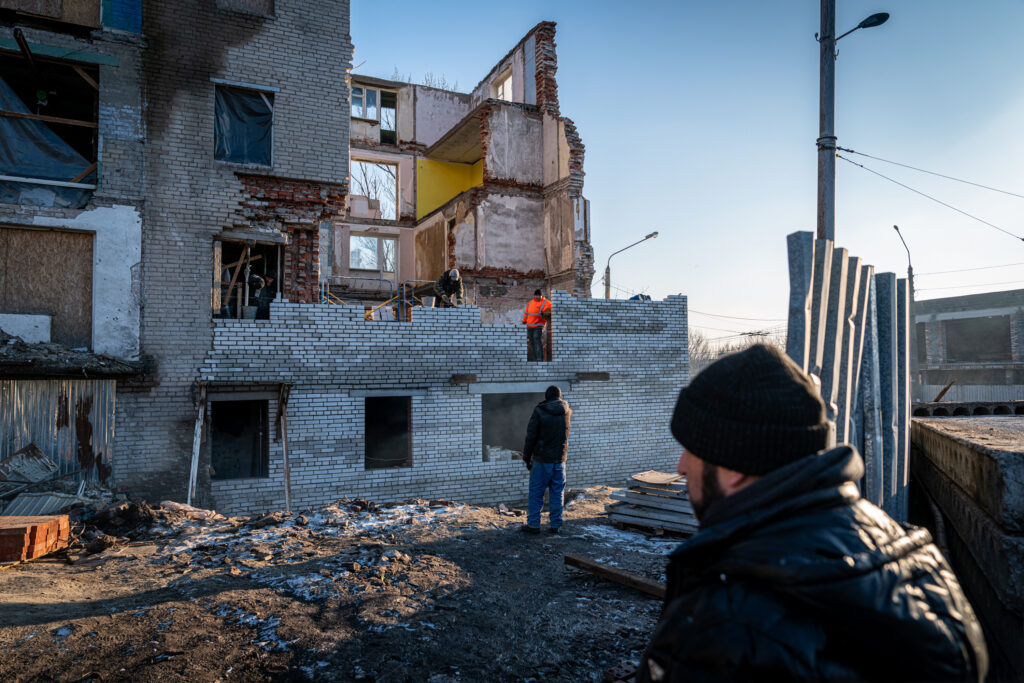
Efforts in Ukraine to recycle materials damaged by Russian bombings dovetail with the government’s plan to meet the environmental targets the country must satisfy to join the EU. In other words, Ukraine is using circularity to hedge its future away from Russia, under the umbrella of Brussels. In turn, Brussels is channeling funds to promote environmental objectives in the country even as Russian attacks continue.
Since the full-scale invasion, cities in Ukraine have been developing ecological processes that did not exist before. In the east of the country, where shelling has been the most severe, the city of Kharkiv has been scrambling to establish protocols for recycling materials. The first step is to create a single site for storing them and then to crush the rubble so it can be used in road paving. The next step is a more careful analysis of what could be reused in construction. One of the most fascinating experiments underway in Ukraine is Circularity on the Edge, a project by a team of young researchers featured at the 2025 Venice Architecture Biennale that explores how to use AI tools to salvage materials from damaged buildings. Delegating the search for viable rubble to machines would be a gain in safety, especially given the widespread use of asbestos in the roofing of Soviet-era housing.
Across the country, nonprofit organizations promoting the circular economy, including platforms for buying secondhand materials or getting instructions on how to treat rubble, have popped up in number. At the New European Bauhaus Festival in June, thirteen Ukrainian initiatives around circularity were presented to European Commission President Ursula von der Leyen. They featured research on reusing concrete and various bio-based materials. The NGO METALAB has been helping house Ukrainians displaced by the war, at times using recycled components, some imported, including windows salvaged from demolished buildings in Switzerland.
A Continent of Unloved Buildings
Charbonnier’s “war ecology” label is neither optimistic nor pessimistic. It is an interrogation about whether environmentalists in Europe should embrace an aggressive geopolitical stance that allows them to advance the green transition at home. And if so, for how long? Orain suggests that that “war ecology” isn’t relevant only during armed conflict, because the capitalism of finitude has produced a permanent condition of neither war nor peace.
It is against this theoretical background that environmental ideas are now being reframed. EU policy on reuse in architecture has embraced a focus broader than just construction and the built environment. The headquarters of the EU Council in Brussels, inaugurated in 2016, has a facade composed of thousands of reclaimed wooden window frames, and circularity has long been on the bloc’s economic radar. But since Putin’s war in Ukraine and especially after Trump’s reelection, the concept has become strategic. Rather than depending on unreliable sea routes or unsavory trade partners, European states want to buttress their economic resilience by relying more on resources at or near home.
The EU’s Circular Economy Act, up for adoption before the end of the year, seeks to create a single market for secondary raw materials, in the hope of encouraging businesses to circulate and resell what would otherwise become waste. Enrico Letta, a former prime minister of Italy and the author of a 2024 report on the future of the EU single market, has said that circularity is now “part of the European Union’s strategic autonomy.” The topic also surfaces in discussions about the provision of critical raw materials. Old buildings will become a kind of materials bank from whichto retrieve copper, steel, and aluminum, as well as lithium, cobalt, and rare earths, scraped from heat pumps or battery storage.
Europe might need a single market to tackle what is undoubtedly the largest challenge of circularity it will face in the decades ahead: what to do with the gargantuan stock of buildings from the recent past, particularly the period of intense urbanization between 1960 and 2000—the built legacy of the latter stage of the extractivist fossil-fuel-driven peace described by Charbonnier.
The face of cities across Europe changed forever during those decades. That was partly because of the construction of acclaimed art museums, public libraries, skyscrapers, and other big-ticket projects that tend to be featured in architectural books. But mostly it was because an enormous amount of functional construction—houses, offices, malls, schools, hospitals, gyms, warehouses, industrial facilities—took place.
When it comes to assessing today the value of these more mundane structures, many fall into an awkward intermediate zone. They are too recent to be considered for heritage status but too old to be left as they are, since they show signs of decay or no longer meet current needs. If they were slated for razing, few people would march in the streets to protect them. An upcoming book (which I co-edited with Candela de Bortoli) by Lasse Lind and Kåre Stokholm Poulsgaard of the Danish architecture and innovation firm 3XN GXN calls them “unloved buildings.” And unloved they will continue to be, until circularity compels a change in point of view, inviting us to love the unloved or at least better cope with them.
Out of the Capitalism of Finitude
How to make do with this legacy will be a fundamental challenge for Europe on at least two levels. The first has to do with finding architectural solutions amid the war ecology. The second is about the broader cultural conflicts around it.
Regarding architectural practice: One difficulty is that there are so many unloved buildings that it is hard to speak for all of them at once. Yet there is a fundamental, and useful, difference between how best to tackle housing versus office buildings. Since the second half of the twentieth century, disputes around architecture have reached their acme around modernist mass housing and urban planning. Every European metropolis seems to have its bogeyman: Robin Hood Gardens in London, Le Vele in Naples, Mjølnerparken in Copenhagen. Disagreements and debates about what to do with those projects sometimes led to demolitions, which disproportionately affected the most marginalized populations. And yet Europe needs a lot of affordable housing, and so optimizing the existing building stock cannot but be a priority.
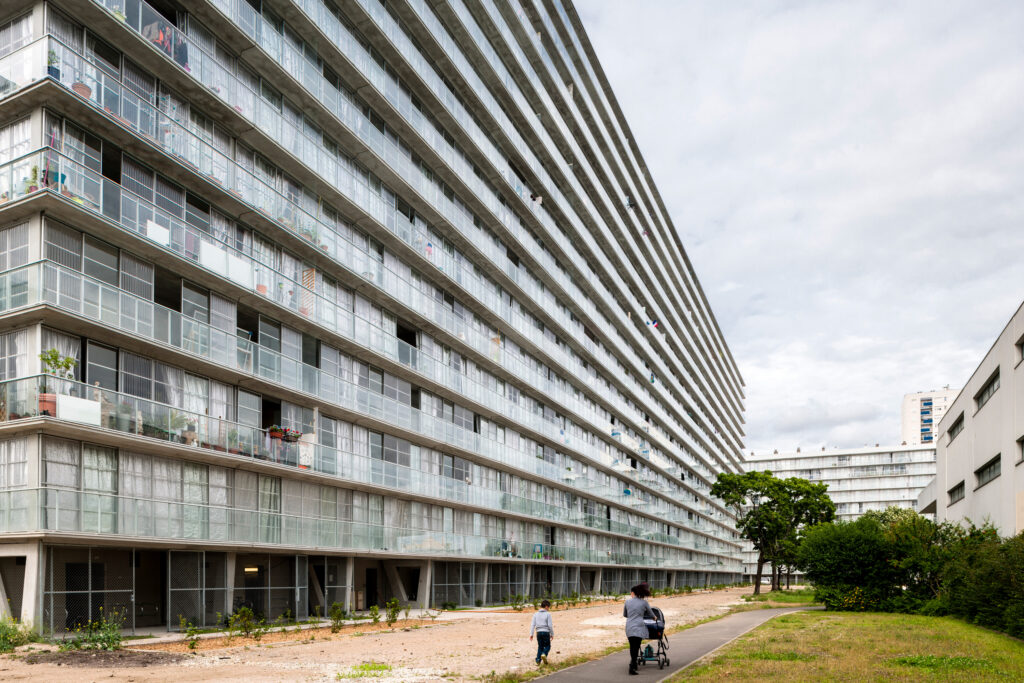
Lacaton & Vassal’s transformation project of Grand Parc in Bordeaux is often praised as a prime success of urban circularity in housing. Completed in 2017, the project superimposed spacious, diaphanous loggias onto the unattractive facade of a 1960s public housing complex. The project’s cost was low enough to persuade the development’s operating company to keep the wrecking ball away. The planet was spared a massive amount of extra CO2 emissions. Tenants got larger, more dignified dwellings.
Renovating or transforming offices is equally crucial, because these buildings epitomize the logic of urban obsolescence. Towers in business districts are especially bulky and especially costly to refurbish, and regulations for doing so are still in their infancy. Some of the most ambitious projects in this realm—from the architectural collective 51N4E’s overhaul of Brussels’s former World Trade Center to 3XN GXN’s ongoing transformation of the 124-meter-high Euston Tower in London—combine multiple strategies: retaining certain preexisting structures, relocating others within the same complex, recycling some materials somewhere else. These giant experiments have a lighter CO2 footprint than does new construction, but they still pollute. Hence Malterre-Barthes’s maximalist call for a moratorium: “As long as the agents shaping value definition standards remain in the hands of the construction lobby, greenwashing will be the norm. Recycling still relies on extraction.”
Meanwhile, adversarial dynamics have intensified in architectural theory over the last two decades with the strengthening of the far right. Stephan Trüby at the University of Stuttgart has shown, notably in the collection of articles Right-Wing Spaces, that the Alternative for Germany (AfD) and Die Heimat (formerly the National Democratic Party of Germany, NPD) use architecture as a tool to advance their ultranationalist agendas.
The political program of the AfD, which in September 2026 won nearly 44 percent of votes in Saxony-Anhalt, an eastern state in Germany, slams modern architecture: “For a great deal of money, nondescript blocks or other geometric forms that feel cold and lack any connection to tradition are being erected.” Its bête noire is the Weimar-era Bauhaus school, which was based in the state, because the movement “always strove to avoid any reference to national roots.” The AfD said it “is responding with a #deutschdenken (‘thinking German’) campaign,” adding that “every construction project sponsored by the state or a municipality and serving a public purpose must draw upon a recognized architectural tradition.”
The party does seem to nod at sustainability when it states that “preference should be given to highly durable regional materials.” But according to Trüby, what fundamentally characterizes the AfD’s position on architecture is its penchant for reconstruction instead of new construction. Trüby has documented how reconstruction, rather than being a technical matter for experts in heritage, has been deeply politicized in Germany. In a 2018 article in the newspaper Frankfurter Allgemeine Zeitung,he describes how the just-completed renovation of Frankfurt’s historical center embodies the ideas of the conservative critic Claus Wolfschlag, who in 2007 advocated a “reclamation of architectural heritage” as a way to end post-Nazi Germany’s “cult of guilt.” In other writing, Trüby quotes Wolfschlag’s argument against new construction: “Any further building activity seals off additionally ecologically valuable pasture or at least encourages further urbanization of the area inhabited by Germans.”
In other words, there seem to be points of contact between circularity and the far right—from the emphasis on using local materials to the opposition to new construction. This should not come as a surprise: In principle at least, different ideological orientations can coexist with, even support, environmentalism. In Ecofascism Revisited: Lessons from the German Experience (2011), Janet Biehl and Peter Staudenmaier map a landscape of environmental activists in the West who “bring together reactionary ecological themes with anti-immigrant sentiment, eugenic policies, and a nationally or racially tinged defense of the land.”
Might the far right hijack circularity to foster its exclusionary thinking? A seemingly harmless recommendation to “build our cities with local materials” could shade into a project to “build our cities in our national style” for authentic white natives only. The risk is an interpretation of circularity that feeds a nostalgia for a pre-industrial Europe of small towns without immigration and an idealized vernacular revived in response to anonymous contemporary metropolitan architecture. Considering that the overwhelming majority of migrants in Europe are living in cities or towns, what is at stake is not just architectural styles.
As Orain explores how the EU and its member states should respond to the capitalism of finitude, he observes that far-right parties would naturally seem to be the most likely to exploit this new paradigm: “An imperial response to the climate crisis,” manifested by land grabs and the massive relocation of solar panels, wind turbines, or data centers, “would be consistent with their ideological arsenal, if they had a medium and long-term vision.” But they don’t, according to Orain, because, “blinded by their identity-based and xenophobic preconceptions, most of them neglect the economic dimension.”
If anything, the far right’s inability to ride the war ecology could give an advantage to progressive environmental forces. Charbonnier expresses some hope that the war ecology could actually help advance the green transition—but only if it is accompanied by redistributive policies to spare society’s poorest from bearing the costs.
Orain, for his part, believes the war ecology has already brought the EU to the verge of “a life-or-death struggle between the economics of ecology and the authoritarian capitalism of finitude.” If energy and resource needs keep increasing, resort to imperial violence against other states will be the simplest way to satisfy them. And then even the progressives who rode the war ecology would surrender to the most extractivist among their fellow citizens.
To preempt that possibility, Orain proposes a path toward “an exit door from the capitalism of finitude that does not bring us back to the mirages of neoliberalism.” Europe must push forward a democratic, decentralized, and selective degrowth economy that reorients food production, energy consumption, and construction practices toward a more pacified relationship between humanity and all nonhuman inhabitants of the planet. “Construction itself should be conceived as much as possible starting from local and renewable resources,” Orain adds.
If this formulation seems to echo the AfD’s praise for “highly durable regional materials,” the similarity is only apparent. Circularity’s driving principle might be summed up as “form follows availability,” yet it does not dictate using traditional designs or aesthetics. Instead, it invites recombining upcycled materials (including, in the future, more and more bio-based ones) without a binding regard for their original value, monetary or historical.
Opposing new construction does not necessarily encourage reconstruction. The case for architectural reuse is a case about repairing the present, not defending or restoring the past. Practicing circularity starts with accepting that it hinges on a double paradox: dismantling the old architectural order without demolishing it, and building a new one without building too much.