The Contradictions of Giorgia Meloni
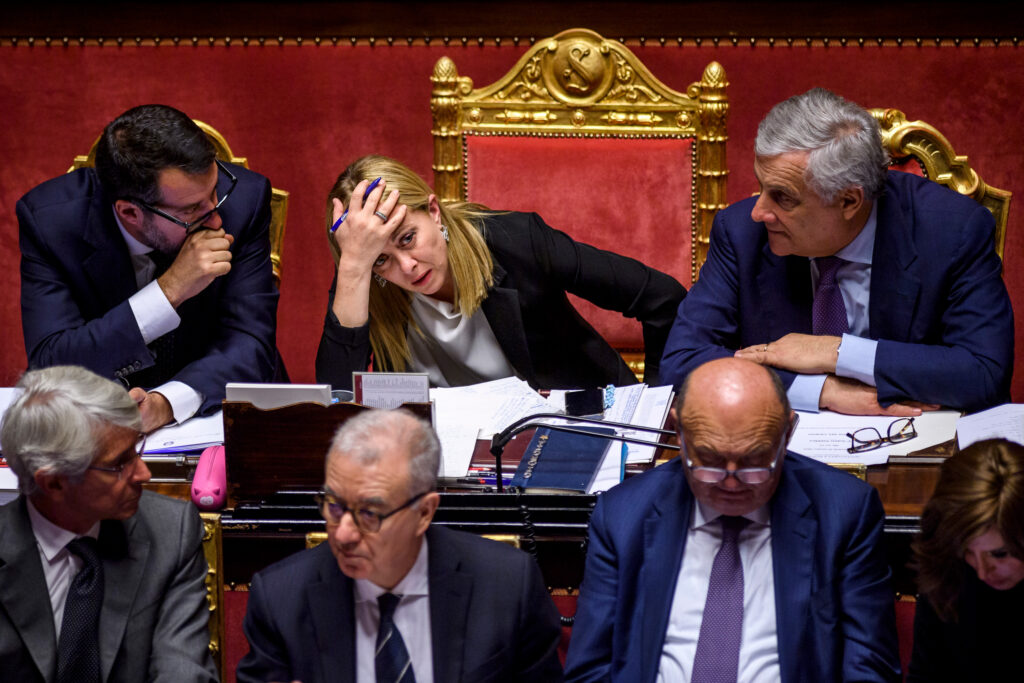
Giorgia Meloni’s election in 2022 as Italy’s prime minister was a pivotal event: A charismatic new figure in Western Europe broke the barrier that had kept far-right parties from power. Her trajectory has been remarkable. She is Italy’s first female head of government, coming from a decidedly non-elite background, and she entered politics through a marginal, far-right party with fascist roots. In 2012, when she founded Fratelli d’Italia, its chances were not bright. In 2013 it won 1.96% of the vote; in 2022 it garnered 26%. After a decade spent aggressively workshopping ideas, terms, and communication strategies, Meloni outstripped, outlasted, and outperformed all her rivals in Italy, as well as other rightwing leaders such as Marine Le Pen and Viktor Orbán. She now leads one of the longest-running governments in Italian postwar history.
Melonismo is a significant new phase in Italian politics, but it is remarkably hard to categorize. Scholars, pundits, and journalists describe her party as post-fascist, post-post-fascist, anti-anti-fascist, afascist, nationalist, nativist, national-conservative, sovereigntist, populist, and post-populist. They discuss whether her politics should be described as radical, conservative, or far-right; whether her project is undemocratic or authoritarian. They study the degree to which the mainstreaming of her party is the result not only of “ideological compromise, but also through shifting norms of political acceptability.”
The difficulty in defining Melonismo is not accidental. It is a moving target. In the chaotic political environment of Italy in the 2000s, Meloni sought to build a solid majority that stretched from far-right to center-right. She relied on a small, cohesive, loyal party apparatus; a highly personalized form of politics and messaging; and a broad, emotive, black-and-white discourse that accommodates significant shifts in policy, undertaken as new allies, enemies, challenges, and incentives present themselves. It is also worth noting that at the same time that Meloni brought a far-right party to the center of Italian political life, the center was shifting right across Europe and the West.
As the political journalist Susanna Turco notes in her excellent book Re Giorgia: Controstoria della donna che si e presa l’Italia (2022), no Italian politician has told their story as often and as well as Meloni has over the years, through her social media feeds and her best-selling 2021 memoir Io Sono Giorgia. Meloni weaves her biography and personality into her political project: This identification is so tight that it is practically impossible to investigate that project without also painting a portrait of the woman who has carried it so far.
The story begins with a father whose absence and rejection are the original trauma of Meloni’s life: what she calls its “black hole”. When Giorgia was a baby, he sailed off to the Canary Islands on a ship called The Crazy Horse. She hasn’t seen him since she was twelve; he later served nine years in prison for drug smuggling. Meloni and her older sister, Arianna, were instead raised by their devoted single mother in the left-leaning, working-class neighborhood of Garbatella, in Rome. By her own account, Giorgia was awkward, overweight, and irascible. Also in her telling, this background made her who she is: an underdog who doesn’t give up, an outsider who defies expectations.
As a teenager, Meloni discovered politics. In 1992, when the 15-year-old joined the youth group of the Movimento Sociale Italiano (MSI)—a party founded by former members of the Mussolini regime—the entire postwar Italian political system was on its way to collapsing. The assassination of anti-mafia judge Paolo Borsellino in a car bombing in Palermo—just two months after the killing of his colleague Giovanni Falcone—spurred her political engagement. Falcone and Borsellino had been leading huge, successful anti-mafia investigations, and their brazen murders shocked and horrified the country.
At the same time, another massive investigation (“Mani Pulite,” or “Clean Hands”) was uncovering a system of kickbacks so well established among Italy’s political class that it was referred to as an imaginary city: Tangentopoli (“Bribesville”). Hundreds of members of parliament were implicated, politicians fled into exile, and the First Republic—dominated by parties such as the Socialists and the Democrazia Cristiana, which held the center within a highly polarized system—came to an end.
Meloni was consumed by right-wing activism. She discovered an appetite for confrontation and a gift for imposing herself, especially in what she has called “overwhelmingly male environments.” The group she belonged to was insular and esoteric, headquartered in a dilapidated Roman ruin. They called themselves “The Seagulls” after the book Jonathan Livingston Seagull. Another key reference for the group was The Lord of the Rings; they were entranced by its vision of heroes protecting their civilization against an existential evil. Meloni and other members of Fratelli d’Italia quote the book to this day to extol selfless bravery (“I do not love the bright sword for its sharp edge, nor the arrow for its swiftness, nor the warrior for its glory. I only love that which I defend”) or patient dedication (“it is the small hands that change the world”). When Meloni founded a yearly youth festival, she named it Atreju after the young hero of The NeverEnding Story—another fantasy in which courage and self-sacrifice save a cherished world against the advance of “The Nothing.”
Meloni and her cohort saw themselves as an embattled, enlightened vanguard, on a mission to fight the prevailing left-wing youth culture. Their frame of reference was not the fascist past as much as the violent confrontations between far-right and far-left groups in Italy in the 1960s and ’70s; confrontations in which they believed their side had been unfairly stigmatized. What is significant about this early political formation is the degree to which it has shaped Meloni’s Manichean worldview and her aggrieved insistence on victimhood.
The political vacuum of the early 1990s was filled by Silvio Berlusconi, the obstreperous media mogul who in 1994 began his long, chaotic, cynical reign, in which he openly bent public institutions and the law to serve his interests and to shield himself from the consequences of his decadent personal life. (As a parliamentarian, Meloni voted in favor of laws passed expressly to shield Berlusconi from prosecution; the only criticism she makes of him in her book is that his private behavior was “unscrupulous.”)
Under Gianfranco Fini, the MSI evolved into Alleanza Nazionale; in 1995, he made a formal condemnation and break with the party’s fascist past, and fully entered the electoral political space. Meloni writes in her memoir that the move made perfect sense to her: “it was a way to make our demands more palatable.” First pushed to run as a candidate to the Chamber of Deputies in 2006 by Fabio Rampelli, she has repeatedly been put forward as the kind of young, appealing, female face that could help the right redefine itself and appeal to new voters. As he explained, “we needed to identify someone who would radically break with the cliche of the figure who came from the historic Italian right, intimidating, with a shaved head and a strong-willed jaw, a thug, a child-eater, a brute. That was the objective. And if you make the boss a woman, from a different generation, with blue eyes, pretty, self-deprecating … then that means it’s all over.”
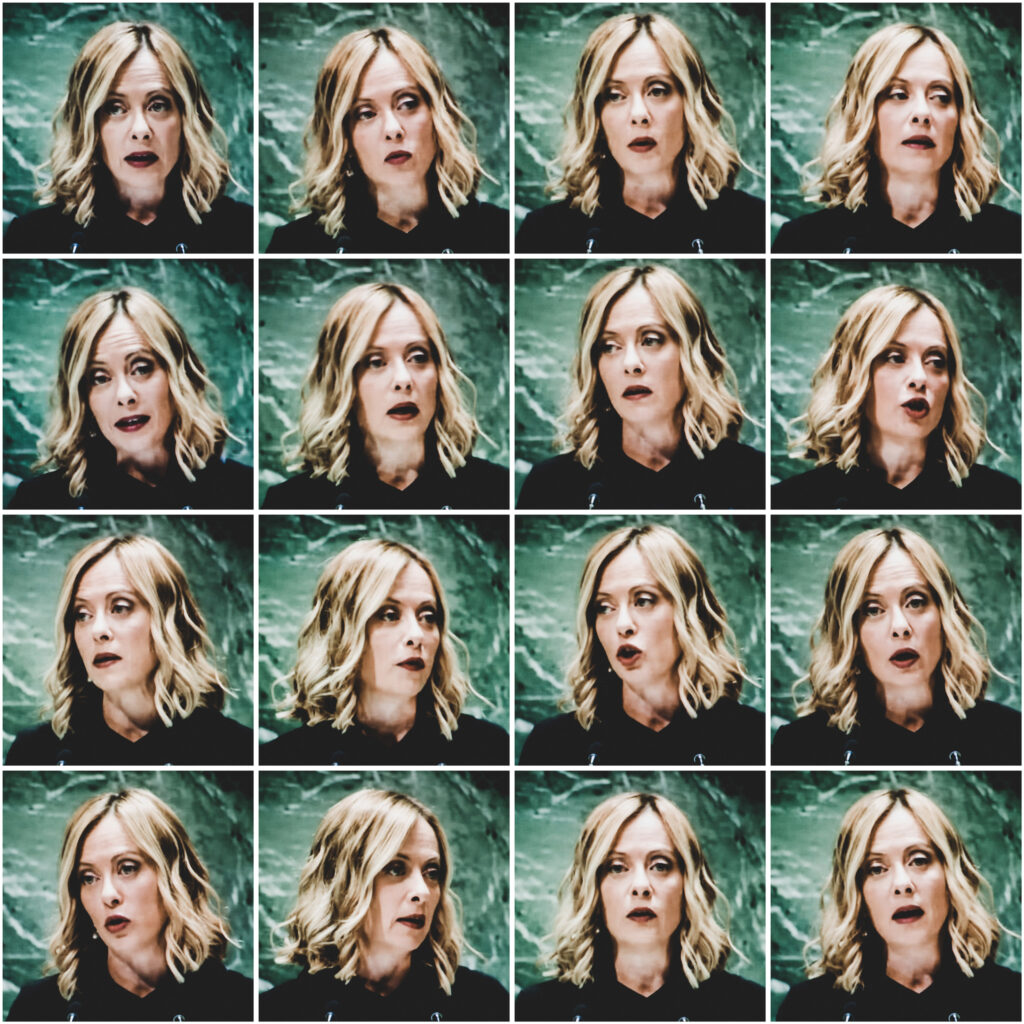
Meloni has honed a communication style that conveys her no-nonsense, woman-of-the-people persona: the voice of outraged common sense and common decency. Her girlish appearance and diminutive size contrast with her gravelly voice, heavy Roman accent, and combativeness. She is quick-witted and theatrical, employing highly expressive gestures—the rolled eyes, the exaggerated shrug, the dramatic pause—to devastating effect.
In 2006, Fini appointed Meloni vice president of the Chamber of Deputies; it was, according to Turco, “a way to present a young and modern right.” The same logic applied when she was made Minister of Youth in 2008 in a government headed by Berlusconi. At 31, she was the youngest minister in the country’s history. In 2012, the center-right coalition that included Fini and Berlusconi collapsed. Berlusconi had been the target of endless investigations for corruption, and the center of countless sex scandals. But what finally brought him down was the financial crisis, followed by recession and austerity. At this low point for the country and the right, Meloni found herself without a political home. So she set out to create one.
Meloni built her party and her profile during a decade in which Italy, post-Berlusconi, cycled rapidly through various political options, all of which promised and failed to deliver a radical break from the status quo. The overall atmosphere, in Italy as elsewhere, favored populist movements that were anti-EU, anti-globalization, anti-establishment, and anti-technocratic.
There was the grass-roots Cinque Stelle Movement, led by comedian Beppe Grillo, who organized the so-called V-Day rallies—the V stood for “vaffanculo” (“fuck off”)—to call out politicians convicted of corruption and other crimes. This heteroclite movement, which claimed not to be a political party and not to belong to left or right, was in favor of universal basic income, environmentalism, and direct democracy; against austerity and the EU. Once it came to power, however, its lack of ideological cohesion and internal discipline yielded predictably disappointing results. Then there was the young social democratic mayor of Florence, Matteo Renzi, known as a “rottamatore” (“demolition man”) for his stated desire to sweep aside the old political class; he resigned after a constitutional reform he proposed was rejected by voters. This period also saw the swift rise and fall of Matteo Salvini’s Lega, a right-wing (and originally separatist) northern party with virulently anti-immigrant, anti-EU views, which won heavily in elections in 2018 and 2019, only to bleed supporters due to Salvini’s ego and miscalculations. All these parties formed improbable alliances and short-lived governments.
Meloni, competing within this crowded, unstable political field, embraced immigration as her signature issue. She accused immigrants of taking advantage of public services while disrespecting Italian culture; highlighted crimes committed by immigrants and told them to “go home”; called for a naval blockade to protect Italy’s coasts and for the sinking of ships used by NGOs to offer assistance to migrants stranded at sea. Meloni’s heightened anti-immigrant rhetoric was partly driven by the salience of the issue and the need to win over a portion of Salvini’s electorate—something she successfully did by 2022.
In October 2019, at a right-wing rally in Piazza San Giovanni in Rome, Meloni gave a speech culminating in a famous line: “I am Giorgia. I am a woman, I am a mother, I am Italian, I am Christian. You won’t take that away from me!” Meloni’s battle cry was remixed over a thumping techno beat by two Milanese DJs. Their intent was satirical, but something unexpected happened: Taken out of context, the song became a viral hit. Meloni supporters treated it like an anthem. She used it as the title of her autobiography; the speech is her opening scene. It was a turning point in her transformation into household name and pop culture phenomenon.
At the same time, Meloni (who studied to be an interpreter and who speaks English, French, and Spanish) was cultivating an international profile, creating ties with Hungary’s Viktor Orbán, France’s Marine Le Pen, Poland’s PiS party, Spain’s Vox, and the MAGA movement. She freely borrowed new terms and ideas that had become fashionable within these circles. She inveighed against gender theory and cancel culture, and she embraced the “great replacement” conspiracy theory—the belief that leftist politicians, NGOs, and global capital were in league to flood Europe with immigrants so as to undermine its identity.
“Enemies are useful,” Meloni writes in her memoir, and leftists are her number one. She paints them as foolish and hypocritical at best and actively treacherous at worst. “It matters to me not to be liked by those people,” she writes. “Their hostility is my north star, showing me I’m on the right course.” A non-exhaustive list of other enemies includes international finance, globalization, groupthink, political correctness, Islamism, NGOs, George Soros (who she once described as a “speculator” and “usurer”), EU bureaucrats, and EU countries—France and Germany in particular.
Between 2015 and 2019, Meloni tried out a number of anti-EU positions, calling for the liberation of Italy from the “slavery” of the euro and for exempting it from the obligation to follow EU regulations and laws. In 2019 she told the audience at CPAC: “Democracy in Europe has become a trick,” because of the dominance of non-democratic EU institutions, whose real goal is to impose the choices of “globalist and nihilist elites,” and “to destroy our identity and civilization and turn us into undefined citizens of the world and perfect consumers.”
But Meloni was already dialing down these kinds of arguments well before her election. There is no trace of such extreme anti-EU positions in her platform today, just as there are none of the encomiums she used to offer to Putin as a supposed defender of Christian and European values.
In the fall of 2021, during her electoral campaign, she warned her supporters: “There’s no room in Fratelli d’Italia for nostalgia for fascism, racism, anti-semitism, folklore, and imbecility.” She also said, in a video in French, English, and Spanish released before the election: “The Italian right has handed fascism over to history for decades now,” and “unambiguously condemned the suppression of democracy and the ignominious anti-Jewish laws.” Yet, as Turco points out, Meloni is more categorical when speaking to foreign audiences on this topic; when addressing Italians, she’s always quick to also condemn left-wing totalitarianism as having committed even worse crimes. She has kept the symbol of the Alleanza Nazionale in her party’s flag; she often uses the motto “Dio, Patria, Famiglia” (“God, Fatherland, Family”), claiming it is “not a political slogan,” and that it dates to well before fascism. In a profile in Il Foglio, the scholar and writer Giorgio Caravale describes Meloni’s “extraordinary operation of dissimulation, always walking a tightrope of ambiguity and silent connivance.” Her unwillingness to totally repudiate her party’s roots stems from both electoral calculations (the need to appeal to her far-right base) and personal considerations (the need to defend her own biography).
The war in Ukraine was an inflection point. By throwing her support unequivocally behind the US and the EU, Meloni differentiated herself from most of the populist left and right movements in Europe. Fratelli d’Italia had already joined—through a somewhat fortuitous path, driven as much by opportunity as affinity—the European Conservatives and Reformists Party in the EU. This party was home, pre-Brexit, to the UK Conservatives and, more importantly, to Poland’s PiS—a successful, conservative, firmly Atlanticist ruling party. Meloni became the president of the ECRP in 2020, a key step on the path towards Fratelli d’Italia’s acceptance as a responsible, legitimate party and its transformation into what the political scientists Salvator Vassallo and Rinaldo Vignati, in their book Fratelli di Giorgia, argue it has become today: a new entity in Italian politics, a “national-conservative” party.
Other scholars continue to classify Fratelli d’Italia as part of the radical far-right. In their view, its essential characteristic remains an exclusionary political vision, a nativism that champions real, deserving Italians—defined in ethnic and cultural terms—against foreigners and other groups that are deemed deviant or dangerous to the nation. In a 2025 interview, the political scientist Andrea Pirro argued: “The contrast between a ‘corrupt elite’ and a ‘virtuous people’ typical of populism is just the framework within which nativism, the ideological hinge of far-right parties, is articulated. In some sense, we can consider populism the instrument, nativism the end.”
Fratelli d’Italia’s highest ranks hail almost exclusively from the right-wing networks in which she has moved since her teenage years. The party is run by a small group of like-minded, lifelong collaborators, almost all of the same generation, with many shared experiences and personal ties (Arianna, her sister, is the political secretary of her party and in charge of its membership office).
Fratelli d’Italia’s voters included more men than women (28% versus 24% of the vote); more middle-aged voters than voters under 35 or over 64; and more business owners and private sector workers. But the party did well in all categories, expanding its base like no far-right party had before, both geographically and socio-economically. According to Vassallo and Vignati, its electorate “takes on the normal traits of the center-right,” even as traditional trends among those voters (lower education levels, higher likelihood of living in small, rural communities) have grown less striking.
Power within the party itself is highly centralized. Meloni is the undisputed chief, surrounded by a cult of personality that reveres her reputation for phenomenal competence, workaholism, and the ability to master all subjects better than anyone else. She faces no internal rivals, and the party’s participatory and democratic channels are extremely limited. In this respect, there is a parallel between Meloni and Berlusconi, a figure from whom she seems to otherwise diverge almost completely: Both of their parties are unimaginable without them at the center. (One might say that as the traditional right-left polarity in Italian politics has grown weaker, it has been replaced by polarization around individual politicians. In this sense, Italy seems to have anticipated a world-wide trend, also evident in Trump and the MAGA movement.)
During the COVID crisis and the technocratic government of Mario Draghi, Fratelli d’Italia stayed in the opposition. This allowed Meloni to channel citizens’ frustrations with government policies during the crisis, and to seem like a fresh alternative once it was over. In an election with a high rate of absenteeism, she siphoned votes from a weakened Lega and diminished Forza Italia, and even from a center that had been fragmented and ideologically scrambled by movements such as Cinque Stelle.
As is always the case in politics, Meloni’s success is a matter of contingency as much as strategy. Her ideology is sweeping yet superficial, and her discourse contains few original elements. One must look elsewhere for the factors that have set her apart. These include her talent for communication and argumentation; her mastery of social media channels to create a direct, intimate relationship with supporters; her ability to manage ambiguities, contradictions, and shifts in position, and to speak to multiple audiences in multiple languages and registers; and the elements of her biography—her class, her gender—that are difficult for other politicians to replicate.
Meloni has shown a particular aptitude for personalizing confrontations and for turning the tables on her adversaries. During her time as a parliamentarian, she drew attention to the fact that her adversaries had reportedly nicknamed her “pesciarola” (fishmonger), because of her virulent interventions. She published a video of herself holding a tray of fish, playfully calling out: “Fresh fish! Excellent prices!” Turning serious, she said the nickname just showed how much the left was disgusted by common people such as herself.
Meloni has also used her gender to great effect. She emphasizes it in order to relate to Italian women voters and to signal that her party cannot be accused of being retrograde. In 2022, responding in parliament to a question as to whether her government’s policies subordinated women, leaving them “a step behind men,” Meloni replied: “Look at me, Onorevole Serrachiani. Does it look to you like I stay a step behind men?” Meloni scored a big round of applause and yet the exchange is telling. For the question wasn’t about Meloni’s own power and position but rather what she had to offer other women.
Meloni’s vision of gender relations does not challenge male privilege and misogyny. “In my whole political experience I have never felt really discriminated against,” she writes. Yes, she had to work harder than men, she admits, and to overcome some initial skepticism. But it’s not a problem that men dominate politics because it has not been a problem for Meloni herself, who tells us, “I have more fun competing with men.” She has chosen to be called “il president” (using the masculine gendered definite article in Italian) rather than “la president”; the upper echelons of her party are overwhelmingly male.
When Meloni speaks of being a woman, she mostly speaks of being a mother. She often shares touching glimpses of her devotion to her daughter Ginevra, a much-loved child who was born unplanned and out of wedlock. This is in line with her party’s policies, which emphasize the role of women as current or potential mothers. Meloni also uses motherhood as a powerful element in what might be called a “politics of protectiveness.” It is by virtue of being a mother that Meloni portrays herself as empathetic but also pragmatic, ready to make the difficult decisions required to safeguard the country.
Take the way she approaches immigration in her memoir—with tough-love rhetoric that is more palatable than the outright racism of parties such as the Lega. Before the scenes of shipwrecks in the Mediterranean and drowned children, Meloni writes that as a mother she cannot but be moved: “my impulsive instinct would be to open my heart, arms, borders, the doors of my house: to welcome these suffering people and give them shelter.” [Meloni, 234] But she has the courage to ask the hard question: If Italy should allow anyone who wanted to enter, “stripping itself of all it has,” would that really lessen the suffering of the world? The intellectually honest answer, she says, is no, because it is impossible for Western countries to take in the hundreds of millions who would like to live there. [235] Meloni tells her supporters that the good-heartedness of leftists is either a dangerous delusion or hypocritical cover for nefarious aims. It is the right that is realistic and, in its realism, more truthful, trustworthy, and humane.
Indeed, Meloni’s most successful issue is immigration. Arrivals of immigrants by sea to Italy peaked in 2023 at 157,651, before dropping to 66,316 in 2025. The European parliament recently approved a measure to create “return hubs” outside the EU where migrants would be detained and processed. Meloni declared that “Italy’s approach to an organized management of migratory flows… has now become Europe’s approach too.” Her vision has gained traction in part because of the lack of a persuasive and principled European vision of migration. Many European governments are ready to embrace her “pragmatism” when it comes to cutting deals with autocratic regimes outside Europe, sub-contracting them to police migration flows and retreating from support for human rights and democracy outside Europe’s border. European Commission President Ursula von der Leyen supported a $1 billion EU-Tunisia deal that aligns with Meloni’s vision of outsourcing immigration control.
Yet despite its anti-immigration rhetoric, the Meloni government must face the reality that Italian agriculture, tourism, and other sectors cannot function without foreign workers. It has approved a quota of nearly half a million work visas for non-EU workers over the next three years. Close to 9% of Italian residents are foreign citizens today.
Meanwhile Italy faces a set of seemingly intractable demographic and economic challenges. It has one of Europe’s lowest natality rates; only 370,000 babies were born there in 2024. The Italian economy is also hobbled by the EU’s lowest female employment rate: 53.7% in 2024. Real wages in Italy decreased 8.8% from January 2021 to September 2025; GDP growth is .5%, and Italian manufacturing continues to shrink in the face of Chinese competition.
For the historian Giovanni Orsina, the populist wave seen in Italy and elsewhere—that culminated with Meloni’s accession to power—has been a symptom, rather than a cause, of the crisis of liberal democracy. People have lost confidence in the progress promised by globalization and neoliberalism. They have suffered from “the deterioration of collective identities and intermediary bodies,” the harshness and abstractions of late capitalism, the “loss of control of their existential environment.”
In a 2023 interview, Orsina noted: “The populist wave does not recede because it disappears, but rather because it enters institutions and installs itself there. It becomes a chronic feature. As the populist ‘barbarians’ do not have the strength to demolish the established order … there is only one way forward: that the barbarians become ‘romanised,´ swallowed by and integrated into the mechanisms of power.” His hope was to see a post-populist conservatism emerge that could “counterbalance the destructive potential of the processes of planetary integration” by providing “more politically structured, realistic and durable responses.”
That is a tall order for any politician. In 2025, Orsina wrote that what the Meloni government amounted to so far was not so much a counter-revolution to undo the changes of recent decades, as “the contrary of a revolution.” Hers is a majority that “instead of celebrating the erosion of national sovereignty and community bonds, tries pragmatically to slow and limit it. Nothing less and nothing more.” The defining characteristic of the Meloni government lies “not so much in what it does as in what it prevents.”
In other words, Melonismo, despite its fiery language and invocation of existential stakes, has proven less disruptive than anticipated. It is cautious, long-term, incremental; one might even say—especially as long as it is in power—risk-averse. The party is no longer a start-up that needs to attract attention through daring gambles and extreme positions. Unsurprisingly, as Meloni has acceded to power, her rhetoric has become more statesmanlike, emphasizing national achievement. “We are no longer the weak link in Europe,” she said in a recent speech. “We are a credible, authoritative nation, looked at with respect by the world.”
In that same speech, she acknowledged the difficulties Italy faces today. The US war on Iran, she pointed out, has dealt a blow to the already weak Italian economy, which is particularly vulnerable to increases in oil and natural gas prices. The war has also made Meloni’s unqualified support for, and supposedly preferential relationship with, President Trump, finally untenable. The two have had a very public breakup, trading taunts and insults.
Meloni continues to criticize EU regulation and bureaucracy. The large post-Covid recovery funds Italy received from the EU have not led to a hoped-for economic recovery. The Meloni government has spent over 1 billion euros subsidizing electricity bills, and is asking the EU to bend rules around acceptable deficits to better tackle this “extraordinary energy crisis.” “Brussels” remains a useful foil (and certainly there is valid criticism to be made of its inefficiencies and democratic processes), even as Meloni continues to cooperate, negotiate, and seek assistance from the EU. The ultimate aim is no longer to dismantle the EU but to reconfigure it, curtailing its commitment to minority rights, democratic safeguards, and environmental and economic regulations.
Meloni’s critics fear that she is bent on a similar institutional takeover inside Italy as well, and perhaps a gradual, silent erosion of democracy, which, as Pirro points out, takes place “through the increase of executive powers, the diminishment of judiciary ones, the repression of dissent, the colonization of the media landscape, the distortion of electoral rules.” In the name of stability, the current government has pushed through an election law reform that will make it easier for it to maintain its majority.
Yet most still believe that Italy’s constitution, institutions, law, and public opinion protect it against authoritarian drift. Earlier this year, Italians rejected a judicial reform that Meloni had championed, but that her opponents argued was intended to chip away at the independence of judges. Other initiatives—from a plan for greater regional autonomy to a proposed bridge between the mainland and Sicily—have stalled and failed.
Meloni is currently busy presenting herself as the tough-minded steward Italy needs at a time of crisis, recalibrating her international relationships to show her electorate that she can stand up to the US (and take a more critical stance towards Israel) and obtain concessions from the EU. After the cynicism of the Berlusconi years and the subversive chaos of the Cinque Stelle Movement (for which Meloni expresses contempt), Fratelli d’Italia articulates its mission in a register of high seriousness and earnestness. It promises order, protection, and pragmatism. Given the geopolitical and economic constraints it faces, it may be able to offer only modest results.
Meloni, as she has promised, isn’t going anywhere. Her goal is to maintain and entrench right-wing hegemony. To this end she will likely continue to deploy her talent for pragmatic accommodation, creative redefinition, and persuasive storytelling. It is hard to imagine the prime minister will not also continue to have recourse to the enemies, boogeymen, and scapegoats, to the narratives of victimhood and battle, that are at the heart of her political imagination and that have served her so well thus far.