Maximalism Must Fall
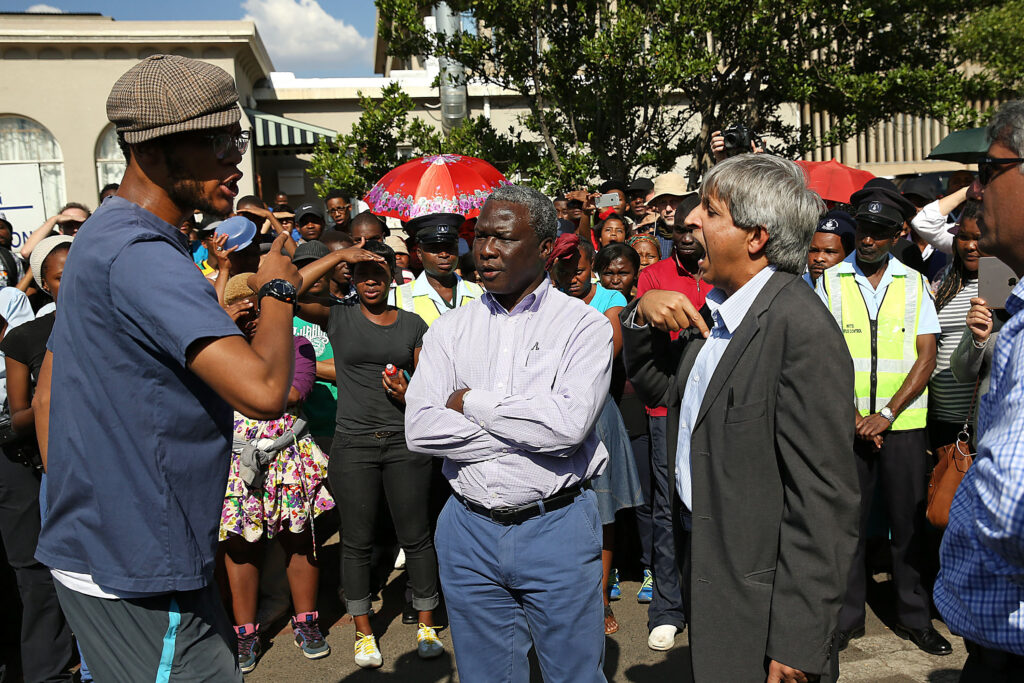
In 2015, two related but distinct social struggles broke out in South Africa: #RhodesMustFall (RMF) and #FeesMustFall (FMF). The first erupted at the University of Cape Town on March 9, when a student named Chumani Maxwele threw feces at a statue of Cecil John Rhodes, demanding its removal and the decolonization of the curriculum. The second struggle emerged in October at the University of Witwatersrand in response to an increase in university fees. The “fees struggle” quickly spread across public universities, garnering enormous public support and leading to further demands for a free higher education system. Vice Chancellors of the public universities argued that they could not do without the fee increase given inflation and the erosion of the government’s subsidies. The ensuing stalemate was broken when President Jacob Zuma and the ANC government agreed to pay the fee increase to the public universities, the first significant increase in the public subsidy to universities in two decades.
Over the next two years protests continued unabated. Students argued that the fees in South Africa’s public universities must be removed entirely, and that these institutions must be decolonized. They called for greater access for young people from marginalized communities and a curriculum that was less Eurocentric and more oriented towards Africa’s needs and interests. Soon leaders expanded their struggle beyond the university to demand a more empowered democracy and a more radical economic agenda that addressed inequality and the legacies of apartheid, including the unequal ownership of land. These student activists became known as the Fallists. They came from the Pan-Africanist and Black Consciousness movements, as well as the ANC (many were the children of prominent leaders in the ruling party). On December 16, 2017, President Zuma, in one of his final acts in government, declared free education for those with family incomes less than R350 000 ($21,000).
Kayum Ahmed’s new book Theorising Fallism: Rhodes Must Fall and the Global Movement to Decolonise the University (2026) is about this group of activists, and his essential purpose is to theorize Fallism. He argues that the movement’s political inspirations of Black Consciousness, Pan-Africanism, and Black Radical Feminism enabled activists to make meaning of the uprising through three separate elements: “epistemic disobedience” against the university, an understanding that Black liberation is inextricably tied to the alienation of Black students and staff (described as Black pain), and finally an attempt to develop theory from protest. These elements compelled students to protest against the colonial character of the university, striking against its monuments to exploitative figures, its curriculum of racial capitalism, and its exclusionary managerial practice.
Ahmed argues that the resulting theory and praxis transcended national boundaries and inspired political action against colonial symbols and curriculum in Oxford University, thereby reversing the traditional dynamic of theory flowing from North to South. He holds that the reverse influence of Fallism also extended to the student intifada at Columbia University in 2024. Fallism is thus a new radical struggle to “dismantle and remake the university” and society.
How persuasive is his argument? A theory is an established, structured, and evidence-based model explaining why and how a phenomenon occurs. If it is to be decolonial, then the experience and evidence should be located in what used to be the colonized part of the world. This is how I would interpret the writings and reflections of Mahmood Mamdani1 or Achille Mbembe,2 or even Ali Mazrui and Walter Rodney.3 Similarly, decolonization of the university cannot simply mean prioritizing a curriculum that speaks to the analytical and political interests of a select group of radical activists. This interpretation defies what it means to be a university, which is in its essence an institution that questions dogmas, however radical. By its very academic and cultural architecture, a university must be ideologically plural, where people are not silenced, threatened, or prevented from questioning anything.
This interpretation of decolonial theory and the decolonized university suggests that Fallism is far from constituting a theory of the South. It does not marshal evidence to explain that the profound alienation of young people in South Africa two decades after the democratic transition was the result of anything more than economic marginalization and disappointment with the ANC’s rule. It does not demonstrate through an excavation of the curriculum in South Africa’s universities that teaching and research is profoundly reflective of experiences of peoples outside South Africa. Nor does it comprehensively analyze the protest experience of South African students, especially those in the historically Black universities.4 But most damaging for Fallism is its condemnation of anything it disagrees with as “colonial” and “Western.” This is merely a rhetorical device to delegitimize other interpretations of developments in South Africa.
Nowhere is this clearer than in the Fallists’ understanding of the South African constitution, which they see as profoundly Western and European.5 This view misunderstands the genesis and content of the document. South Africa’s constitution is not simply a product of western frameworks of rights. Rather it is rooted in the history of political and economic dispossession in South Africa and the debates on how to address historical colonial injustices while protecting the rights of individuals in a modern capitalist economy. As such the constitution reflects a compromise between contending political forces in South Africa. But the nature of that compromise cannot simply be labelled colonial and European since the actors were local and their agreements were rooted in the political realities of South Africa.
Similarly, the curriculum in South Africa’s universities, whether in Law, Economics, Engineering, Humanities, Health Sciences, or Natural Sciences, cannot be dismissed as Western and non-African because a group of political actors do not believe it is radical enough to suit their ideological predispositions. I do not mean to suggest that South Africa’s curriculum is perfect and not in need of revitalization. Neither do I suggest that the South African curriculum is not influenced by theoretical frameworks and research developed in the broader global academy. It is—and should be—as long as these frameworks explain local developments. Where they are not useful, they are rightly subjected to critique, then adapted and revised. This is how social theory is built.
Do we do this adequately? No! But neither is it valid to say that South Africa’s universities are simply a manifestation of the colonial institutions of yesteryear. Their curricula are vastly different from 30 years ago, as are the inhabitants, their missions, and their managerial practices. The mere fact that RMF was able to experiment as it did proves that these universities are far more dynamic than the activists’ fervid rhetoric suggests.
None of this means that universities cannot do better. Academics could theorize more from local experiences. Their curricula could better reflect experiences in other parts of the African continent and the broader Global South. And they should address the deep economic and social inequities within their staff and students. So yes, these universities can do far better—but that does not mean they are unabashed expressions of coloniality. By creating this impression, Ahmed and many Fallist activists do an incredible disservice to South Africa, its academy, and its traditions of resistance.
Yet this is still a book that is worth reading. Ahmed tells the story of the largest student movement in South Africa’s post-apartheid history from the perspective of its leaders and activists. It details their attempts to give meaning to a spontaneous eruption of discontent that expanded beyond their wildest imagination. Many other explanations of the movement, by academics, Vice Chancellors, and even other students, don’t so well capture how the movement unfolded in the eyes of its leaders.6 It is therefore an important part of a collection of analyses of the Fallist movement.
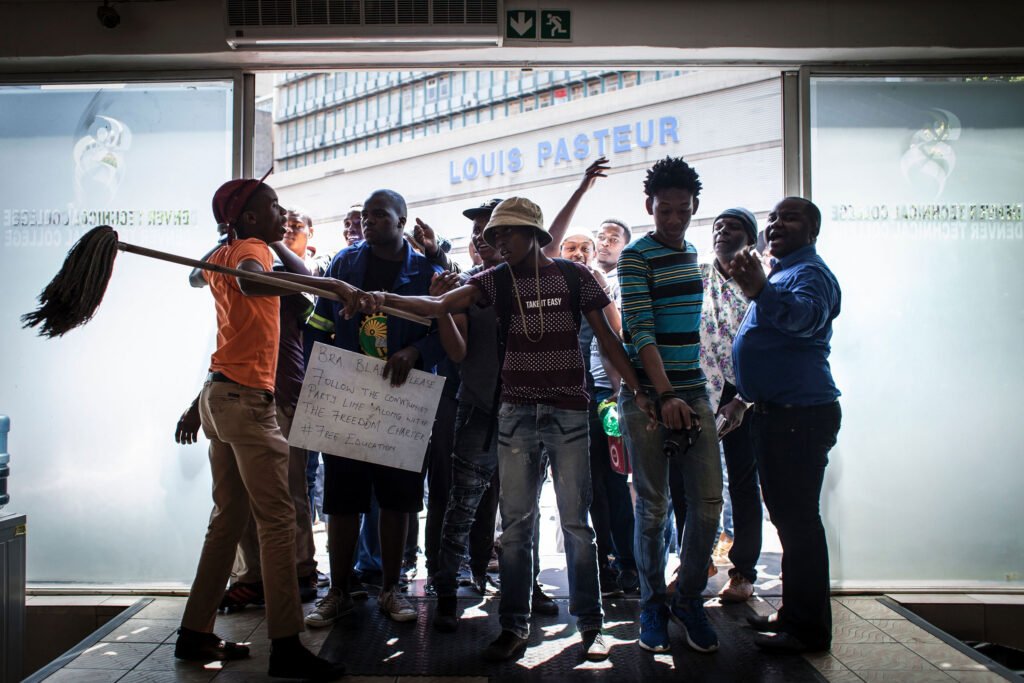
Ahmed says that he wrote the book as a scholar and an activist. His participation in the student struggles in both UCT and Columbia, and his assertion that they are connected and speak to the political struggles in South Africa, Palestine, and the United States, therefore demands thorough reckoning with his views on transforming the university and the broader society.
Let us begin with the university. Ahmed repeatedly claims that universities occupy a paradoxical position for Black and marginalized students. They offer “the promise of knowledge as an emancipatory force capable of disrupting socio-economic exclusion,” yet their “epistemic and pedagogical structures often reproduce the very forms of alienation, exclusion and violence that such knowledge seeks to overcome.”7 Here lies both his understanding of the strategic value of the university and his failure to grasp its institutional mission. Universities, like all institutions, reflect the dominant consensus within the nation. But their mission gives them relative autonomy, enabling those within them to question, and even to threaten, the status quo. But their autonomy is always constrained and does not detract from the essential purpose of producing knowledge, training a new generation of professionals, and reproducing society’s elite. If universities do this well, and couple it to an agenda of inclusion, they can drive social mobility.
Yet two developments threaten the mission of universities. The first is their expanding business model—what’s known as their corporatization. The political economy of higher education has been fundamentally transformed: as access expanded, so have public costs, prompting governments to increasingly deflect the burden onto students and their families through fees. Higher education is therefore treated as a private good. The challenge for universities is to remain faithful to the institutional mission while maintaining financial stability.
This is where the rubber hits the road. Ahmed is not wrong when he speaks of the importance of recognizing the intersectionality of discriminations and of building alliances between students and workers. But he and the Fallists remain silent on how this is to be done in a financially sustainable manner. They assume that this will all be paid for by the state. But what happens when the state does not fully pay? In the case of UCT and Wits University, the state only provides about 35% of institutional expenditure. What happens when the state gives no public subsidy at all? This is the situation with SOAS University of London, where I currently serve as Vice Chancellor. Higher education executives must then consider increasing fees or cutting expenditure or attracting more philanthropy. Each of these options comes with trade-offs. Which to choose and why is the stuff of strategic management of higher education.
It is a challenge avoided by even our most iconic academics, including Mahmood Mamdani and Achille Mbembe, who do not wade into the debates on how to close the financial circle. Yet this is where real strategic thinking is needed and where the future of universities will be decided. Progressive scholars and activists can either ignore these issues and wait for the rise of a socialist society where higher education is fully subsidized, or they can assist in thinking through structural and institutional reforms (with all their attendant trade-offs) needed for survival in a hostile financial climate. But Ahmed and the Fallists have nothing to say in this regard.
The second challenge universities face is political polarization. Universities are today the sites of furious political battles, where stakeholders try to draw the university into supporting their cause. A primary challenge is the behavior of the activists themselves. In South Africa, activists crossed the boundary of peaceful protest. The RMF and FMF campaigns were accompanied by individual acts of racial prejudice in which a small group of activists deliberately targeted white staff and students with offensive behavior, graffiti, and slogans. The leaders of these movements were often silent in the face of this racism. There was also significant violence: buildings burned, offices bombed, and staff and students threatened. There is a culture in South African universities, not yet found in the US and UK, where protestors march into classes, disrupt the lectures, and force out other students. These acts violate the rights of students and staff, and chill the intellectual atmosphere.
Ahmed, like many other progressive scholars, is astonishingly indulgent of violence; he dismisses the violence during RMF and FMF as a product of university authorities calling in the police. This is a flimsy excuse. In my book Rebels & Rage, I tracked a number of violent events at Wits University: In many cases, the evidence categorically proved that violence predated police intervention.8 But the bigger question is how do we explain this indulgence of violence? Some RMF and FMF activists have a romantic attachment to violence, demonstrated by Kayum’s own words when he speaks of how Franz Fanon saw violence as a catharsis for oppressed people under colonial occupation.9 This romanticized attitude was expressed when RMF and FMF activists split into political factions, a phenomenon that is well documented in the social movement literature.10 But Ahmed does not confront the troubling role of violence because of what it might say about these activists and movements. His failure to do so is an astonishing breach of academic and professional responsibility.
The Palestinian encampments in western universities like Columbia came nowhere near the violence of the RMF and FMF campaigns. But the violation of others’ rights, and the intimidating climate this produced, were certainly evident. At SOAS, the executive decided to allow the encampments on the grounds that students and staff are entitled to peacefully protest. Yet the SOAS executive also established parameters for the conduct of protestors: examinations should not be disrupted, infrastructure should not be destroyed, and individuals should not be targeted. The purpose of these injunctions was to prevent a chilling atmosphere, which would compromise the mission of the university. We also indicated that if these parameters were consistently breached, we would intervene and close the encampment.
Universities, as sites where a plurality of ideas are meant to peacefully prevail, will inevitably confront situations where the advocacy of one group threatens the rights of another. The university’s responsibility is to permit advocacy without stifling open intellectual inquiry. All institutional stakeholders can be made uncomfortable—but never threatened. Advocates of the Palestinian cause can make their case while the university also allows those in favor of Israel the right to articulate their own case.
Institutional cultures are sustained by three elements: information, the practice of norms, and accountability. Most progressive scholars are comfortable with the first two, but they are terrified by the third. But without accountability universities cannot succeed because there will always be a minority who refuse to play by the rules. Indulging them will corrode the norms needed to sustain an institutional culture. How to hold students accountable while being empathetic to the fact that they need to be allowed to make mistakes and learn from them is the permanent challenge of strategic management of higher education. Unfortunately, these issues are completely absent from Ahmed’s book: He holds that the university must simply be co-opted into the progressive cause.
These issues are also absent from much of the literature on the Palestinian encampments and how different universities have chosen to manage them. Instead, executives are exhorted by conservative politicians on the one hand to take firm action against the protestors, and on the other by activists and progressive scholars to support the protestors at all costs. Yet neither choice is practical since both violate the mission of the university.
Should universities always be neutral on political issues? Most university Presidents and Vice Chancellors in the Western world say that they should—especially on the Palestinian question. But in March 2024, I questioned the necessity of institutional neutrality in a lecture to Cambridge University, arguing that this approach obfuscates the implicit values, norms, and behavior that embed institutional life.11
Universities in democratic societies are grounded in values of freedom, liberty, dissent, and the like, just as much as those in colonial societies were embedded in the racialized assumptions and imperial ambitions of those societies. Moreover, the empirical evidence indicates that institutional neutrality is not necessary for intellectual plurality—and it is intellectual plurality that is the lifeblood of the university.
Liberal universities cannot avoid taking a position when core social values are being violated, but they shouldn’t be drawn into the churn of day-to-day politics: the trick is how to distinguish between the two. This perspective allowed for SOAS to call for a ceasefire in the Israel-Palestinian war, and to condemn the attacks on civilians, education, and health infrastructure by all parties when most universities in the UK and US refused to do so. The decision was fully endorsed by the senate, and widely supported within the university, even across the political divide. But Ahmed is oblivious to these debates because he approaches these issues solely from the perspective of the activist with a cause, rather than the academic with an institutional mission to protect.
But even his perspective as an activist—and that of the Fallists more broadly—demands scrutiny. Though Fallists come from a variety of political traditions, they cohere around a maximalist political agenda. South Africa’s democratic transition, so simplistically and inaccurately derided by the Fallists, is instructive about why this is a problem. The transition was an advance—even if partial—on what existed before. It has crucially led to significant, if insufficient, change in the lives of South Africans. (Indeed, the Fallists own struggle was only made possible by the advances made in the democratic transition.) Democratic empowerment is a continuous process of social change. Each generation builds on the partial successes of the prior in an ongoing project of inclusion, social mobility, and freedom from want. Maximalism is unlikely to achieve such political breakthroughs.
All of this holds important lessons for the Palestinian struggle which Ahmed concludes with. But they are not in support of the maximalist agenda that he proposes. Rather they are lessons about brokering relationships and alliances between reformers in Israel and Palestine so that they can develop the political imagination for a future that is non-zero-sum. This requires marginalizing extremists in both camps so that they do not become spoilers in a democratic agenda. This historical moment, defined by both the horrendous act of October 7 and the devastating genocide perpetrated by the Netanyahu government, requires not only mobilizing against the latter, but also condemning the former. Only then can one build political alliances across communities that will enable a solution for both Palestinians and Israelis.
What we need is a politics defined less by emotion and rage, and more by a strategic ability to critically dissect the forces set against social gains. Nowhere is this clearer than in the case of Hamas’ actions on October 7. The attacks were abhorrent. But my critique is not only moral. It is also a strategic one. October 7 gave the Netanyahu regime and the Israeli right the means of mobilizing Israeli society for the decimation of Gaza. It provided the political space to refashion the entire Middle East with destructive implications for its people. The consequences of October 7 may result in the establishment of a resurgent ethnically- and racially-grounded greater Israel that would be devastating for the world’s political stability. A maximalist act of violence led directly to a calamitous political outcome.
From this perspective, democratic South Africa, with all its flaws, was not such a bad transient outcome. It is a democratic project that requires much more work. Its political elites need to be held accountable. Its socio-economic dimensions require fundamental change. But it is a political outcome far preferable to what has emerged in Palestine, and it is a lesson that Fallists need to learn.
Democratic politics should not be conceived in maximalist terms. Instead, it is a never-ending process of inclusion and change, in which one set of advances and reforms serve as the foundation for another. It is only this long and critical view that will build the broad base of political support necessary for turning the tide in favor of democratic accountability and social progress.
Adam Habib is Vice Chancellor of SOAS, University of London. He was the former vice-Chancellor of the University of Witwatersrand in Johannesburg, South Africa. He was also the Chair of Universities South Africa during the #RhodesMustFall and #FeesMustFall protests.
- Mahmood Mamdani, “Between the Public Intellectual and the Scholar: Decolonisation and some Post-Independence Initiatiives in African Higher Education,” Inter-Asia Cultural Studies, 17:1 (2016) pp.68-83. ↩︎
- Achille Mbembe, “Decolonising the University: New Directions,” Arts and Humanities in Higher Education, 15:1 (2016), pp.29-45. ↩︎
- See A. Kayum Ahmed, Theorizing Fallism, pp. 24-25. ↩︎
- This is an insight particularly brought to my attention by Rekgotsofetse Chikane, one of the leaders of Rhodes Must Fall, in a commentary on an earlier draft of this review essay. ↩︎
- A. Kayum Ahmed, Theorizing Fallism, pp.90, 145-150. ↩︎
- See Adam Habib, Rebels and Rage; Jonathan Hansen, As by Fire: The End of the South African University (Cape Town: Tafelberg, 2017); Max Price: Statues and Storms; Leading Through Change (Cape Town, Tafelberg, 2023); Susan Booysen, ed, Fees Must Fall: Student Revolt, Decolonisation and Governance in South Africa (Braamfontein: Wits University Press, 2016); Rekgotsofetse Chikane, Breaking a Rainbow, Building a Nation: The Politics Behind #MustFall Movements (Johannesburg: Picador Africa, 2018). ↩︎
- A. Kayum Ahmed, Theorizing Fallism, p.xxii. ↩︎
- Adam Habib, Rebels and Rage, pp.198-208. ↩︎
- A. Kayum Ahmed, Theorizing Fallism, p.121. ↩︎
- See Donatella della Porta and Mario Diani, Social Movements: An Introduction (Malden: Blackwell Publishing, 2006). ↩︎
- Adam Habib, Academic Freedom and Social Values: Contesting Institutional Neutrality in Favour of Intellectual Plurality, Lecture to University of Cambridge, 21 March 2024. ↩︎