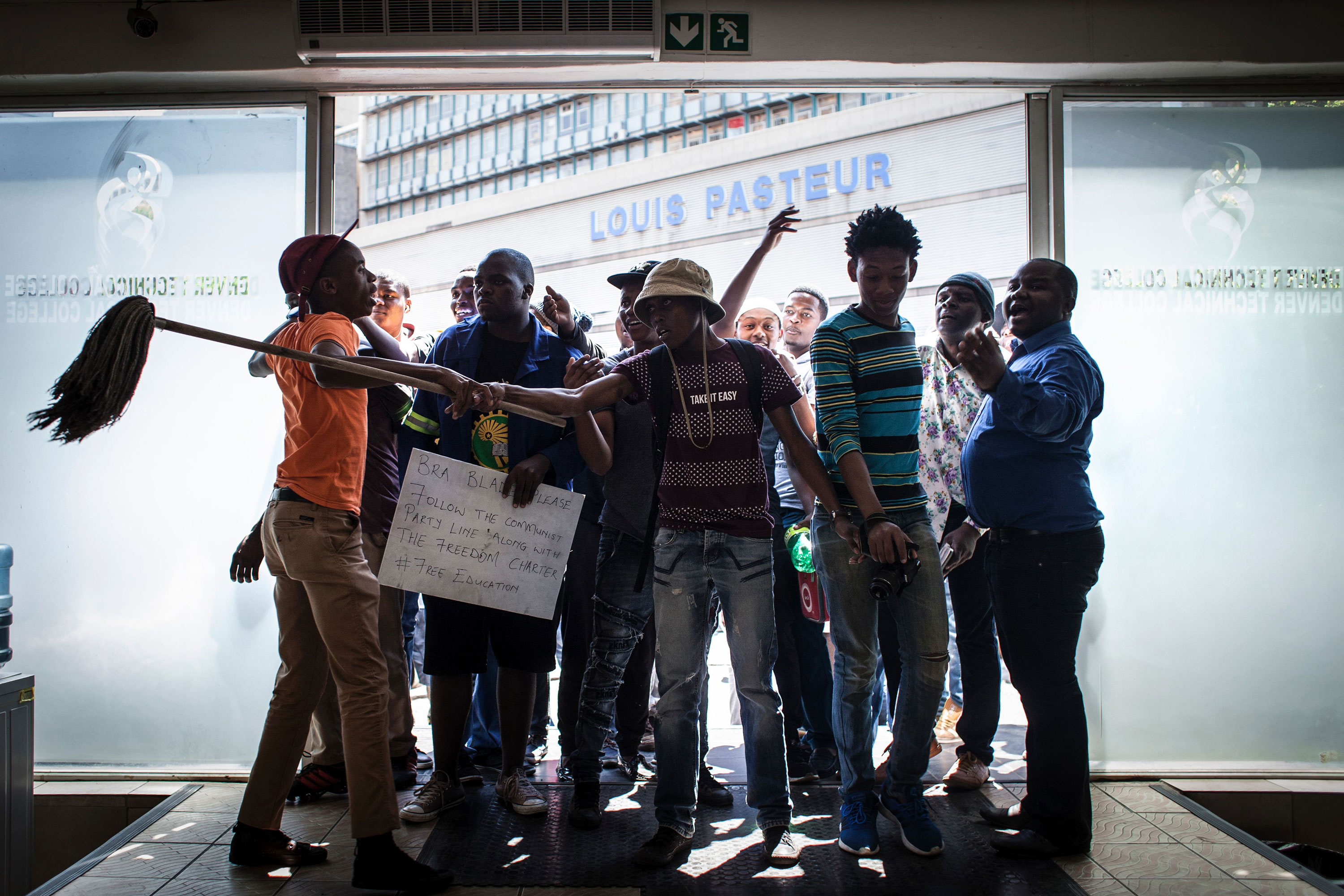
Adam Habib, the South African academic and public intellectual, has had a storied career. Currently the Vice Chancellor of the School of Oriental and African Studies (SOAS) in London, he previously stewarded the University of Witwatersrand (Wits) in Johannesburg, one of the continent’s finest educational institutions. During his time at Wits, Habib navigated the university through the convulsions wrought by #FeesMustFall, an explosive student movement in 2015 demanding a reduction in fees and an increase in government funding. Together with #RhodesMustFall, a related decolonial protest earlier in the year, the movement became known as Fallism. In this issue of the Ideas Letter, Habib takes its measure. His analysis is at once magisterial and devastating.
Chinese feminism has benefited from a slate of critical interpreters in recent years. Angela Xiao Wu and Yige Dong offer their own illuminating take on a conflict-laden field shaped by everything from marriage markets to state backlash. They also reconsider their own insight from a decade ago—which they named “made-in-China” feminism—to see what’s changed. Despite unrelenting pushback and censorship, feminism in China continues to expand—and to fight back.
Ghanaian writer and technologist Bright Simons follows with an intriguing meditation on the social world of AI. He suggests that intelligence is always social before it’s individualized, thus AI’s real power comes from collective human thinking. Bucking the mainstream, he argues that we need more human interaction, not less, if AI is going to succeed in bettering our civilization.
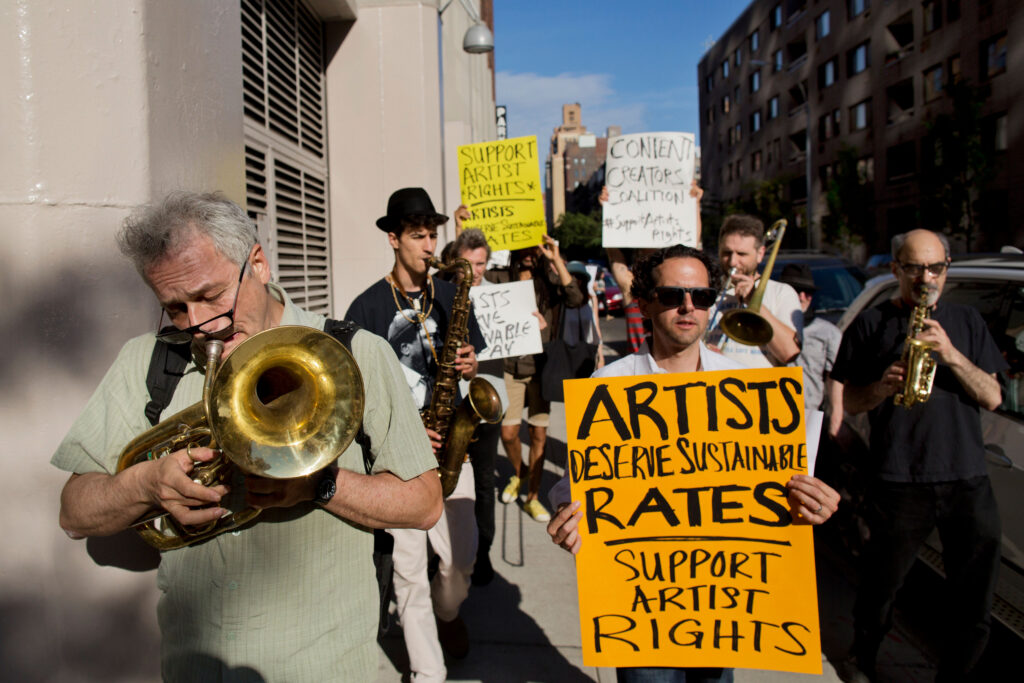
Marc Ribot is remembered as one of New York’s classic downtown musicians. Aficionados also know him as one of the great guitar virtuosos of our day, mixing genres in a fashion that betrays not only eclecticism but a commitment to syncretic and hybridized music. My interview with Ribot touches on the politics of music and his unswerving commitment to the labor rights of musicians.
Our curated section kicks off with a coruscating critique of Yascha Mounk’s conception of populism and its relationship to democratic practice by Chinedu Kelechi Okite. He covers considerable ground as witnessed by voluminous trans-disciplinary references.
From our friends at Jacobin, Andre Pagliarini opines on the responsibilities and realities of the Brazilian left once Lula is no longer on the scene (hopefully four years from now). His new book on the politics of Brazilian nationalism is arriving this autumn.
Last, we feature a recent lecture, delivered by the German political sociologist Hartmut Rosa, on what happens in today’s society when judgment is elided in the interest of getting things done. Well worth watching!
We have featured Marc Ribot’s music once before, but it’s fitting here again. Ribot has had many bands over the years; this particular outfit, Los Cubanos Postizos (aka “The Prosthetic Cubans”), plays music inspired by Cuban son. Here is their eponymously-derived track, an infectious composition entitled Postizo.
—Leonard Benardo, vice president at the Open Society Foundations
Maximalism Must Fall

Adam Habib
The Ideas Letter
Essay
Habib revisits the student uprisings that shook South African universities in 2015, reviewing Kayum Ahmed’s Theorising Fallism as an entry into the ambitions and afterlives of the #RhodesMustFall and #FeesMustFall movements. He credits Ahmed with capturing how activists made sense of their own struggle and projected its influence globally, while questioning the strength of its theoretical and empirical foundations. Habib then turns to the university itself, arguing that any serious project of transformation must grapple with questions of financing, governance, and accountability that Fallism largely ignored.
“Institutional cultures are sustained by three elements: information, the practice of norms, and accountability. Most progressive scholars are comfortable with the first two, but they are terrified by the third. But without accountability universities cannot succeed because there will always be a minority who refuse to play by the rules. Indulging them will corrode the norms needed to sustain an institutional culture. How to hold students accountable while being empathetic to the fact that they need to be allowed to make mistakes and learn from them is the permanent challenge of strategic management of higher education. Unfortunately, these issues are completely absent from Ahmed’s book: He holds that the university must simply be co-opted into the progressive cause.”
Feminism: Made in China

Angela Xiao Wu and Yige Dong
The Ideas Letter
Essay
Wu and Dong revisit “made-in-China feminism” — a concept they first developed a decade ago — to examine how gender conflict is being reconfigured in a harsher economic and political climate. Moving from viral scandals and online subcultures to state discourse and academic analysis, they trace the shifting tension between “entrepreneurial” and “noncooperative” feminist practices, alongside a backlash that casts women as both symptom and cause of social crisis. Dominant readings reduce complex dynamics into ideological narrative, obscuring the structural conditions that shape how feminism is lived in contemporary China.
“Loaded labels for ‘feminism’ have proliferated on the Chinese internet. There’s ‘Chinese homegrown feminism’ (tianyuan nüquan), ‘feminist cancer’ (nüquan ai), ‘feminist whores’ (nüquan biao), and more recently, ‘female pugilists’ (nüquanshi) and ‘extreme feminism’ (jiduan nüquan). Many of these terms have been imposed; some have then been reclaimed. When a backlash names, it seeks to mock and belittle; when the government names, it creates additional risks for the women who are targeted. … The task instead should be to understand Chinese women’s struggles on their own terms.”
The Social Edge of Intelligence

Bright Simons
The Ideas Letter
Essay
Simons challenges the dominant story of AI-driven efficiency, arguing that the intelligence powering today’s systems is built from accumulated human interaction. As organizations automate work and offload thinking, they risk thinning the social processes—learning, disagreement, coordination—that make that intelligence possible. The result is a paradox: the very drive to replace human labor erodes the conditions on which future AI depends.
“The AI industry is telling a story about the future of work that goes roughly like this: automate what can be automated, augment what remains, and trust that the productivity gains will compound into a wealthier, more efficient world. … The Social Edge Framework tells a different story. It says: the intelligence we are automating was never ours alone. It was forged in conversation, argument, institutional friction, and collaborative struggle. It lives in the spaces between people, and it shows up in AI capabilities only because those spaces were rich enough to leave linguistic traces worth learning from.”
Guitar Hero
An Interview with Marc Ribot
Leonard Benardo
The Ideas Letter
Interview
Marc Ribot has spent more than four decades moving fluidly across the boundaries that ordinarily organize musical life: between downtown experiment and popular song, between sideman and bandleader, between art as formal inquiry and art as political intervention. But what makes his work so compelling is not simply its range. Again and again, Ribot has returned to larger questions about music’s social consequences: what it means for sound to carry political force, how genre can function as both resource and constraint, and what artistic freedom looks like under the economic pressures of the contemporary music industry.
“I feel pressed to accelerate in a different direction (or another) every time I pick up a stringed instrument I’ve never played before. I’m afraid to write this, as it’s probably grounds for involuntary commitment, but each one of them tells me to play something different. That’s how I hear guitars. I don’t listen for any objective criteria—tone, fret buzzes, intonation, etc. I just wait to find one that tells me to play what I need to play. (Don’t worry, if any dogs give me murderous commands, I won’t listen.) … I don’t see being labelled “eclectic” as a value: it’s been more of a curse. The name of my first late ’80s, early ’90s rock band—Rootless Cosmopolitans—was designed to shield me from this curse (“rootless cosmopolitanism” was a crime in Stalinist Russia used to arrest Jews and intellectuals). It was a way of telling those who critiqued the fact that I was all over the place that they were being Stalinists.”
A Critique of Yascha Mounk’s Understanding of Populism and Democracy
Chinedu Kelechi Okite
Philosophy and Social Criticism
Journal Article
Okite makes the case that Yascha Mounk’s influential account of populism as both democratic and illiberal rests on unresolved ambiguities about the nature of political conflict and the coherence of liberal democracy itself. He argues that Mounk oscillates between a vertical, antagonistic vision of populism and a more pluralist, horizontal understanding of democratic struggle, while also wavering on whether liberalism and democracy are in tension or mutually constitutive. Turning to Claude Lefort, the piece reframes populism as an attempt to occupy the inherently “empty place” of power in democracy.
“When analysing the ambiguities in Mounk’s work, this paper underscores that any plausible account of what makes populism a threat to democracy must consider the nature of the liberal democratic struggle and how populism fits into this struggle. The result is that the populist antagonistic political struggle makes it a threat to democracy. It is not only because populism undermines liberal institutions, as Mounk argues, but rather, populist filling up the empty place of power that determines democracy as one can draw from the analysis of Claude Lefort (1988, 17–19, 224–35) undermines both the liberal guarantee of individual liberty and equality of citizens; hence it cannot be democratic.”
Brazil’s Left After Lula
Andre Pagliarini
Jacobin
Essay
As Brazilian President Luiz Inácio Lula da Silva seeks reelection for what will likely be his final term, Pagliarini argues that key decisions within Brazil’s left are already shaping the post-Lula political landscape. Fernando Haddad’s likely gubernatorial run in São Paulo and debates over electoral alliances reveal how tactical choices double as early tests of succession, party direction, and independence within the left. What emerges is a broader strategic dilemma: how to balance unity against the far right with the pluralism and internal tensions that have long defined the left.
“These internal debates matter not only for Brazil but for the region and the world. Indeed, as the far right advances across Latin America and beyond, decisions over coalition-building, party autonomy, and generational leadership will shape whether progressive forces can present a credible counterweight to authoritarian currents in this hemisphere and beyond.”
From Agency to Execution
The Atrophy of Discretion in Everyday Life
Hartmut Rosa
Université Jean Moulin
Conference
Rosa argues that contemporary life is increasingly organized around execution rather than judgment, as lived situations are broken down into “constellations” of measurable variables that can be processed by rules and systems. He traces how this shift hollows out agency by replacing responsiveness to circumstances with the impersonal logic of procedures and indicators. The result is a diminished sense of autonomy and a world that is more efficient on paper, yet less capable of trust, responsibility, and meaningful human action.
“When I was young, of course we had a lot of Lego bricks, and the idea was: build something. What we built was not too impressive. There was a Danish Lego advertisement from 1981: a young girl built a house, and this house wasn’t really well crafted—it was totally uneven and so on. But the girl was proud and said, ‘It’s beautiful as it is.’ So the idea is: it’s agency. You have to draw on experience, on judgment, and you need a good eye to build something, and what you build is expressive of who you are. … Nowadays they also play with Lego bricks, but they get complete models—build a Titanic ship—and they come in neat packages with a clear plan. So our kids are moving from agency to execution. They don’t need judgment, and the ship they build is not expressive of who they are. It looks great on the shelf, but then it’s dead.”