Pragmatic Failure
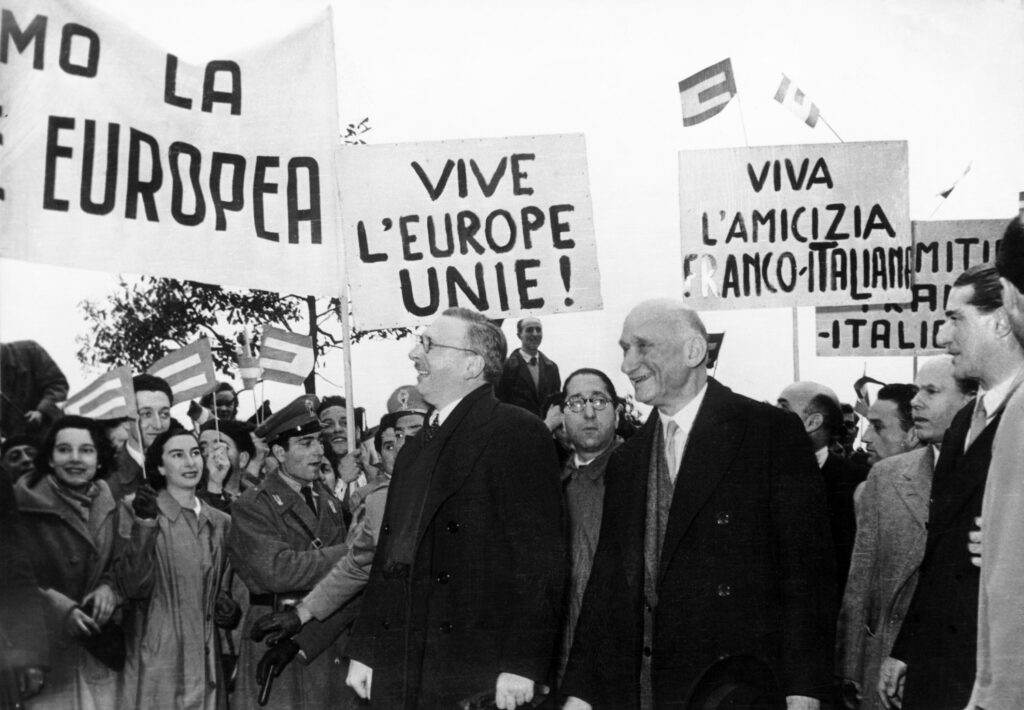
Europe rose from the ashes of war, genocide, and colonialism by redefining its identity in contrast to its historical past. A new Europe was born based on rights, cooperation and integration, and a cohesive European identity to match. Though never a superpower in the postwar era, Europeans once felt secure in an international order where, despite frequent violations, multilateral institutions, international law, and democratic principles shaped the dominant norms. Europe, and especially the European integration project, saw itself (in quintessentially Eurocentric terms) as a gold standard for the world. The world was moving in its direction: Europe was swimming with the tide.
That world is gone. In response, leaders have adopted the language of power, pragmatism, and transactionalism. This shift has occasionally been decisive, as seen in the continent’s push for rearmament and the defense of Ukraine. Other times, it has been partial and clumsy, evident in the half-hearted attempts to redefine relations with the Global South. And in some cases, it has not materialized at all, as Europe’s recoiling from the Middle East and its subordination to the United States suggest.
With the international order rupturing, European leaders have been swayed to endorse a colder, more cynical, more transactional view of Europe. But if Europe is overtaken by the currents of nationalism and transactionalism, it will be hollowed out, meekly existing at the mercy of predatory imperial powers beyond its borders. Without a recommitment to its ideals, Europe will lose itself.
European Division and Agency
Foreign policy and defense have always been where the cohesiveness of European identity meets its hardest limits. Nation-states have jealously guarded their sovereignty in this domain, refusing to give up authority to collective European institutions. This means that the EU has been constitutionally constrained and institutionally limited in playing an active role in diplomacy and defense. As a result, decisive action has taken place within NATO, but only when driven by the US, which acts as the implicit, and at times explicit, majority shareholder of the Alliance.
The standard explanation of Europe’s weakness in foreign affairs is the lack of agreement between European governments. In the Yugoslav wars of the 1990s, European passivity, riddled by division, was jolted only when Washington came to the rescue, first in Bosnia and then in Kosovo. In the 2003 Iraq War, Europe was split at its core, with France and Germany opposing the war, while the UK, Italy, and Spain supported it; there was also a divide between Western and Eastern Europe, the latter then on the cusp of entering the European Union. In 2011, it was a US-led NATO, rather than the EU, that intervened militarily to halt the massacre in Benghazi, ultimately toppling Muammar Gaddafi’s regime in Tripoli.
Cleavages multiplied as the EU enlarged over the decades and its heterogeneity increased. When nationalism, authoritarianism, and populism resurfaced across the continent, especially with the rise of the far-right, those divisions deepened. The threat is not simply that of an EU that fails to project its voice in the world, but one which hollows out from within, reverting to being little more than a common market.
But blaming the absence of a coherent European foreign policy and cohesive European identity on the divisions between European governments obscures both the deeper maladies hampering Europe, and areas where significant European agency has existed.
At times, the shock of division has spurred European action. This was true in the Balkans, where after the Kosovo war in 1999, the EU engaged heavily both in conflict prevention—in Montenegro and Macedonia—and in attempted resolution—between Serbia and Kosovo—while initiating the process of European enlargement towards the region. Though the Western Balkan countries have not entered the EU yet, the region proceeds towards European integration, making progress on reforms while not slipping back into violence. Montenegro, and perhaps even Albania, may see EU membership within the next few years.
The Iraq War forced Europe to reflect on its identity and global role. Millions of Europeans took to the streets to protest the US-led war. Intellectuals like Jürgen Habermas and Jacques Derrida articulated a Kantian vision of European identity rooted in multilateralism, international law, and soft power. In retrospect, their vision had blind spots—patronizingly overlooking Eastern Europe and ignoring the resurgence of the Russian threat, which would demand hard power as well. Regardless, the 2003 Iraq War marked a pivotal moment in the formation of a European identity.
Unable to prevent the Iraq War, Europeans rediscovered their collective purpose by launching a multilateral diplomatic initiative enshrined in international law to address the Iranian nuclear question: what later became known as the E3/EU+3 format—France, Germany, the UK, and the EU High Representative, alongside China, Russia, and the US. They did so despite the fact that the role of EU High Representative had been established only two years prior, and that the Bush administration was scornful of the initiative. The E3/EU+3 patiently managed the Iranian nuclear file, keeping dialogue alive with Tehran, including during the difficult years of Mahmoud Ahmadinejad’s hardline presidency. Eventually, it delivered the Iran nuclear deal—known as the Joint Comprehensive Plan of Action—in 2015. That agreement—sabotaged by the first Trump administration in 2018, which triggered the cycle of escalation with Iran—remains Europe’s most significant diplomatic achievement.
Over the course of the Ukraine war, observers have watched for signs of European division. Russia has traditionally been one of the most divisive foreign policy questions in Europe. Before 2022, Western and Southern European countries typically favored engagement with Moscow, while Northern and Eastern European countries pressed for stronger sanctions, especially after the 2014 annexation of Crimea. After the large-scale invasion began, many predicted a split between a “peace camp” and a “justice camp” in Europe, with the former concentrated in the south and west and the latter in the north and east of the continent.1 As far-right forces gained ground across Europe, Russia became increasingly effective at disrupting European unity, leveraging its relationships with far-right leaders, above all Hungary’s Viktor Orbán.
These divisions are real and have contributed to diluting and delaying European action on Ukraine. But they have not prevented Europe from agreeing on 20 sanctions packages against Moscow, becoming Kyiv’s largest—and, since Trump retook office, its only—economic and military supporter, and including Ukraine in the EU enlargement process. And with Orbán’s resounding electoral defeat in 2026, a major obstacle to European unity on Ukraine has finally exited the political scene. Division can often be overcome, and it is not always synonymous with weakness and inaction.
Towards Unity in Ambiguity
There was a time when Europe—beginning with, but not limited to, the EU—had a clear sense of such identity. Unable to define itself through language, ethnicity, culture, or religion, which would have exposed the continent’s divisions, Europe chose to identify itself through civic liberal principles revolving around rights, democracy, international law, and multilateralism. Its identity was shaped not in juxtaposition with an external Other, as is often the case with nation-states, but in contrast to its historical Self. There had been an old Europe of nationalism, colonialism, and fascism that had sown death and destruction across the continent and the world. Europe’s postwar renaissance would be enshrined in the repudiation of that past, uniting in diversity through European integration, international cooperation, democracy, and the rule of law.
The reality was messier than this rosy picture allows. European policies towards Africa or the Israeli-Palestinian conflict were often accused of hypocrisy and double standards. After the fall of the Berlin Wall, competing frameworks for understanding the world emerged. Alongside an enduring liberal outlook, a civilizational contender took hold, encapsulated by Samuel Huntington’s “clash of civilizations.” Where liberals saw a world converging on shared democratic values, Huntington saw irreconcilable blocs defined by religion and culture destined for conflict rather than cooperation.
In Europe this translated into a creeping return to defining European identity through religion and culture rather than rights and law. This propelled a European foreign policy vision based less on rules-based cooperation and integration, and more on erecting walls. Nowhere is this clearer than in the transformation of the EU’s relationship with Turkey. Once based on the aspirations of integrating Turkey into the EU, it is now a transactional relationship in which Brussels pays Ankara to keep refugees far from its shores. Even so, European official documents and public pronouncements remain unambiguously anchored—however hypocritically—to the language of liberal norms and values.
By the mid-2010s, Europe’s world—based on rights, integration, and multilateral cooperation—was fraying. Violence re-erupted with the beginning of the war in Ukraine in 2014. When the Arab spring turned into winter, war, repression, and state collapse followed in North Africa and the Middle East. The reverberations reached Europe with the wave of terrorist attacks. The world was becoming more multipolar: Europe was in relative decline, and its patron, the US, would no longer be the world’s hegemon. This meant that Europeans could no longer lecture the rest of the world on democracy or easily condition aid and trade on the adoption of European standards. It had to concentrate instead on investing in its defense in the face of a resurgent Russia and a distracted, disengaged America. With the rise of nationalist populism in Europe and the increasing violation of liberal norms, the priority became protecting those values at home rather than promoting them abroad.
This realization came with an acknowledgment that European foreign policy had to become more pragmatic. This was not initially interpreted as a call to shed liberal values, but rather to adopt a more realistic, humble, and less Eurocentric view of the world. In fact, a genuine commitment to greater pragmatism could have meant becoming more, rather than less, principled in world affairs. Nowhere was this clearer than in Ukraine, where a more muscular European approach centered on military support for Kyiv and sanctions against Moscow was seen not merely as compatible with Europe’s liberal ethos, but as the only ways to live up to it. Europe would use hard power not for the sake of becoming yet another geopolitical player, but to honor its commitment to protecting a “geo-liberal” space in wider Europe.2 Europe’s military rearmament was meant to serve its intellectual and political rearmament in defense of liberal values threatened by Russia in Ukraine.
But this didn’t last. Principled pragmatism—resting on a recognition of how the world was changing alongside an unshaken commitment to what kind of world Europe stood for—gave way to publicly voiced cynicism, transactionalism, and the danger of abdicating values altogether. Nowhere is this clearer than in the Middle East today, where a broad majority of European governments have responded with studied ambiguity—a calculated vagueness that conveys cynicism: knowing what international law requires and choosing to look away.
With a few exceptions such as Spain in the EU, and Norway outside it, most European governments have adopted a similarly ambiguous stance. Major European leaders—including far-right Giorgia Meloni in Italy, liberals like Emmanuel Macron and Donald Tusk in France and Poland, Christian Democrats like Friedrich Merz in Germany, and center-left Keir Starmer in the UK—have recognized US and Israeli violations of international law. Yet none of these leaders—nor European Commission President Ursula von der Leyen—have followed recognition with clearcut condemnation. Meloni, while acknowledging to the Italian Parliament that the war violated international law, declared that she neither condemned nor condoned it. Merz claimed that international law was not a useful framework and that this was not the time to preach to friends and allies. Von der Leyen put the cherry on top when she said that debating whether the war in the Gulf is one of choice—that is, illegal—or of necessity—legal—“partly misses the point,” and that Europe must accept the world as it is.3 Her words were such an explicit repudiation of the EU’s long-standing international principles that European Council President António Costa felt compelled to correct course, reaffirming Europe’s belief that multipolarity and multilateralism must go hand in hand.4
As war in the Middle East has taken a sour turn for the US, with the illusion of a quick win morphing into a strategic debacle, European leaders have begun distancing themselves from Trump. Many European governments had shortsightedly backed the war, despite its illegality, believing that a swift resolution in the US’s favor would deliver strategic gains for Europe too. They soon learned the scale of their miscalculation. The war has represented a temporary boon for Russia through higher oil prices and depleting the air defence interceptors available to Ukraine. Washington has also lifted sanctions on Russian oil (while this measure is meant to be temporary, it may well become permanent over time).
Europeans have watched, dumbfounded, the increasingly unhinged US president, with his gleeful threats to commit war crimes in Iran, his insults directed at European leaders, his calls to abandon NATO and suspend Spain’s membership of the Alliance, and his announcements of troop withdrawals from Germany. Even far-right leaders are distancing themselves from him, not necessarily because they no longer share his administration’s predatory worldview, but because proximity to Trump is becoming politically toxic. This is certainly true in Italy, where there has been a major public falling out between once Trump-acolyte and would be “whisperer” Meloni and the US president. It is also visible in France and Germany, where the Rassemblement National and the Alternative für Deutschland have voiced dissent. Only Orbán remained wed to Trump, and this may well have contributed to his resounding electoral defeat.
All this is symptomatic of Europe’s slide away from its traditional identity based on rights and law. European governments were seduced by the sirens of transactionalism, sidelining international law to curry favor with Washington. But the gamble was lost.
Reclaiming Europe’s Identity and Global Relevance
Europe has long claimed that its collective identity is grounded in rights, law, and multilateralism. This is how European integration has developed internally, starting with market integration and spreading into other policy areas over time. It is how Europeans have presented themselves to the world. Of course, they have never fully lived up to that self-image, which invites inevitable accusations of hypocrisy. But this does not detract from the fact that it is how Europe has understood itself and its global role.
European leaders may think they are more realistic today than their idealistic predecessors. The opposite is true. If Europe abdicates its commitment to rules, norms, and law, however imperfectly it lives up to these, it will cease to exist as a collective entity, as European integration is hollowed out from within. The EU is a community of rules and law. Without it, the continent would slip back into a Europe of nations, which is precisely what far-right forces in Europe, as well as imperial aspirants in Moscow and Washington, would like it to be. If Europe abandons its principles and laws, rather than working to reassert them alongside other small and middle powers, it will not emerge as a muscular global player but will instead be pulled apart by predatory players like Russia and the US.
The liberal international order in which postwar Europe felt at ease is over. That order rested on a configuration of power—largely dependent on the US—that no longer exists. Though the US often betrayed the liberalism it purported to represent, today it no longer even claims to stand for that liberalism. Meanwhile, proudly illiberal powers have risen, foremost China. As Canadian Prime Minister Mark Carney recognized at the 2026 Davos conference, the international liberal order is over.
But there are two ways of recognizing that the liberal international order—the pretense that norms could be sustained without the powers that upheld them—had become a fiction. The first, brazenly pushed by Trump, is to get rid of norms altogether. Trump is no hypocrite: He generally says what he thinks and does what he wants, as authoritarian leaders like Putin and Xi Jinping tend to do. Trump’s route to ending the fiction is to openly embrace the law of the jungle, in which the large and powerful conquer and subjugate the weak and small. The lions at the top of the food chain may eventually turn on one another, but for now they are busy devouring those below. The world envisioned by Trump, Putin, and Xi is one of imperial collusion rather than one of competition: The world is large enough for three empires, at least for now. It is a world in which Europe sits squarely on the colonial menu—whether of Trump’s imperial ambitions over Greenland and his determination to unravel the EU or Putin’s obsession with Ukraine, with China waiting in the wings. Were Europe to end the fiction by disavowing the norms on which its post-war self was founded and reverting to a Europe of nations, it would fill the sails of this dark vision.
The second route to ending the fiction of the international order requires realigning norms to the ongoing power shifts to reaffirm them. The world has become more multipolar. Alongside the US, China, Russia, and Europe, there are India, Brazil, South Africa, Turkey, Canada, Australia, Saudi Arabia, Indonesia, and more. Many of these middle powers, notably those from the Global South, have demanded a greater voice in global governance. Frustrated by the absence of a profoundly reformed multilateral system that better reflects shifting power balances—starting with the UN Security Council and international financial institutions—they have pursued their interests in a more transactional and unconstrained manner. But this does not mean that small and middle powers favor a lawless world in which norms and institutions are discarded, but should be read as a call for a reshaped and reformed multilateral system.
The die is not cast, and both futures remain possible. For now, the only certainty is the one Europe should fight for—a world governed by law rather than power alone. Europe was right to recognize the changing global tides and the profound power shifts in the international system. But it was wrong to infer from this that its self-interest required shedding its principled identity, embracing crude power instead. Europeans only stand to lose from this. The gap between aspiration and attainment is not a reason to reject those principles, but the very reason to embrace them.
- https://ecfr.eu/publication/peace-versus-justice-the-coming-european-split-over-the-war-in-ukraine/ ↩︎
- Richard Youngs (2024) Geoliberal Europe and the Test of War, Cambridge University Press, Cambridge. ↩︎
- https://ec.europa.eu/commission/presscorner/detail/da/speech_26_576 ↩︎
- https://www.consilium.europa.eu/en/press/press-releases/2026/03/10/speech-by-president-antonio-costa-at-the-eu-ambassadors-conference-2026/ ↩︎