Sembène Erased
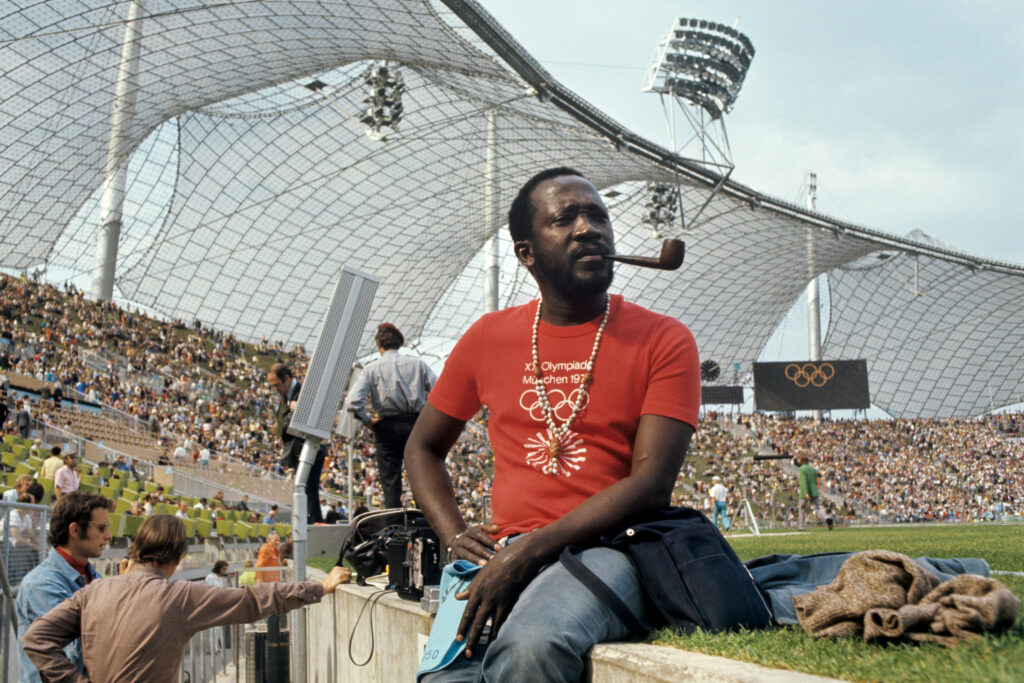
In 1972, Ousmane Sembène, the Senegalese filmmaker and novelist, arrived at the Olympic Games in Munich. Along with eight other filmmakers, he had been invited by the American producer David L. Wolper to capture the spirit of the games. Wolper’s idea for the film was to make an anthological documentary by inviting directors from around the world to capture the scale and spectacle of the extraordinary global event over the course of 17 days. He recruited filmmakers from the US, USSR, UK, Czechoslovakia, Germany, Japan, and France. Sembène was the only African filmmaker on the project.
Sembène wanted above all to capture the fraternity between the Black athletes from the American national team and the African sportsmen representing their countries. He was specifically interested in the improvisational nature of these rare encounters, which he saw as representative of Black nationalism. Speaking to an interviewer in French and communicated through a translator, his stated idea for his section of the film has an unfinished quality, either lost in translation or yet to be worked out: “For this film I’m going to plan to improvise meeting the people. It is my first film of that type of documentary style,” he said. If Sembène was still working through his intentions, he would not have been alone; the other filmmakers shared this artistic anxiety and kept reworking their ideas as they filmed.
What is clear is that Sembène understood the historical nature of the meetings between African American and African delegations. Through their encounters he wanted to capture two historical moments: the ongoing struggle for civil rights in the US, and rising anti-apartheid sentiments which had resulted in a ban on South Africa and Rhodesia (now Zimbabwe) by the Olympics Committee, while much of the continent grappled with self-determination and political instability. One athlete that typified these historical currents was Jesse Owens, the African American Olympian who was then heroically returning to Germany, where he’d won four gold medals in the Berlin Olympics in 1936. As a boy, Sembène had watched Owens win in a movie theater in Dakar; nearly forty years later, in 1972, he comes across as a starstruck and nostalgic fan, finally getting to meet the hero of his youth.
But Sembène’s film didn’t make the final cut. The documentary took the name Visions of Eight, rather than the originally intended Visions of Nine, and was released to mixed reviews the following year. Beyond a few minutes of footage that appear to have been done by Sembène showing interviews with Owens and close-up shots of sportsmen in transit, possibly members of an African team, his work on the film is lost to history. The reasons for Sembène’s excision are unclear. A 2021 retrospective, released by the Criterion Channel as Munich ’72: The Making of Visions of Eight, speculates that Wolper’s reasons for cutting Sembène were purely aesthetic. There’s also the suggestion that there was a problem with Sembène’s methodology; it’s insinuated that as a director he simply failed at the task at hand. (In Wolper’s memoir, he claims that Sembène never finished his part of the movie.) But this isn’t consistent with what we know of Sembène’s skill as an auteur. True, the project marked his first foray into documentary filmmaking. But he’d already been making films for nearly a decade, since his first feature film, Black Girl (1966). In Munich, he wanted to make evident a cinematic language that was as distinguishable as possible from what he called Hollywood’s “dream factory.” Art, Sembène believed, did not have any frontiers.
In the retrospective, Wolper is sincere in his focus on making a global film. But he ultimately comes up against the limits of his imagination. He is crucially unable to see, even right there in Munich, the unfolding political landscape defined by racial tensions, the ban on apartheid countries, a divided Germany, and, during the course of the games, the massacre of Israeli athletes by Black September—which is only alluded to in Visions of Eight. He had a film to cut together in about two weeks and nine filmmakers under pressure to produce footage for him to work with. When the filmmakers sent their cuts to Wolper, they understood that a producer’s edit was part of the game, and that he would make snap decisions. In his view, Sembène’s footage did not hold up narratively. The supervising editor for Visions of Eight, Robert K. Lambert, recounts a moment when Wolper asked him to redo Sembène’s portion: “I cut a sequence, and Wolper looked at it. It was determined that there wasn’t a sequence there. So it became Visions of Eight. The title’s my fault. We couldn’t make it Visions of Nine. We tried like hell.”
But, from the opening sequence to the last, it is evident that Sembène’s cinematic language would not have been that incongruous with the project. The filmmakers each met the moment with different aesthetic attitudes. Sembène’s problem seemed to stem more from the fact that his material was obvious in its politics. For instance, the Japanese filmmaker Kon Ichikawa captured, in a technical feat, the human body under the condition of extreme speed. In a similar style, the American filmmaker Arthur Penn showed a monotonous high jump sequence. And in a stark, straightforward sequence, the Swedish filmmaker Mai Zetterling showed the obsessive daily rituals that make an athlete exceptional. It’s important also to note that the ’72 Olympics were characterized by a concerted effort to ensure that very little of the games was lost to history. Three large computers connected with a data transmission network (using the best available technology at the time, Siemens System 4004/45 computers) were equipped to record no fewer than 500 million facts in 30 storage devices: real-time results from the games, bio data about the participants, details on sporting equipment, granular data on the athletes’ diets (e.g. 140,000 liters of orange juice, 6,400 kilos of calves liver). This vast information-gathering exercise and focus on record-keeping, even of the most mundane data, is precisely what makes the inability to account for Sembène’s work noteworthy.
Visions of Eight—despite its absence of Sembène’s vision—is a beautifully made, occasionally ambitious film, much to Wolper’s credit. But it is also a film about Sembène’s erasure. The viewer is asked to surrender to a watered-down notion of the universality and specificity that stories afford us. Even a seemingly incidental decision by Wolper to include a section with yodeling singers and milkmaids shapes how we remember the ’72 Olympics. For the final section of the film, Wolper and the British filmmaker John Schlesinger disagreed about whether to include footage of the terrorist attack. Schlesinger was certain that this was one of the defining moments of the games. Wolper did not agree. He thought that it would date the piece—and he did not want to be seen as highlighting the Palestinian cause. So the massacre ended up on the cutting room floor.
What becomes necessary to emphasize about the Sembène problem is not the failure of a dialectical relationship between a producer and filmmaker. One can see why Sembène’s material could not be marshaled into an agreeable form. Between Wolper and Sembène, it’s unlikely that there was enough congruence in their notions of filmmaking and cultural touchstones for their visions to cohere. Their experiences may have overlapped in parts, but in reality, they must have had vastly different days in Munich. And perhaps Sembène was just too idiosyncratic in his approach to build a bridge towards Wolper’s vision. He is known to have held a rigid philosophy regarding his creative freedom as an African filmmaker and novelist. He did not have any desires to be legible to a broader audience if this compromised his point of view. Remaining resolute in his center was a matter of personal principle.
And so, it’s important to note that the stakes were high for Sembène, and this impasse would have been more than a falling out between director and producer. It was emblematic of broader impositions on African storytellers, where the burden of legibility had been, in Sembène’s view, perpetually placed on African storytellers in the service of a global audience. In his own works, he would not indulge the conceptual horizons or barriers placed on him as a creative sovereign—even if it came at the cost of all that historical data and narrative experimentation.
Our experience of the world is mediated by any number of powerful vested interests: Sembène had Wolper to contend with. Today, African storytellers like Sembène are vulnerable to the dictates of social media companies in a competitive global market and attention economy. Insisting on a personal preference, in the way that Sembène sought to do, has only become harder. For the African storyteller, the simple preservation of stories and an insistence on a narrative range that reflects the possibilities of our storytelling can feel like a luxury—even more than it did for Sembène in 1972.
“African storytelling” is not a useful category because it signifies a monolith that does not exist. Algerian literature is as distinct from Senegalese literature on the African continent as Irish literature is from Russian literature on the European continent. But in the absence of finer data, the category will have to do. African novels make up only 5.6 percent of the global book market. A 2025 UNESCO report places the number of libraries in South Africa, for instance, at 1,949—compared to a population of over 63 million. Bookshops per person in Nigeria are 1 to every 50,000 people. The number of titles published continent-wide per year is about 86,000, based on 2023 statistics—far behind India, Brazil, and France. A similar report exists for films. Globally, the book market, like the film market, is faced with a deficit problem. Throughout Africa, we consume too much art from beyond the continent, while taking up too little space in the global output. Only a negligible fraction of books or films made by African storytellers find a global audience.
The internet’s intervention as an emancipatory tool promised to sidestep this problem for many African storytellers. It provided distribution pipelines that were unavailable through the traditional publishing industry. As an alternative, it solved much of the problems of creative freedom. It was the means by which African storytellers could find that global audience while telling the stories they wanted to tell. Online, the African storyteller did not have to deal with the Sembène problem and there was no Wolper to appease. Without these barriers and oversight function, new and irreverent narrative impulses developed with a ready audience.
But for these storytellers who have come to rely on the internet, the question of its endurance has become urgent. This digital environment that enabled narrative sovereignty for African storytellers is subject to pressures that move fast, create new vulnerabilities, and answer to no one. There is the amassing of stories in every imaginable format online, the real threat of their erasure, and no clear idea of how we might preserve this literary, textual, and visual history. There is always the risk that these archives could be lost—and we need a strategy that addresses this risk. When we consider all the intelligence lost in the destruction of great libraries throughout history, preserving the wealth of stories created and consumed online becomes an existential concern. Protecting the archive in a moment when social media companies and AI present very real threats requires solutions that understand what is at stake for storytellers who want, like Sembène, to continue to have creative control and narrative authority over their work.
For Chinua Achebe, the African storyteller’s ability to reclaim and hold complete authorial control is essential to the dynamism of African art. In an interview with Bill Moyers in 1988, he spoke of his experience of reading well-meaning novelists who had cast him as the savage by recounting the proverb: “until the lions have their own historians, the history of the hunt will always glorify the hunter.” In a Paris Review interview, he went further. “If you don’t like someone else’s story,” he said, “write your own. If you don’t like what somebody says, you say what it is you don’t like.”
Achebe’s ideal was taken up by the Kenyan novelist and thinker Yvonne Adhiambo Owuor in a 2015 TED Talk. Owuor’s version of dynamism, like Achebe’s, is aware of the African storyteller’s access to a wealth of stories, and the need to maintain authorial sovereignty. But she puts forward a more contemporary vision for maintaining authorial sovereignty. Owuor’s preferred kind of African storytelling is trans-historical, multi-dimensional, and pro-innovation. She points out that “historical events of existential import provide an arena for narratives to compete.” For this reason, she maintains that the infrastructure which sustains storytelling, and the kinds of stories sustained within it, are always high stakes. If Achebe revealed how narrative competition and dominance worked within traditional publishing in his time, Owuor’s aim is to clarify the stakes for a new generation of African storytellers, most of them working online. “Does Africa,” she asked, “have an enduring [imagination] infrastructure to carry the weight of its unprecedented future?” This question seems prescient now that the future is here: African storytellers today have generative AI to deal with, and AI’s re-imagination of narrative dynamism and control.
To listen to Owuor is to understand that world-making is always a battle for narrative dominance. A fight for who gets to determine the hero, the villain, and the sacrificial victim, and whose archetypes we justify in our individual and collective imaginations. We should take Owuor seriously. In 2023, she delivered the keynote address at the European Conference on African Studies in Cologne, where she advocated passionately for narrative sovereignty as a strategy to avoid becoming footnotes in the narratives of others. She said:
We need to cohere around a common story… The lack of an African self-myth, a collective self-myth, a binding story—and please not Wakanda—that is linked to a multi-sensory, multi-generational, transcendent, multi-universe aspiration, one that requires a fiery re-imagination of ourselves, the world, and the galaxies – that lack makes us susceptible to be blasted by left, right, and center by others’ more potent stories, and all the blowing winds of time.
Owuor makes it clear that an investment in memories generates futures. The future she invokes here does not simply gesture toward the accrual of time, or a record of orbits and transits through space. It’s an iterative state where we progress toward custodianship and control as the protagonists in our stories. In view of this future, it isn’t merely “archive fever” to hope that Sembène’s excised footage exists somewhere—correctly preserved among his body of work, rather than forgotten in Wolper’s LA studio. Even his lesser footage would be something to think with, to argue with, and build from. It is the archive that confers critical authority. Without it, there is only the version of the story that Wolper chose to tell.