
Peter Mair, the Irish political scientist who died in 2011, published a landmark essay and book on what he called “ruling the void.” He argued that Western democracy has been hollowed out in part because parties have withdrawn from their representative function and become more like governing elites rather than channels between citizens and the state. Mark Leonard, one of the keenest observers of European foreign policy, is a Mair devotee. I asked him to take the measure of Mair’s thesis for today’s political conjuncture, and he does so brilliantly. Leonard worries that Mair’s void will be filled by far-right ideology and mobilization. That may indeed be what the future portends.
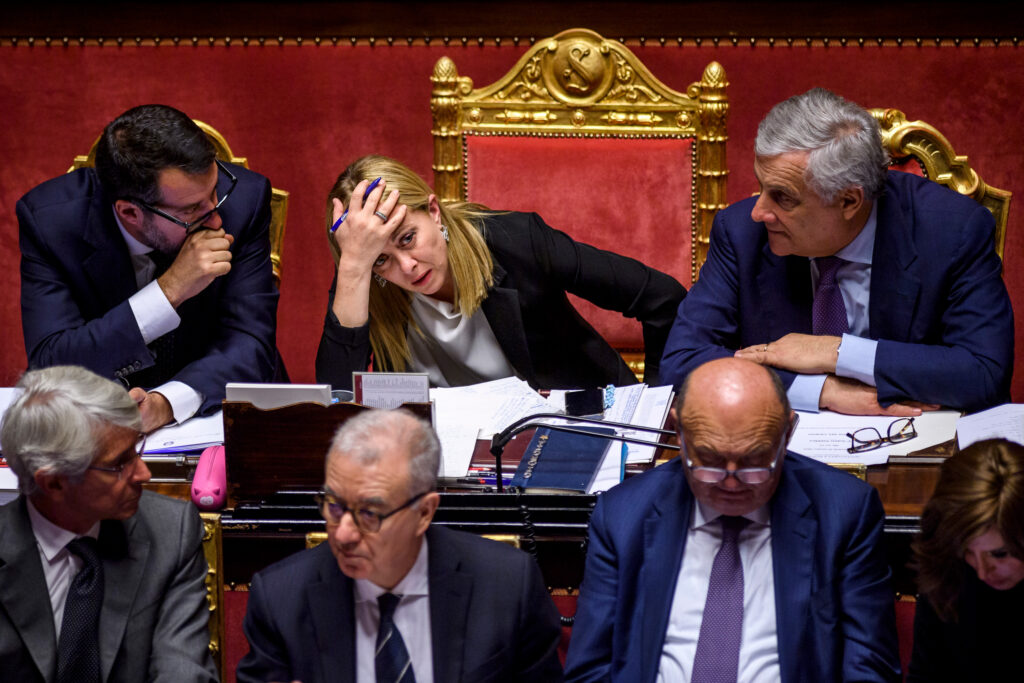
Europe remains the focus, via Italy, of our next essay, written by the versatile writer and Italophile Ursula Lindsey (she spent much of her youth in Italy). Lindsey, who has written for The Ideas Letter on American decline as seen from the Middle East, now turns her attention to Melonismo, the political current around Prime Minister Giorgia Meloni. Meloni is a complicated and contradictory figure, who in some ways fulfills Mair’s description of managing the politics of a depoliticized society. Lindsey argues that Meloni’s durability rests on her personal narrative and her tactical flexibility: She is a moving target, which makes her hard to pin down ideologically, but for that very reason, she is all the more effective. Her critics warn of longer-term risks to democratic institutions and checks on power.
Finally, Owen Hatherley, who has lately turned his attention to the political culture and aesthetics of the built environment in Asia, tries to make sense of a puzzle: Why does Japanese modernism constantly reinvent itself? What are the implications of its culture of forced obsolescence, in which buildings are literally torn down every generation? It is a story that few are better equipped to tell than Hatherley.
Our curated content begins with an essay about one of the godfathers (and an enfant terrible) of postwar American sociology: C. Wright Mills. Zaheer Baber traces Mills’s resistance to what he called the harmful professionalization of American sociology—the bean-counting nature of the discipline. In true Millsian fashion, he argues for reviving the big picture: Macro-theory must not be defeated by the small-minded.
We follow with the thorny question of expertise by spotlighting the introductory article to a special issue of the Review of International Studies. Policymakers have long dressed up expertise in the guise of scientific objectivity to make it more persuasive. But the authors of this paper hold that authority is increasingly conferred by other means, such as inclusion, urgency, and aesthetic appeal. At the same time, they warn against assuming this pluralization is straightforwardly progressive.
Last, the anthropologist Shahram Khosravi argues that defeat is not just a possible outcome of political struggle but a generative standpoint for knowledge and resistance—what he calls “defeat as method.” Khosravi develops the broad theoretical argument according to which genuine critical thought today can only come from the standpoint of the defeated, not as passivity or victimhood, but as a way of generating understanding and meaning from within brokenness.
Our musical selection for Issue 69 takes us back to the late eighteenth century and the overture of Luigi Cherubini’s Médée. I have been on a Medea kick of late, reading the original Euripides and watching the Pasolini film with Maria Callas from 1969 (the great soprano’s only silver screen appearance). The story is as gruesome as the music is sublime.
—Leonard Benardo, vice president at the Open Society Foundations
Froth, Fury, and the Rise of the New Right

Mark Leonard
The Ideas Letter
Essay
Leonard revisits the political scientist Peter Mair’s influential concept of the democratic void: the widening gap between increasingly detached political elites and citizens who no longer participate in the mass parties that once connected society to the state. For the historian of political thought Anton Jäger this void has evolved into an era of Hyperpolitics, in which intense political engagement no longer translates into durable institutions or meaningful political change. Leonard argues that the New Right has solved this problem by filling the void with a new infrastructure of leader-centered, emotionally charged mobilization rooted in the attention economy, which is transforming not only electoral competition but the very nature of democratic politics.
“On this reading the New Right is the first formation to solve the Hyperpolitics problem, and that is precisely why it is winning. The revolution is not only about what laws pass but about what politics itself is becoming and how the mainstream parties are forced to practice it when faced with the New Right. This is the most Mairian answer of all: The New Right is completing the destruction of party democracy that the cartel parties began, replacing it not with a new set of mass parties but with an infrastructure for permanent affective mobilization and using that to rewrite the political rules. Rather than classical parties or froth, there are now a new set of institutions that inhabited the void but have also set themselves up to exploit it through their control of the attention economy.”
The Contradictions of Giorgia Meloni
Ursula Lindsey
The Ideas Letter
Essay
Giorgia Meloni’s rise marks a new phase in the mainstreaming of Europe’s far right. She has turned a movement rooted in post-fascism and nativism into a durable project of government, using tight personal control and ideological flexibility to absorb institutional constraints without surrendering the movement’s broader ambition to reshape Italian politics.
“Melonismo, despite its fiery language and invocation of existential stakes, has proven less disruptive than anticipated. It is cautious, long-term, incremental; one might even say—especially as long as it is in power—risk-averse. The party is no longer a start-up that needs to attract attention through daring gambles and extreme positions. Unsurprisingly, as Meloni has acceded to power, her rhetoric has become more statesmanlike, emphasizing national achievement. ‘We are no longer the weak link in Europe,’ she said in a recent speech. ‘We are a credible, authoritative nation, looked at with respect by the world.’”
Easy Come, Easy Go

Owen Hatherley
The Ideas Letter
Essay
Hatherley considers Japan’s willingness to dispose of its buildings to ask a central question of contemporary urbanism: Should buildings be designed to endure or to change? Revisiting the radical Metabolist architects of the 1960s, he argues that their vision has often been misunderstood as one of ideological transience, when its deeper ambition was to create structures capable of continual adaptation. A surviving public housing complex in Hiroshima suggests that architecture need not choose between permanence and demolition—that the most sustainable buildings may be those designed to evolve.
“The redevelopment of Choujen-Motomachi is a moving achievement, and one which fully deserves to be as well-known as any post-war housing project. Like Park Hill, the estate is an image of an egalitarian new city in which old ideas about buildings and cities no longer apply, one where the working-class community floats in space. Unlike its English cousin, the renovation proceeded without displacing the original residents. And it has squared the circle—a building complex that is both “sustainable” and concrete, adaptable and preserved, futuristic but not disposable—and has done so because of the remarkable forethought of its architect, who proved here that Metabolism was not just a matter of goofy utopias but of a futuristic architecture that could endure in a real future world of material scarcity and much more limited energy availability than could have been imagined in the sixties.”
“Why?”
C. Wright Mills on the Spirit of the Classical Sociological Tradition and Positivist Versus Critical Sociology
Zaheer Baber
Sociology Lens
Journal Article
Baber revisits C. Wright Mills to argue that sociology has drifted away from its classical purpose. Rejecting the postwar drive to model the discipline on the natural sciences, he contends that the great sociologists have sought not merely to explain society but to connect personal experience to historical structures and ask what a more just society might look like. Baber argues that recovering this broader intellectual ambition is more urgent than ever in an age of metrics, hyper-specialization, and technocratic expertise.
“It is largely the concerted, seamlessly intertwined theoretical, methodological, and empirical interventions by C. Wright Mills in the post–World War II period that opened new intellectual and political spaces for nonpositivist, nontechnocratic critical sociology to flourish. As discussed earlier, Mills was by no means the first or the only sociologist to call out the pretensions of positivist sociologists. He was, however, one of the most determined and passionate advocates of critical sociology to go beyond hortatory exhortations and provide empirically grounded exemplars of the genre.”
The Pluralization of Expertise
The Good, the Glamorous, and the Political
Annabelle Littoz-Monnet, Juanita Uribe, and Leandro Montes Ruiz
Review of International Studies
Journal Article
Global governance no longer relies exclusively on the authority of science and on claims of political neutrality. The authors argue that expertise is increasingly validated through participation, moral purpose, aesthetic appeal, and creativity. But rather than democratizing decision-making, according to them, new forms of expertise often become part of the same technocratic machinery they were meant to challenge.
“This special issue critically examines this turn towards the pluralization of expertise and its politics. It does so, first, by revealing often unnoticed and mundane practices of knowledge authorization in global governance fora, bringing to the fore their distinct operating modes in making knowledge ‘expert’. We explore how knowledge is made authoritative through practices centred around inclusion and participation, through knowledge aestheticization and embellishment, when knowledge is authorized through its seductive allure and design, or yet through claims that invoke the timely, benevolent, morally good, or yet creative, out-of-the-box and imaginative nature of knowledge. These practices consist of routine ways of doing in global arenas, which increasingly delineate what knowledge can be authorized and thus pass as expert and policy relevant. They relate to modes of producing and packaging knowledge but also function as governing practices. Authorizing specific forms of knowledge as expert is, indeed, intrinsically linked to the exercise of governing, as expertise not only defines how problems ought to be understood and tackled, but also makes governance possible.”
Defeat as Method
Thinking from within the ruins
Shahram Khosravi
Cabinet
Essay
Khosravi argues that those who have endured repeated dispossession—colonized peoples, migrants, and the defeated of history—possess a distinctive way of understanding the world. Drawing on Frantz Fanon, Walter Benjamin, Shia traditions of lamentation, and anti-colonial thought, he argues that defeat is not simply a condition to be overcome but a way of thinking, one that transforms vulnerability into historical consciousness and sustains hope without illusions.
“The defeated of the earth already inhabit the very conditions that post-apocalyptic narratives attempt to describe. A historical defeat is never merely an event of the past; it carries within it the potential for future revolutionary moments. Lamentation over defeat is not a passive act of remembrance but a practice of hope—an orientation toward the possibility of the new. It is a willingness to meet an approaching defeat with an open face. This paradox, this tension, can be understood as a form of pessimistic hopefulness.”