The Irresistible Rise and Fall of Evo Morales
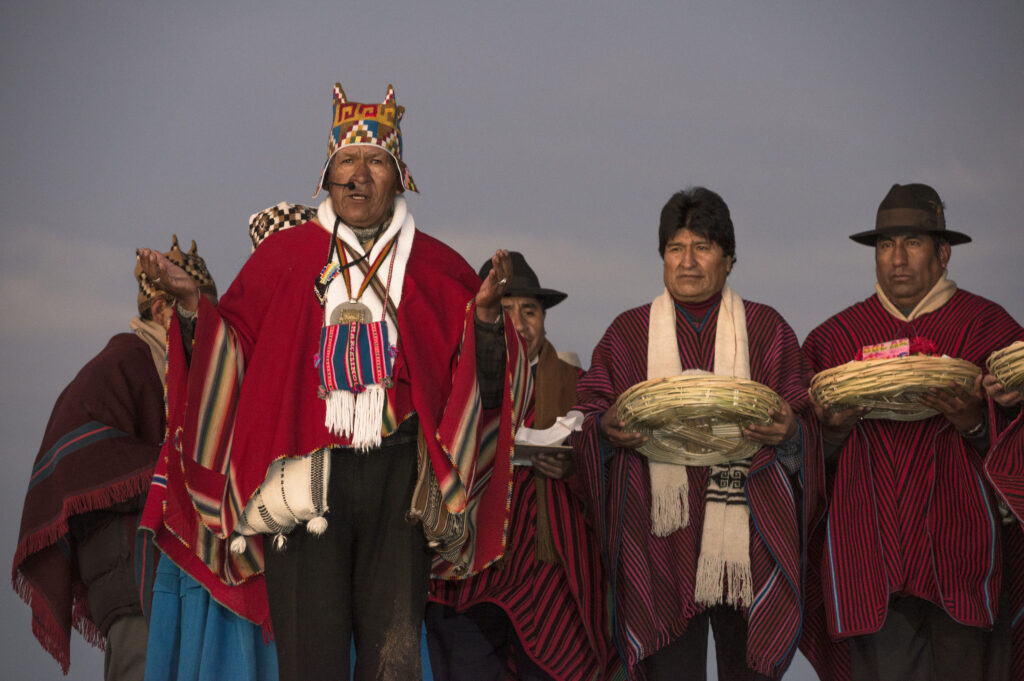
Rodrigo Paz Pereira’s election to the presidency of Bolivia in October 2025 ended a long political era. Evo Morales’s Movement for Socialism (MAS) had held power for almost two decades, unbeatable both in the streets and at the ballot box. This time it didn’t just lose the election. It ceased to exist as a political force. The new government’s slogan, “capitalism for everyone,” signaled a dramatic break from the MAS’s state-centric discourse. And Paz’s choice of ministers made it clear that the change runs deeper: his cabinet is noticeably whiter, reflecting the decline of indigenous representation that had characterized the Plurinational State under the MAS.
Bolivia’s new era has also produced a powerful image: the exile of Morales in the Chapare, the subtropical region of the Cochabamba Department known for its coca leaf crops. Coca-growing peasant unions, which function like militias, are protecting the former president from arrest stemming from several ongoing judicial proceedings—including one involving the alleged abuse of a minor, a partner said to be underage when the relationship began. The kidnapping of Nicolás Maduro in Venezuela has fueled fear among Evistas that the “gringos,” who have regained influence in the country, might collaborate in his detention should Paz find it convenient. In La Paz, rumor has it that such support has already been requested but that, for the moment, the Americans have shown no interest.
The man who was once one of Latin America’s most iconic presidents, wielding virtually unchallenged power from 2006 to 2019, can no longer move freely around the country today for fear of being jailed. He divides his time between politics and raising tambaqui, a fish popular in the region. Morales retreated to this safe haven—the region where his political career began in the 1990s—hoping to withstand a campaign to demonize him.
Morales was the most powerful president in Bolivia’s history, even more so than Víctor Paz Estenssoro, the leader of the 1952 National Revolution who nationalized the mines, pushed through agrarian reform, and established universal suffrage. Morales was also the longest-serving president in a country frequently wracked by political instability: 13 years, 9 months, and 19 days. And his star shone well beyond his home country.
Morales was one of the most popular leaders of Latin America’s pink tide. His trips abroad drew huge and enthusiastic crowds, captivated by his aura as an indigenous, socialist, and anti-imperialist icon. If Luiz Inácio Lula da Silva projected the image of a metalworker from Brazil’s impoverished Northeast who forced his way to the presidency, Morales was an Aymara (one of Bolivia’s major indigenous groups) from the deep Altiplano who migrated with his family to the Chapare jungle. Against all the odds, and wielding pronounced anti-American rhetoric, he built a political career that led to the pinnacle of power.1 How did he do it, and what is the nature of this leader’s legacy?
Andean Capitalism
Morales’s “Democratic and Cultural Revolution,” launched in January 2006 with a ceremony at the pre-Columbian ruins of Tiwanaku, drove two historic processes that sought to reshape Bolivia: the nationalization of hydrocarbons and the convening of the Constituent Assembly. The “recovery of gas” was part of a long-held revolutionary nationalist tradition based on the idea, popularized by the Uruguayan writer Eduardo Galeano’s famous book on Latin America’s “open veins,” of a poor country sitting atop enormous riches plundered by large corporations. According to this view, placing natural resources under state control would finally make industrialization possible. In parallel, the Assembly set another goal: building a plurinational country that truly reflected the country. But the leap from nationalizations (in the 1930s, ’50s, ’70s, and 2000s) to industrialization encountered obstacles. The state traditionally lacks the capacity to carry through such processes, which often end in disappointments that feed new cycles of economic liberalism.
Faced with the difficulty of grasping Bolivia’s complex sociopolitical dynamics, analysts often reach for the idea of abigarramiento (“motley society”), introduced by the Marxist sociologist René Zavaleta in the 1970s. This concept sought to capture the existence of social formations in which multiple historical temporalities, modes of production, and cultural horizons overlap without ever fusing. It is not simply diversity, it is a conflictual, unresolved coexistence between different societies that never quite became one.
The neoliberals of the 1990s, above all President Gonzalo Sánchez de Lozada, tried to address these realities with the tools of multiculturalism, backed by the World Bank and other multilateral lenders. Under this framework, several reforms were introduced that expanded indigenous-peasant participation in municipal spaces. But when Sánchez de Lozada attempted to extend liberal democracy into the countryside, indigenous-peasant actors appropriated these mechanisms to reinforce their own power through their unions and community institutions—which were anything but liberal. The MAS, though it opposed those reforms, became one of their principal beneficiaries.
If the reformists of the ’90s sought to combine multiculturalism with neoliberalism, Morales and his government combined multiculturalism with revolutionary nationalism. But there was one crucial difference: This time indigenous people were no longer the supporting cast of an elite-led project but the protagonists. Morales was president, commander-in-chief of the armed forces, and a kind of spiritual leader of the nation. As the historian Françoise Martinez has shown, in the 1925 centennial album marking Bolivia’s independence—a richly illustrated 1,142-page publication—indigenous people were barely visible, dismissed as an obstacle to civilization. Later, with the 1952 Revolution, indigeneity became part of the nation, but often in folklorized form. Now, with Morales, the nation’s family photo placed indigenous people at its center.
Even so, the economic and social model implemented by the MAS was less radical than foreign observers tend to assume. Terms like suma qamaña (living well) and communitarian socialism gained traction in leftwing political analyses on Bolivia. In reality, the economic model was closer to what former vice president Álvaro García Linera called “Andean capitalism.” The concept lacked epic resonance and was largely set aside, but it captured the MAS project better than the communitarian-socialist rhetoric that surrounded it.
Although the MAS won the support of indigenous communities, it was above all the party of informal and semi-informal economies (peasants, merchants, mining cooperatives, among others), sectors with a strong entrepreneurial spirit and an ambiguous relationship to the state. They demanded its services while rejecting its interference, since these economies were built on strong family ties rather than state institutions.
The MAS’s most loyal base was the coca-leaf growers of the Chapare, in the subtropical lands of Cochabamba in central Bolivia. This is an important sector for Bolivia’s peasant movement, marked by little communal culture, stigmatized as “narco-traffickers” (because so much of the coca leaf is diverted into the production of cocaine), and hardened by the fight against US-backed coca eradication in the 1990s and early 2000s. Morales and his faction effectively reclaimed this “millenary leaf” as a symbol of national dignity and anti-imperialist struggle, rallying behind the slogan ¡Kawsachun Coca, Wañuchun Yanquis! (Long live coca, death to the Yankees!).
At the same time, the MAS, founded in 1999, managed to unite the whole of Bolivia’s traditionally fragmented left. It brought together indigenist, Marxist, and left-nationalist traditions, but its core was unions and social organizations, unified by their criticism of neoliberalism and “internal colonialism”: the colonialism of Bolivia’s own elites, who replaced the Spanish colonizers after independence in 1825. Like Bolivia itself, the MAS is also a “motley” party. The party expanded from the countryside into the cities in a process the political scientist Moira Zuazo called the “ruralization” of Bolivian politics. Peasants replaced miners, the traditional vanguard of Bolivia’s popular movement, following the crisis of state-run mining in the 1980s. But this ruralization unfolded in the context of rising social mobility and migration: Young people left to study in the cities and later returned to the countryside, and rural leaders enmeshed with urban politics. This gave rise to the emergence of what the anthropologist Alison Spedding termed “semi-peasants.”
The MAS emerged out of massive social mobilizations, such as the water and gas wars, which plunged the entire political system into crisis. But this occurred against a backdrop of deeper shifts: the decline of La Paz’s traditional elites, which had long wielded power, and the useless struggle of Santa Cruz’s elites—based in the country’s agroindustrial east—to convert their economic power into national political hegemony.
New Indigenous Elites
This decline has left the traditional elites of Andean western Bolivia—La Paz’s above all—increasingly dependent on the rents of their participation in political power. In parallel, an indigenous-mestizo bourgeoisie has emerged, controlling much of trade, mining, and even smuggling. These indigenous-mestizo nouveaux riches display their wealth publicly in various ways. The most traditional is through festivals, such as the Gran Poder, but in recent years they have built the so-called cholets—a blend of the words cholo (urban indigenous) and “chalet.” These are multistory buildings, brightly colored and lavishly ornamented, that typically combine shops or event halls with the owner’s residence on the top floor. These buildings can reproduce structures resembling the Titanic, the Eiffel Tower, or superheroes like Iron Man: a kitschy architecture designed to display wealth and power. Most of these buildings rise in El Alto, a city of about one million overlooking La Paz that at first glance appears poor and chaotic, but behind that impression lies enormous economic dynamism. Some indigenous intellectuals, such as Pablo Mamani, speak of qamiris to define these wealthy indigenous people. “There is the emergence of an Aymara elite that has the economic capacity and the imaginative capacity to create costly constructions, in a creative, neo-Andean form,” Mamani writes. “They are part of an emergence that deserves not only an urbanistic gaze, but an economic, sociological, and political one, in order to understand its dimensions.” These economic sectors are integrated into “globalization from below,” with growing commercial ties to Asia. There is also a large mestizo sector that controls the powerful mining cooperatives—including those devoted to gold mining, which is enjoying an unprecedented boom.
At the other end of the country, Santa Cruz’s white elites present themselves as Bolivia’s dynamic element. Resting on agricultural production, services to the hydrocarbons industry, and finance, they have operated since the 1950s as conservative, pro-market forces and are sometimes compared to the elites of neighboring Paraguay, which is traditionally conservative and virulently anticommunist.
The MAS’s Andean capitalism sought to acknowledge this reality and build an economy in which the state would control the rents from natural resources, above all gas, and use them to drive national development. In an article published in 2006, García Linera explained that, contrary to the views of various radical leftists, socialism was not possible in Bolivia. Accepting that reality, the goal then became “to once again place the state at the center of the Bolivian economy and, around it, integrate foreign investment, local private investment, and peasant, communal, and micro-entrepreneurial-artisanal sectors, aiming at a productive shock.” That shock never arrived, but the economy grew by about 5% annually during the MAS’s first decade, and Bolivia experienced a sustained economic boom driven by both rising commodity prices and a prudent macroeconomic policy.
The Limits of Left-Wing Populism
The MAS government was highly effective at shaping a new Bolivia, but it failed to build effective and enduring institutions. The 2009 Constitution was a great advance, but it was not backed by a solid state apparatus that could sustain the statist project. At the same time, the so-called “government of social movements” had two faces: Social leaders were brought into it but only for their movements to be co-opted. social leaders entering government on one hand, their movements being co-opted by it on the other. Being the leader of a social movement became a stepping stone for entering the administration. The MAS came to be seen as a party of jobseekers. Despite its radical discourse, it neither wanted to nor was able to improve the state’s institutional framework, which remained at the mercy of the corporatist demands of its social base. That is why complex reforms, like those in health and education, never advanced. The long-awaited industrialization 2rocess was reduced to building factories—for paper, glass, milk— of dubious viability to satisfy the demands of small towns and communities.
But the greatest limit to the MAS’s proceso de cambio (process of change; the party’s term for its overarching political goal) undoubtedly was Morales’s own determination to remain in power indefinitely. From 2016, his obsession with reelection replaced any transformative agenda. That year, the government held a referendum: Should the constitution be amended to allow Morales to run for a fourth term? “No” defeated “Yes” by a narrow margin, but Morales disregarded the outcome. In addition, the ubiquity of Morales’s image and hyper-populist politics produced social fatigue and a disconnect with younger generations that had grown up under him, some of whom were even drawn to the libertarian Javier Milei in neighboring Argentina. What had once been new became old, as Latin America drifted rightward.
The first major rupture came in 2019, when Morales did seek a fourth term—and instead the election broke his hold on power. The vote count was suspended for nearly 24 hours; when it resumed, Morales’s lead had widened just enough to avoid a runoff. The opposition cried fraud. Weeks of protests followed, led by civic committees and opposition figures, until police units began mutinying in early November, which plunged the government’s authority into crisis. On November 10, with the military also withdrawing its backing, Morales resigned and went into exile. Jeanine Áñez, a little-known opposition senator, assumed the presidency days later; the MAS denounced a coup d’état. When she took power, she said that God and the Bible were returning to the presidential palace.
Emboldened, the Áñez government pushed for a vengeful conservative project that ultimately collided with reality. In 2020, the MAS showed it still retained its strength and, against all odds, returned to power with Luis Arce Catacora, a former economy minister, as president. The right-wing opposition retreated as the popular classes voted once again for their party.
But things were no longer the same. Tensions between Morales—now back from exile in Argentina—and the new president swiftly escalated. Arce’s government sought Morales’s imprisonment, and Morales, in turn, worked toward his former minister’s downfall. In fact, Morales’s current internal exile in the Chapare began under Arce’s government, which used state power to divide the MAS. But rather than opening up to build a broad alliance, the coca leader retreated ever further into the company of his most loyal followers.
The Return of the Right
The 2025 elections unfolded amid unforeseen circumstances. After Arce kept control of the MAS party label, Morales decided to found a new party, EVO Pueblo. He had been disqualified from running, and when he failed to have that overturned, he called on voters to spoil their ballots; in the first round, null votes reached nearly 20%. While this showed that Morales retained significant political influence, especially in rural or semi-rural areas, it no longer translated into institutional weight: The MAS was left with almost no parliamentary representation. Morales refused to back the MAS’s young senator Andrónico Rodríguez, who sought to lead a way beyond the internecine struggle between Morales and Arce. Despite having once been Morales’s political heir apparent, Andrónico came to be regarded by Morales as a traitor—as did, in Morales’s eyes, his vice president of nearly 14 years, García Linera.
In the second round of the 2025 elections, MAS voters no longer cast null ballots. In a contest between two right-wing candidates, they chose the lesser evil: the pragmatic Rodrigo Paz Pereira over the hardline former president Jorge “Tuto” Quiroga. Paz also benefited from the popularity of his running mate, Captain Edmand Lara Montaño, a former police officer who had been expelled from the force for exposing corruption and had become a TikTok influencer. Bolivia thus joined South America’s rightward shift, albeit incompletely. The MAS imploded, and the left-wing populist model had run its course. But unlike in some of Bolivia’s neighbors, it was not the far right that seized power. Even so, Paz’s government has positioned itself close to the United States (and to Israel) while trying to maintain ties with Lula da Silva in Brazil. Tellingly, Paz chose as one of his principal advisers the controversial Argentine Fernando Cerimedo, dubbed Latin America’s “MAGA man” by The Economist. Cerimedo, cofounder of the Argentine troll-newspaper La Derecha Diario, is an expert in dirty political warfare, or, in Steve Bannon’s terms, in “flooding the zone with shit.” But Cerimedo’s story in Bolivia ended badly: on August 18, Cerimedo was arrested at Bolivia’s Viru Viru airport, suspected of having sent hitmen to kill his ex-partner, the lawyer Nadia Beller. The case has sparked a political scandal of enormous proportions. Following the attack, Beller—who went from being a MAS supporter to a fierce anti-Morales figure—not only accused Cerimedo but also denounced a “corruption network” surrounding Paz that allegedly involves the president’s family.
The Paz government embodies a return to power of the traditional elites—not without significant doses of anti-indigenous racism—amid a spirit of revenge against the MAS. This vengeance was one of the forces behind the more than fifty days of roadblocks that shook the country in May and June of this year, triggered by a law letting small farmers’ land serve as loan collateral and fed by months of rising costs after the government had ended longstanding fuel subsidies the previous December. Even after Paz repealed the land law, the blockades continued, organized largely by the Bolivian Workers’ Central and peasant organizations such as the Túpac Katari Federation. It is a weak government, challenged by both the left and the radical right.
Scattered
The Bolivian left finds itself in crisis. Following the end of the Cold War and the neoliberal hegemony that took hold in Bolivia, it rebuilt itself from the countryside. Morales’s leadership unified an array of political groups and cultures; today the left has returned to its traditional scattering. The implosion of MAS has given rise to splintering factions that blame one another for the disaster. The question now is how a reconstruction of the unified left could possibly take place. What everyone agrees on is that the MAS era, as we knew it, has come to an end—and that Morales has permanently lost his aura as an exceptional leader.
This has happened, in part, because of the difficulty of the “process of change” to adapt to the new circumstances of the past two decades, especially social mobility. Today there are more students of indigenous origin at private universities, some coming from the countryside, while grassroots entrepreneurship has blossomed alongside economic growth. But today’s young people are more connected and globalized in their habits of consumption (including the specialty coffee shops that have taken over Bolivian cities) and their ideas (libertarianism is popular among some students). The discourses that mobilized enormous popular energy two decades ago now seem outdated. And Morales has done nothing to catch up. On the contrary, he has retreated into ideological positions that make it possible for him to praise “brother” Vladimir Putin as a “liberator of peoples” and to support Maduro. The question everyone asks today is whether the government will move forward with his arrest and what consequences that would carry if it does.
Even so, a new generation of young leftwing and pro-Indigenous social leaders and intellectuals is emerging, positioning themselves critically against both the MAS’s past government and the new rightwing administration. What remains of the MAS, and Morales himself—who retains influence in rural Bolivia—, will have to reckon with this situation if they hope to survive and regroup. But the Bolivian left probably won’t be able to rebuild itself from either anti-Evista positions or an outright rejection of the “process of change.” The Bolivian left is searching for new leaders and political projects capable of regrouping the population left orphaned by the MAS’s implosion.
- There is a story within the story here: The US ambassador who most fiercely opposed Morales in the early 2000s, Victor Manuel Rocha, turned out to be a Cuban agent—and his invectives against Morales may only have helped improve Morales’s standing in the polls. ↩︎