The Medium as a Site of Struggle
An interview with Sean O'Toole
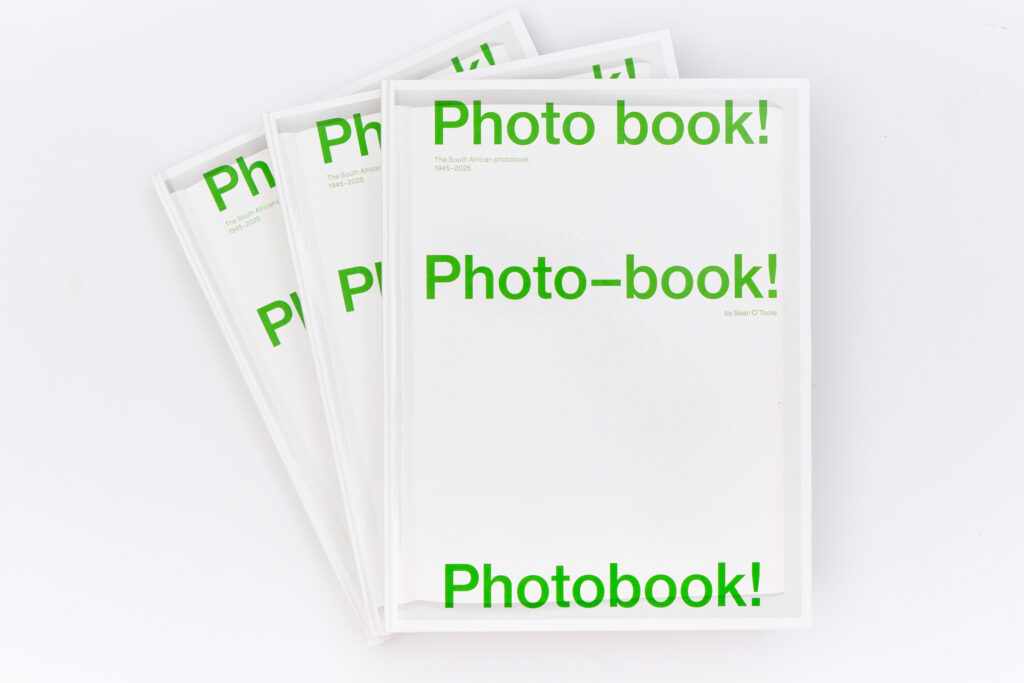
South African photography, whether emerging from the front lines of oppression and struggle, or documenting everyday life in a troubled, hopeful place, has occupied a distinctive position in the annals of global photojournalism and political witness. But what happens when one changes the aperture from photographs in general to the photobook in particular? In Photo book! Photo-book! Photobook! (2026), Sean O’Toole, one of South Africa’s most respected arts writers, traces the emergence of the form via forty-five works that appeared between 1948, when the National Party came to power, and 2024, which marked the thirtieth anniversary of the country’s first democratic elections. If the end of apartheid has proved to be less an event than a social process, then the South African photobook shows what a long, uneven, and complex process this will be.
In his introduction, O’Toole describes being asked, in 2004, to do a weekly column on photography for the South African newspaper the Sunday Times. “It was meant to run for six issues. It lasted six years.” Those years, he writes, coincided with “an extraordinary international emergence of South African photography and a boom in photobook publishing”—a moment when a global audience was also hungry for visual renditions of a new, post-apartheid South Africa. In the course of writing the column, O’Toole amassed a sizable collection of photography books. For many of the photographers whose work he explored, it had been the book, not the gallery exhibition, that represented the ultimate form: its portability and physical endurance, but also the possibilities for allowing a more personal, more controlled sensibility to shape a sequence of images.
During the COVID lockdowns, O’Toole took up a research residency at the A4 Arts Foundation in Cape Town. He made use of the empty gallery to unpack and explore his library, covering the walls of the exhibition space with its covers, images, and text. His research traced a history in which the South African photobook gradually detached from colonial anthropology and salon pictorialism and emerged as a modern, cosmopolitan form—but at a moment which also saw the entrenchment of white Afrikaner nationalism and the beginnings of the liberation struggle. The resulting exhibition (which showed first in Cape Town then Kyoto) was a mix of the familiar and the unexpected. It moved from images of sharp-dressing gangsters, jazz musicians, and African National Congress leaders in 1950s Johannesburg (many of them from the archives of Drum, in its heyday the most widely read magazine in Africa) to Ernest Cole’s epic document of black life under apartheid, House of Bondage, a work immediately banned on publication in 1967. (“No form of media,” wrote art historian Okwui Enwezor, “frightened the regime more than photography did.”) There were searing images of the June 1976 Soweto Uprising by Peter Magubane; of the rolling mass actions of the 1980s as documented by the Afrapix Collective; of victims and perpetrators at the Truth and Reconciliation Commission hearings—all evidence of South Africa’s strong tradition of photojournalism and documentary as social protest.
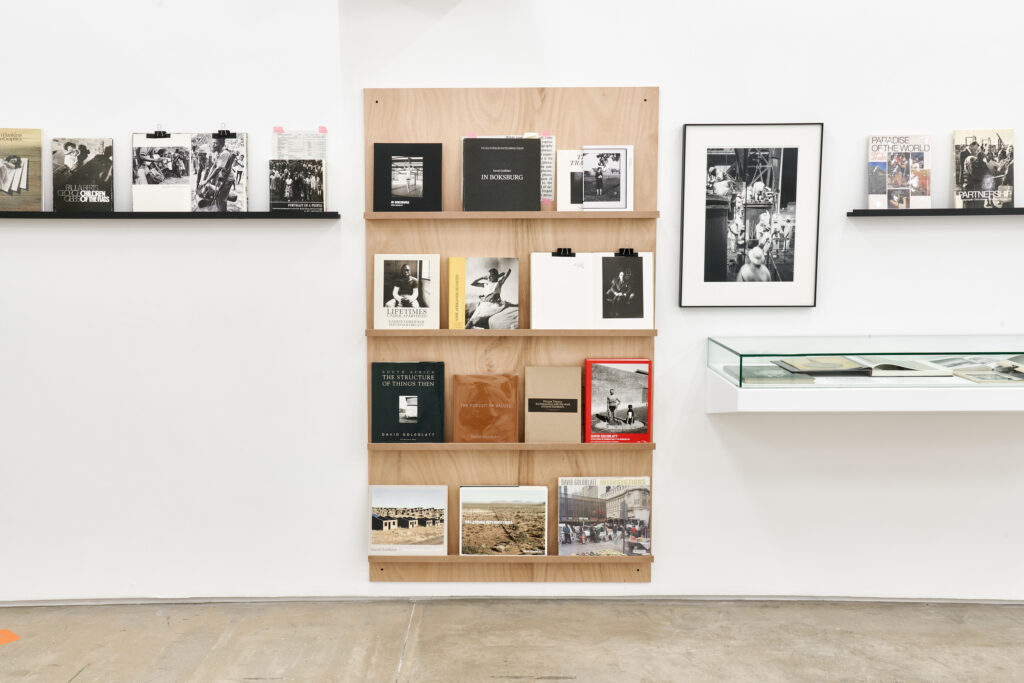
But the photobook format also took things in less familiar directions. There were books about roses and Cape Dutch architecture alongside celebrations of 1960s infrastructure and high-apartheid modernism; arty nudes and soft porn; coffee-table Africana, mining company prospectuses and dubious ethnographies that nonetheless contained remarkable images. As Martin Parr and Gerry Badger remark in their global survey, The Photobook: A History, photography’s status as both art medium and mass medium means that the genre comprehends everything from auteur-like visual essays to state propaganda.
What the exhibition and resulting book develop is an idea of photographic practice as more than just the single, iconic image or decisive moment. If South African photography has often been shaped by the urgency of witness and broadcast—the need to produce emblems of unfolding crisis, from the 1960 Sharpeville Massacre to the pre-election violence of the early 1990s, the years of the “Bang-Bang Club,” two of whose members won Pulitzer Prizes—then the photobook reveals other documentary traditions. Many of the books profiled—whether their subjects are small towns or inner-city blocks, prisons or freeways, landscapes or nightclubs—are the result of slow observation, repetition, the longue durée of the photographer’s attention across time, as exemplified in the work of David Goldblatt and Santu Mofokeng, two artists who achieved global prominence in the post-apartheid decades. Their quieter, more reticent, and dispassionate images are nonetheless suffused with a psychic intensity, deeply political without being easily politicised. “What emerges is the cumulative portrait of a complex intelligence,” O’Toole writes about Mofokeng’s photo essays, “attentive to history yet wary of certainty, grounded in observation rather than assertion.” Ideas are allowed to “surface obliquely, recur and deepen over time,” meaning to accrue through proximity and repetition. These lines are true of many of the works profiled here, and indeed of his own book about photobooks.
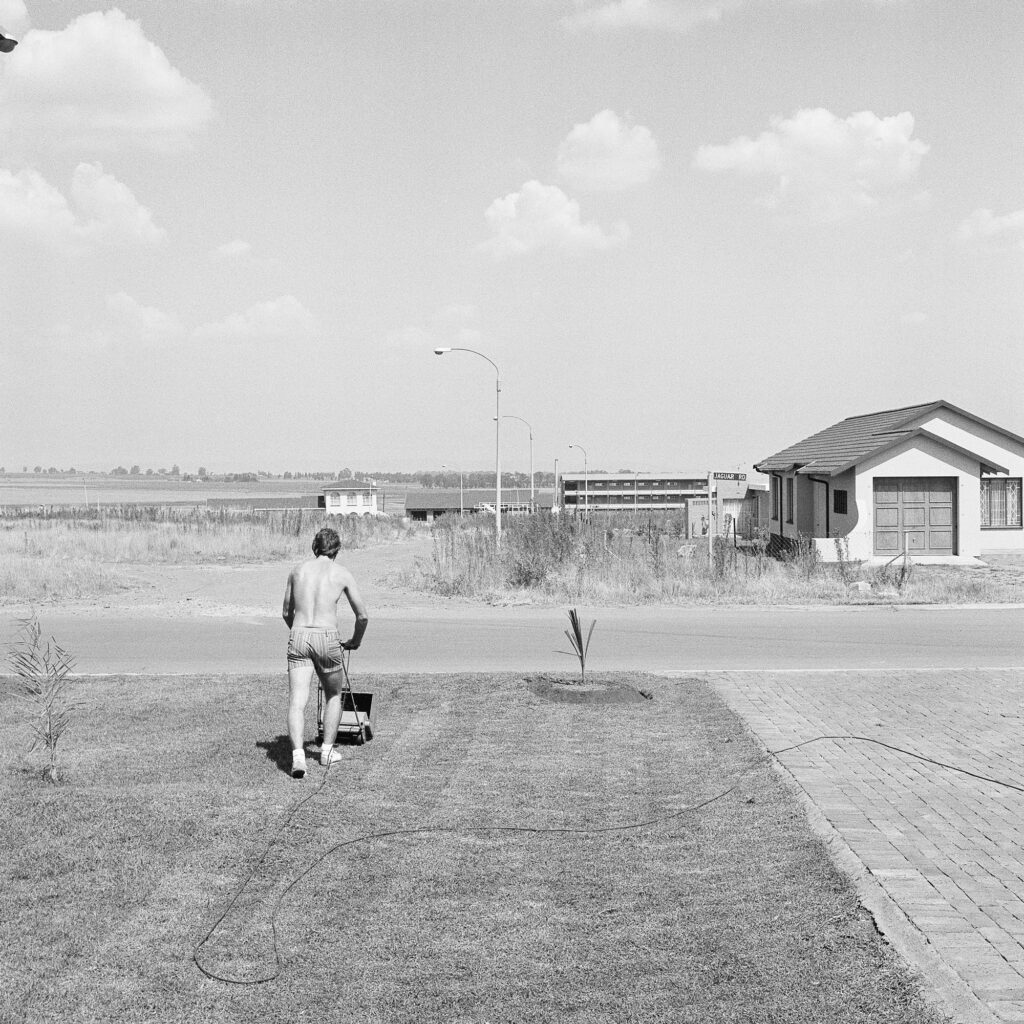
Writing about photographs involves a degree of exposure (one that doesn’t, I think, apply to the more diffuse practice of writing about writing). The reader, simultaneously apprehending the image, is, in a sense, looking over the writer’s shoulder, and drawing their own conclusions. The result can be a sense of: Says who? It’s a reaction I have never had when reading O’Toole’s work. Interpretation never runs ahead of itself, never loses touch with the materiality of the image (and what went into the making of that image). His approach is sometimes oblique but always grounded. And this groundedness—in social, historical, institutional worlds—is one of the reasons why he is now the most trusted and generous interpreter of art from South Africa, both within the country and beyond. The following interview began as a series of conversations, first at a public event, and later in O’Toole’s Cape Town flat, where a picture from Goldblatt’s In Boksburg—of three young girls playing on a mound of excavated earth in 1980s white suburbia—was hanging on a nearby wall, like a silent partner in the exchange. The transcripts were then edited and compressed over email.
Hedley Twidle: Your photography column was meant to last six issues but went on for six years. What kept you at it, and what did you see? What was happening in and to South African photography at the time?
Sean O’Toole: My column coincided with a great uptake of South African photography internationally. In 1998, photographer David Goldblatt had become the first South African artist to receive a solo exhibition at MoMA. It was a watershed moment. By the time I started, South African photographers were attracting considerable attention for their challenging assignment work and innovative approaches to editorial photography; throughout the 2000s they were also a dynamic presence within the art circuit, especially in museum showcases and at biennials. Some names that come to mind include Jodi Bieber, Pieter Hugo, Santu Mofokeng, Zwelethu Mthethwa, Zanele Muholi, Guy Tillim, Mikhael Subotzky, Nontsikelelo Veleko, and the collaborating duo of Adam Broomberg and Oliver Chanarin, who influenced the form of new documentary photography through their work at Colors magazine.
The section I wrote for, though it had aspirations to be a review, was still grounded in news and fluff—hence its billing as a “lifestyle” supplement. That gave some license to mix the journalistic tradition, of which South Africa has a long history, with the emergent post-apartheid photography. At the time I was regularly moving between South Africa’s two main urban centres. In Cape Town, this enabled me to get the scoop on Pieter Hugo’s breakout series The Hyena & Other Men in 2005 (portraits of animal wranglers on the periphery of Nigerian cities) and to meet George Hallett, who designed those memorable 1970s covers for Heinemann’s African Writers Series (with author portraits of Bessie Head, Dambudzo Marechera, and Wole Soyinka, to name just a few) and later took extraordinary photos of Nelson Mandela in the years after his release. In Johannesburg, I went to Santu Mofokeng’s house and found him slumped on the pavement, crying because he’d recently discovered that his older brother, Ishmael, had been diagnosed with HIV/AIDS. He showed me a sequence of photos he had taken during a recent trip to Motouleng Cave, a sacred site in the eastern Free State province, where Ishmael found spiritual sustenance. One of the photos from that series, Eyes Wide Shut (2004), a haunting portrait of a man in winter clothes confronting certain death, is now iconic. And rightfully so: the response of President Thabo Mbeki’s government to the HIV/AIDS epidemic was abysmal, extending to the denial of antiretroviral therapy.
I think the newspaper format, and writing for a lifestyle section, helped in responding to the range of work emerging in response to post-apartheid South Africa’s stark social issues: deep inequality, joblessness, violent crime, the HIV/AIDS epidemic, to name just a few. In an art magazine, you tend to end up writing less about the photo in front of you than sparring with Sontag or Barthes—something Geoff Dyer acknowledges early on in his eccentric book on photography, The Ongoing Moment (2005). A column for a more specialist photo publication, on the other hand, might’ve become mired in the technicality of photography, like the transition to digital photography (of which the mid-2000s was the tipping point).
HT: What other bodies of work were emerging at the time? And what were the debates surrounding them?
SO: One photographer stands out: Zanele Muholi. I first interviewed Muholi in 2005 as part of the column, three years after they had co-founded the Forum for the Empowerment of Women, the first black lesbian rights organization in South Africa. It was already clear then that Muholi was a hyphenate proposition: an activist and artist. It is a tradition with strong precedents in South Africa, encompassing figures like Ernest Cole, Omar Badsha, and, more recently, Dean Hutton. Muholi’s early portfolio was nonetheless singular: It included evidence of the brutal violence perpetrated against black lesbians alongside intimate, occasionally playful portraits of same-sex partners.
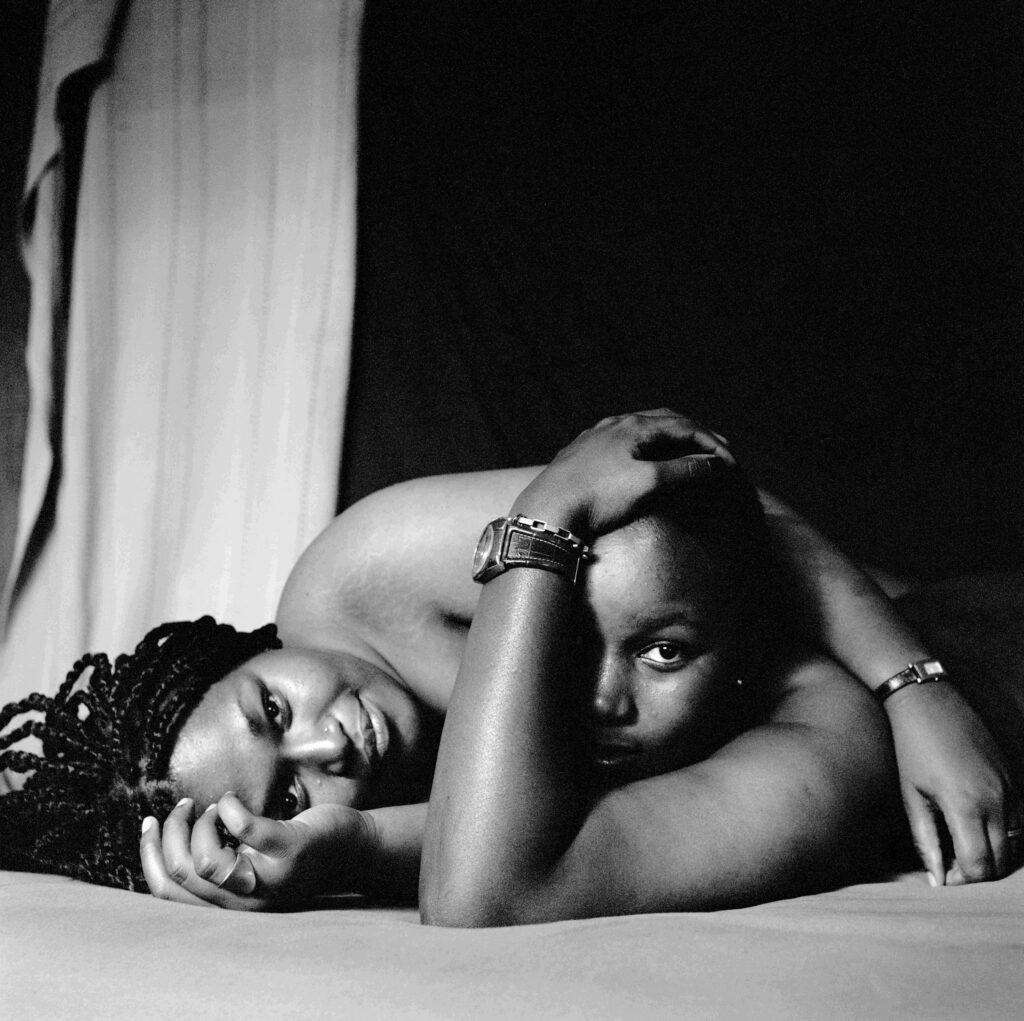
None of this was palatable for the newspaper, which opted to run with a sexually suggestive color photo of a tree root photographed by Muholi in 2005 while attending the World Social Forum in Caracas. This kind of prudery and bias was omnipresent. In 2010, arts and culture minister Lulu Xingwana famously walked out of an exhibition featuring Muholi’s photos, describing their work as “immoral.” Most of Muholi’s early work was shot in black and white, but the early 2000s also saw the emergence of color documentary. David Goldblatt and Guy Tillim both pivoted to color. It might seem like a benign thing, but the use of color was controversial, since South Africa had largely been perceived, or produced, in black and white.
In 2004, while in Tokyo for an exhibition of South African photography, I heard Santu Mofokeng and Zwelethu Mthethwa (who was later convicted of murder) briefly exchange barbs at a lunch table. Crudely paraphrased, Mthethwa, who had achieved international prominence with his color portraits of slum dwellers, described black-and-white photography, particularly within the South African tradition, as oppressive. Mofokeng, who had worked almost exclusively in black and white, viewed the criticism as facile, a careerist manoeuvre. Both photographers formed part of my column series. These sorts of flare-ups were commonplace. In 2005, I attended a public talk by the academic and cultural theorist Sarah Nuttall at the Market Photo Workshop, an independent photography school in central Johannesburg founded by David Goldblatt in 1989. Nuttall made a strong case for expanding the definition of socially conscious photography: If you looked at the social reality of Joburg ten years after apartheid, she said, there were new consumer cultures emerging; and these were interesting subjects for a new kind of photography. In the audience was the elder statesman Jürgen Schadeberg, whose black and white pictures of the 1950s for Drum magazine, a general interest monthly magazine founded in 1951 aimed specifically at metropolitan black readers, have been so influential, and who as a photo editor at Drum mentored many South African photographers, notably Ernest Cole and Peter Magubane. He objected that Nuttall lived in “cloud cuckoo land,” because what she was asking for was essentially a kind of fashion or lifestyle photography. “The main battle in South Africa is social,” he said, listing as proof the country’s HIV/AIDS rate and high unemployment.
My point is that, in that moment, there was a clash of traditions: a very strong journalistic photo-documentary tradition, negotiating the torsions introduced by the increasingly moneyed art world. At the back of all of this was the collapse of print media. Traditionally, a photojournalist like Schadeberg, when he left South Africa in the 1960s, could make his money publishing in the weekend newspaper supplements in London. But by the early 2000s, that system was in decline. The gallery—and to a lesser extent, the academy—became the new patron. It was noticeable how photographers working in the documentary tradition were moving into the art world.
HT: You begin with an essay titled “A Modest Tradition.” It’s a diptych piece: a lengthy meditation on two major figures—Ernest Cole and David Goldblatt—anchored via two influential books. One is Cole’s 1967 portrait of urban black lives under apartheid, House of Bondage (in which he tried to convey, as he put it, “the extraordinary experience to live as though life were a punishment for being black”). The other is Goldblatt’s In Boksburg from 1982, which, as you put it, captures the “sequestered calm” of white suburbia at a time of massive political repression. Why did you frame the project in this way?
SO: David Goldblatt and Ernest Cole were born ten years apart, in 1930 and 1940 respectively. Yet in the long sweep of modern South African photographic history, they seem to straddle very different periods. Although younger than Goldblatt, Cole’s photos are indelibly linked to the 1960s, and to his first book—the only book published during his lifetime. His reputation is still anchored in that era. Goldblatt’s beginnings as a photographer were more tentative. In the manner of many South African sons, myself included, Goldblatt worked in his father’s business, a men’s outfitter. The death of the family patriarch in 1962 drew a line beneath his uncertainty and hesitation, and on September 15, 1963 Goldblatt declared himself a professional photographer. I admire the certainty with which David expressed himself. Over time he built up a considerable reputation, but it was only with the 1998 MoMA exhibition that he fully entered the international photographic and art world.
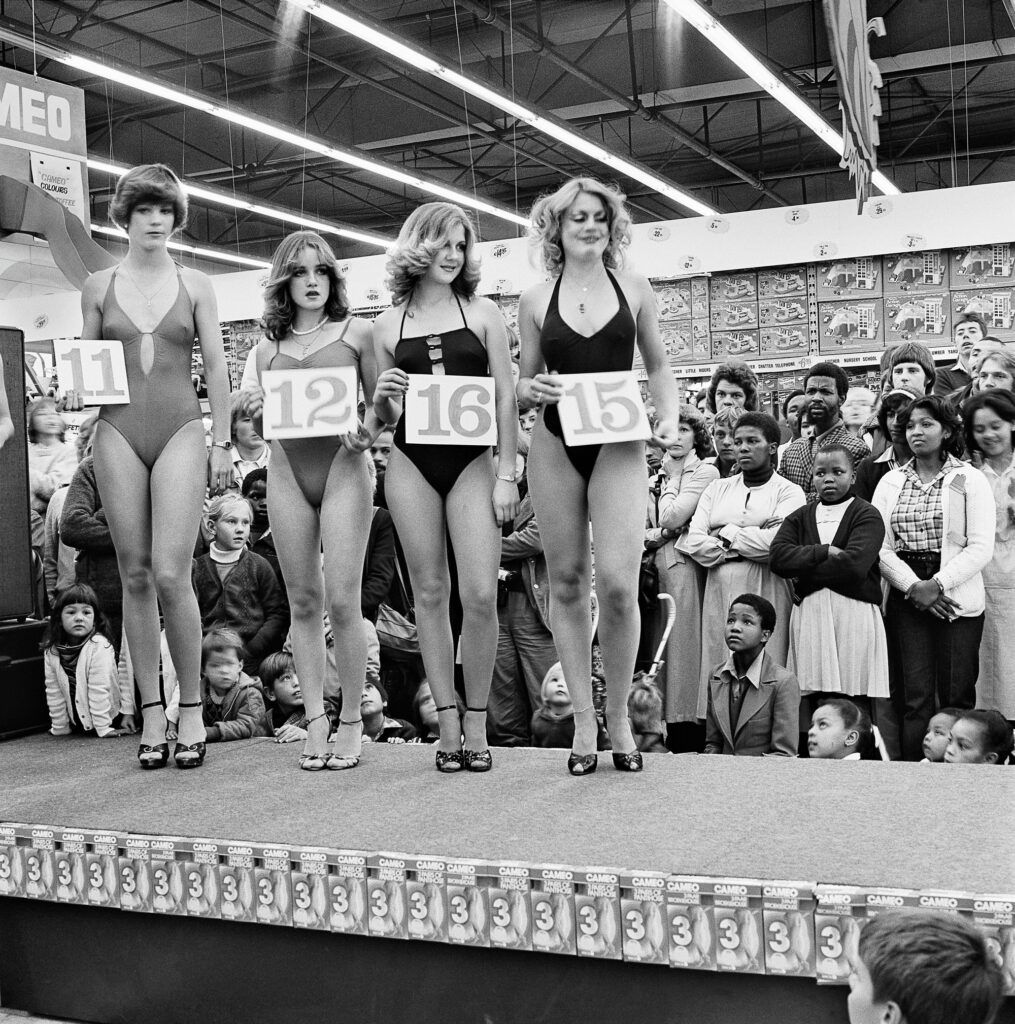
So two men, roughly of similar age, motivated by different rhythms in their work, each with a penchant for motorcycles and freedom of movement, who achieved international visibility at very different stages of their careers. Initially I was far more aware of Goldblatt than Cole. I had just recently returned to South Africa after a long stint abroad when the Apartheid Museum opened in 2001 in Johannesburg. It contained a lot of Cole’s work, blown up to very large scale to make an impression, which it did, especially his well-known photo of naked mining recruits submitting to a medical inspection. It was the first time I’d heard of Cole, and not long after I found a copy of House of Bondage at Clarke’s Bookshop, a Cape Town institution. The first book I bought by Goldblatt was South Africa: The Structure of Things Then (1998), which narrated South African history through the rudiments that it leaves behind, buildings mainly. One of the earliest examples of an architectural form in the book is Van Riebeeck’s Hedge in Cape Town, a defensive barrier of indigenous wild almond trees planted by the Dutch East India Company to delineate the border of the early colony. I found it a remarkable book. I treated it less as an art object than an atlas to a country that I was from but didn’t fully know. I went, in some instances, to go look at the things he photographed, superficially to verify that they were true but really to learn how to look at South Africa anew.
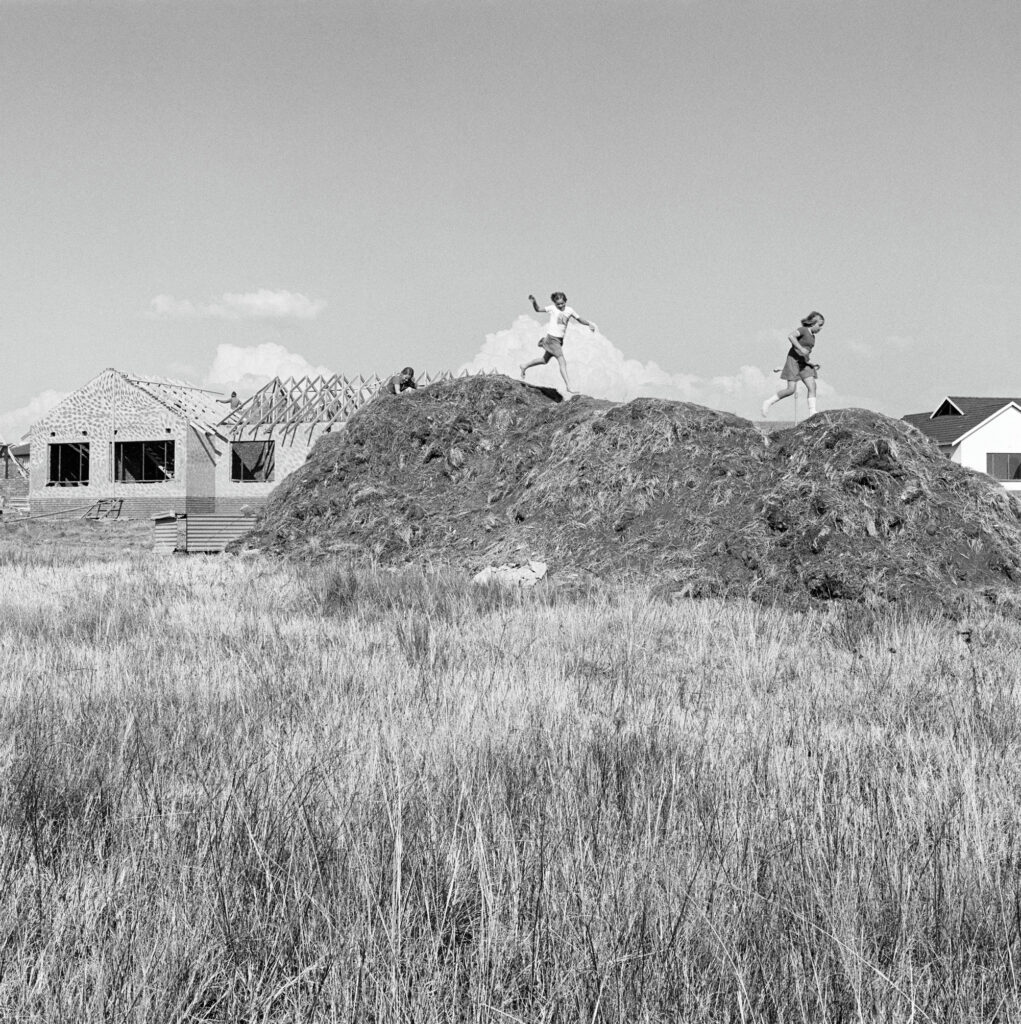
But the book that made most of an impact was In Boksburg, which I pair up with Cole’s extraordinary book in my essay. There was something visceral and familiar about the subject of Goldblatt’s book: white suburbia. When I wrote an essay to a 2015 reprint of In Boksburg, I asked for a photo from the book, instead of payment. The photo I received shows three young, white girls playing on a mound of excavated soil near a partially completed suburban home. It is a picture of my youth. This charged yet bucolic scene is very different to those scenes contained in Cole’s book, which extended the arc of enquiry announced by Sol Plaatje’s foundational political text, Native Life in South Africa (1916), from rural to urban South Africa.
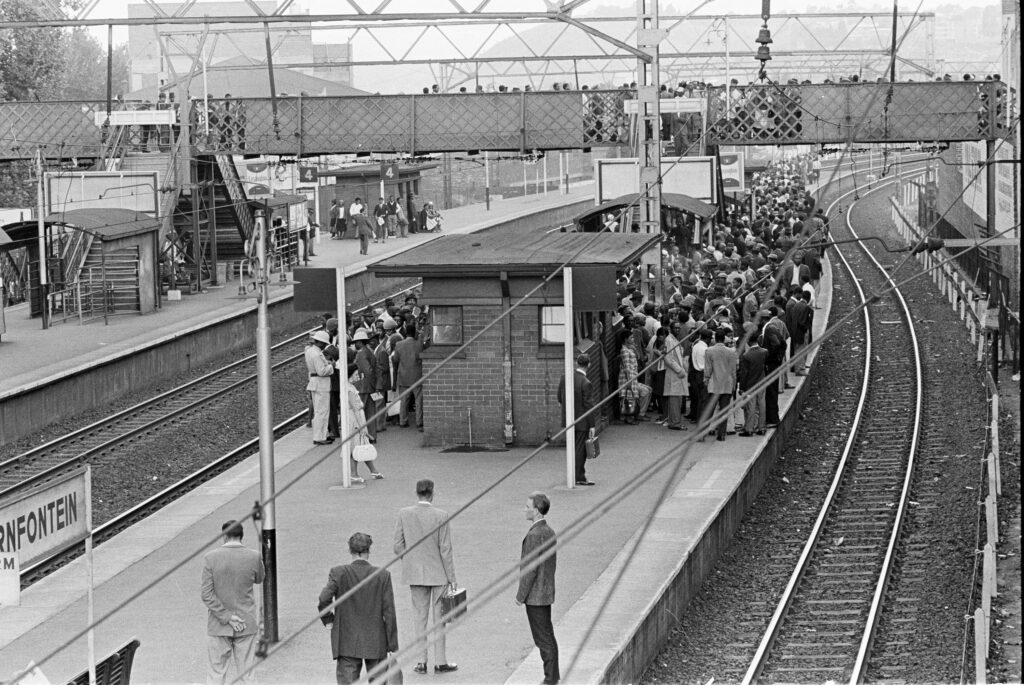
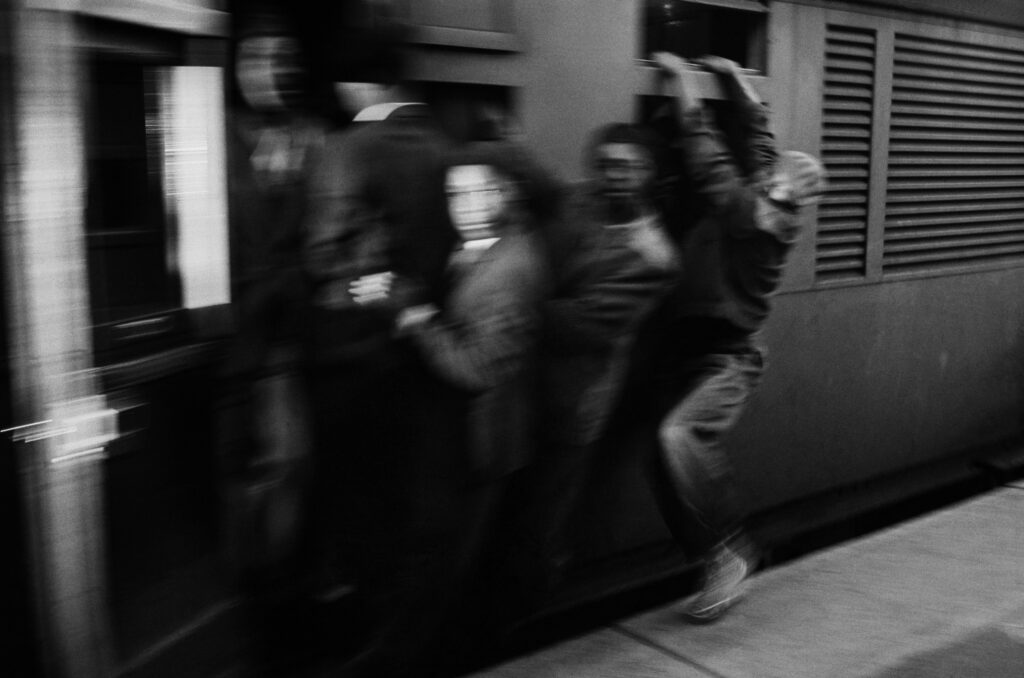
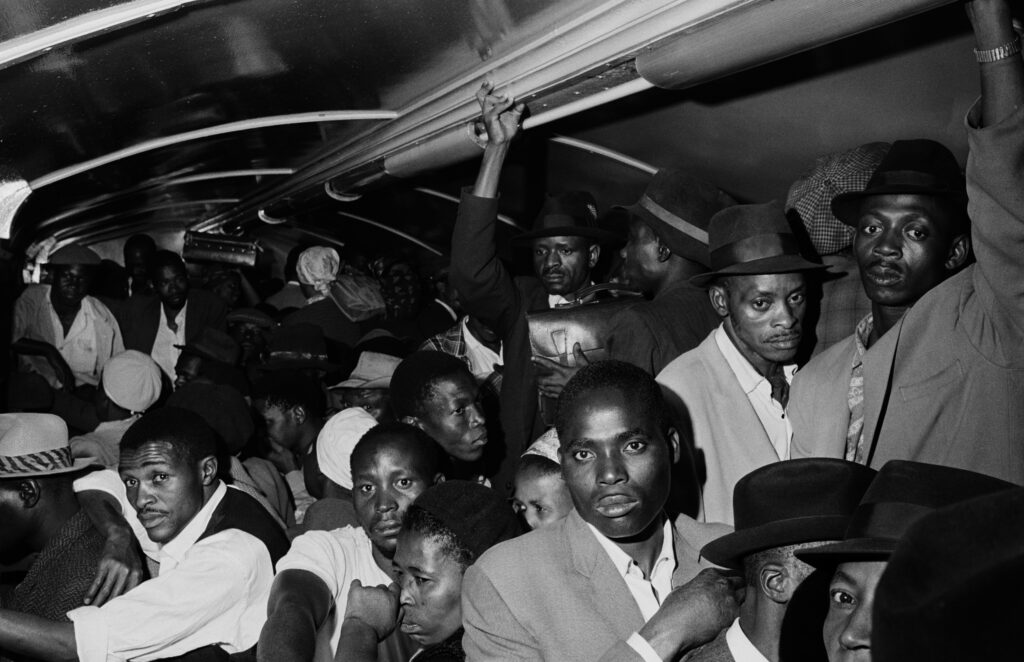
Not everything about Cole’s book was unfamiliar. I grew up in a conservative Pretoria family and, for fear that I would become a communist while studying at the University of the Witwatersrand, was made to commute by train to Johannesburg every day. The trains were racially segregated, a system that was always tested on Friday afternoons. Apartheid was a philosophical idea that entrusted faith in language and the officiousness of bureaucrats and policemen, but on Friday afternoons it was a far simpler thing: a white man spread-eagled across a three-seater, telling black commuters the carriage was full. Cole’s book, which includes a chapter on crowded train commutes, resonated with my memory of the miseries inflicted on ordinary working people. My essay offers close readings of the making and reception of two books that, in my opinion, innovatively utilized the photobook as a medium to analyse and understand South Africa. Cole’s book was summarily banned by the apartheid state, and Goldblatt’s book was a commercial failure. Their legacy and influence today are unquestionable.
HT: Photo book! Photo-book! Photobook! is the fruit of a multi-phase project and has a lengthy backstory. It begins with you unpacking your own library of South African photobooks and making these the centrepiece of a gallery research residency, then a public exhibition. In a sense, you explode your library—its roughly photocopied pages and images, its ramifying ideas—onto the walls of a gallery. You walk and talk people through it, interview photographers and critics, think in three dimensions. Then you fold everything back into the format of a printed codex. Throughout the project, you seem both to chafe against and welcome the physical parameters of the book format, which could be described as a technology for compressing large tracts of time and space, both physical and psychic, into a modest area. What was revealed in the process? What were its pleasures, challenges, or (most importantly) surprises?
SO: One of the by-products of the global photography boom of the 2000 and 2010s is a surplus of photobooks. Even South Africa, a relatively minor book market, saw a remarkable output of them. I built up an eccentric library over the years. In interviews, photographers often spoke to me of their desire to “make a book.” Why a book? But even this question assumes certainty about what constitutes a photobook and the existence of a reliable bibliography, a lineage to slot into or react against.
There is an extensive archive of writing about South African photography, but very little research into photobooks about or from South Africa. This struck me as odd. All I had was my fallible collection and an inkling of something bigger. It was a useful prompt to compile an index of South African photobooks. The Dutch historian Ben Krewinkel’s remarkable website Africa in the Photobook was especially useful, but the internet also trades in chimeras and dead ends. I ended up doing idiosyncratic fieldwork searching for “unknown unknowns,” to use Donald Rumsfeld’s phrase. That’s pretty much the sense I had setting off in search of overlooked and forgotten books in private libraries and used bookstores.
Another important library for me was Clarke’s Bookshop where, during one of my visits, I watched proprietor Henrietta Dax repack a section of collapsed books. At one point she turned and said: “God, I hate Guy Tillim’s books. They’re all in different formats.” It was an entirely practical remark, and a useful reminder of the shape-shifting quality of the thing I was trying to study. Unlike novels, photobooks do not conform to any standard. My library at home has various sections for photography books, ranging from shelves for super-sized tomes to nooks for petite books of the self-published variety. This physical indeterminacy gestures to something more fundamental. Is it “photo book” or “photo-book” or “photobook”? I don’t know, but rather than legislate an answer I leaned into the uncertainty. In the Cape Town and Kyoto exhibitions that showcased books from my library, the books were (with some exceptions) all free to browse by visitors. Books in galleries are frequently presented under glass, but I felt it was important that the books be handled and understood as objects with a history.
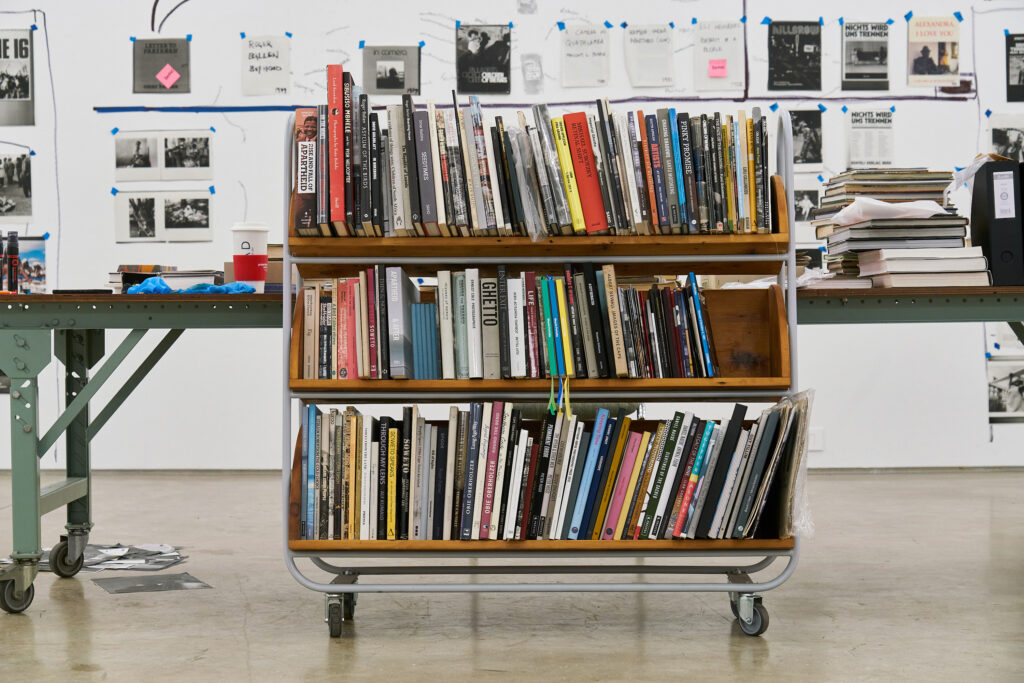
If the book is a great compression device, a place where ideas get distilled, my exhibition was the opposite. It included literary journals, pamphlets issued by trade unions and anti-apartheid organizations, lavishly illustrated books on flowers, picture books published by various municipalities in the 1970s and ’80s, photobooks for the tourist trade, all presented in chronology with various other “boundary objects” that spoke to the many uses of photography in publishing after 1945. The timeframe of the exhibition and subsequent book is important. The internet may have supplanted the book, but during the decades of high apartheid (1948–1990), books represented the apex of distributed knowledge, and as such were vigorously censored. The exhibition included a copy of Jacobsen’s Index of Objectionable Literature, a commercial register of all the books banned during the apartheid years. It also included an artwork by Alana Blignaut about an infamous private photobook, the so-called “terrorist album,” an analogue database of political dissidents compiled by apartheid security police. Its existence and workings are described in a remarkable 2020 book by historian Jacob Dlamini.
Some books I didn’t want to personally own, like a photobook hastily compiled and issued in 1966 following the assassination of Prime Minister Hendrik Verwoerd, a foundational ideologue and architect of apartheid. It was, however, important to acknowledge and show these books. As a researcher you can’t hold your nose and keep this history at a distance. It is part of the story of photography and photobooks in South Africa.
HT: On the one hand, you’ve created a kind of reference work, the distillation of much research and enquiry over the years, one which aspires to the even-handedness of a survey. But on the other hand, it’s also animated by the less even-handed, more idiosyncratic impulse of the bibliophile, the amateur collector. So there’s a tension between a canon-forming work by a learned art critic, and the more unexpected itinerary of the enthusiast. What happens, conceptually, when one changes the aperture of enquiry from “South African photography” to the photobook in South Africa?
SO: This question perplexed me from the outset. I am interested in the charged territory of South Africa, then and now. I resolved that the focus of my work is geographic, but not nationalistic. Books published internationally were considered alongside books produced locally. Citizenship was never a criterion for participation. But this only partially answers your question. Let me go back to Santu Mofokeng. In 2011, I travelled to Paris to review his solo exhibition, Santu Mofokeng: Chasing Shadows, at Jeu de Paume, an important exhibition that enshrined him as a central figure in modern South African photography.
It included fascinating ephemera, ranging from Mofokeng’s research proposal into the politics of black photographic representation for the African Studies Institute at the University of the Witwatersrand—with annotations by the historian Charles van Onselen—to the first publication (as a newspaper article) of his extraordinary essay Train Church in the late 1980s. This intimate essay describes the religious fervour of black train commuters during stultifying journeys to and from work. It forms part of a haunted archive of ennui and bondage that encompasses Ernest Cole’s photos of train riders in House of Bondage (1967) and David Goldblatt’s The Transported of KwaNdebele (1989), which documents the long bus journeys of black workers sequestered to tribal “homelands.”
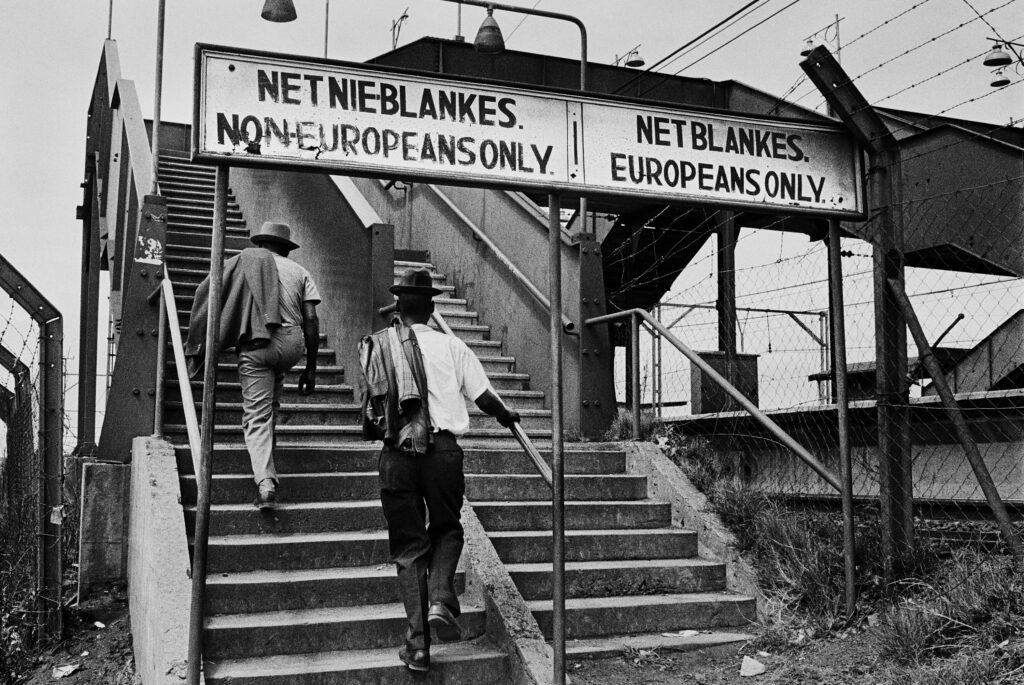
Mofokeng started working on this series in 1986 while commuting by train to work on Drum magazine’s visual archive with Jürgen Schadeberg, culminating in the important photobook The Finest Photos from the Old Drum (1987). Teju Cole wrote a gorgeous appreciation of Mofokeng’s essay for The New York Times Magazine in 2017, not coincidentally two years after photo editor Joshua Chuang had collated this loose assembly of photos into something far more coherent and substantive: a photobook. Train Church was the first release in Mofokeng’s multi-volume photobook Stories (2019, a box set thatpresents 551 photos from an archive of approximately 30,000 frames made between 1985 and 2011). The book is organized into 18 essays that capture the breadth of Mofokeng’s record of black life, from labor tenancy and political resistance to acts of faith and cultural practice.
I single out this book for a simple reason: When it appeared, it thoroughly reframed Mofokeng’s career, far more so than any of the well-received museum exhibitions that laid the groundwork for it. I am very much interested in the medium as a site of struggle: How do you create coherence out of a set of images? The book has traditionally been a remarkable tool for that. And having befriended a number of photographers through my journalistic work, I realized this was an aspiration for many of them, far more so than an exhibition. I think partly because an exhibition is temporal, whereas the book, as Goldblatt plainly said to me, lives long after you. So you’d better get it right.
HT: You use the strict, perhaps unimpeachable organizing principle of chronology. Yet so many of these works are out of time in a way, or somehow decoupled from how South African history is often produced for national or global consumption. They’re retrospective, or they come late, or aren’t punctual. They’re not operating at the event horizon of current debates or cultural politics. And there’s something about the medium, with its impulses towards both the single moment and the long duration of developing images—in all the senses of that word—that intrigues me here.
SO: Following a recent book launch, an elderly man came up to me afterwards. I’d seen him sitting in the audience and assumed from his demeanor that he was bored. I was partly right. After congratulating me on an interesting talk, he asked why I had harped on about the past instead of showing contemporary work? It was a fair review of my talk, but of the forty-five publications discussed in my book, twenty-seven were issued after 1994, the democratic era, which is also South Africa’s contemporary era. Many of these books were about present-day South Africa, but as many had a retrospective quality: Mofokeng’s book begins in the 1980s, Schadeberg’s The Black and White Fifties (2001) revived pictures of a lapsed Joburg, John Liebenberg’s Bush of Ghosts (2010) revisited the South African Border War (1966–1990), and Billy Monk’s eponymous 2012 photobook shows scenes of mixed-race carousing in 1960s Cape Town. And therein is a lesson: Photography might be about instantaneity, more so in the social media present; but I think most photobooks come late, particularly in South Africa.
A good example here is Mofokeng’s photobook The Black Photo Album / Look at Me: 1890–1950 (2013), which isn’t featured in my book. The origins of this remarkable portrait archive of families in cosmopolitan dress lay in fieldwork he undertook at the African Studies Institute into family portraits of people living along that great sweep of the Orange River between Kimberley up to Johannesburg. One could derisively call the people pictured Black Victorians, but these people refused the image of the indigene which was being foisted on them by photo-ethnographers like Alfred Martin Duggan-Cronin and painters like Irma Stern. With Stern, for example, it’s always sultry and scantily clad natives in the fecund wild. That wasn’t an image that interested Mofokeng. His book, which grew out of a slide-photo installation developed in the 1990s, includes a series of pungent questions. “Who is gazing?”, “Who were these people?”, “What were their aspirations?”, and “Do these images serve as testimony of mental colonization?”
One of the more recent book profiles is Lunga Ntila’s Ukuzilanda. She was a young artist who grew up in a diplomatic family, struggled with issues around identity, and tragically committed suicide in 2022, at age 27. Over the last decade or two, against the backdrop of Black Lives Matter and Fees Must Fall, collage has re-emerged as a popular compositional method for artists interested in themes of identity, community, and struggle. I can name five or six black artists in the present tense who work with collage. Mainly this is done in a standard art world way, which is to say a singular, framed image. But Ntila, working closely with risograph publisher Candice Ježek, did the hard work of taking a series of discrete images and sequencing them into a photobook.
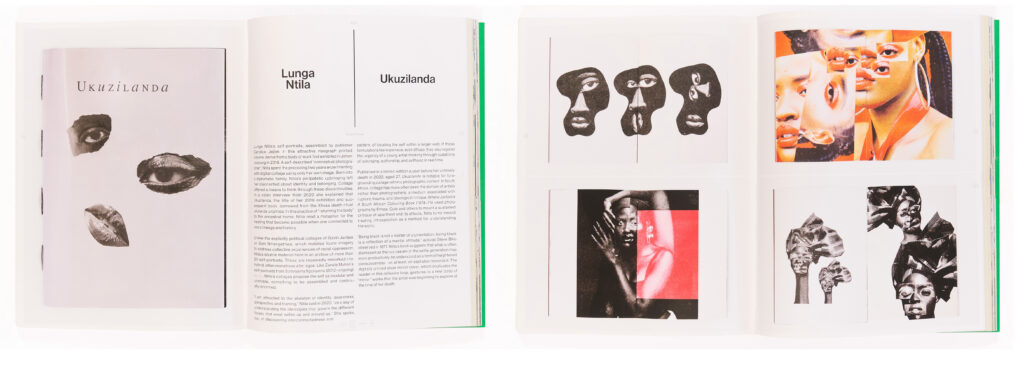
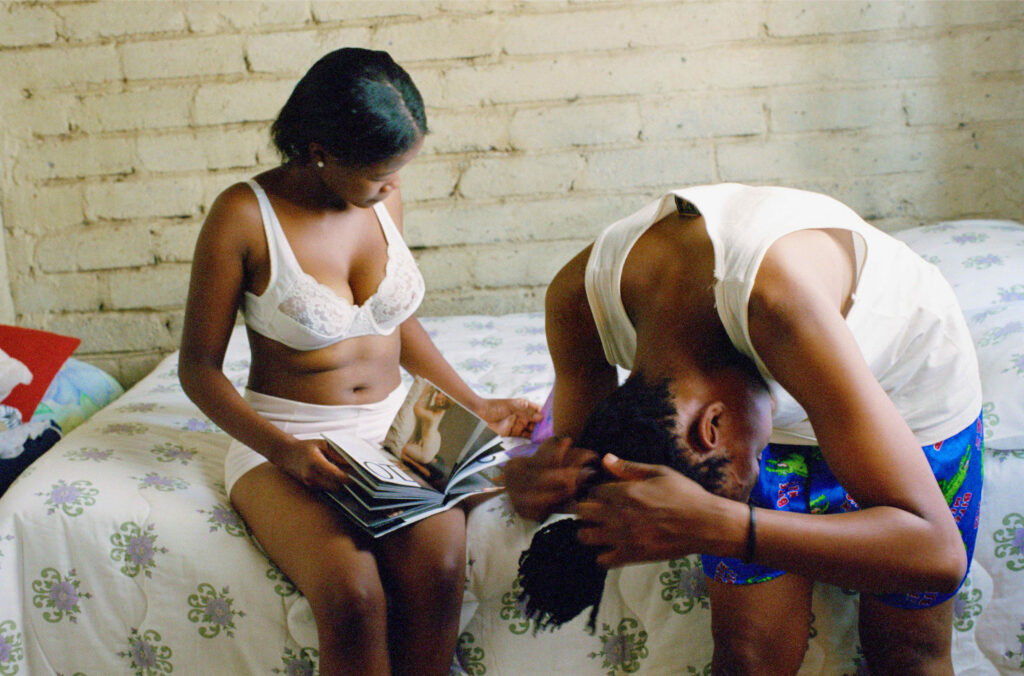
On one level, Ukuzilanda slots into a very contemporary genre: the hipster zine. But I think it’s important to balance acknowledgement with judgement in any criticism. Yes, Ukuzilanda was made for a post-internet audience interested in DIY publishing, but beyond that Ntila produced something that is striking, even unnerving. In her photo collages, body dysmorphia becomes a kind of metonym of a disrupted cultural identity as well as personal identity. And nearby in the chronology are Zanele Muholi’s improvised self-portraits, in Somnyama Ngonyama, Hail the Dark Lioness (2018), which they initiated in 2012 and have continued making at various locations globally. Both these books replenish our understanding of photography, its pliability and utility to not only describe but also imagine personal experiences. If Ernest Cole and Santu Mofokeng are going out and finding the social instances of black identity—be it rural or urban, and how it’s lived and the texture of that—with Ntila and Muholi you enter a far more interior world of the artist, a space at once playful and exploratory, but also anxious and fundamentally private and other.
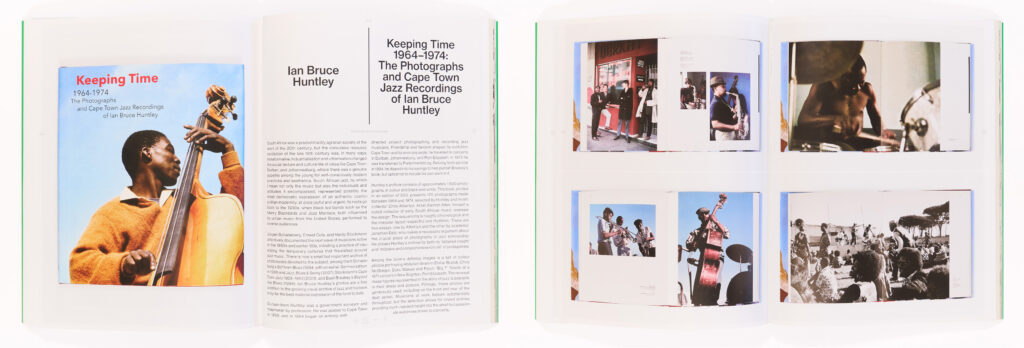
HT: Photography is, for me, the most silent of the visual arts—more silent even than painting or sculpture. And so I was struck by how often musical or sonic metaphors come up in this book, whether in your own writing or in what your subjects say about their photographs—almost as if photographs are calling out for precisely what’s not there. It’s very noticeable in Ian Bruce Huntley photographs of Cape Town jazz musicians, Keeping Time 1964-74 (which I’m glad you included, since it’s one of the best examples of the genre in South Africa, among many books on jazz photography). You also write that, as with musical composition, compiling a photobook “requires a mastery of discrete elements like tone, form, and duration.” And then Goldblatt himself uses an intriguingly counterintuitive metaphor when talking about In Boksburg. His aspiration, he says, was “to make a statement in Middle C: right in the centre of the scale. Not dramatize it, not add anything to it at all, just quietly in Middle C.” So I suppose my question is: were you aware of just how much the musical or sonic echoes through the book? And why does it?
SO: In the early 2010s, I worked on an essay about nightclubbing in Johannesburg from the 1950s to the present—not about the music itself, but about the venues where people partied. It turned out to be a profound research project. The history of pleasure in South Africa, a fraught topic, has only been sporadically recorded. Johannesburg, the city where I caroused in my youth, is soberly appraised by writers and photographers in the main. Whether the subject is labor, civil unrest, political disobedience, or white leisure, which endures as a trope, it is chiefly recorded during the day. But there is a counter archive of sorts, often linked to jazz and dance. I first recognized it in Jürgen Schadeberg’s photos of revellers in the 1950s, which in turn enriched my appreciation of Billy Monk’s fascinating yet concise archive of night owls and party folks from late 1960s Cape Town. I’ll be the first to admit that my theory of pleasure after dark is imperfect. Some of Ian Bruce Huntley’s marvelous photos of jazzmen were made in open fields under a blazing sun.
HT: Will Shoki’s piece for this issue charts South Africa’s shift from a labor-hungry racial capitalism under apartheid to a post-apartheid crisis of unemployment, joblessness, and psychic stasis. This, he argues, has led to politics of eligibility: who belongs within the nation, who should be able to access state provision, where and how the lines between insider and outsider are drawn. Within our “crisis of strangers” as you have called it, the stranger cannot always be so easily marked out. Mozambicans and Zimbabweans don’t look different from South Africans. I’m also thinking about the challenge that chronic joblessness presents to visual representation. How does one render the wiling away of empty, unmarked, useless time that comes with mass unemployment? How does this widely shared, defining national experience (which young black South Africans bear the brunt of) comes to be photographed, or not? So I suppose it’s a question around photography and the working class, or non-working class. And here I’m thinking of Lindokuhle Sobekwa, maker of the most recent work in your timeline, I carry Her photo with Me (2024).
SO: It’s an urgent question, one that has occupied generations of South African photographers, from Constance Stuart Larrabee and Ernest Cole to Sabelo Mlangeni and Lindokuhle Sobekwa. I’ve known Lindo since he was a teenager. I was, as often happens in the life of a journalist, called in on short notice to write about him for a small monograph published through a mentorship programme he’d passed through. A French industrial company based in Ekurhuleni, near where Lindo grew up in the township of Thokoza, had set up a social-responsibility project offering after-hours photography mentorship at his high school. Lindo joined that programme and was mentored by Mikhael Subotzky and Bieke Depoorter, both members of Magnum Photos.
For his project Nyaope: Everything You Give Me My Boss, Will Do, Lindo photographed drug users in his local community. His decision to focus on addiction grew out of an encounter with a user on a Thokoza street in 2013. Sobekwa was walking with his camera when a neighborhood youth asked him to take some photographs with his crew. He spent time in the makeshift dosshouse where they returned after days spent begging for money and foraging for scrap metal to sell. I was struck by the startling honesty of his photos. On a purely formal level, some of them reminded me of Jürgen Schadeberg’s 1950s photographs of street gamblers, but Lindo’s work also evoked the ambiguous intimacy of Larry Clark’s Tulsa (1971), a portrait of an American speed-addicted community in which it is unclear whether the photographer is participant or observer, but which retrieves extraordinary images regardless.
That project catapulted Lindo into the spotlight. In 2018, he was nominated to join Magnum Photos, where he was named a full member in 2022. He was barely out of his teens. Lindo was born in 1995 in Natalspruit, a settlement just north of Thokoza on the deindustrializing eastern outskirts of Johannesburg. His father, who died in 2004, was a carpenter. His mother worked as a domestic help. He spent his early childhood living with relatives in the Eastern Cape, a rural Xhosa-speaking enclave, before returning to Thokoza in 1999 to pursue his schooling. In many ways a typical South African biography. What has always struck me about Lindo is his groundedness.
You used the phrase “collective psyche.” When I met Lindo in 2015, he sent me a note: “Over the years I have witnessed almost everything that one can experience in the township: love, despair, lust, unity, pain, friendship, empathy, conflict, betrayal, and forgiveness. Most importantly, I have grown up with a sense of family that has always existed within Thokoza, despite the ongoing racial segregation and lingering effects of apartheid. Township residents create their own rules and unify socially to confront things like crime, gangsterism, rape, alcohol abuse, shack fires, domestic violence, and family dysfunction.” These are not South African tropes, they are lived realities, which Lindo has made the subject of his work, perhaps most eloquently, and autobiographically, in I carry Her photo with Me (2024).
When he was six, Lindo accompanied his older sister, Ziyanda, to collect money from their absent father. On the way home, resisting his sister’s insistence that he hand it over, he ran off and was struck by a car. Lindo was hospitalized for three months. During this time, Ziyanda disappeared. He would not see her again for more than a decade. The book is essentially a quest to find his sister, to recover her biography. The experimental form, which mixes new and found images, color and black-and-white, reportage and portraiture, and which favors occasional textual interventions to captions, reflects the influence of his two mentors. Like Bieke Depoorter’s Agata (2021) and Mikhael Subotzky’s Ponte City (2014), made in collaboration with artist Patrick Waterhouse, Sobekwa’s book resists the narrative form and stylistic cohesion of classic documentary. While grounded in autobiography and loss, his book offers a powerful statement on the image oblivion that defines the reality of the world’s poor.
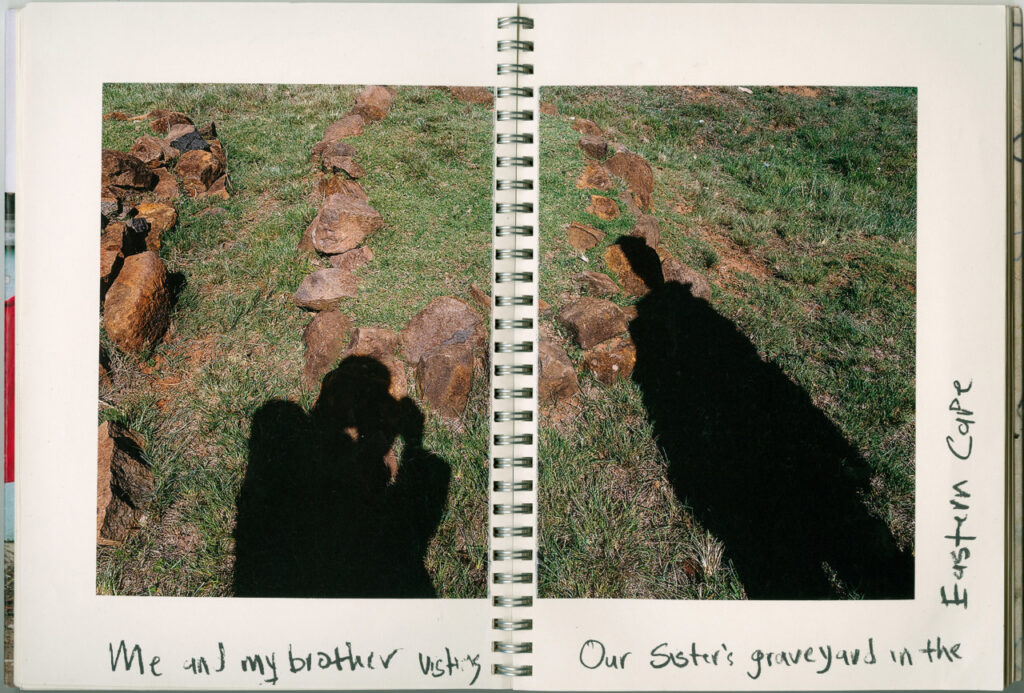
Perhaps it’s worth setting this scrappy book, with its single photo of a deceased sister, against a history of photography that was so certain about what it was showing: say, Cole’s photographs of naked mineworkers submitting to medical inspection, or the iconic photos of the Soweto in 1976. But Lindo came of age in the internet era, where doubt and alternative truths prosper alongside access and facts. I think this ambiguity is part of what animates his project: going out to try to photograph the impossible, the memory of a deceased sister, to somehow evoke her even though showing her directly isn’t possible.
If I could expand on exactly what that “something” is, I would—but I can’t quite. There’s something there, though, in that doubt. I view doubt a bit like modesty: It is a useful starting point for negotiating the world. Doubt is the opposite of certainty, which is helpful in photojournalism—but only up to a point. I don’t mean to downplay the documentary and photojournalistic traditions—they’re noble traditions. But when these ways of seeing and telling get lionized as the sole legitimate way to narrate experience, they close down experience. My modest book about other, extraordinary books is guided by this faith.