The Secret Agent
Carnival Strikes Back
In 2025, the Rio de Janeiro Carnival parade was, for the first time, interrupted by an announcement: I Am Still Here, a film that portrays the brutality of Brazil’s military dictatorship, had won the Oscar for Best International Feature Film. It was the first time Brazil had won. The atmosphere in the Sambódromo, a special stadium built by architect Oscar Niemeyer for the annual Carnival parade, was as euphoric as a World Cup victory.
The film is not an easy one. Directed by Walter Salles Jr, it depicts the tragic story of the forced disappearance of former congressman Rubens Paiva and the search—led by his wife, Eunice—for the truth about what happened to her husband, a former Congressman who was imprisoned, tortured, and killed by the military forces at the behest of Brazil’s dictatorship. In a country as polarized as Brazil, it was far from obvious that the Oscar victory of such a political film would be celebrated almost unanimously.
Brazil remains deeply divided in its interpretation of the dictatorship. Half the country voted to reelect former president Jair Bolsonaro in 2022, who not only continues to defend the military regime as the best period in Brazil’s history, but attempted to actually replicate the coup d’état that inaugurated the dictatorship in 1964 when his opponent, Luiz Inácio Lula da Silva, won. He is currently imprisoned.
Bolsonaro’s hatred for I Am Still Here runs deep. He has always despised Rubens Paiva: In 2014, when the country erected a statue honoring Paiva, Bolsonaro spat on it. So the fact that the film provoked an explosion of joy in the Sambódromo, interrupting the Carnival parade, is no small matter.
Later in 2025, there was a reversal: It was not a major film prize that interrupted Carnival, but Carnival that burst into Cannes. Director Kleber Mendonça, actor Wagner Moura, and the whole team that created the new film Secret Agent paraded through that most traditional of European festivals by dancing the frevo, an iconic Carnival dance from Pernambuco.
Pernambuco is the home state of Mendonça and the soul of Secret Agent, which, after winning Best Director and Best Actor at Cannes, won the Golden Globe prizes for Best Actor and Best International Film and has just been nominated for a slew of Oscars. It has been captivating audiences around the world. Pernambuco is in Brazil’s Northeast, a region historically exploited through an alliance between local elites and the wealthier Southeast. It is also the region that benefited the most from the social policies launched by President Lula in his first two terms (2003-2010). Lula himself was born in Pernambuco, from where he was forced to migrate as a boy due to the droughts that scourged the state. His mother moved him to São Paulo, where he built his life as a metalworker, union leader, and politician.
Pernambuco has a deep Carnival culture with its own unique characters that shape the carnivalesque-horror atmosphere of Secret Agent. The Ursa, a bear figure, a two-headed cat, and the Perna Cabeluda (“Hairy Leg”)—though not strictly a Carnival figure, the story of Hairy Leg haunted the streets of Recife; it was created by a Pernambuco journalist as a way of talking about violence that escaped government censorship—contribute to the absurd realism of Pernambuco’s Carnival, accompanied by frevo, a frenetic march danced with acrobatic steps inspired by capoeira.
Pernambuco also has a progressive political tradition. Before the dictatorship, under the leadership of Francisco Julião, it was the birthplace of the Ligas Camponesas, an agrarian movement that preceded the Landless Workers’ Movement (MST). One of the most progressive governors ousted by the 1964 coup, Miguel Arraes, was also from Pernambuco (his grandson, now 34, is currently mayor of Recife and considered a presidential contender for 2030). Raquel Lyra, the current governor, is one of only two women governing a Brazilian state in 2026. She is an independent centrist who rejects Bolsonarism, leading a popular administration.
Pernambuco has always offered a profound cultural richness. Frevo permeates nearly everything and musicians continuously mix local influences with sounds from across Brazil and indeed the world, creating extraordinarily rich blends. Luiz Gonzaga, Capiba, Alceu Valença, Lenine, Chico Science, Mombojó, Johnny Hooker, and João Gomes are examples of the state’s remarkable musical vitality.
The Pernambucan essence of Secret Agent helps us grasp why it is such a different film from I Am Still Here, even though both take place in the same decade, both portray Brazil under the dictatorship, and both speak to Brazil today.
Secret Agent, imbued with the allegorical spirit of Carnival, could never be a precise historical reconstruction. Perhaps for that reason, the dullest characters in the film are the two young contemporary historians trying to piece together what happened in 1977, when most of the film’s action takes place.
The art direction of both films is impeccable, transporting viewers to the period with mastery. But Secret Agent is not only fictional—it is a carnivalesque film that works within Latin America’s magical realist tradition, deploying Carnival’s monsters and creatures to give form to social realities that realism alone cannot express, conjuring a fictional 1977 Brazil as a present, unsettled condition. Secret Agent reveals the dictatorship’s entrails. A dictatorship is not only built on its most explicit political acts, but on the concrete actions of every state agent—and even of private actors who absorb the authoritarianism emanating from a dictatorial regime.
If the 1964 coup marked the dictatorship’s beginning, its radicalization came in 1968 with the infamous Institutional Act No. 5. Habeas corpus and other civil guarantees were suspended. The decree was issued by dictator Artur da Costa e Silva, but required the signatures of the entire cabinet. The vice president, a civilian named Pedro Aleixo, hesitated. He was asked, “Are you afraid of giving this power to President Costa e Silva?” He replied, “To the President, not at all. What I fear is giving this power to the policeman on the corner.”
Secret Agent is a film about those policemen on the corner. It does not portray high-level political persecution orchestrated by a dictator, but rather how authoritarianism grants everyone within the power structure the authority to act as the dictatorship itself. Dictatorship is a tightly woven alliance between corruption and violence. Censorship and enforced silence allow any authority figure to do anything—to use extreme violence not only to further the regime’s supposed ideals, but for personal gain.
The opening scene of the film is masterful. Marcelo (played by Wagner Moura) is a former professor and research scientist on the run who stops at a gas station in Recife, the capital of Pernambuco. There he notices something poorly covered with cardboard: a corpse. When he asks the gas station attendant, he learns the man was killed by the attendant’s coworker during an attempted robbery. Lawlessness already presents itself. Seconds later, a police car arrives—and we immediately see that the police are not there to uphold law and order, but to extort a small bribe from Marcelo.
The dictatorship grew in the name of “law and order,” yet it spread disorder to create personal benefits for those with power. In today’s Brazil, the military police kill more than 6,000 people per year. And the calls for “law and order” continue to legitimize police violence beyond the law. These deaths are not investigated. The police are not investigated. Their impunity breeds corruption as they forge deep alliances with criminal organizations.
At one moment in the film, the deaths of 91 people during Carnival are announced. “Eu acho é pouco,” says a policeman—“It’s not enough for me.” These deaths echo contemporary massacres, the largest of which occurred after the film’s release when Rio de Janeiro’s police killed more than 120 people last October. But “Eu Acho É Pouco” is also the name of a Pernambuco Carnival bloco (street party). The words highlight the cracks through which Carnival seeps into a scene of violence and corruption.
In one of the film’s most striking lines, a character says “You need the jeitinho Brasileiro [the Brazilian way] to protect yourself from Brazil.” The phrase expresses a core idea in Brazilian sociology. Authors like Antonio Candido (in his influential essay “Dialectics of Trickery”[1970]) and Roberto DaMatta (in his book Carnivals, Rogues, and Heroes [1991]) show how Brazilian society constantly seeks spaces that oscillate between order and disorder, between the legal and the extralegal—and Carnival is the ultimate expression of this inversion of hierarchies. The jeitinho, known as a way of solving problems by bending rules, becomes a form of resistance in a country where “order” uses violence for personal ends. As the jurist Goffredo da Silva Telles, a powerful voice against the dictatorship, once said: “Disorder is the order that does not suit us.”

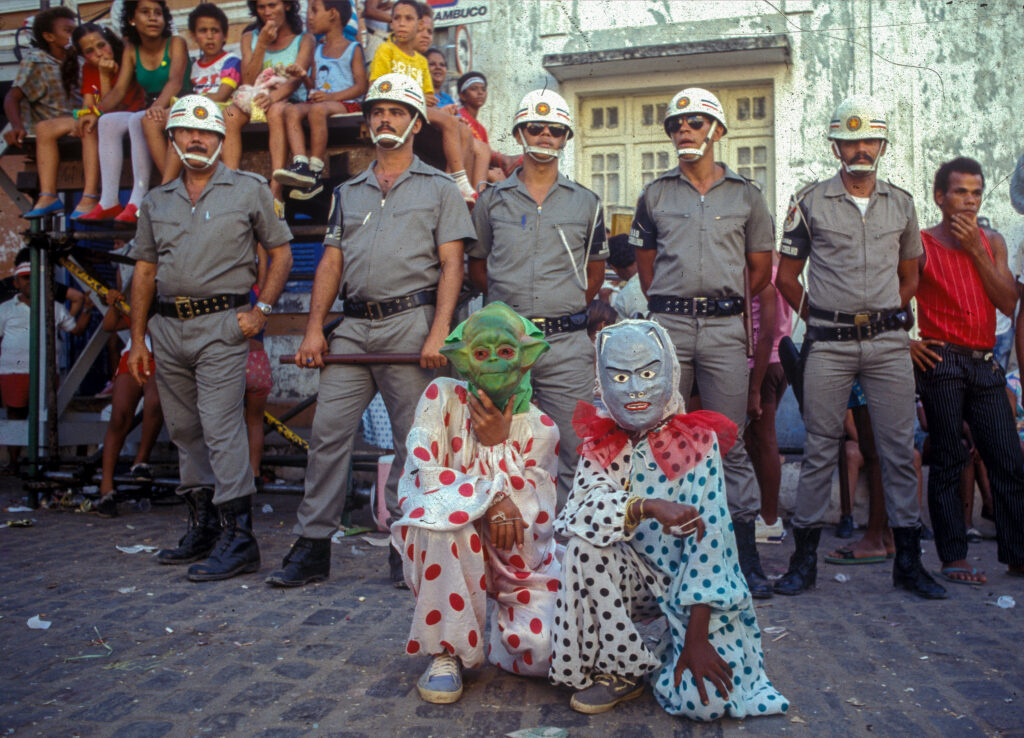
Resistance is a constant theme in the film. It appears in Carnival itself when police officers taking part are called to solve a crime, and traces of lipstick reveal that they were dressed as women—one of Carnival’s traditional acts of hierarchical inversion. Resistance appears in Dona Sebastiana, an elderly woman that shelters people persecuted by the regime, but also in Carnival’s allegories and monsters, like the Ursa and the Perna Cabeluda: the resistance of chaos challenging the order that the dictatorship tried to impose.
But resistance appears most powerfully in Marcelo. At the start of the film, the viewer assumes the protagonist is a political militant fleeing state persecution. Slowly, we realize this is not the case. Marcelo is a scientist, who invented a new technology that could produce cheaper energy. That discovery challenges the business model of Eletrobras (Latin America’s biggest power company) and for that he is persecuted by a former executive director from São Paulo who does not want his invention to succeed, illustrating how global capital and Brazil’s southeastern elite impede the development of a vibrant region like the northeast, in particular Pernambuco.
Marcelo does not yield; he resists the corrupt violence that the dictatorship entrenched in Brazil. Marcelo is an anti–antihero. As Candido writes in “Dialectic of Trickery,” a “hero without character” is the archetype of Brazilian literature who moves between light and shadow, chaos and order. Marcelo, however, is morally upright from beginning to end. He uses loopholes in the law because the law itself is violence, but he never bends ethically—pointing to a possible vision of a Brazil with integrity. Yet Moura’s interpretation enriches the character: He subtly conveys a perpetual weariness in his gaze, which contrasts with the film’s vibrant, colorful energy.
Another key difference between Secret Agent and I Am Still Here lies in the six years separating their stories. The latter is set in 1971, when direct persecution of political militants was at its most intense, coordinated by the regime’s highest ranks. Secret Agent takes place in 1977, under President Geisel, who initiated a process of political opening. Brazil was still a dictatorship—the Congress was shuttered that year—but direct persecution of leftwing militants was no longer the regime’s main priority. Authoritarianism, violence, and corruption had by then seeped deeply into relations between public and private actors. The dictatorship had begun to shape interpersonal relations themselves.
The film shows how authoritarian projects distort not only the relationship between the state and its citizens, but the fabric of society as a whole. This is why the echoes of the 25-year dictatorship still resonate so strongly today, whether in policing practices or political behavior.
But in the film it is the resistance of the jeitinho that shows there are ways to escape oppression and violence. These paths rely on subverting hierarchies through a carnivalesque logic, tied to the best of Brazilian culture.
The film’s opening sequence is set to the song “Eu Não Sou Cachorro Não” (“I Am Not a Dog”) by Waldick Soriano. The lyrics—“I am not a dog to live under humiliation”—evoke the Brazilian expression complexo de vira-lata (“straydog complex”), the idea that anything from Brazil is destined to fail because it lacks the pedigree of developed countries. Mendonça resurrects a vision of Brazil that the dictatorship tried to extinguish.
The 1964 coup stifled a Brazil of infinite potential. This was the Brazil that introduced Bossa Nova and modernist architecture to the world, the Brazil that held two World Cup titles. And it was in response to the coup that the tropicalist movement emerged, blending rock and American culture with samba and Brazilian popular music. The movement was a response to the nationalism embraced by the dictatorship that called every dissident anti-patriotic but that, at the very same time, blindly followed directives from Washington (as Juracy Magalhaes, the ambassador to the US, said: “what is good for the US is good for Brazil.”). Tropicália was also a response to the leftwing nationalism that rejected anything that came from the US, from the electric guitar to liberalism. The movement drew heavily from the Brazilian modernist poet Oswald de Adrade, whose “Cannibal Manifesto” encouraged devouring foreign influences to create something uniquely Brazilian.
The movement never shied away from its political perspective, but instead of repeating traditional leftist catchphrases they combined French 1968 slogans—“It is forbidden to forbid!”, “Be realistic, demand the impossible!”—with the Beatles, and traditional Brazilian culture with contemporary art. Tropicália confronted the dictatorship through music, experimentation, and deep irreverence. The dictatorship imprisoned Caetano Veloso and Gilberto Gil, two of the movement’s greatest icons, and sent them into exile in London. It is precisely this Brazil—one that devours foreign influences and returns them to the world refracted through its own prism—that Mendonça celebrates and, in a sense, reconstructs with a contemporary and Pernambucan accent.
The year 1977 was pivotal for cinema. In the United States, contemporary filmmaking was reinvented with Jaws. In Brazil, Argentine director Hector Babenco released Lúcio Flávio (Passenger of Agony). Babenco’s film resonates in Mendonça ’s work, whether through its bloody aesthetic or its theme: death squads—organizations of police officers hired by businessmen to carry out extrajudicial executions with the dictatorship’s tacit approval. Of course, American audiences might recognize Tarantino in Secret Agent’s final chase scene and shootout, but beneath it flows Lúcio Flávio. The scene is framed by one of Pernambuco’s most traditional musical expressions: “A Briga do Cachorro com a Onça” (“The Fight Between the Dog and the Jaguar”), recorded by the Caruaru Fife Band, a tropicalist outfit recorded by Caetano Veloso and Gilberto Gil. It is this Pernambucan tropicalism—constantly blending Brazilian and global references, traditional and contemporary—that forms the fabric of the film. The film’s trailer also features a track by the great Italian master of film scores, Ennio Morricone—“Guerra e Pace, Pollo e Brace”—which sounds like a song by Os Mutantes, the psychedelic tropicalist band, adding to the colorful tension that frames Secret Agent.
Recife today is a city with frequent shark attacks, among the highest in the world. This was not the case in the 1970s, but Secret Agent brings shark attacks into its plot in order to reference Jaws (titled Tubarão—Shark—in Portuguese) and to invent an origin story for the myth of the Perna Cabeluda, which emerges from the belly of a giant shark that had devoured the leg of a murdered political militant.
This cinephilic tropicalism goes beyond an esoteric homage to cinema. Mendonça has long advocated for film theaters as essential cultural spaces. In 2023, he directed the documentary Pictures of Ghosts, about Recife’s historic cinemas. His homage ranges from the directors and films referenced on screen to the importance of physical movie theaters themselves—especially street cinemas, not shopping mall multiplexes, and certainly not streaming. Mendonça’s grand cinematography demands the movie theater experience.
Several of Mendonça’s earlier films (Aquarius, Neighboring Sounds) contain this strong urbanist element—seeing cities and buildings as part of the narrative. And the discussion about the role of movie theaters as resistance to predatory urbanization emerges again here. This layering of references—breaking hierarchies in cinema and politics, denouncing corruption, and celebrating Brazil’s ability to carnivalize foreign influences into something universal—connects deeply with Brazil’s current dilemmas.
Mendonça confronts the persistence of racism and class inequality in contemporary Brazil by weaving into the fictional narrative the real life tragedy of Miguel, a five-year-old boy who died in Recife in 2020. Miguel was the son of a domestic worker who, during the COVID-19 lockdown, had no choice but to take him to her employer’s apartment because his daycare was closed. While the mother was ordered to walk the employer’s dog, the child was left unattended; moments later, he fell from the ninth floor and lost his life.
What can a developing country aspiring to be a global power, and struggling in the tension between democracy and authoritarianism, offer today? The Brazil that successfully defended its institutions from Bolsonaro’s severe assault in 2022, condemning the former president for attempting a coup—something US institutions proved insufficiently robust to do—is the same Brazil that is unable to condemn corrupt and violent police officers for the massacres they commit, largely against Black favela residents.
Democracy has done immense good for Brazil. Since the 1988 Constitution ended decades of dictatorship, the country has created a universal public health system, a broad social safety net, universalized primary education, drastically reduced illiteracy, stabilized the economy, built strong international reserves, implemented effective environmental and Indigenous-rights protections, and created social policies that dramatically reduced inequality. Last year, another important step was taken: For the first time, income taxes were eliminated for the lower middle class, compensated by taxing the superrich.
Even so, the dictatorship remains embedded in the country’s hardware. The networks of corruption and violence that allow private interests to capture national resources remain powerful. And democracy shows a fragile, weary integrity—like Marcelo. The only viable path for Brazil is to create imaginative ways of carnivalizing this tension between order and chaos, authoritarianism and democracy, public and private interests. President Lula recently gave the world a lesson in the power of Carnival.
In 2025, President Trump fiercely attacked Brazil, establishing effective tariffs of 50% on Brazilian goods even though the US has a trade surplus with the country. He openly justified the tariffs as retaliation for Bolsonaro’s imprisonment and Brazil’s efforts to regulate Big Tech. Unlike other leftwing leaders in the region, Lula chose a pragmatic approach rather than an ideological one. He responded firmly but sought space for a casual personal encounter as both leaders crossed paths between their speeches at the UN General Assembly.
When they met, Lula showed the world that he leads a country whose landmark statue transforms crucifixion into an embrace: He offered Trump a hug. Trump was “carnivalized.” Soon Trump deviated from his teleprompter and told the world, live, that he had been “enchanted” by Lula’s charm and wanted to work with him and with Brazil. Months later, the tariffs were lifted.
Of course—because we are talking about Brazil—powerful industrial interests operating fluidly between public and private sectors, much like Marcelo’s killers, also helped soften Trump’s stance. The press reported that the owners of JBS, the meat empire and major donor to both Trump and Lula, played a key role in altering Trump’s position. But the truth is that without Lula’s tropicalist embrace, Trump’s shift would’ve been impossible.
Secret Agent stitches together memories with the thread of Carnival. The film leaves countless questions unanswered—but memories of Carnival are like that. It exposes the guts of an unjust country dominated by powerful interests, yet one that constantly organizes itself amid disorder to absorb the world’s influences and return something original and forceful. And Brazil makes one thing clear: we don’t mind if the Oscars invade our Carnival. But when that happens, one must always be ready for Carnival to burst back when least expected.
Pedro Abramovay is is vice president of Programs at the Open Society Foundations. He previously served as Brazil’s National Secretary of Justice, among other senior posts within the Ministry of Justice. His most recent book is Democracy on a Tightrope: Politics and Bureaucracy in Brazil, co-authored with Gabriela Lotta.