Unifying Flying Objects
“I have said, you know, in the Baptist Church we would say that the devil is in our way and the devil has been in our way through this thing,” the Republican congressman Tim Burchett declared in the summer of 2023. This devil was the Deep State—though Burchett wasn’t thinking about Donald Trump and how the CIA supposedly yearned for his destruction. “The UFO,” he also said, quoting the words of the documentary-maker Jeremy Corbell, “is emerging as a major topic of global importance.”
Burchett was seated at a House Oversight subcommittee hearing. It was unlike any that the Washington mandarins could remember. Politicians were lashing the government for what they considered unnecessary secrecy around the nature of unidentified flying objects or—as they had been rebranded—UAPs, short for unidentified aerial (or anomalous) phenomena. During the hearing, two former Navy fighter pilots, David Fravor and Ryan Graves, described encounters with objects that, as Fravor put it, “accelerated like nothing I’ve ever seen.” David Grusch, a former intelligence official who worked with a Pentagon task force investigating unidentified aerial phenomena, testified that he had been told that the U.S. government had captured and reverse-engineered downed UFOs for many decades and that “non-human” biological matter had been retrieved from the craft. Grusch said that he was “informed in the course of my official duties of a multi-decade UAP crash retrieval and reverse engineering program” to which he was denied access. The Pentagon rejected Grusch’s claims, but that hardly mattered to the many thousands of people who were certain that aliens were among us. Grusch seemed credible. It was only a matter of time, it seemed, until the truth of the extraterrestrial presence on planet Earth was revealed.
Ever since the Roswell incident in 1947, when a flying disc was alleged to have been recovered by the military in New Mexico, UFO conspiracy theories have proliferated. Flying craft sightings, close encounters, and a wide range of unexplained phenomena have all contributed to the idea that extraterrestrials have visited us. Some ufologists believed in fake documents that revealed a purported governmental organization known as MJ-12 that recovered alien technology and even collaborated with alien invaders. Secrets may lie at Area 51, the Nevada Air Force facility that is believed among alien enthusiasts to be a storage site for classified information on extraterrestrials. In the postwar era, stories of close alien encounters—those where civilians entered spacecraft or even met the creatures themselves—grew far more common. The quarter-century following Roswell marked a particular boom time, leading the astronomer and UFO researcher J. Allen Hynek to publish, in 1972, The UFO Experience: A Scientific Inquiry, which contained a system for classifying alien encounters. Close encounters of the third kind—when the entities are in or near the UFO—gained far greater currency after Steven Spielberg used Hynek’s term for the title of his 1977 film.
Accounts of alien abductions and meetings follow a familiar schism: the extraterrestrials are either here to help, to serve as advanced seers for our primitive species, or to inflict harm. Appearances vary widely. A familiar invader is the “grey” alien: small humanoid body, large eyes, gray skin, and a hairless head. Greys tend to fall on the demonic side of the ledger. Friendlier alien visitors include the “Nordics,” taller-than-average humanoid aliens who have blond hair and blue eyes and who employ some form of telepathy. They are on Earth to impart a more profound knowledge or awareness of the cosmic order. Alien-human hybrids, some argue, already walk among us.
Now the UFO is hot again, and interest is only growing. Given that Burchett is a Tennessee Republican, and a proud supporter of Trump, his belief in a government conspiracy to hide the truth about UFOs going back to the 1940s could be read simply as a partisan fight against a bloated, sinister federal government. It’s not. Politicians of all stripes have been intrigued by the UFO phenomenon for decades and skeptical of received narratives. Neither party has an exclusive claim on alien intrigue. Democrats and Republicans, according to most polling, retain a near-equal belief in UFOs and alien visitations—Democrats, if anything, tend to believe more—and in a greatly polarized era, this constitutes a feat of unity, one that has endured over decades of tumult. The late Harry Reid, who served as Senate majority leader, once secured a total of around $22 million for a clandestine Pentagon operation—the Advanced Aerospace Threat Identification Program—to investigate UFO reports. “I’ve always been fascinated by things I don’t understand—by the mysterious and the unexplained,” he wrote in 2021. Five years earlier, Hillary Clinton promised that, if elected, she would release information about Area 51. When pressed, in a radio interview, on whether she believed in UFOs, the former secretary of state, U.S. senator, and first lady didn’t laugh. “There’s enough stories out there that I don’t think everybody is just sitting in their kitchen making them up,” she replied.
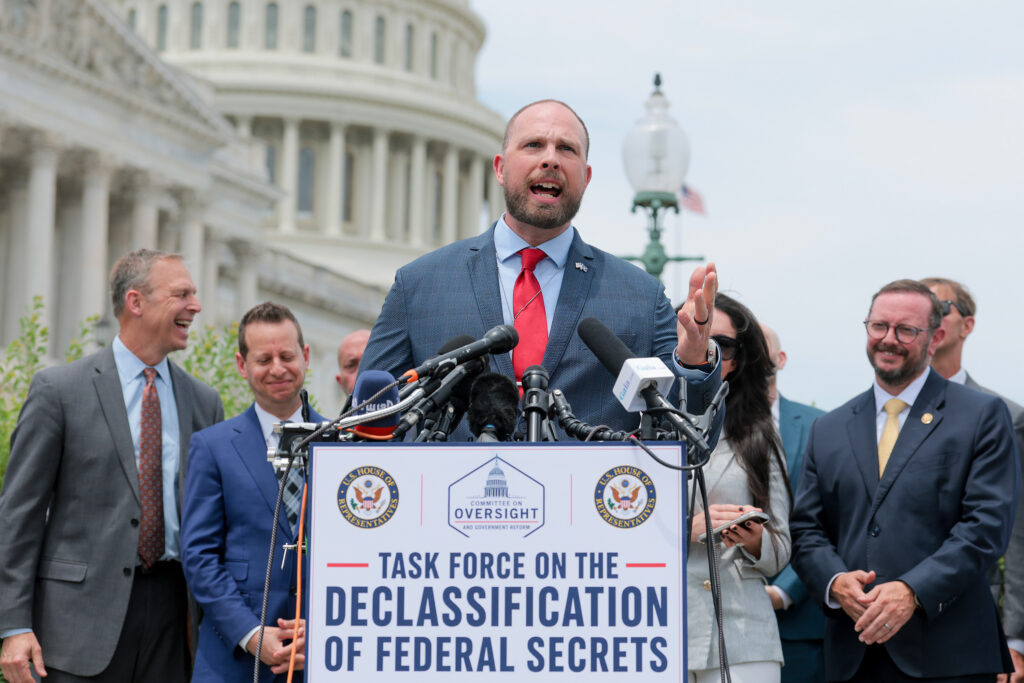
Trump’s return to the White House was supposed to put these questions to rest for good. Defying the Feds was his raison d’être. This year the Pentagon began releasing formerly classified files on UAPs and even launched a website, war.gov/ufo.But no greater answers came. Grusch, as the Washington Post reported, returned in June, standing on the steps of the Capitol with members of the House Task Force on the Declassification of Federal Secrets. His claim was that billions of dollars in secret spending had been hidden from Congress, while Burchett told the Post that “we’ve a government that refuses to release files.” If not all Americans agree, plenty at least believe something is out there. A large majority, according to a recent CBS News and YouGov poll, believe in intelligent life on other planets, and a fifth of respondents already think aliens have made contact with Earth. While about a third (33%) believe aliens will never reach us, the rest think we will either meet extraterrestrial life in the future or already have.
“For those in the ufology field, the issue had never been whether flying saucers existed,” writes Mark Jacobson in Pale Horse Rider, his 2018 book about the famed American conspiracy theorist Milton William Cooper, who firmly believed in the presence of extraterrestrials on Earth. “Of course they did”:
“Too many people had seen them. For many, it became the central moral issue of the time. If beings from another world and/or dimension were not only in our midst but also communicating with humans, wasn’t that the biggest piece of news short of the coming of the Messiah? What right did the United States government have to keep such monumental information to itself?“
It would be the height of American solipsism to deem UFO fascination a purely American affair. Alien sightings went global a long time ago. The British had their own Roswell-style incident near Rendlesham Forest in Suffolk, where strange lights and craft were allegedly spotted in 1980. To this day, there is no shortage of British UFO hunters. A UFO and alien were claimed to have been spotted by a group of children in Voronezh, then part of the Soviet Union, in 1989.Governments in various countries have been accused of hiding the truth. But it remains the case that almost all conspiracy inevitably flows back to the United States, which boasts a military-industrial complex capable, at least in theory, of marshaling limitless resources to suppress the supposed reality of alien visitation.
Pop culture has been more than happy to cater to our intrigue. In 1938, Orson Welles convinced some radio listeners that Martians had invaded Earth with his adaptation of H. G. Wells’s The War of the Worlds. Movies from Close Encounters of the Third Kind via E.T. the Extra-Terrestrial to Independence Day, Arrival, and the recent Disclosure Day have been strong performers at the box office. Spielberg, who might be more responsible than any other human being alive for bringing aliens to the popular consciousness, crafts a tale in Disclosure Day that dovetails almost perfectly with the arguments proffered by the likes of Burchett. In the film, an American cybersecurity specialist (Josh O’Connor) steals evidence of encounters with extraterrestrials from his employer, a secretive federal contractor, and works with a TV meteorologist (Emily Blunt) to reveal the truth to the public. Here, the aliens themselves come in peace, a reminder that, in film portrayals as in abduction stories, they take many different forms—benign guides for the human race as well as invading, predatory cretins.
In the 2020s, we hear less about close encounters but there is a more widespread conviction that a government conspiracy has kept the truth of alien visits from ordinary Americans. Why? Has the evidence load grown greater? Alien intrigue tends to follow the pattern of most conspiracy theorizing: enough circumstantial evidence, even an overload, but never the definitive revelation that can end the debate for good. After so many decades of sightings and testimonies and investigations, shouldn’t we know if the aliens are among us? The federal government has a long and disturbing history of deception and subterfuge, of the sort of malevolent surveillance that would have seemed the domain of the sickly paranoid before it came to light. MKUltra, the CIA’s attempt to alter human behavior through the forced application of psychoactive drugs, and Operation CHAOS, the CIA’s extensive domestic espionage program—along with COINTELPRO, the FBI’s long-running illegal and covert infiltration of the American left and associated movements—all proved Big Government can and will lie to you. But thanks to whistleblowers and congressional inquiries, the American public eventually learned the truth about COINTELPRO, CHAOS, and MKUltra. The Cold War military buildup produced no shortage of opportunities for strange foreign craft to operate in our airspace. Aliens, then, would be next. At some point, there had to be a disclosure, evidence that was impossible to ignore or refute—the creatures visited, the technology is here, and there are people deep within the government who know the reality of the contacts we made.
Yet we remain bound to anecdotal and circumstantial evidence. There’s no grand quasi-scientific theory about how advanced extraterrestrial life might evolve on other planets and then arrive here. There has been no smoking gun. It’s possible that sentient life elsewhere in the universe has never visited Earth. The belief in alien visitation is fundamentally different from a belief in aliens themselves. It would be absurd, given what we understand about the nature of the universe, to reject the concept of intelligent life residing on some exoplanet many light-years away. There are numerous planets that could host biological life, orbiting their own stars as we circle the sun, but the closest, near the star known as Proxima Centauri, are at least four light-years away from Earth. That’s four years, at the speed of light, to reach us—and more than 70,000 years on human-constructed spacecraft. Out of the billions of potential galaxies holding billions or trillions of planets and stars, why not a few with humanoids?
“At a time when traditional religious belief has declined steeply among educated people in the West, extraterrestrials offer a way to articulate spiritual and moral concerns in rational and scientific terms,” writes the critic Adam Kirsch in his new book We Want to Believe: How Aliens Went Mainstream and Why It Matters. “Religion promises personal immortality in heaven, while science promises species immortality in the heavens; but both agree that human existence is a test, and that the penalty for wickedness is destruction by fire.” But the renewed fascination with extraterrestrial life also slides neatly into our neo-spiritualist age, where Americans of all political backgrounds seem to be drawn to otherworldly forces, whether they be mystical or extraterrestrial. It’s notable that a Baptist congressman like Burchett is willing to fully entertain the possibility of alien life. UFO speculation and discourse may not, at first, seem compatible with organized religion, especially Christianity in America. Believing in the presence of aliens remains subversive among the religious because it calls into question humanity’s divine mandate. God created us here on Earth, yet if there are other human-like creatures in the cosmos, what does that say of God? Some forms of pantheism have gods wholly focused on Earth. Do these aliens get their own gods?
To believe in extraterrestrials on Earth—to have them flying here, stopping in, observing us, even communicating with us—is tantamount to accepting the occult. It requires a similar leap of faith, an adherence to the unseen that never loses its allure. “Like the Spiritualists of the nineteenth century, [alien] believers see technology as a portal or a frequency shift that allows humans to connect to other minds, humans or extraterrestrial, as well as to places outside of the current understanding of space-time,” D. W. Pasulka writes in American Cosmic: UFOs, Religion, Technology (2019). The aliens possess a mode of travel so far beyond the realm of our comprehension that they are little different than angels or demons. Much of existence defies explanation. If we are, as a culture, embracing mysticism, aliens naturally fit into this schema. They are, by their nature, mystical beings, imbued with an essence that cannot be fathomed. A spirit passes through an aperture between our world and their own; an alien might travel in a similar fashion, slipping through dimensions. The cultural critic Ted Gioia has hypothesized that we are living in a neo-Romantic moment, where tech skepticism and a general wariness of an over-optimized modern existence have given way to a Romantic upsurge comparable to that of the early 1800s, when the Industrial Revolution upended pastoral society.
As Americans, we only seem to be growing warier of empiricism, waving away the claims of raw facts to explain what we perceive around us. And rather than the God of the Bible, there has been a rush toward astrology, tarot, and the occult—as Katya Ungerman, a prominent tech writer, has argued, citing Tucker Carlson’s claim he was physically attacked by a demon, and a story told by Gregg Phillips, who was briefly head of FEMA’s Office of Response and Recovery, claiming that he was once teleported, by forces unseen, to a Waffle House 50 miles away in Georgia. “Demonic vexation, teleportation, increased interest in religious practice—thosephenomena are all signs that life feels, to many, increasingly charged with unseen forces. You might say it has been re-enchanted,” Ungerman wrote. “There’s a widespread feeling that the material explanation is no longer sufficient; that something uncanny, maybe even numinous, is diffused into the texture of ordinary American life.”
In place of organized religion and pro-science atheism is this spirituality, this new medievalism. Sometimes, it can be compatible with religion. The early-twenty-first-century intellectual fantasy was that declining church attendance would beget a permanent secular majority. If not the muscularity of the New Atheists, led by the likes of Richard Dawkins, then at least a de facto deism that chased God out of the public square. Instead, religion has endured—there are many reports of an uptick in Catholic Church attendance and adult conversion—and proud, combative atheism can feel like a relic of the 2000s, when Christopher Hitchens was alive and a public intellectual. But it would also be a mistake to declare that the United States is returning to its nineteenth- and twentieth-century roots, when pews were jammed and God was invoked at every public opportunity. We are more pluralistic now, and also less willing to fashion our society around the dictates of the Bible or any particular religious text. A successful politician needn’t be Christian, married, or have children. Anti-gay sentiment has tailed off dramatically. The fall of Roe v. Wade did not diminish the desire for Americans to have abortions. The culture remains overtly less Christian than it was thirty or forty years ago. Faith, at the very minimum, cannot be weaponized as dramatically as it was during the George W. Bush years. Were a New Atheist resurrected, he’d have much less to battle against. The twice-divorced, philandering Trump can only be so effective an emissary for Christendom. For all the policy victories they’ve won under Trump, the evangelical right doesn’t seem as emboldened or as culturally dominant.
In the early months of the pandemic, Trust the Science was the national mantra, and technocrats like Dr. Anthony Fauci became, for a period, genuine celebrities. This was, ultimately, a phenomenon of the American left, as opposition to lockdowns and vaccines became fully right-coded. But it’s a historical anomaly that this kind of resistance became the domain of the Republican Party. Trump, with his magic polarization wand—he oversaw Operation Warp Speed, then effectively repudiated it—can be blamed. So too can the college-educated, professional-managerial strain that makes up so much of the Democratic Party. The scientists were, in fact, fallible—beaches and playgrounds didn’t need to be roped off, and some of the vaccines did appear to have caused injuries—and this development further inflamed conspiracy-mongering on the right, with bogus Covid treatments proliferating on the internet and vaccine skepticism ballooning. Robert F. Kennedy Jr.’s movement into the GOP and his elevation in the Trump cabinet cemented this rightward swerve. All of it amounted, in some form, to deep skepticism of official and received narratives, the kind coming from the federal government and the technocratic establishment. Before the pandemic, such skepticism would not have been sorted neatly into either political party. A Democratic or Republican voter could believe 9/11 was an inside job, the moon landing was fake, and Oswald didn’t act alone.
Aliens remain a unifier: the prime conspiracy, in 2026, that joins the left and the right. Both camps, red and blue, may be inching toward a new mantra, something like Trust the Science—Sometimes. Or, trust it if it verifies my belief. It’s not as if the left wants to talk much about pandemic preventive measures or resuscitate Fauci. His brand of empiricism is falling out of vogue. In the meantime, aliens appear primed to outlast other recent obsessions, like QAnon. They endure like the greatest, unkillable political conspiracy theories, whether it’s the debate over who really killed JFK or what brought down the Twin Towers. Aliens represent, in some sense, the safest conspiracy. Disclosure is always around the corner. Adherents to the cause can perpetually invest hope in a new revelation or sighting, another president who, unlike Trump, will finally do what needs to get done. And what is that? Who can say, really? Jews await their Messiah. Christians anticipate Christ’s return. The descent of an alien to Earth—or, at least, final proof of intelligent life in the cosmos—follows similar divine logic. One must believe. Belief can be world-affirming or world-denying. It can be easier to turn to outer space than face the misery of mankind, the wars and diseases and dysfunction, the rampant inequality and existential despair. The Middle East is aflame. Ukraine is aflame. Gaza and Sudan are immiserated. Artificial intelligence, we are told, might end us all—unless nuclear war or climate change does it first. History teaches us that humanity is a resilient species, able to survive wars and plagues, but that’s cold comfort to those living through them. “When people are beginning to see that everything is at stake,” Carl Jung argued late in his life, “the projection-creating fantasy soars beyond the realm of earthly organizations and powers into the heavens, into interstellar space, where the rulers of human fate, the gods, once had their abode in the planets.” Perhaps, in this construct, it “might be better to accept the possible reality of flying saucers than not.”
Aliens, for the hopeful and the despairing alike, serve as a deus ex machina. Any creature with the power to cross the universe is something close to a god. This god could deliver us into a new golden age or eradicate us entirely. Either way, an end point is promised, the cessation of a certain world order and the dawn of another. This concept, for some, is enchanting. Human beings aren’t much for middles. We prefer to know we are alive during the most important time in history, at the very pivot point. Once revealed, an alien may save us from bloodshed or famine or—just as vital—ennui. What drudgery might be erased in this brave new alien world! We’d even be forced to look up from our phones. Our new god might love us or kill us. In the meantime, we can keep believing. That’s the eternal nature of humanity, and it’s this belief that can, perhaps, supersede the polarization of our times. We can remember what binds us. That is the dream of disclosure—one we can, steadfast, hold onto. If an alien flew down to Earth and revealed itself, our wars would suddenly seem petty. As a species, we’d have a moment, at least, to exhale. What comes after that can’t be known. Who can say that an advanced alien is capable of halting wars in the Middle East, Sudan, and Ukraine?
But there is still a yearning for something more. If alien belief is humanity at its most conspiratorial, it can also be seen as humanity at its most hopeful. We don’t want to be alone. We never did.