Content Violation
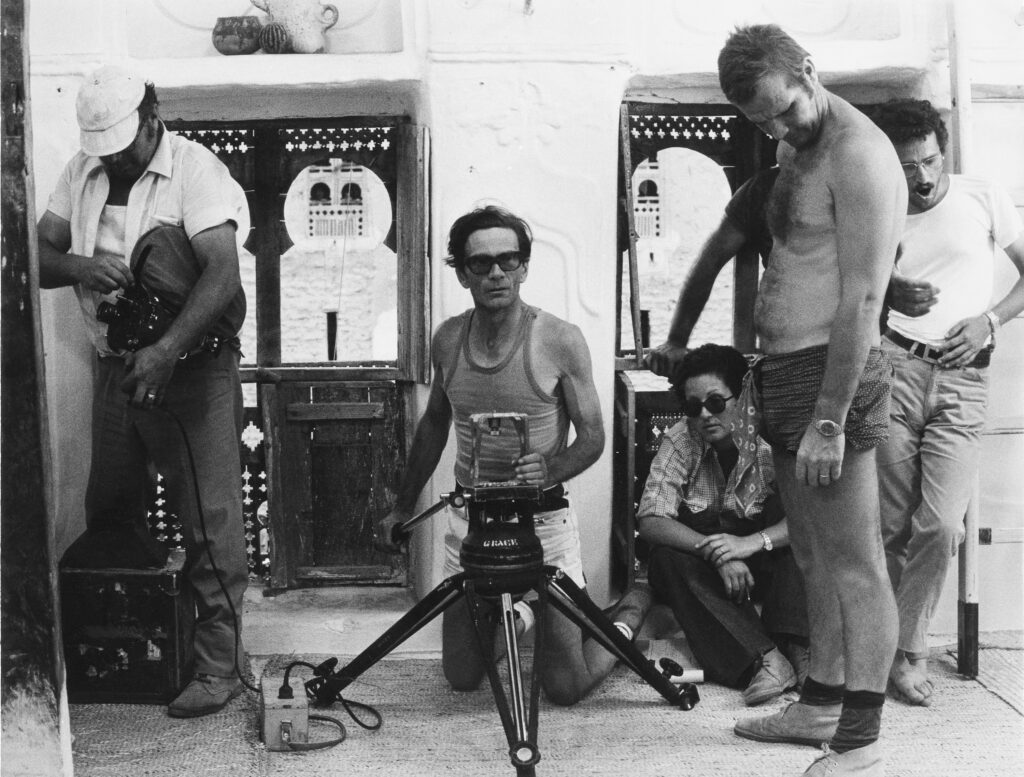
Watching the penultimate scene of Pier Paolo Pasolini’s film, Salò: 120 Days of Sodom, I have never felt so wholly ignored, and therefore despised, by a director. Released in 1975, the film takes place in the fascist republic of Salò (the Italian Social Republic), a few months before its demise in 1945. The film centers on the self-annihilating pursuits of four highly educated fascists, The Duke, The Bishop, The Magistrate and The President, who orchestrate rituals of elaborate brutality in a countryside villa in Marzabotto.
Over the course of two hours, we are subjected to a remorseless spectacle that quickly escalates in horror. After the fascists find four handsome young guards to do their bidding, nine young women (including the fascists’ own daughters) and nine young men are rounded up for the events that unfold over 120 days. Each segment of the film—based on Dante’s Inferno—begins with an older raconteuse telling stories set to soft piano music, inspiring awe and repugnance. As viewers, continuing to watch requires bodily dissociation to continue watching scenes of rape, incest, ingestion of nails, sadomasochism, coprophagia, scalping and murder.
After the 120 days of horror, The Duke, The Bishop, The Magistrate, and The President watch through binoculars as their surgically calibrated plans culminate in a bloody, ritualistic orgy of murder. Nipples are cut off, tongues are removed. No one survives: the victims and guards die, and the fascists themselves will march to their own death once they leave the villa, with the fall of the RSI. Through a point-of-view shot of occluded binocular vision, I become aware I am watching a staged filmic spectacle. Having sat through the ordeal, I realize I have participated in a ritual that uncovers not only the driving engine of fascism but the affective substrate of totalitarian culture. This is what Pasolini termed “false permissiveness.” In the age of generative AI, false permissiveness has new and unsettling relevance.
Born in Bologna in 1922 under Mussolini’s rule to a fascist military officer and a public school teacher, Pasolini lived his anti-fascism deeply. After fleeing to Rome at the age of 30 due to a scandal, Pasolini embarked on his prolific body of work across film, poetry, critical essays, and novels, wielding a film camera and a pen with equal ferocity. Pasolini was seemingly contradictory in his anti-fascist views. Openly gay and a staunch Marxist in a society that was deeply religious, conservative, and homophobic, Pasolini was skeptical of gay liberation movements in the 1960s and dismissive of the hippies (people he called “long hairs”). While supporting the legalization of abortion, he was opposed to abortion itself.
“I want to attack the permissiveness of our new ways,” Pasolini wrote. “So far, society has repressed us. Now it offers only a false front of permissiveness.” This false tolerance and cultural acceptance by the state masked an even more terrible core: the twining together of capitalism and authoritarianism. This false permissiveness was tied to consumerist culture. The state and the market would subsume personal identity for the sake of profit while eradicating the possibility of changing the structures of power. In many ways, Pasolini anticipated the paradox embedded in the narratives of inclusion and representation under capitalism. Identity can be commodified and sold—and quickly dropped when no longer seen as lucrative or worthwhile, like the rapid rise and decline of corporate DEI initiatives or the swiftness with which big banks pulled their sponsorship of gay pride parades after Trump’s second election.
One character in Salò succinctly captured the idea of false permissiveness: “While society represses everything, man can do anything. When society begins to permit something, only that something can be done.” Pasolini saw “the terrible double bottom of our new liberties,” which would create a “greater conformism than before.” He detested consumer culture and TV, viewing television as a fascistic force that was able to do what Mussolini’s regime could only aspire to: rooting authoritarianism deep within a person’s soul, permeating their dreams and desires. As a culture-maker, Pasolini was concerned with the spiritual consequences of politics and technology upon society, the vocabulary that shapes political and social imagination.
In Pasolini’s political writings, Lutheran Letters (1976) and Corsair Writings (1975), we see a man grappling with the persistence of fascism through its transformation from a “classical” form to a new consumerist kind of fascism. The terror of uniformed, armed men marching through the streets gives way to the new power of advertisement and the idea of choice—consumerist behavior that is more stubborn and more deeply lodged than the classical form of Nazism. “No fascist centralism ever managed to do what the centralism of consumer civilization has successfully accomplished,” he wrote. While classical fascism was “totalitarian but not totalizing,” consumerism created a world that was technocratic, homogenized, and totalized, treating human bodies and human relations as purely mechanistic. In Pasolini’s logic, for example, institutionally sanctioned abortion turns heterosexual sex into an act of pure pleasure, which corporations can co-opt and market for profit.
In a world of individualized consumerism, everyone becomes an aggressor: we each have to get our piece of the pie in a dog-eat-dog world. Like the guards in Salò, we see the cracks of cruelty and corruption, and we not only go along with it, we actively strive to become closer to power. We might hate capitalism, but we like our nice things, and we want nice things for our kids. We ride our dream of joining the upper class, buying ourselves the good life, toppling each other, ignoring each others’ suffering: it’s within consumerism that “we are all becoming little Hitlers, little power seekers,” in Pasolini’s words. Striving for personal choice, we fail to change the power structure. Instead, we settle into false permissiveness.
I recently tried an experiment. I prompted several AI video models—Kling, Bytedance’s Seeedance, Grok’s Imagine, Google’s Veo—to make a version of Salò, with a request to include contemporary iconography around consumerism. Feeding the models film stills from Salò, they chugged along until I was told there was a “Content violation policy. This content could not be processed because it was flagged by a content checker.” Salò exposes the false permissiveness deeply embedded in generative AI as a technology furthers our individualistic, power-seeking behavior.
The first layer of false permissiveness that generative AI cultivates is the promise to “democratize” creation. With promises of “creativity for everyone,” “design for the 99%,” corporate GenAI platforms transform the meaning of democracy into a fantasy in which each of us wields total power and control rather than recognizing the matrices of power we inhabit. The figure of the individual is re-entrenched as a locus of importance, of hustle, of the entrepreneurial spirit. Everyone—your grandmother, your dad, you—can now make an app! Write an essay! Direct a film! Everyone can make endless narrative content!
At a strange sales pitch for Seeedance this past year, an energetic young Bytedance employee wearing jeans and a crisp white polo shirt, making erratic arm movements, expounded to our visiting group of creative technologists the advantages of their model. He showed us examples of anime movies and fantasy clips that had been produced, as well as a squirrel cartoon whose sole narrative arc seemed to be stuck in the phase of rising action: you’ll just have to wait for the next episode for resolution, which may never come. The squirrel cartoon, it turned out, was the result of a Seeedance engineer making a cartoon for his child, who enjoyed the first episode so much that he asked his dad for more. To answer such an innocent request, there was Seeedance to the rescue, much cheaper than Google’s model, that could make episodes on a budget until the child was an adult. In a world of violence and uncertainty, what more could a parent want than to give their child a safe, controlled, utterly custom media experience?
Through ChatGPT and Gemini—objects that condition behavior—we can accelerate the drive for power that each of us already feels through consumerism. Like the Bytedance engineer, we can become the hero of our own story: the plumber (just send Claude a picture of your plumbing issue), the kind boss or outstanding job applicant (make this email sound nicer, ChatGPT), the sexy guy (help me write a flirtatious text, Claude!). Whatever your chosen descriptor is, the “democratic” promise of GenAI is that each of us is ultimately powerful and victorious above others. As a set of production tools, GenAI glides easily into the creative industries that already regarded art as consumable objects of demand and social media influence, supplied by constant human production and capital. The writer Hilton Als summarized it neatly in his recent remark on types of art that exist only as “a product in service of a career.” Built upon the massive amounts of user-generated content made available in the web 2.0 boom (which inculcated the millennial girlboss-influencer era), GenAI is less of a disruptive surprise technology and more of a logical conclusion. In the act of experiencing “democratic creation,” we continue to bring more shareholder value to one corporation or another.
The second layer of false permissiveness is revealed through Salò’s degeneracy and the models that refused to generate my consumerist-themed Salò remake. Over the past few years, concepts of AI alignment, and “pluralistic” or “democratic” AI governance have emerged. Many of these “pluriversal” or “democratic governance” initiatives around AI—including collective constitutional AI and pluralistic alignment–are supported by the same corporations that make AI. In response to the more centralized proposals like collective constitutional AI, others have proposed “democratic fine-tuning” (winner of an OpenAI grant), where model responses are shaped by specific user groups.
In a world of democratic AI alignment, Salò would never exist. It is a film deemed “near unwatchable” by Susan Sontag, and was banned for decades across many countries. One watching is more than enough for most. Gary Indiana observed that while most “video stores of the Western world offer a glut of more violent, more sexually explicit” movies than Salò, Pasolini touched a nerve with his film, making a work of art so deeply unacceptable that it defies categorization. AI alignment heralds a sense of “morality” to be found in white papers and opinion polls—brief brushes with the masses. If Salò were allowed to be a part of a GenAI model, that would assume society has moved beyond its obsession with individualistic power-seeking. Salò, in its complete unacceptability, lives in a universe beyond the bourgeois sense of AI alignment and its middle-class moralizing. In its ritualized shock, we as viewers are moved to imagine a universe beyond current conditions, possibilities and vocabularies. After watching Salò, one is reminded that underneath the mantras of consumer choice and technological progress are the grinding elements of corporations and class elites jockeying for power through profit and the control of imagination.
For all Pasolini’s complex writings on culture and the marriage of capitalism and fascism, at times Salò reveals his droll side. The scenes of coprophagia in Salò were his commentary on processed, packaged junk foods—as a society we are forced to eat shit. In this wild, filmic vocabulary of terror and comedy, it is hard to define the genre of Salò. As one of the last films made before the onslaught of global austerity measures in the 1970s, it is even more difficult to imagine a film that mixes slapstick comedy and unwatchable violence being financed and made now (the curtains used for the villa’s set cost 6 million lira, about $80,000 today).
As Pasolini made Salò andbegan writing about how consumerism was becoming the new fascism, the fabric of authoritarianism itself also began to shift. On the left and the right, the crux of authoritarianism’s evils was understood as the individual crushed by a faceless system that bulldozed freedoms. From Hayek to Popper, Rand to Orwell, such a model centered the individual and the private sphere as sites of resistance to the authoritarian leviathan.
In making Salò, Pasolini picked up on a thread often neglected by observers of authoritarianism. Roland Barthes, in his review of Salò, identified it as a difference between “fascism as structure” (the kind of fascism studied by political economic analysis), and “fascism as substance,” a far more spiritual affair that permeates life, like carbon monoxide. Pasolini understood the power of “fascism as substance,” and since the 1970s, this is the realm that the technologists of Silicon Valley have occupied, spreading fascism-as-substance. Authoritarianism shifted from the police state model, incorporating more interior elements. It doesn’t need jackboots; it needs capitalism.
In the emerging political economic landscape, technology has so suffused our world that a technocratic mode of living—often called techno-feudalism or techno-fascism—has overtaken our democratic one. Fascism-as-substance is embodied by the billionaires who own the companies that churn out chips and servers, AI models and new platforms. Yet fascism-as-substance acknowledges the lived complexity of GenAI at this moment: a cultural producer who is opposed to GenAI might still vibe-code a website about the deleterious environmental effects of AI, a tech worker at an AI startup who hates their job but needs to pay the rent, Marxist students and professors relying on GenAI to create bibliographies, data center activists using NanoBanana to generate visual material for slides, even TikTok influencers declaring their refusal to use GenAI to generate clout and likes.
The new face of fascism relies on a singular logic: pure and total brutality, power for power’s sake. “In our world, our will is the only legality,” proclaims The Duke, standing above the victims before they are stripped, and the frenzy of violence begins. Fascism-as-substance names this contradiction within us. Pasolini forces us as viewers to look in the mirror. It is not only that we live under tech CEOs who seek power for power’s sake but we ourselves have created a culture that runs on the same logic.
Pasolini’s desire to make Salò began when he read the Marquis de Sade’s 120 Days of Sodom (on which the film is loosely based), as well as Maurice Blanchot’s writings on de Sade. In Blanchot’s book, the true terror of Sade’s political vision is complete annihilation. For de Sade, a passionate libertine, total freedom and personal sovereignty contain the seeds of their own destruction. The heart of libertinage requires an individual to seek individual sovereign power—the premise of true freedom—such that all surrounding him become victims, objects, subjects, annihilating everyone but the individual. Such a stance of absolute negation will eventually annihilate the libertine himself; with nothing to be free from, how does the libertine exist? He doesn’t. That’s why, in Pasolini’s telling, everyone in Salò dies.
Such a total fatalism is the bleakness embedded in fascism-as-substance. It is the foreclosure of imagination that GenAI hints at, and the loss of language through authoritarianism’s appropriation of vocabulary that Salò is so concerned with. Throughout the film, the fascists quote Baudelaire and Nietzsche to justify their cruelty. Democratic AI model alignment presume a vision of freedom that operates within the boundaries of the permissible, freezing status quo ethics into computing—an ethics that, by Pasolini’s measure, is a conformist flattening of the world. The capacity to inhabit language and imagination outside the present moment is lost.
Some computer scientists have appropriated the language of “emergence” and “non-determinism” to describe the behavior of AI models. Yet if one reads some of the original papers closely, emergence is actually an arbitrary metric. “Non-determinism” is equally dulled; the result of a computer’s number storage constraint that causes inexact math with large sets of probability tables. Like the fascists of Salò quoting philosophers for barbarous ends, AI companies appropriate the language of emergence and non-determinism to mystify their models into a proxy for authentic life.
In Emanuele Trevi’s Something Written, a memoir/novel that chronicles Trevi’s time at the Pasolini archives, Trevi discusses Salò and Pasolini’s unfinished novel Petrolio, both works have become so shrouded in myth since Pasolini’s still-unsolved murder. One theory about Pasolini’s death is that he went to Ostia in search of lost reels of Salò, which had been stolen some months earlier. Another theory focuses on the corporate intrigue within Petrolio, an oracular work that describes the Eleusinian journey of an Eni petroleum corporate executive who undergoes a ritual transformation and gender transition, while colluding with fascist forces. Another theory is that fascists were so upset with Salò that they murdered the director. Trevi writes that Pasolini’s works are characteristic of him: they are works of literature, of film, that think. The sad figure of an artist who only tells tales of “the portion of the cage assigned to him,” Pasolini’s art is an endless ritual of becoming that still transforms, decades later.
If it is possible to love such a perverse, unimaginable, unwatchable film, I do love Salò. In an age of GenAI, Salò reminds us that art is a process rather than a commodity, a ritual that brutalizes and transforms. In the end, when we realize that we have not just witnessed, but have been transformed by, watching torture through the eyes of the four fascists, through the medium of film, we have done a terrible thing. Salò’s unacceptability and decades-long ban underscore what happens when something so radical and transgressive arrives. Innate in us too are the seeds of violence and fascism-as-substance. I do not bemoan the loss or acceleration of a system of cultural production that always treated art as something to be consumed. I do not hold precious the figure of the human, when it has always been a historically contested category, nor do I want a more creative AI model that will let me make Salò or defy CSAM content rules in the name of art. What I do want are the conditions that must exist for a work of art like Salò to come into being—so original, so eviscerating that we no longer become the storytellers of our portion of the cage, challenged to truly be with the friction of the world, past emergence into rupture.