Guitar Hero
An Interview with Marc Ribot
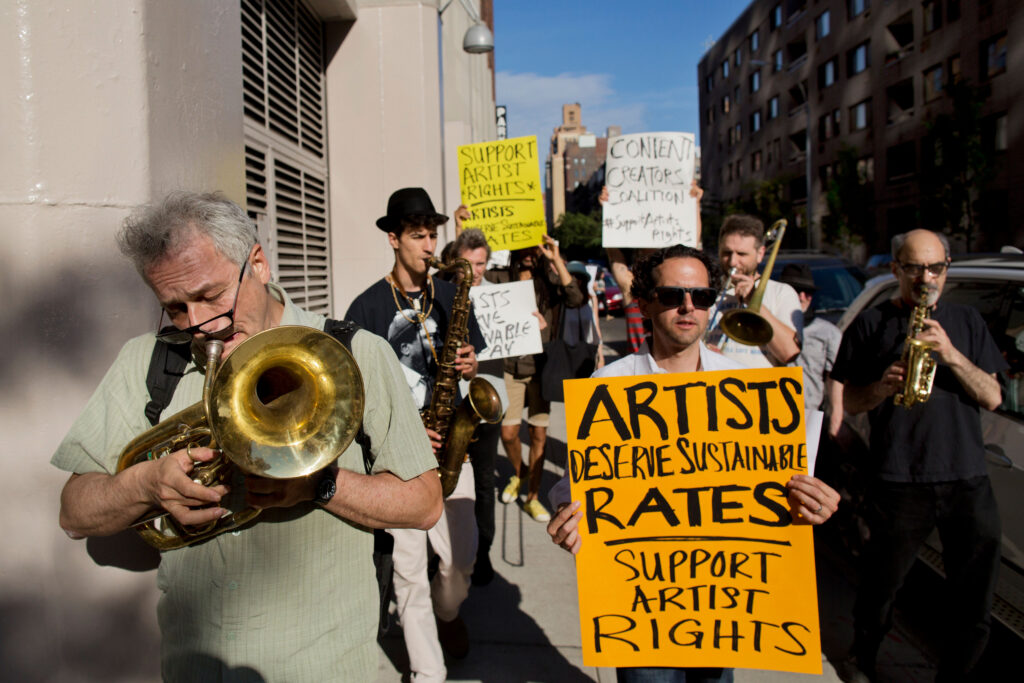
Marc Ribot has spent more than four decades moving fluidly across the boundaries that ordinarily organize musical life: between downtown experiment and popular song, between sideman and bandleader, between art as formal inquiry and art as political intervention. But what makes his work so compelling is not simply its range. Again and again, Ribot has returned to larger questions about music’s social consequences: what it means for sound to carry political force, how genre can function as both resource and constraint, and what artistic freedom looks like under the economic pressures of the contemporary music industry.
Leonard Benardo: To get things going, allow me to ask an initial broad question, and we will narrow as we go along. I wonder how you understand and grapple with the relation between music and politics. There are those who claim that music is a sphere wholly outside politics and that to introduce the political into it would unnecessarily sully the art. Others view music and politics as inextricably linked, arguing that separating the two can only be a fool’s errand. Where do you come down? Is all music political? What does music require for it to be political? Is it a question of content? Is it expressed in the sounds themselves irrespective of “content”? How to understand?
Marc Ribot: If it’s OK, I’ll respond aphoristically.
“Politics,” Wikipedia tells us, “is about making agreements between people so that they can live together in groups.”
You say that “There are those who claim that music is a sphere wholly outside politics and that to introduce the political into it would unnecessarily sully the art.” I agree that introducing politics into music sullies it. But I would challenge the belief that this is unnecessary. In fact, being “sullied” is exactly what I need from art.
Composer, pianist, and bon vivant Anthony Coleman likes to describe his favorite part of both cuisine and music as “the filth”—that undefinable goo between the objects you can identify that actually makes it great. I share this aesthetic. I guess “we got da funk.”
But we didn’t just “got” it. We actively sought out music that corresponds not just to the body, but to the parts of the body we’re taught to hide: a bass envelope filtered to sound like a squelched fart, a cuíca that amplifies the friction of wet skin, sliding guitars and trombones whose slippery glissandos return us to the atonal space between The Well-Tempered Clavier’s official notes, wah-wah pedals, and plunger mutes (you heard right: the rubber parts of toilet plungers) that turn notes into human “oohs” and “wahs.” And not just any body: the Black Body—the body repressed, constitutionally written out of the body politic… it’s “too funky” desire policed by unspeakable violence.
Anthony and I, two Jewish white kids born around the time that the repressed body had collectively decided it was going to return regardless of the consequences, and coming of age sometime between the wah-wah pedal and the Mu-Tron III, somehow identified with that body’s liberation. This solidarity of filth and funk may have been instinctive, unconscious… and entirely aesthetic.
But it was a choice “about how people can live together in groups.” A demand to replace the non-agreement of white supremacy with a new agreement—that included acceptance of the whole person, body and soul, self and other. The proof of that acceptance is that no one has to hide… or whisper. Bootsy Collins’ amp specs: two Crown Micro 5000 and 3600 power amps—eight custom-made cabinets with Electro-Voice speakers: two 4x18s, two 4x15s, and four 8x10s.
And that’s political, ain’t it?
LB: I very much appreciate the richness of your explanation of the political. Now for something a bit more straightforward: you have been eloquent and vocal about the complexities and deleterious effects of AI on music. Can you share what are, for you, the most concerning elements?
MR: Unregulated AI is going to put a lot of musicians—and other workers—out of work. No, there aren’t going to be robots playing guitar at your neighborhood bar or playing violin at the symphony. But mid- and downmarket films and video are already using AI-generated scores. Ditto people recording demos, and commercials, and other things they once hired musicians for.
In addition, 30,000 AI-generated songs are being uploaded to Spotify daily—that was last month, it’s probably more by now—and if people click on those, humans don’t get paid. In addition: feeding AI systems is going to accelerate catastrophic global warming.
All that stuff is bad, but the worst thing about AI is that it will make even more people like Mikey Shulman, the CEO of the AI music generating company Suno, rich. Mikey rationalizes the fact that his company will destroy human artists by telling us we weren’t really that happy to begin with: “It’s not really enjoyable to make music now,” he says. “It takes a lot of time, it takes a lot of practice, you need to get really good at an instrument or really good at a piece of production software…. I think the majority of people don’t enjoy the majority of the time they spend making music.”
How many more people like Mikey can the world stand before it vomits and drowns us all?
You asked: “Others view music and politics as inextricably linked, arguing that separating the two can only be a fool’s errand. Where do you come down? Is all music political? What does music require for it to be political? Is it a question of content? Is it expressed in the sounds themselves irrespective of “content”? How to understand?”
I come down resolutely on the side of those who don’t know.
Are we (artists) our brothers’ keepers? The Biblical God never definitively answers Cain’s question. But it’s worth noting that the text puts the question in the mouth of a murderer.
And I have to admit that although I love everything about Spain—people, music, food—and have many friends there… its public art makes me sick. Are all the old statues beautiful? All the dedications to famous departed writers touching? I don’t give a shit. First tell us where the bodies are buried.
And to see formalist avant-gardism placed in the service of such amnesia is particularly disgusting.
The famous starchitecture of Valencia? So what? Fuck Salvador Dali and his melting clocks.
I remember, as a child in the early 60s, being taken to an exhibit of Dali’s gold work near my hometown in New Jersey. “This is weird,” I thought. And that’s exactly what I was supposed to think. Art is weird stuff made by quirky people like Salvador Dali. The show was perfect for New Jersey, for the second-generation immigrant Italians and Jews so desperate to leave history (and Black people) behind in the cities they’d fled. That all the people in the gallery were white: that wasn’t weird. The fact that a half mile away, there was a Black city whose revenues had collapsed in the “block buster” selling hysteria of the same people now gawking at the elongated gold elephants… that wasn’t weird. That neither artist nor curator mentioned the US-supported Spanish dictator still in the process of murdering his opponents… all that was normal… all that silence. All that unbearable, deafening silence.
It’s probably lucky I didn’t know how to make bombs. I might have wound up a Jainist, like that poor girl in Roth’s American Pastoral.
On the other hand, agitprop is also usually a drag.
I guess, judging by my Songs of Resistance recording, that I sometimes feel it’s necessary. Every army needs a marching song. As the civil rights song goes: “We are soldiers in the army/ We have to fight although we have to cry.” Perhaps that line moves the song beyond agitprop. The idea that fighting is a burden, crying a necessity … if it agitates and propagates, it does so for a different future than the SS song “with a step so firm, step so firm! 1-2-3-4, Everyone wants to join!”
I keep a special place in my heart for the frustrated lovers in Georges Bataille’s Blue of Noon who never gaze up from their perverted obsessions to notice Barcelona fighting for its life against Franco’s fascists.
That said, I’ve found the need to fart in church to be, not exactly an ethical obligation, but one inseparable from my aesthetic… part of the job description of a rocker. Which is probably how I wound up with titles like “Yo, I Killed Your God” and “Fuck La Migra.”
Having survived my teenage years, I’ve tried to distinguish between transgressing the rules of the powerful and simple bad manners or being mad at mommy.
Yes, there are many different ways that music can be political: and “political” lyrics are probably not the most original of these, especially when they consist of virtue signaling tropes aimed at a vaguely left consumer demographic.
I’ve come to believe that the deep politics of music lies in the economic forms through which it is produced, not in the content expressed by its artist/producers.
I’m involved in trying to combat the collapse of union protections—particularly in the indie label sector in which the large majority of creative musicians work—and the corresponding declines in pay and conditions. Such conditions don’t determine what musicians can express, but they certainly affect who can do the expressing.
I’m skeptical of current mythologies in which recording for non-union so-called “independent” labels will enable us to fight corporate exploitation. Indie deals generally pay more on the backend and less upfront than major labels. This may be a better choice for those who can afford to self-produce and self-promote. But it’s morally—and politically—neutral. Presenting this as anti-corporate political action is a bit silly (particularly since most indie labels have corporate distribution—often through the major labels themselves). Signing with an indie label won’t end the corporate system in music. For those whose goal is empowering musicians to challenge corporate power, we need a union.
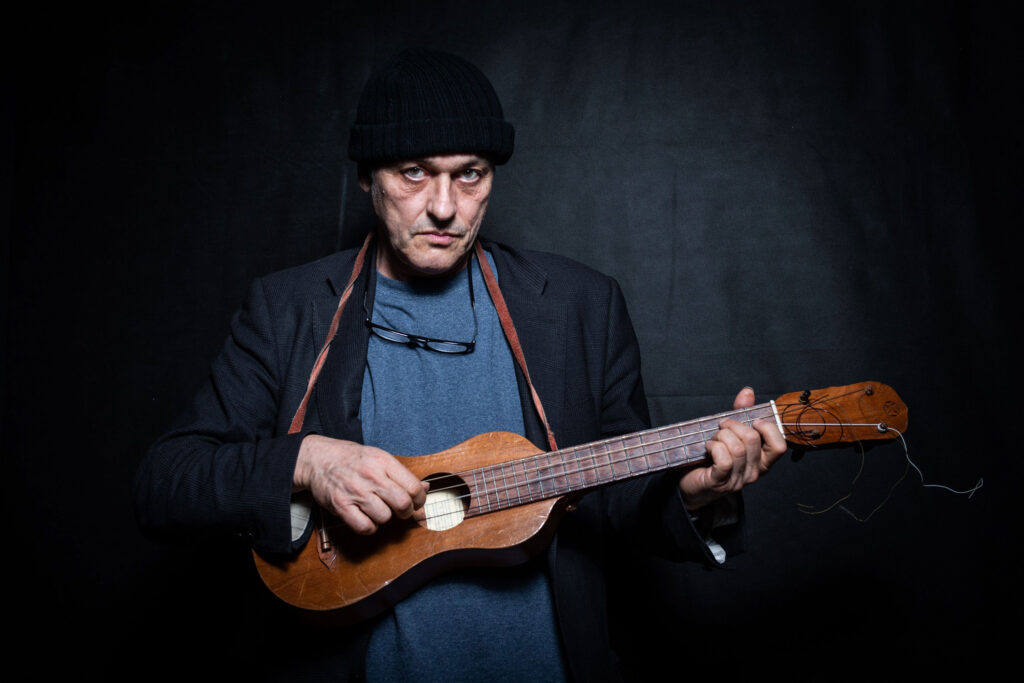
LB: I really appreciate this second reply to question one, Marc. It fills out for me where you are coming from—and helps clarify what you countenance to be BS. I enjoy your Songs of Resistance—some very beautiful music on it, especially the Tom Waits duo you quote, “Bella Ciao” and “The Militant Ecologist.” There are other instances, unavoidable perhaps, where there is a Liberation Music Orchestra sensibility. Maybe that’s always the case when you have a full slate of “political” songs. Where Dylan, I guess, had his fill was with the “irony deficiency” of so many fellow folkies. There is only so much genuflecting to earnest political commitment that one man can take.
The Spanish Civil War is clearly a touchstone for you. And your “political music” has an old-left quality to it (minus the Stalinism). One might say that you bring a 1930s (more than a 1960s) ethos to your thought and music. For sure, Woody Guthrie would sign on to your critique of corporate capital, and that mystification of the “independent” label. “Fuck la Migra” doesn’t call to mind “Fight the Power” for nothing!
Can we turn for a moment to the question of genre? Your music has been associated with a lot of them: jazz, downtown, free, noise, experimental, and so on. The easy reply when asked why so many genres, is to aver: why tie oneself down? And of course that’s true. But outside of the intrinsic value of being labeled “eclectic,” have you ever felt pressed to accelerate musically in one direction or another? Do you shift genres based on where you are in life, and all that that means? Have you ever been anxious about your own eclecticism?
MR: I feel pressed to accelerate in a different direction (or another) every time I pick up a stringed instrument I’ve never played before. I’m afraid to write this, as it’s probably grounds for involuntary commitment, but each one of them tells me to play something different. That’s how I hear guitars. I don’t listen for any objective criteria—tone, fret buzzes, intonation, etc. I just wait to find one that tells me to play what I need to play. (Don’t worry, if any dogs give me murderous commands, I won’t listen.)
I don’t see being labelled “eclectic” as a value: it’s been more of a curse. The name of my first late ’80s, early ’90s rock band—Rootless Cosmopolitans—was designed to shield me from this curse (“rootless cosmopolitanism” was a crime in Stalinist Russia used to arrest Jews and intellectuals). It was a way of telling those who critiqued the fact that I was all over the place that they were being Stalinists.
I don’t think I’m eclectic. I’m following continuities between different times and places and sounds that maybe other people don’t hear. I heard punk rock in the peak moments of a Jack McDuff organ solo at the Key Club in Newark, New Jersey, in 1979. The same sweat, the same intensity: the same deep need to groove. Just different music, that’s all. I heard it again in Arsenio Rodriguez’s recordings of the ’40s and ’50s: bands that had to make people dance if they wanted to keep the gig. My tastes aren’t eclectic: I’m looking for a single holy grail that jumps around a lot.
Theoretically, ideally, as a composer, I don’t believe in genre. It’s a lazy person’s short-cut to composition. But as a guitarist who gets called to play other people’s stuff, it has come in handy. Because I do believe in literacy. If you’re going to call yourself a guitarist, you should know who Charlie Christian, Django Reinhardt, BB King, Hubert Sumlin, Chuck Berry, Sister Rosetta Tharpe, Ike Turner, Robert Quine, Tom Verlaine, James Blood Ulmer, Derek Bailey, Fred Frith, etc., etc., are. Not only the notes, but the sounds, what type of strings, pick-up, amp, mics, board, reverb, or echo they use.
Genre is simply one of the parameters one can play with as a musician: loud vs. soft, high vs. low, acoustic vs. electric, dry vs. reverby, trebly vs. bassy, 1930s vs. 1970s, punk vs. salsa, Django vs. Howlin’ Wolf vs. Television: we play history. And one can use genre without being obedient to it, as a referent, not a set of rules. One can use a 1980s digital delay on a 1940s Django style solo. One can—and I did on some Tom Waits records. The more conscious play with the more parameters, the better.
I work by putting things next to each other and letting them fight it out. Six stringed dialectics. I know The Importance of (not) Being Earnest as well as the next joker. For a while, I was trotted out as a specimen of post-modern guitar playing. I was in John Lurie’s Lounge Lizards, fer chrissakes. I premiered John Zorn’s “Book of Heads.” But by the time (the late ’80s) that the rest of the culture was catching up with post-modernism’s penance for being too earnest, we were done with it. Irony corrodes. Sooner or later it poses the question: “OK: what the fuck are you really about?” That’s not an easy one to answer either. Lurie decided he was really about Fela (hmmm). Zorn started Tzadik records and composed 700 pieces in Klezmer modes (each one occupying precisely one-half page of music paper). I decided I was really at my best when I stopped caring about what I ‘was,’ and started a band called “Los Cubanos Postizos” (The Prosthetic Cubans).
My longest musical LTR has been “Ceramic Dog,” referring both to chiens de faïence a term connoting an emotional state so extreme it precludes motion (as when two dogs freeze just before a fight, or two lovers stare mutely into each other’s eyes), and Jeff Koons’ kitsch “Puppy.”
So I haven’t worked out how, as an artist, to approach the political without being an asshole. All I know is that at this moment it seems urgent to try. In that sense, maybe I’m a post-post-modernist.
LB: Post-post modernism seems a very reasonable and capacious space to occupy. And as someone who spent many years working on (and living in) Russia, I appreciate your resignification of the rootless cosmopolitan! I would be eager to get a sense of what Europe offers for your music in a way the US may not. You spend considerable time both living and playing in Europe. Are the opportunities to play in Europe because of the festival circuit always greater than the US? Can you give any brief sense of how the scene differs for you in, say, France, Italy, Poland, and elsewhere? Where is the infrastructure and the fan base strongest for your work? Are there environments that inspire more than others or does it always come down to the intangible?
And one generally related question: might you offer a sense of how musicians keep afloat these days? If festivals in Europe aren’t an option, do most make a living through private lessons, and for the lucky few, teaching appointments at schools, colleges/universities? Is recording necessary for broadening one’s name but brings in, as a matter of course, only scant income?
MR: The history of the so-called Downtown scene that I came up in is closely tied to Europe. I could count the number of US gigs I did outside of NYC with Zorn or the Lounge Lizards on one hand. Part of this has to do with the critical recognition in Europe of jazz as a great art form from the time of Louis Armstrong and Josephine Baker. Some to do with US postwar cultural hegemony. And some has to do with specific postwar CIA-funded projects such as the Congress of Cultural Freedom (see Frances Stonor Saunders’ The Cultural Cold War). Although much of the CIA funding was exposed and shut down in the late ’60s and early ’70s, the touring circuits and fan base they established remained. US embassies were active in funding festivals right up until Trump shut them down this last year (or so I was told by my promoter in Split, Croatia).
Festivals and other subsidized venues in Europe remain an option for me, despite defunding as some European nations drift rightward. Much euro funding is regional or municipal, so not always affected by national trends. And the funding is hardwired into the EU constitution, which designates a state role in protecting culture, which in turn creates Ministries of Culture, which in turn have budgets, at least some of which must reach actual artists.
The days when the occupants of euro festival green rooms resembled certain Manhattan bars may be over, but we—and the recordings we make—are still a global industry, a fact which seems to have escaped US arts funders, who continue to respond to crises in the arts economy by subsidizing local arts venues: a policy about as effective as addressing a crises in the global wheat or oil economies by funding Iowa bakeries or Texas gas stations.
But yes, word from my colleagues is that Euro Jazz Net (the set of non-mainstream booking agencies) touring ain’t what it used to be. There’s competition from World Music, and, somehow, multiple rounds of arrogant US presidents threatening European countries for not participating in US wars hasn’t endeared us. I was told by a Norwegian promotor during the first Gulf war who had booked US jazz musicians his whole life: “Suddenly I wondered: why am I supporting Americans?”
(We also tour Europe effectively without visas. European artists wishing to tour the US need very difficult to obtain visas costing ca. $4,000 per person for a two-week visa.)
In the last six years, I’ve built a relationship with a US booking agency, the Chicago-based “Big Fish,” and been very happy with their work. I still tour mostly in Europe, but now do at least one-third US touring. I have to say I enjoy touring the US. There are some pretty strange people scattered around this country. And a fair amount of them show up at my gigs.
How do musicians keep afloat these days? If by “afloat” one means both alive and working as a musician, I should start out by saying that a substantial number haven’t. Musicians hate to talk about our failures—the best way to get gigs is by talking about how busy we are, not how broke. Audiences don’t know which of the performers on stage have a day gig (or return to one the moment their tour ends). And the real tragedies tend to be hidden. But those who believe that the mass devaluation of music following Napster/YouTube/Google’s mass infringement and the institutionalization of that market failure in the Music Modernization Act (the legal architecture behind Spotify’s .0038 starvation wage) are victimless infringements should have a word with the directors of the Jazz Foundation of America, and the other Foundations who try to catch precarious musicians when they are pushed over the edge. I personally know a colleague whose life was saved by JFA’s medical intervention, and several whose dignity was saved by their end- -of-life funding, and one who they reached too late. It should be noted that all the above generated, during the course of their lives, large sums of money for labels, distributors, platforms.
During Covid, while other professions continued online, the inability of musicians—then unemployed at twice the rate of the Great Depression—to control the online distribution of free copies of our work pushed many who had been on the edge over it. Not all have returned. Similarly invisible are the talented young people who avoided the profession altogether.
Yes, musicians have and will continue to have other jobs—teaching, wedding bands, dog walking—and then, for the more traditionally minded, there’s always pimping, prostitution, and drug dealing.
I was amused by the Future of Music Coalition’s “Artist Revenue Streams” study. Funded by the Ford Foundation Technology and Society branch—which also funds much of the rest of the pro-tech industry, anti-copyright echo chamber—this study was published right about the time when knowledge of the damage done to creative industry workers by mass online infringement was threatening to boil over into demands to reform the DMCA Section 512 Safe Harbors, which protect online corporations from liability for the massive damage caused by their hosting of copyright-infringing content. The study’s faux empiricism places all the different legal sources of musicians’ revenue side by side without attempting to measure their pay rates, work conditions, social status, or compatibility with music work, all while coldly ignoring the affective realities: How, for example, might a concert pianist feel about being forced into giving private lessons to beginners in order to survive?
The overall effect of the study, and, I believe, the intent of its designers and funders, is to minimize the affective and material damage that musicians have suffered as a result of the tech corporate anti-copyright policies supported by Ford Tech and Society-funded groups such as Public Knowledge, EFF, and Fight for the Future.
And so? Musicians can always deal with precarity by finding other jobs, or, failing that, call for rescue by the charitable angels. There are so many helping hands when we’re pushed over the edge. And God bless every one of them.
But few seem willing to address the structural causes of our precarity. When we fight those, we’re on our own.
LB: Might we finish where we started? Your voice doesn’t appear often on your recordings yet your most recent effort, the sublime Map of a Blue City, has your voice throughout it. Give a sense, if you would, of any forthcoming musical projects, ideas, aspirations.
MR: My ambitions are to reacquaint myself with my Pro Tools setup—I get pretty good at engineering, then I get busy touring for a year and forget everything—so I can record a backlog of projects I’ve been thinking about. The songs on my last record—Map of a Blue City—are maybe one-fifth of what I currently have written.
I’m also looking forward to reviving my early ’90s Shrek material—and I just did a great concert at Big Ears Festival with my old friends Sebastian Steinberg (bass), Chad Taylor and Ches Smith (drums), and Mary Halvorson (guitar). I’m also deeply infatuated with this vintage flamenco guitar I picked from a guy with no teeth in a shopping mall in Andalusia. I want to get in the studio, see how it records. And I’m touring with my band, Hurry Red Telephone, in late April, and with Ceramic Dog this summer in Europe.
I also hope that the Music Workers Alliance will get enough funding to enable us to finally hire an executive director. We’ve done incredible work this year, challenging the American Federation of Musicians to fight for indie musicians. We’ve organized petitions, picket lines (three in the last four months), and press releases. We’ve really impacted the union’s willingness to fight for indie musicians in their negotiations with the major labels. We’re preparing to help the union leverage the major labels into accepting the union’s demands. MWA’s goal is an accountable, democratic organization capable of empowering indie musicians to fight back against our exploitation through collective action. We’re trying to reform the AFM. If we can’t do that, we’ll look elsewhere. Ultimately, “democratic/accountable” means “members/dues funded.”
But we need some bridge funding to get us there. Know any angels?
Leonard Benardo is vice president for the Open Society Foundations.