Dark Imagination
The Legacy of David Graeber

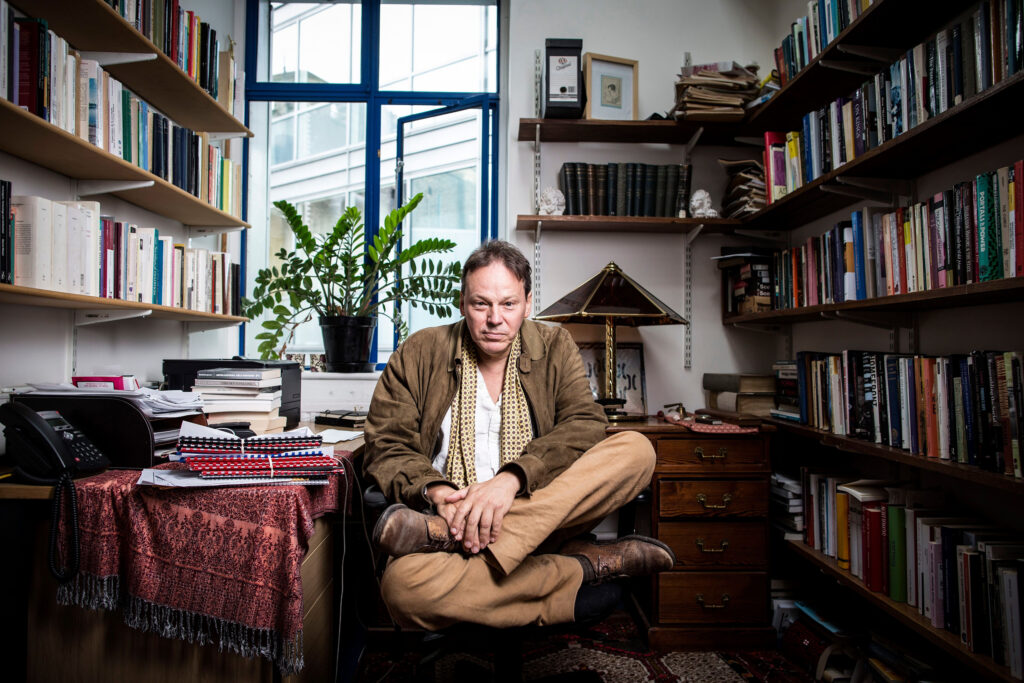
The anthropologist David Graeber, who died in 2020 at the age of 59, was a renowned scholar, bestselling author, and committed activist. His books ranged from a history of debt and humanity to a treatise on why much of the job market is composed of useless “bullshit jobs.” He was a central figure behind the 2011 Occupy Wall Street movement and Global Justice Movement, the co-founder of the Anti-Capitalist Convergences organizations, and his legacy continues through the David Graeber Institute. He was perhaps the most influential anthropologist and anarchist of the past two decades, whose work continues to shape how progressives across the world think about history, the world, and how to build a better future.
Across dozens of books, essays, and articles is one central idea, summarized in his best-known quote from the final pages of Direct Action: An Ethnography (2009): “The ultimate, hidden truth of the world is that it is something that we make, and could just as easily make differently.” In the same chapter, Graeber contrasts two conceptions of political reality. There is the right-wing vision that the world is shaped mainly by violent physical forces, and the left-wing view that imagination is the stronger source of power. Graeber’s work was in many ways an attempt to prove that the second view is correct.
Underlying this central idea about the ultimate truth of the world are two arguments that reappear across his work. The first is that human social forms, whether they be brutal dictatorship or fierce egalitarianism, begin as acts of play and imagination. Even kings and dictators originally started largely as temporary acts of theater. The second is a result of the first: that changing the world is mainly a matter of changing our beliefs.
In Graeber’s view, patriarchy, slavery, capitalism, and even the very idea of gods and kings are all make-believe games that we got “stuck” in. It was a grand vision of not just politics, but also the cosmos. He even speculated that the movement of electrons could simply be subatomic particles playing.
Graeber was a brilliant, provocative thinker who is remembered fondly with good reason. He also disliked blind obedience and would have wanted others to question and interrogate his ideas. This piece will do so. Unfortunately, his grand vision of the ultimate, hidden truth of the world—that imagination is the key shaper of the world—is largely wrong, how he thought we should approach political organizing is a dead end, and his work has a surprisingly dark view of humanity.
Was the First Throne Imaginary?
One of Graeber’s most revealing books is one of his least known. On Kings (2017), a collection of essays written with his mentor Marshall Sahlins, suggests that human imagination is the answer to some of the most important questions of history: why did kings arise, around 5,000 years ago, and why do they persist to this day?
In their telling, the origin of kings lies not in weapons or agriculture, but in a primordial part of human thinking. They claim that humans have always lived under “terrifying despots” who may seem imaginary to us today, but were real and threatening to our early ancestors. As they put it, “insofar as there is a primordial political state, it is authoritarianism.” Physical kings draw their power mainly from ancient imagination, not swords.
Hence, kings are not 5,000 years old, but as old as humanity. People have always had a belief in a dangerous, hierarchical cosmos, and the first kings took this idea of divine power and made it into earthly royal power. Graeber and Sahlins propose that “kings are imitations of gods rather than gods of kings.” What then happened was that people found a way to project heavenly power onto Earth, thus creating flesh-and-blood kings, and thrones made not of clouds, but of gold and steel. Graeber and Sahlins are unclear on how exactly this occurred but do note that it must have been contingent and included “many unexpected turns.”
To prove their point, they marshal a set of traditional societies including the Shilluk of South Sudan, the Natchez of the Lower Mississippi, the Cheq Wong of Malaysia, the Inuit of the Arctic, and communities within Madagascar. In his 2004 book Fragments of an Anarchist Anthropology, Graeber puts forward a similar case: that even the most peaceful, egalitarian groups are pacifists and anarchists in reaction to having a cosmos that is a battlefield of demons and tricksters. He draws on the Piaroa of South America, the Tiv of Nigeria, and the peoples of Highland Madagascar.
It’s an enthralling thought, but it simply isn’t supported by the evidence.
First, none of the examples they use are representative of the nomadic-egalitarian hunter-gatherers of our deep past. For the first roughly 300,000 years of human existence, people lived as nomadic-egalitarian hunter-gatherers. While no living group is a relic of our deep past, nomadic-egalitarian hunter-gatherers like the Hadza in Tanzania and the Khoisan in the Kalahari are the best analogues to how groups lived in the Paleolithic. Their movement, camps, tools, and food sharing are all similar to what we find in archaeological record during the Paleolithic. They live in Africa, the cradle of humanity, and many of these groups diverged genetically from the rest of humanity tens or hundreds of thousands of years ago, with no signs of major changes to their basic material way of life (well, until recently). Consistent, intensive agriculture and the first unambiguous signs of rulers and inequality don’t begin until over 10,000 years ago when the climate changed and the world entered a new, warm, stable period known as the Holocene. There is also copious evidence from human physiology and biological anthropology that humans are evolved from egalitarian groups.
The examples that Graeber and Sahlins use are radically different. The Shilluk, Natchez, Cheq Wong, Tiv, Piaroa, and the villagers of Madagascar are all farmers and most are also sedentary.
Second, their theory can’t explain when kings arise: there are no signs of permanent or even temporary kings for the first 99 percent of history. Homo sapiens has been around for 300,000 years, yet clear signs of inequality begin to emerge only after the world entered the Holocene. It then took another 5,000 years before the first king took his throne. And when they did, it was only in certain places that had access to similar resources (that is, grains like wheat, rice, and corn). If kings are an enduring feature of our cosmology, then they should have been taking over in random locations across the world for 300,000 years.
Third, the best, most rigorous studies point in the opposite direction. The most systematic attempt to find the origins of religion examined 33 different societies, using genetics and language to estimate how old different groups are on our ancestral tree, and coded their religious beliefs. It reached the opposite conclusion: humanity began as hunter-gatherers, with animism as the “most recent common ancestor” belief, while the belief in hierarchical gods was one of the last to evolve, thus “suggesting a deep history for the egalitarian nature of hunter-gatherer societies.” A belief in high gods also appeared to have no correlation with other religious beliefs. This suggests that rather than evolving from deeper religious roots, belief in high gods emerged from political institutions.
Another study using a database of dozens of archaeological cases came to a similar conclusion: big societies and big kings came before big gods. The first kings of the world were using stories of great chains of command between gods and lower beings to justify their own rule.
The best evidence suggests that Graeber was wrong. Kings are not an outgrowth of our ancient cosmic beliefs, but instead just early, successful warlords. The idea that they were divine figures is not a relic of archaic beliefs but a successful PR campaign. Yet it is easy to see why Graeber preferred his version: if kings are simply an outcome of imagination and free-floating human choice, then all it takes is a change in beliefs to oust them. It is an affirmation of Graeber’s “ultimate hidden truth.”
This false belief in the centrality of imagination and the authoritarian desires of humanity would become the centerpiece of his last and most influential book: The Dawn of Everything.
False Dawns
It was Graeber’s final book, co-authored with archaeologist David Wengrow and published after his tragic passing. It was also the most ambitious book of his career: an attempt to rewrite the story of the human past. They claim that humans have essentially always had inequality and hierarchy, and that “the state has no origin.” Instead, humans have, at least for the past 40,000 years, frequently been unequal and lived under rulers—but, according to Graeber and Wengrow, such hierarchies were always playful and temporary constructs. Our ancestors existed as flexible hunter-gatherers who could move fluidly from living as nomadic anarchists in one season to sedentary despots in another: there was “no single pattern.” That same flexibility and playfulness extended to how people fed themselves; the Davids suggest that the early adoption of agriculture was really just “‘play farming’ if you will, switching between modes of production, much as they switched their social structures back and forth.”
Our ancestors changed their social structures not primarily because of material circumstances, but instead because they were able to consciously choose their social forms. (Graeber and Wengrow are incredibly unclear about the role of material circumstances, but spend most of their time rejecting their influence in explaining history.) Our ancestors “moved back and forth fluidly between different social arrangements, assembling and dismantling hierarchies on a regular basis,” meaning that “the real question should be ‘how did we get stuck?’ … How did we lose that political self-consciousness, once so typical of our species?” In other words, the big question is how we got “stuck” with kings, bosses, and empires, and forgot that we were playing.
Graeber and Wengrow point to two major pieces of evidence to justify their new vision of human origins. The first is hunter-gatherers who change their social structures with the seasons. For instance, Native American groups of the Great Plains such as the Lakota and Cheyenne foraged in a dispersed anarcho-communist style during most of the year, but came together into a more authoritarian structure with a quasi-police force during the summer months when they undertook buffalo hunts.
The second piece of evidence is a collection of “grand burials” and buildings from Upper Paleolithic Europe (roughly 42,000 to 12,000 years ago). They include houses made from mammoth tusks, and richly decorated individuals buried with 10,000 ivory beads. These, alongside the seasonal hunter-gatherers, are presented as evidence that we have been consciously playing with being unequal and despotic for tens of thousands of years.
The Davids are unclear about how long our extreme social flexibility lasted. They suggest that our ancestors “spent most of the last 40,000 or so years” regularly changing their social structures, but there is little we can say about the three million years before that, since “evidence is extremely limited” (this is simply untrue: we have tens of thousands of artifacts, sites, and skeletons from this period). They claim that later, due to the sheer variety of different hominid species that existed in prehistory, and the range of environments they lived in, “the only thing we can reasonably infer about social organization among our earliest ancestors is that it’s likely to have been extraordinarily diverse.” The implication is that we have, since our dawn as a species, been playfully changing our social organization, including the temporary adoption of monarchs.
Grand theories require commensurate evidence. This is severely lacking. There are just a handful of documented cases of foragers changing their political arrangements dramatically between the seasons. At least one of those covered in Dawn—the Nambiquara—isn’t seasonally changing: Graeber and Wengrow were relying on outdated fieldwork. For the tens of thousands of years of Upper Paleolithic Europe there are only a few anomalous findings, and it’s unclear if even these indicate inequality. As Graeber and Wengrow themselves note, they often contain dwarfs and the disabled which could just be part of an unknown celebration. Later burials that do signal inequality tend to involve burials of healthy men (usually capable of combat at some stage in their life), often with weapons and sometimes signs of human sacrifice like a funeral retinue. These finds are also exceptional: outside of Europe there are no archaeological indications of inequality or hierarchy during this period.
Most importantly, seasonal societies don’t support the conscious freedom that Graeber and Wengrow ascribe to our ancestors. Seasonally changing groups are changing with the seasons. They are not changing at random times of the year. They are not sitting down in an assembly to democratically choose different social forms. They are habitually repeating the same customs and ways of living each year. There is no evidence that they are just playfully and creatively adopting new social structures at will. They were just as stuck as the Egyptians were with their pharaohs.
And why did humans get stuck with kings in only a handful of areas with grains after the world had warmed? Graeber and Wengrow are incapable of answering that fundamental question. They offer a very hazy hypothesis that agriculture and human sacrifice allowed for extraordinary care of dead kings in Egypt (giving them food and company in the afterlife), creating a fusion of care-and-violence which allowed kings to take root, but they refuse to generalize any further. As they observe, “perhaps this is what a state actually is: a combination of exceptional violence and the creation of a complex social machine, all ostensibly devoted to acts of care and devotion.” It’s unclear why this combination of care and violence took so long to create and why it proved to be so potent that we got stuck for thousands of years thereafter.
Like On Kings, Dawn cannot explain the brute, raw reality of the historical record: why and when states and kings arise, and why there are no clear signs of rulers and inequality for the first 300,000 years of human history.
The Davids present their book as a debunking of the old vision of humanity: that Homo sapiens lived for the first 300,000 years as nomadic-egalitarian hunter-gatherers before access to certain agricultural resources, like grains, allowed for the construction of kingdoms and empires that expanded across the world. The old vision can at least explain the basic pattern of why kings arose when and where they did. It doesn’t make imagination the driver of history as Graeber believed, but it is a better, simpler way of understanding history.
Ideas Before Evidence
Archaeologists and anthropologists have found an array of problems in The Dawn of Everything. There are numerous empty citations (those that are irrelevant or don’t provide evidence), the authors ignore reams of literature (including biological anthropology, evolutionary psychology, and the archaeological finds of 260,000 years during the Paleolithic), they don’t have any clear method, exaggerate key claims, overlook much of the existing evidence, and, most egregiously, misrepresent sources.
One example of this misrepresentation is their claim that the anthropologist Marcel Mauss calculated that just 40 percent of seasonal changes in the social arrangements of Inuit groups were due to physical circumstances. That number never occurs in the cited book and Mauss instead concluded the opposite: the Inuit are “governed by environmental circumstances.” Another misrepresentation: that settlers in North and South America who were captured by Indigenous societies “almost invariably” chose to return to their Indigenous captors. But the 1977 thesis they cite contains a very different finding: “Boys and girls captured below the age of puberty almost always became assimilated while persons taken prisoner above that age usually retained the desire to return to white civilization.” These are just two of a host of misrepresentations that have been neatly summarized in a clinically thorough YouTube series on the channel What Is Politics.
Such allegations have plagued other works of Graeber. Economists have similarly accused Graeber of misrepresenting cited sources in his book Debt (2011), and generally strawmanning much of the field (a claim I would have been skeptical of until reading The Dawn of Everything). In Bullshit Jobs he initially expected that 20 percent of people were stuck in meaningless and psychologically destructive jobs. He later said it was 30–50 percent based on two small surveys, and that the number was increasing. Later, a larger survey found the real number was closer to 5 percent (in the EU) and declining. It’s not a fatal error, and the thesis of Bullshit Jobs has genuine value, but two small-scale surveys and some Twitter-sourced interviews were never a robust foundation for a grand economic theory.
I believe a tweet from Graeber in 2017 can help explain this pattern of misrepresentation. He asked “does anyone know any handy rebuttals to the neoliberal/conservative numbers on social progress over the last 30 years?” He continued, “again & again i see these guys trundling out #s that absolute poverty, illiteracy, child malnutrition, child labor, have sharply declined…” Generally, one starts with the evidence and works toward a conclusion. Ironically, Graeber, like his theory of the world, seemed to start with the ideas and look for the evidence later. That makes for creating fun ideas but it is not a robust basis for understanding the world or for changing it.
Just Act Like You Are Already Free
In 2011, Graeber got the chance to use his understanding of history to change the future. This was due to his key role in Occupy Wall Street (OWS).
The movement was both an incredible success and a crushing failure. On September 17, a group of protesters occupied Zuccotti Park in Lower Manhattan to take a stand against the corruption of the global economic system, which they saw as manifest in Wall Street. In less than a month, it had spread to over 600 communities across the US, and globally to more 951 cities in 82 countries. Polls suggested that OWS also had majority support across the US public. Despite these promising beginnings, the encampment in Zuccotti Park was cleared within two months and the movement resulted in no policy changes.
Graeber was the most prominent intellectual involved in organizing OWS and had a genuine influence on its successes. He helped craft the motto of “we are the 99%,” which distilled so many frustrations into a single ingenious framing of the many against the few. He was also one of its most eloquent and public voices, penning numerous op-eds and essays, and eventually a book called The Democracy Project (2013).
Graeber was also partly responsible for the failures. He founded the Process Working Group, which shaped the organization of OWS and trained facilitators to do consensus decision-making. With others, he pushed for a flat, leaderless movement which would use consensus and direct democracy, refuse to make demands or engage with the state, and practice “prefigurative politics”—the idea that your movement should take the political form you eventually want society as a whole to take. Part of that is about building an alternative utopia which others can flock to. Graeber once pithily summed up direct action as “the defiant insistence on acting as if one is free already,” which is what OWS in many ways attempted to do.
OWS was split into two factions: those who wanted to make concrete political demands and those who wanted to stay silent. Graeber was a key voice for the “no demands” bloc. His rationale was that demanding anything from the government would mean recognizing its legitimacy. If the state is simply a bad play that people have become convinced of, then the best way to slay it is to ignore it, to remember that it is illegitimate and originally imaginary.
Many within OWS disagreed, and pushed for the group to have at least one clear political demand. One such proposal garnered the support of a two-thirds majority from those at the assembly, but the “consensus” threshold was a near unattainable 90 percent. It left the movement without a clear way of turning popular support into political wins. Susan Kang, a sociologist who studied and participated in OWS, lamented that because of the lack of demands, “OWS missed its chance to make a significant and immediate impact on policy debates and outcomes.” In contrast, previously successful movements such as suffragettes, unionists, and civil rights activists all had clear political demands.
OWS also ended up looking worryingly like the Simple Sabotage Field Manual, a 1944 guide from the OSS, the CIA’s predecessor. It advises saboteurs of organizations to “refer all matters to committees,” “make the committees as large as possible,” “never permit short-cuts,” “be worried about the propriety of any decision,” and “hold conferences when there is more critical work to be done.” The results could be absurd: in October 2011, the assembly of Occupy Atlanta had such a lengthy debate about whether to let the civil rights hero John Lewis speak that eventually he just left (the assembly eventually agreed to let him speak during “open business” but it was too late).
Perhaps the best summary of what happened with the movement comes from Micah White, a co-founder of OWS who co-authored the email that initially drew the protesters to Zuccotti Park. White later mused that the lack of demands was a “strategic error” that was “unavoidable” due to the popular “prefigurative anarchism” that Graeber championed. “They wanted to test that out,” said White. “And, congratulations, it did not work.”
OWS wasn’t just an attempt to “act as if one is already free.” It was in many ways a recreation of what Graeber imagined our ancient ancestors to have been like: collectively and creatively choosing new social forms. While both On Kings and Dawn were written several years after OWS, he expressed similar ideas about history in earlier books, like Fragments of an Anarchist Anthropology. His activism and history mirrored each other, perhaps because he’d already developed his ideas about history, or because his view of history was partly a reflection of his activism. Yet he never seemed to realize that his view of humanity underpinning OWS was a grim one.
A Dark History of Humanity
Graeber holds a strangely dark vision of humanity. It is a vision in which deep down all of us secretly dream of domination. Our primordial political nature is an authoritarian one, in which the cosmos itself is ordered into kings and subjects.
It is also a vision that requires us to think of humans as breathtakingly stupid. We get stuck because 5,000 years ago different groups for different reasons each gave too much power to rulers, leading to us to forget that we were playing make-believe tyrants. Different groups made that same silly mistake again and again across the Near East, China, and the Americas.
While he may have held a grim view of our deepest desires and collective memory, Graeber did seem to trust that we can and will choose freedom over kings. He was pessimistic about our psychology and history (at least the last 5,000 years of it), but optimistic about our agency and ability to regain lost, ancient freedoms. This is the liberating part of his ultimate truth: on any given day we can both imagine a better future and choose it.
It also explains why he saw materialism—that material circumstances can largely explain social structures—as so intolerable. In his view, materialism limits our ability to choose otherwise. In Dawn, Graeber and Wengrow admit that they fears the material view of history since it has “dire political implications.” They worry that a materialist explanation means that we need to return to being foragers to be free and equal. Given the impossibility of supporting eight billion people living as hunter-gatherers, “the best we can hope for is to adjust the size of the boot that will be forever stomping on our faces.”
This is a mistaken view of materialism. Very few materialists believe that choice is unimportant; rather, they believe that material circumstances—things like environment and technology—give some people more power than others.
A population that depends on tilled fields of wheat, with access to bronze axes and swords, doesn’t mean that people will just spontaneously and collectively adopt an empire. It means that if a cartel of men decides to use weapons to demand grain and worship then everyone else faces the choice to resist (and likely die), move (if possible), or accept subjugation. Most people in these circumstances will, over the long run, make similar choices, which is why grain and bronze weapons preceded the first kingdoms of China and Mesopotamia, while copper weapons were in use prior to the rise of the First Dynasty of Egypt. Similarly, the first macro-states (above 100,000 square km) across Eurasia didn’t occur until the introduction of bronze weapons. Every social change requires choice; it’s just that the conditions of the world decide whose choices matter more.
This view of materialism also shows how odd the central premise of The Dawn of Everything—and Graeber’s view of history more generally—is. Dawn implies that social change was the outcome of collective, even democratic, social choice. That is why the ability to “reorganize social relations” is one of the initial freedoms they believe that humanity as a whole had in the ancient past. This is not just a belief that choice is the central variable in historical change, but also a rather peculiar vision of choice where social structure is determined by everyone all at once, presumably through some kind of consensus process. It’s an unusual view since this isn’t what happens in any of their case studies. It’s unsurprising that when Graeber tried to enact it through OWS, it failed.
An Uncomfortable Ultimate Truth
Graeber was always interesting, occasionally right, and rarely rigorous. His work was not mainly an academic investigation into how society works—it was a political project to convince people that play and creativity, rather than violence, should be, and once were, the organizing principle behind human society.
This led him to prioritize rhetoric and politics over good scholarship. It also led to strategic mistakes with enormous consequences, as with OWS. And, most strangely, it led to a worldview which may be even darker than that of Thomas Hobbes.
Graeber’s ultimate, hidden truth of the world is a half-truth. We can remake the world, but it won’t happen easily just by imagining something better and everyone spontaneously adopting it. Shifting the world will not only require new visions of society, but also a tactical acknowledgment of power and technology. The more uncomfortable ultimate truth of the world is that guns and money matter more than Graeber, and many of us, wished.