Beyond Lost and Found
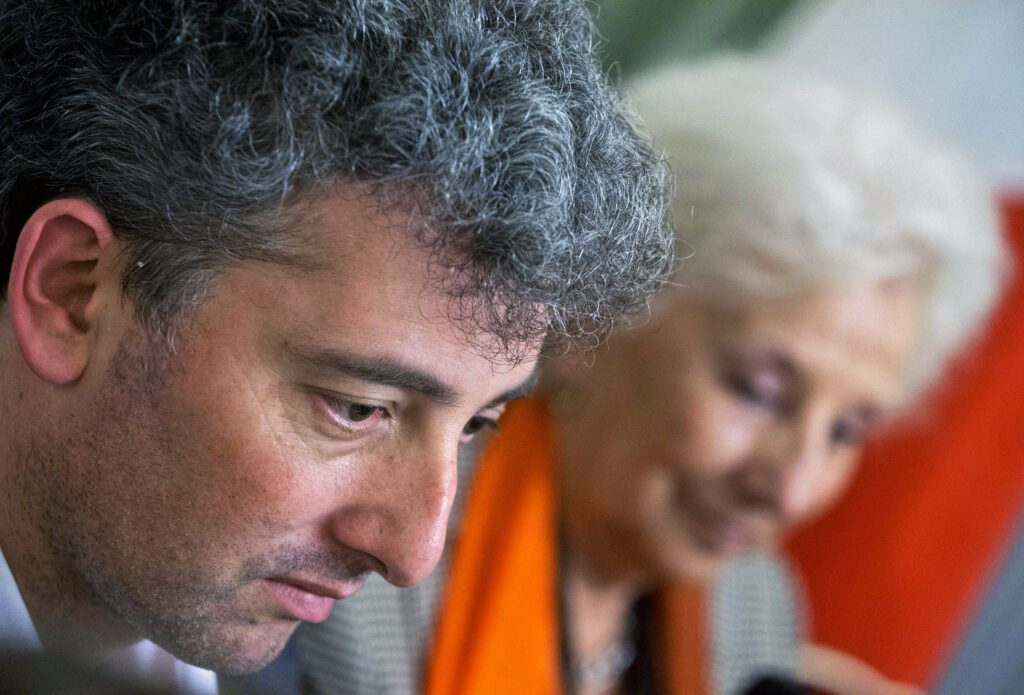
The news broke on August 5, 2014, and it shook all of Argentina: After a thirty-six-year search, Estela de Carlotto, the president of Abuelas de Plaza de Mayo (the Grandmothers of the Plaza de Mayo), had found her grandson—the son of her daughter Laura, who was detained during the ferocious dictatorship that ruled the country and disappeared some 30,000 people between 1976 and 1983. By then Estela had become the most visible face of this group of women looking for some 400 babies born in captivity and illegally handed over to other families, which then raised them as their own children.
Two days later, grandmother and grandson gave a press conference. The entire country—stunned and joyful, witnessing a historic moment and hoping for a luminous ending after so many years of searching—was about to see this man’s face and hear his voice for the first time. Then thirty-six, with tight unruly curls, he introduced himself: “Good afternoon. I’m ‘Ignacio’—or ‘Guido,’ because she’s very set on that.”
“Guido” had spent his life so far thinking that he was “Ignacio”—and Ignacio “Hurban,” bearing the surname of the people he had believed until then were his parents. He was living in Olavarría, about 350 kilometers from Buenos Aires, and working as a musician. But on his birthday, a few weeks before his public appearance with Estela, his girlfriend Celeste had relayed a local rumor to him: “You’re adopted.” When he confronted his parents, they confirmed it. Ignacio decided to take a DNA test.
Many years earlier, his mother, Laura Carlotto, had been active in the Peronist University Youth and the Montoneros, an armed leftist revolutionary group. She was nearly three months pregnant when she was kidnapped from a café in Buenos Aires on November 26, 1977. Laura was held for months at La Cacha, a clandestine detention center on the outskirts of La Plata, in Buenos Aires Province. She was killed on August 25, 1978, at 23, in what the authorities called an “armed confrontation,” a euphemism they commonly used to cover up their own killings. (It is not clear what happened to Ignacio’s father, Walmir Oscar “Puño” Montoya, also a Montoneros militant. It seems likely that he was kidnapped alongside Laura and killed shortly afterward. Remains recovered in a La Plata cemetery were identified as his in 2009.)
People who saw Laura in captivity say she had left instructions that if her baby was a boy, he should be called “Guido.” Laura’s mother Estela—who lived just 15 kilometers or so from La Cacha—held on to the name throughout her decades-long search.
That afternoon at the press conference, the first flicker of discomfort implied in the sentence “I’m ‘Ignacio’—or ‘Guido,’ because she’s very set on that” went unnoticed. It wasn’t the right moment to look for cracks in the tale. This seemed like a storybook ending, with the promise of closure and reparation. And yet something else was already taking shape between grandson and grandmother, and beyond.
Number 114
By then, the Abuelas had identified and found 113 of the babies who were stolen. Ignacio was number 114. But he also represented more than that.
When news broke of Estela and Ignacio’s meeting, Néstor Kirchner and then his wife, Cristina Fernández de Kirchner, had governed for more than a decade, and as leaders of the Peronist political movement, they had made human rights a policy of the state to an extent that no government since the return of democracy had accorded those before.
In 1984, the year after the dictatorship ended, the Nunca Más (Never Again) report documented thousands of cases of enforced disappearances and a systematic plan to repress and eliminate political opponents. In 1985, a landmark trial convicted the junta’s top officials. Even so, for much of the first two decades of democracy, the “two-demons theory” prevailed. It presented the political violence of the 1970s as a confrontation between two equivalent forces operating under similar conditions. And by treating the violence of left-wing armed groups as a crime equivalent to the state’s systematic use of enforced disappearances and extrajudicial killings, it obscured a fundamental distinction in responsibility: The armed organizations committed acts of political violence whereas the state used its repressive apparatus to systematically violate citizens’ rights.
The prosecutions soon encountered fierce resistance from the military, raising fears of another coup. Seeking to contain that threat, the government passed the so-called impunity laws. The Final Point Law of 1986 imposed a deadline on prosecutions for dictatorship-era crimes, while the Due Obedience Law of 1987 shielded most lower-ranking military and security personnel from prosecution on the grounds that they had acted under orders. It put an end to more than 300 criminal proceedings then under way across the country, and it ushered in a series of setbacks in the struggle for memory, truth, and justice.
Those measures were intended to safeguard the fragile democratic order by limiting the risks of a confrontation with the military. But far from ending the debate, they only strengthened the determination of human rights activists, among them the Abuelas. For more than a decade after that, those groups pursued, largely alone—with no state support and little public backing—the monumental task of searching for the children who were taken during the dictatorship, reconstructing their histories, and developing scientific, legal, and social tools that could help restore their identities. Even under President Carlos Menem, though also a Peronist, a policy of accommodation dominated, largely from fear that if the military felt threatened, it might challenge the democratic order.
Néstor Kirchner’s government pushed Congress to annul the impunity laws in 2003, which allowed the trials of people suspected of committing the dictatorship’s crimes to resume. Former clandestine detention and torture centers were turned into memorial sites. Human rights organizations were publicly honored, and the Abuelas—who for years had been dismissed as crazy old women—came to be recognized as central figures in the development of Argentina’s democracy. As Mariana Eva Pérez, herself the daughter of disappeared parents, described in her 2012 book Diario de una princesa montonera (Diary of a Montonera Princess), the cause had now become fashionable.
A few weeks after Estela was united with her grandson in 2014, I was hired by two veteran journalists—María Seoane and Roberto Caballero—to conduct field research and interviews for a nonfiction book about her struggle to find him. That’s how I first met Ignacio—or Guido, as I called him then, following Estela’s instructions—over an intimate lunch at Seoane’s house, far from the media spotlight, in late September 2014.
At the time, he was traveling with his grandmother to different parts of the world, where they met with presidents and other major public figures, including Pope Francis, who, as an Argentine, knew this story well. It seemed as though a path had been laid out for Ignacio. He would take on a central role, alongside his grandmother, in the fight to restore the identities of children stolen by the dictatorship. He was approached with invitations to consider a political career.
For a time he gave interviews on the country’s major television channels and talked about his story, all the while avoiding some topics, like his adoptive parents. He tried to focus on his music (rooted in jazz, drawing on folk) rather than his role as Estela’s grandson or as a human rights activist. He tended to use very general phrases, such as “Hopefully we will find the grandchildren who are still missing” and “I hope the wounds will heal.”
Within two years he stopped attending public events, paused his dealings with the press, withdrew to his hometown, and returned exclusively to his career.
In August 2025, a few months before the fiftieth anniversary of the start of the dictatorship, a landmark date in Argentina, I decided to reach out to him again. Over the previous decade, we had occasionally exchanged messages on social media, exchanging good wishes for a birthday or the New Year. I knew he didn’t want to speak to the press, and I had no professional reason to reach out. Media attention had faded, even as the Abuelas identified 26 more grandchildren, bringing the total to 140 by July 2025. I sent him a rambling voice message, almost thinking out loud: “I’m reading a book right now that got me thinking about how we look at an event over time, and how we come to reflect on the same story differently after years have passed.”
I wasn’t sure he’d agree to talk to me again. But some time later, he turned on the camera on his computer. On the other end appeared a man with the same tight, unruly curls I remembered, now completely white. We caught up: new kids, new houses, new books and records. Soon the conversation turned to his grandmother. He was talkative. When we talked about El nieto, the book about his story that I had researched, published in 2015, he told me he thought that Estela “was more interested in the grandson she had imagined than in understanding who I actually was.” He saw this as the beginning of a series of misunderstandings and conflicts between them.
The call ended, the conversation unresolved. We talked again. And then again. Almost without meaning to, our conversations became a regular thing over the following six months. Little by little, the public figure he had become receded and what came into view was a man struggling to make sense, so many years after the facts, of what had happened to him.
What’s in a Name
“When I appeared in the public eye, everyone started calling me ‘Guido.’ The pressure from my grandmother and the social pressure were enormous, but nobody asked me if I was comfortable with that, if I identified with that name,” he told me in one of our first conversations during that period. And he reconstructed the morning he made a decision that would change everything.
It was in November or December of 2014, just a few months after his life had turned upside down. He was still overwhelmed, trying to form his first bonds with his biological family, when one morning, as soon as he got up, he walked into the kitchen. His girlfriend, Celeste, was making coffee, and he told her: “I’m Ignacio, that’s it. I’m not Guido, I’m Ignacio.”
“I remember it perfectly. It just came out, like something that had been burning a hole in my head finally came down. I said it and it was a relief. I put down a weight I’d been carrying. The thing is, my grandmother never accepted this. My grandmother and a lot of other people.”
In September 2019, in an article published in Gatopardo magazine, he said: “Initially, I accepted being called Guido because I thought it would help. But I was doing the others a favor; I wanted to please everyone. It was a mistake. And I realized that the symbolic weight of the name ‘Guido’ was overshadowing ‘Ignacio.’” Soon after he first learned the truth, he recalled: “I opened a Word document on my tablet and wrote ‘Ignacio Montoya Carlotto.’ And I never deleted it.” The law required him to take his biological family’s surname. He might have challenged the requirement or continued going by “Hurban” informally, but he did not. As he later explained to me, he was comfortable using “Montoya Carlotto” as his surname. It was his first name, and the personal history it represented, that he was unwilling to surrender.
From then on, he said, he began receiving reproaches, even threats. “One of them sent me a letter that said: ‘How can you not go by ‘Guido’? You’re a son of a bitch, you’re dishonoring our struggle. I wasn’t held prisoner for that long so that you could come along now and deny it.’”
The story Argentina was telling then about the dictatorship was almost always being told from the perspective of people who searched for the missing or from the perspective of those who, upon learning the truth about their origins, found a new sense of belonging. One of the most emblematic cases was that of Victoria Montenegro, raised by a military officer who had participated in the kidnapping and disappearance of her parents. Like other children taken by dictatorship forces, Montenegro grew up in a military environment shaped by pro-Nazi ideology. After a judicial investigation required her to submit to a DNA test, she learned the truth about her origins. It took her many years to connect with her biological family. Over time, she became a committed human rights activist, went on to serve as a legislator, and has consistently upheld the legacy of her parents and their struggle. She also wrote a book about her story.
Her experience, like Estela’s, illustrates the decades-long effort to develop the tools that made it possible to find the missing. After years of organizing, research, and collective work, Argentina had built an extraordinary system to identify the children of the disappeared and establish their identities. The Abuelas, together with Argentine and international scientists, helped develop what is known as the “índice de abuelidad,” the grand-paternity index, a method that establishes kinship between grandparents and grandchildren with 99.99 percent certainty, even when the parents—in these cases, the disappeared—cannot be tested. The National Bank of Genetic Data was created in 1987 to preserve DNA samples of families searching for lost children. It is thanks to its database that Ignacio was eventually found.
What if, though, the story began not with a grandmother searching for her grandson but with a thirty-six-year-old man who is told one morning that the people who raised him are not his biological parents and that the real ones were tortured and forcibly disappeared? A man who, shocked at hearing that he might have been adopted, decides to take a DNA test and discovers—within the span of weeks—that he is the biological grandson of one of the most famous and beloved people in the country. A man whose story, without his knowledge, has been a national symbol since 1983. Restitution is supposed to return a stolen identity. Yet to the person on the receiving end, it can also feel like the destruction of an identity that had seemed settled.
Ignacio once described the feeling to me:
“It took me a long time to be able to put a name to it: for me it was an accident, a particular kind of accident, one that made a whole world happy. I used to explain it like this: You’re driving down the highway, you crash, the car is totaled, wrecked completely, but you don’t die; nothing happens to you. The difference is that nobody’s going to tell you: ‘Oh, how nice, I was there. I saw it on TV when you crashed. We were so happy when you slammed into that guardrail.’ Nobody would say that. With this, everyone thinks this is some super happy thing. But it has to do with the fact that the story gets told from the side of the people searching, and the person who gets found has to adjust—there’s no other option left for him.”
Any gesture, any statement, of his that strayed from what others expected of him could be read as disloyalty—to the cause and to his biological grandmother.
“They tell you: You recovered your identity. That’s a problem, because it comes layered with mistaken assumptions. If you think you got your identity back, that means you didn’t have one to begin with. But I had already lived thirty-six years. I can’t turn into a blank slate. If anything, I feel like I lost more than I got back. And if anyone got something back, it was, if anything, the people who were looking for me. Which, of course, I understand, and I probably would have done the same. But nobody ever asked me what all of that did to me. And it turned everything upside down for me. I stopped being Ignacio, I stopped being Hurban, I stopped being a pianist, to become Estela’s grandson, to become a bunch of other things that took me years to take apart. And in some cases, I still can’t.”
Abductors, Caregivers, and “Folks”
When I started reporting on Ignacio’s story in 2014, there was one subject that was difficult to broach: what place Clemente and Juana Rodríguez Hurban—the two people who had raised him and who, until recently, he had believed were his real parents—occupied in his life. Both he and the journalists I was working for forbade me from approaching them. Legal proceedings were opened soon after Ignacio’s DNA test results came back. The Hurbans were charged with falsifying an official document (“falsedad ideológica en documento público”) and with suppressing a minor’s identity. To both the court and Estela—a plaintiff in the case—they were “apropiadores” (appropriators). But Ignacio didn’t want any statement to potentially incriminate the Hurbans; he wanted to keep them as anonymous as possible and shield them from any harassment or public shaming.
Back in the late 1970s, Clemente and Juana were illiterate rural laborers who had spent decades tending a farm. They worked for a powerful and wealthy man with ties to the military. They couldn’t have children of their own, and their employer provided them a baby. According to the judicial investigation, Ignacio likely was handed over on June 26 or 27, 1978, when he was just a few hours old or, at most, one day old. He was registered as “Ignacio Hurban” on June 28, though his birth date was registered as June 2.
During the court proceedings nearly four decades later—held only via written submissions—the Hurbans said their boss had assured them back then that the biological family couldn’t take care of the child. He had handled the paperwork to legalize the situation, registering the boy as their son on a falsified birth certificate. He gave them one instruction: Never tell anyone. They swore not to. (The employer died before Ignacio was identified. The doctor who had signed the paperwork was also charged.)
To Ignacio, Clemente and Juana are his “viejos”—his folks: that’s what he calls them every time he brings them up. In those early years after the truth erupted, in 2014 and 2015, Ignacio lived a kind of double life. In Olavarría, he kept up a close, everyday relationship with Clemente and Juana. Whenever anyone from the Carlotto family came to visit him in his hometown—he built relations with some of those relatives—he asked his viejos to stay away. They went along. “I felt like I had a mistress,” he told me. “I had to hide some people to go see the others.”For his birthdays, he threw two parties; for the end-of-year holidays, two celebrations. He learned to keep those two worlds separate and to move between them without letting them touch. But inside him, that separation was becoming harder and harder to sustain, he said.
Then came the birth of his daughter, Lola. For her first birthday, in June 2017, Ignacio invited everyone. Almost three years had passed since he met Estela, and perhaps enough time had gone by, perhaps tensions had eased enough, for his two worlds to share the same space for a few hours.
According to Ignacio, this was the only time Juana, Clemente, and Estela were ever together. The entire Carlotto clan—nearly thirty people, including uncles, their partners, cousins, and the cousins’ children—gathered on one side of the room, while Juana and Clemente stood on the other, there as Lola’s grandparents. At one point, they approached Estela to greet her. She returned their greeting but kept her distance, physically and conversationally. The rest of the Carlotto family also kept away.
In December 2017, the charges against Clemente and Juana were expanded to include the concealment of a child under 10. To my knowledge, no journalist has interviewed Clemente and Juana to this day. No photos of them have appeared in the media. The criminal case against them remains open, but there is little appetite for pursuing it.
What’s Left Out
In August 2025, when I spoke with Ignacio again, he tried to describe what had happened between him and his grandmother since our last conversation in 2014. For some years after they met, Estela spoke publicly about Ignacio and the relationship they were building. She did not hide the difficulties. In a 2019 interview, she said they were very close at first, but that over time he grew more distant. She said she had wanted more contact and that even if his decision to go by “Ignacio” had hurt her, she had chosen to respect it. Two years later, she described their relationship in warmer terms.
Today Estela is 96, and she no longer speaks to the media. Her children carefully manage her public appearances, seeking to protect her as her health declines. When I tried to reach her for this article, through one of Ignacio’s cousins, I was told she would not speak to me. As Ignacio told me anecdotes about his relationship with Estela, he described a bond that has always been uneasy, weighed down by expectations that neither of them seemed able to meet. He let slip an idea I have found hard to shake: “There’s such a powerful narrative around everything that happened to me, so set in stone, that the slightest deviation from it generates a worrying level of violence, even to this day.”
Perhaps one way to understand that violence is to go back to the moment when Ignacio’s story ceased to be just the tale of one person and became part of a broader political dispute.
In 2015, a year after Ignacio and Estela were united, Mauricio Macri, a conservative right-wing politician tied to economic elites, was elected president. His government was the first to revisit the policies that had been built around memory and human rights during the twelve years of Kirchner governments. But Macri’s positions only made his opponents more reluctant to acknowledge their own contradictions.
Eight years later, in 2023, Javier Milei came to power with an openly far-right discourse, and immediately he did more than publicly question policies of memory. He started dismantling them. Programs tied to those policies were defunded, among them the National Bank of Genetic Data. Vice President Victoria Villarruel challenged the prevailing account about the dictatorship. She has said that the 30,000 disappeared are “mythology.” That on March 24, the anniversary of the military coup in 1976—and Argentina’s Day of Remembrance for Truth and Justice—“only one part of history is remembered.” That “in a war, it is legal to kill the enemy.” And that after the coup, “the population began to be more protected.” And she has spoken up for military officers convicted of crimes against humanity, some of whom are still in prison. Nearly fifty years after the coup, for generations with no personal memory of the dictatorship, an economic crisis and disillusionment with the political establishment feel more immediate than the crimes of the past.
Over decades, the Memory, Truth, and Justice movement had become a fundamental part of Argentina’s democratic identity. But all established narratives have weak spots. Might this one, if it is to survive as a living memory, better resist the revisionist onslaught by making room for its own contradictions and discomforts?
A Final Scene
Ignacio and Estela went through periods without speaking to each other. At several moments he thought they had reached a point of no return. He could have found better job opportunities and a richer cultural life in Buenos Aires or La Plata, where she lives. But he decided to stay in Olavarría, a region dominated by agriculture and the cement industry. Distance became a way to maintain his relationship with Estela.
His relationship with Clemente and Juana changed too. Ignacio hasn’t let them off the hook for their share of responsibility—for hiding his origins from him and lying throughout their entire life together. But he helps them out and sees them fairly often.
Ignacio has been visiting Estela regularly. She recently turned 96, and chances to see her feel increasingly precious to him. He drives four hours from his house to hers just to share a meal and talk alone with her, and then he drives four hours back home. “She’s at her best in that kind of closeness. We’re like friends,” he told me in December 2025.
One of the last times he was with her, Estela asked him: “And how are your viejos doing?” She had never used that word before. Ignacio told her Clemente had gone deaf and Juana had Alzheimer’s. “It’s a circus,” he said. Estela laughed. “Old age is shit,” she said. She went quiet for a moment. “What luck that they raised you with so much love.”