Hammer and Ballot
In March 1977, three communist leaders gathered in Madrid to insist on a simple yet profound proposition: Communism is not in contradiction with democracy. Enrico Berlinguer, Santiago Carrillo, and Georges Marchais led the communist parties of Italy, Spain, and France, between them commanding the loyalty of tens of millions of European voters. At Madrid, they formulated what they called the New Way, a communism committed to democracy. They demanded the full application of the Helsinki Accords of 1975, signed by the USSR, the US, Canada, and nearly all European countries, which included strong human rights provisions. Berlinguer made clear that while Italian communists respected the USSR’s “great conquests in social domain,” they also recognized its “authoritarian traits.”
They met at an auspicious moment: shortly after the fall of right-wing dictatorships in Spain and Portugal, just as the Iberian Peninsula was finding its way to democracy. This made the conference urgent since Spain’s judiciary was deciding whether to legalize the Communist Party of Spain (it eventually did, and the party emerged as a major force in democratic Spain). But the three communists had long shown a penchant for democracy. Already in November 1975, Berlinguer and Marchais had made a joint declaration that committed them to freedom of speech, a multi-party system, and the principle of “alternation” (voluntarily giving up power upon losing an election). By 1977, these democratic communists had found a ready epithet to describe their politics: Eurocommunism.
The term Eurocommunism, however, was a misnomer since the New Way (also called neocommunism at the time) had proponents around the world. The Japanese Communist Party had long supported a similar position, and the communist parties of Australia, Britain, Mexico, Chile, Venezuela, and Israel would also come to adopt similar orientations. I prefer to call this movement Democratic Communism.
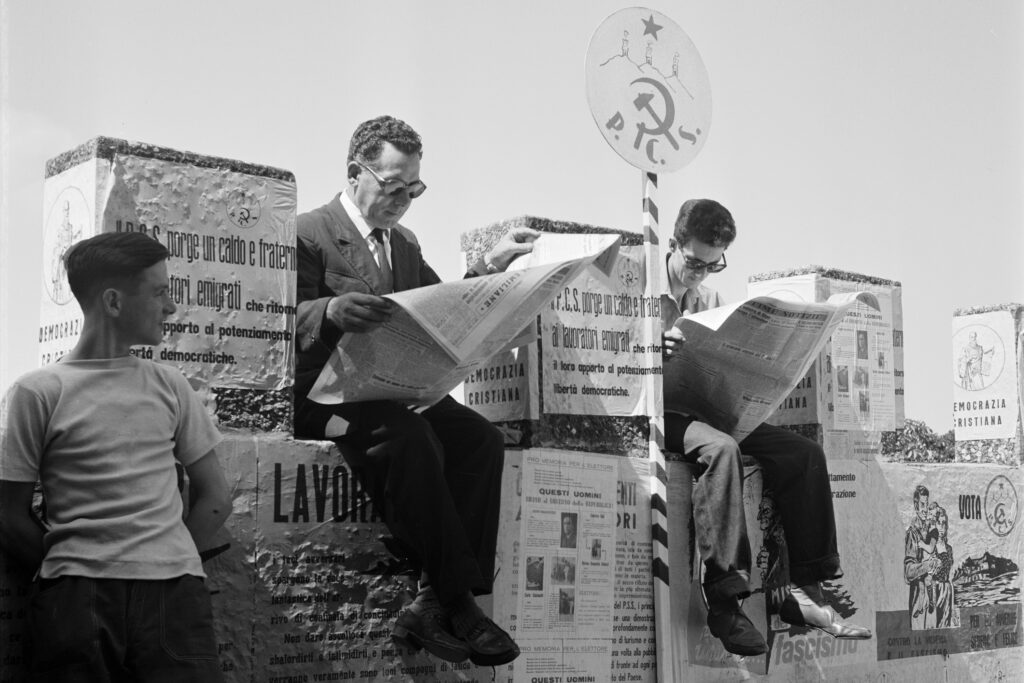
The most prominent democratic communists belonged to the Italian Communist Party (PCI), the largest in Europe. It was the second-biggest party in every Italian parliament from 1946 until the party’s dissolution in 1991. At its eighth congress, held in 1956, it declared its ideology “the Italian road to socialism” (Via italiana al socialismo), and swore fealty to the Constitution of the Italian Republic—a document the party had helped write, and which called for a robust multi-party system.1 The “Italian road” implicitly rejected the Soviet road. Similarly, the Communist Party of Great Britain had adopted The British Road to Socialism in 1951, replacing its earlier program, For Soviet Britain. The Italians were not copying the British but heeding the call of their own party’s theoretician Antonio Gramsci, who died in a fascist prison in 1937. Gramsci taught that socialists did not need to rely on a sudden revolutionary rupture and could instead patiently build their influence via democratic methods. Rather than smash the state, they ought to run the state.
Leader of the party since 1972, Berlinguer had led it to historic heights. In 1973, he penned three articles in the communist organ Rinascita (Rebirth) that grappled with the challenges facing Democratic Communism. He proposed a “democratic alliance” with Italy’s leading centrist party, Christian Democracy (CD). Berlinguer was reacting to major events of the day: the oil crisis and the recession, which together conjured fears of a return to the 1930s. Italy’s young democracy struck him as alarmingly fragile. The right-wing coup in Chile that year, which overthrew the elected Marxist president Salvador Allende, worried him further. Berlinguer concluded that Marxists had to tread cautiously so as to preserve Italy’s democracy. The broad collaboration called for by Berlinguer became known as Compromesso Storico or the Historic Compromise. It was not a compromise on values—he remained committed to communists’ foundational goal of building a classless society—but on methods. Democracy, he argued, was their greatest hope for achieving such a society. On principled questions, the PCI still opposed the CD. In 1974, for instance, Communists allied with other progressives (and against the CD) to secure a victory for a No vote in a referendum on the repeal of Italy’s progressive divorce laws (which Communists had helped pass in 1970).
The party’s new, democratic orientation further increased its popularity. In the regional elections in 1975, the PCI got 33.4 percent of the vote, less than two percent short of the CD. They secured 247 seats and won regional control in three of Italy’s 20 regions: Liguria, Emilia-Romagna, and Umbria. A red belt now ran from San Remo on the Ligurian Sea all the way to Perugia in central Italy. In the general election in 1976, the party increased its vote even further, winning 34.4 percent.
This popularity was burnished by successful governance. Bologna, in northern Italy, had elected a Communist mayor from 1946 to 1991. The city gained international acclaim for its excellent hospitals and public transport. In 1974, Newsweek called it “by far the best governed state in Europe.”2 In 1972, The New York Times gushed: “Red Bologna [which] has better schools, a more equitable municipal tax system, much less real estate speculation, more parks and cleaner streets than any other center in Italy.”3
The party’s massive success brought it many enemies. Berlinguer sought to work with European social democrats, but they often wanted nothing to do with him. The leader of Italian socialists, Bettino Craxi, repeatedly blocked his request for the PCI to join the Party of European Socialists; he also resisted fuller collaboration between the socialists and communists domestically. In 1976, the social democratic chancellor of West Germany, Helmut Schmidt, made it clear at the second G7 summit in Puerto Rico that Western countries would only extend economic aid to Italy if Communists were excluded from the cabinet. Henry Kissinger, the US Secretary of State, needed no convincing. He supported US covert aid to anti-communist parties in Italy and made clear that Italian communists should never be trusted since “their democratic professions are only skin deep.”4 Kissinger predicted that the PCI would still back the USSR on core matters, but he was proven wrong in 1981 when Berlinguer openly opposed the Soviet-backed imposition of martial law in Poland against the trade union Solidarity.5
If Berlinguer was the best practitioner of Democratic Communism, Carrillo was its best theoretician, crafting its most systematic expression. His decades-long struggle against Franco’s fascist dictatorship schooled him in the importance of liberal democracy. The postwar world made plain that the modern democratic state looked nothing like the caricatures dreamed up by Marx and Engels in the Communist Manifesto (1848) or by Lenin in State and Revolution (1917). These communist elders had encountered much smaller and more autocratic states, which lacked universal suffrage. To account for modern developments, Carrillo published “Eurocomunismo” y Estado in 1977. (He placed Eurocommunism in quotation marks because, even though the term was becoming popular, he didn’t approve of its Eurocentrism.)
Ironically, the book was attacked by both Moscow’s English-language mouthpiece New Times6 and the Trotskyite British journal International Socialism.7 Neither the Soviet state nor its radical opponents could countenance Carrillo’s attempt to “elaborate a solid conception of the possibility of democratizing the apparatus of the capitalist state, transforming it into a valid tool for constructing a socialist society.” He went on to criticize the “actually-existing socialism” of the Eastern Bloc and even said that Stalinism possessed some characteristics “similar to those of a fascist dictatorship.”
Carrillo was making a major intervention in Marxist theory. Marxists traditionally believed that the capitalist state was tied to the capitalist class, and the communists needed to completely smash it before building a new system. But militant opposition had already been rendered obsolete (or at the very least hollow) by decades of communist participation in multi-party democracies. Carrillo’s contribution was to articulate the intellectual justification for that collaboration, basing it firmly on Marxist theory.
For Carrillo, communists didn’t need to immediately expropriate all capitalists if they came to power peacefully. They could pragmatically support “the coexistence of public and private forms of property for a long period,” and even utilize multinationals “to facilitate the development of those sectors that are in the national interest.” Crucially, Carrillo made clear that he didn’t want a communist-led Spain to be a geopolitical thorn in the side of the US and NATO (of which Spain was not yet a member). He stressed that the party didn’t seek to destabilize “the present world equilibrium of forces, of passing from American influence to Soviet influence.”
The theory and practice of Democratic Communism are largely lost in canonical narratives. Communism is today siloed in monochromatic accounts, mostly written by its many adversaries, both on the left and the right. The best-known communists of the twentieth century—Lenin, Mao, Stalin, Tito, and Castro—all established or ran authoritarian Communist states. In the 1970s, about a third of humanity lived under the red flag. This mode of governance had wildly different variations: from the genocidal rule of Stalin in the 1930s—easily among the darkest pages of humanity’s entire history—to the less terrible forms of authoritarian socialism, as practiced in the Soviet Union after the 1950s or in the “Tropical Stalinism” of Cuba. But the commonalities of this model are clear: public ownership of the means of production, a planned economy, and an authoritarian, one-party state. Marx had once opined that socialism was nothing but an extension of democracy into the economy. But under authoritarian socialism, progressive social reform went hand in hand with the snuffing out of any democracy. The USSR-style system didn’t allow for any independent political action.
Communism is thus largely remembered as undemocratic. But this ignores the experience of communist parties that helped to bolster democracies in countries such as Italy. It is true that democratic communists did not consistently support democracy everywhere. Even when they had substantive disagreements with the USSR, they often championed it, recognizing the country to be “actually-existing socialism” rather than the capitalist alternative promoted by the US. This explains why these communists were, and still are, often dismissed as “Stalinists,” even though the USSR itself denounced Stalin as a criminal in 1956 and most communist parties around the world followed suit. For pro-capitalist Cold Warriors of the time, the communists in democratic countries, even when they consistently advocated for civil freedoms and the democratic integrity of their states, were either hypocrites (since they supported authoritarianism in Moscow) or wolves in sheep’s clothing who would turn their countries into carbon copies of the Eastern Bloc if they actually came to power. But this view misses much about the reality of democratic communists.
First of all, their defense of Soviet socialism wasn’t usually a defense of its authoritarian features. They often supported the USSR despite its authoritarianism, not because of it. Communists saw the USSR as a particular historical product, which had allied itself with capitalist powers during the Second World War to defeat the scourge of Nazism, thereby gaining a significant world-historical credibility. And it was certainly the case that the only “actually-existing socialism” won fealty even from some democratic socialists. Since the nineteenth century, socialists had dreamed of replacing capitalism with a democratic socialist alternative, but the only durable form of socialist economy that existed in the post-1945 period was the authoritarian version offered by Moscow and allies. It was extremely tempting to criticize it without giving up on it entirely.
This was a dilemma not just for communists in democratic countries but for their bitter rivals on the left, the democratic socialists organized through the Socialist International. The democratic socialists won office in countries around the world but, even when they were in power for decades (as in Sweden), they never quite got around to abolishing capitalism.8 Many members of the Socialist International were disappointed with the USSR and other countries of the Eastern Bloc: They opposed their authoritarianism but, sometimes begrudgingly, appreciated the achievements of their economies. Non-communists like India’s first prime minister, Jawaharlal Nehru,9 and Socialist Zionists of Israel’s United Workers Party (Mapam) praised Soviet achievements, too.10
Left only with an authoritarian socialist model, many communists agitated for democratizing what they had. Among them were communists inside the Eastern Bloc who looked for inspiration beyond the Iron Curtain from their fellow communist parties in the democratic world. Internal democratic opposition led to several major revolts, the most notable in Hungary in 1956 and in Czechoslovakia in 1968. Both were brutally put down by the Soviets, and both were portrayed by pro-Moscow and pro-Washington Cold Warriors as anti-communist uprisings. This view continues to serve as the bedrock of contemporary narratives, but it ignores the fact that the leaders of the revolts were ardent and lifelong communists who openly advocated for a democratization of communism—not a return to capitalism. If democratic communists have a pantheon, it reserves a special place for Imre Nagy, the communist leader of Hungary who was overthrown by the Soviet invasion in 1956 and subsequently executed,11 as well as for Alexander Dubček, the communist leader of Czechoslovakia who was sidelined by the Soviet occupation in 1968 before being removed from his position.12
The Soviet Union’s aggression in 1956 and 1968 shook the global communist movement to the core and prompted thousands to abandon communist parties. But it’s also the case that many others remained in the movement and continued to advocate for the ideals to which Nagy and Dubček dedicated their lives. The 1956 invasion was opposed by many of the movement’s best-known intellectuals, such as the British Marxist historian Eric Hobsbawm,13 and the 1968 intervention was opposed by the communist parties of Australia, Belgium, Britain, Finland, France, Iceland, Israel, Italy, and Spain.14 Clearly many communists around the world had democratic commitments.
For the Japanese, these commitments ran deep. After Japan’s occupation by the Allies in 1945, the Japanese Communist Party (JCP) unequivocally celebrated the new liberal democratic system. In the early 1950s, some of the party’s supporters, influenced by the rise of communist China, toyed with insurrection but they were sidelined. In 1955, the party’s sixth congress clarified its commitment to peaceful and parliamentary activity.15 Under leader Kenji Miyamoto, who was elected in 1958, the JCP declared firm opposition to the one-party models of both the USSR and China; the party purged members who were insufficiently committed to multi-party democracy.16 The JCP worked closely with Japan’s socialists in the 1970s, building up a strong left-wing faction in the country’s liberal democratic system. Under Miyamoto, the JCP received more than 10 percent of the vote in the general elections of 1972, 1976, and 1979.
Other communist parties operating in democracies made similar commitments. In Chile, Communists allied with Christian Democrats to fight against the authoritarian government of Augusto Pinochet. This alliance would eventually play a key role in his defeat in the 1988 referendum. When Chile transitioned to democracy in 1990, the Communist Party of Chile took an active role, and it remains a crucial part of the country’s democratic system to this day.
Legislatures across the democratic world have welcomed hundreds of elected communist political representatives. From city councilors in Toronto to regional premiers in Italy to mayors in Japan, communists have served in elected office. Consider India. Communists were the second-biggest party in all national elections from the country’s independence in 1947 until 1962. The party split in 1964, but the two resulting communist parties have retained parliamentary representation to this day. The bigger of the two, the Communist Party of India (Marxist), got the second- or third-most votes in all national elections from 1971 to 1984. In 1996, India came close to having a communist prime minister (a coalition government offered the position to Jyoti Basu, but his party didn’t accept; he later called the decision a “historic blunder”). In India’s federal system, communists ran regional governments across the country; West Bengal, population 50 million, was led by democratically elected Communists from 1977 to 2011. Communists gained such electoral support because their socialist ideals did not hinder, and in some cases facilitated, effective governance.
Berlinguer’s premature death in 1984, at the age of 62, stripped the PCI of its greatest asset. Less than a week later, buoyed by an outpouring of sympathy for the late leader, the party topped the European Parliament elections—the only time it ever won a nationwide election. More than a million people attended his funeral, the largest in Italian history to that date. In the throngs stood Carrillo, Marchais, and other foreign dignitaries such as Yasser Arafat. Also present was a young Soviet deputy leader who would go on to give Democratic Communism its historic chance: Mikhail Gorbachev.
When ailing Soviet leader Konstantin Chernenko died in 1985, Gorbachev became General Secretary. At fifty-five, he was the first leader born after the 1917 revolution. A lifetime serving the USSR had taught him how grossly inefficient its authoritarian and bureaucratic socialism really was. Inspired by fellow communists such as Carrillo and Berlinguer, Gorbachev tried to democratize the USSR. He ended Soviet imperialism in Eastern Europe and allowed the Berlin Wall to fall in 1989. He sought to end the Sino-Soviet conflict that had split the communist world since the 1960s. Gorbachev arrived in Beijing in May 1989, the first such visit in 30 years. What followed wasn’t just normalized relations between the two massive states but an inspiration for Chinese democrats. The pro-democracy protests of Tiananmen Square coincided with his visit, and the Soviet leader refused to condemn them. It was an open secret, later confirmed by his biographer William Taubman, that he sympathized with the protesters.17
But Gorbachev’s attempts at transforming the USSR into a democratic socialist system failed cataclysmically. The country collapsed, and with it, much of the global communist movement. Gorbachev’s failure showed the deep faults within the Soviet system. It proved too rigid and brittle for reform. Gorbachev’s attempt to keep the planned economy while introducing piecemeal market reforms failed to bring the Soviet economy out of its slumber. He was also not given much time because democratization helped awaken centrifugal forces that brought down the multi-national federation he headed.
Since then, questions have been raised about the desirability of the very principle of a planned economy. Today, many Marxists argue for jettisoning that fundamental of the Soviet economy altogether, replacing it with a market socialism that combines public ownership of the means of production with market mechanisms. From the perspective of the 21st century, the state socialism of the USSR and similar systems is one experience to be judged for its successes and failures, alongside those of other examples such as social democratic rule in Sweden and Yugoslavia’s alternative of workers’ councils. But at the time, Gorbachev’s failure was seen as dooming the entire communist project. In early 1991, months before the lights went out on the Soviet state, the Italian Communist Party announced its own dissolution at its twentieth congress held in the port town of Rimini. Many around the world would follow. China and Vietnam kept the communist system in name while transitioning to a capitalist economy.
Communist parties have never totally disappeared, of course. Communists hold dozens of elected positions in countries such as France, Spain, Portugal, Greece, South Africa, Brazil, Chile, Cyprus, Israel, Jordan, Turkey, and Nepal. In Spain, communists are a key part of the socialist-led coalition government, which is presently enjoying some of the best rates of economic growth in the world while advancing socially progressive legislation.
But all this is a mere shadow of communism’s heyday. More importantly, the democratic theory and practice of communism have been written out of the historical canon. It has fallen prey to what E.P. Thompson called the “enormous condescension of posterity.” The story should be rescued. For those who dream of a renewed global commitment to democracy, it is necessary to recall the leaders of the communist movement who fought against enormous obstacles for democratic socialism.
The track record of democratic communists also gives us an excellent example of how radicals can balance day-to-day politics with a larger vision. Communists knew how to be good mayors (the importance of picking up the trash on time) while also holding on to the goal of a classless society. They understood that the latter couldn’t happen overnight but required gradually winning a democratic majority for socialist ideas. Unlike many on the left today, they didn’t condemn the existing parliamentary systems just because they couldn’t win a majority. Instead, they patiently built power, transforming the lives of real people and constructing enduring institutions. Even after the collapse of communism, these institutions—the parties as well as associated trade unions—proved crucial in the subsequent development of the left (examples include Chile, France, India, and Spain). As democratic socialists such as Zohran Mamdani win executive office today, they’d do well to establish a similar balance between quotidian governance and more transformative goals. Mamdani rightly insists that he is not a communist but a democratic socialist. But if he wants a model of how to practice left-wing politics, he need only look to Enrico Berlinguer, whose life demonstrated that the dream of a classless society and the discipline of democratic patience were never actually in conflict.
- https://art.torvergata.it/handle/2108/362352 ↩︎
- https://files.libcom.org/files/red_bologna.pdf ↩︎
- https://www.nytimes.com/1972/04/25/archives/bologna-the-communist-keynote-city.html ↩︎
- Christian Science Monitor, January 13, 1976 ↩︎
- https://www.marxists.org/history/etol/document/wsl/WSR2-Poland81.htm ↩︎
- https://www.nytimes.com/1977/06/25/archives/attack-by-moscow-viewed-as-attempt-to-split-spanish-communists.html ↩︎
- https://www.marxists.org/archive/harman/1977/09/eurocomm.htm ↩︎
- https://jacobin.com/2019/08/sweden-1970s-democratic-socialism-olof-palme-lo ↩︎
- Nehru, Soviet Russia: Some Random Sketches and Impressions. Allahabad Law Journal Press, 1928 ↩︎
- https://www.jta.org/archive/israel-mapam-party-sends-greetings-to-soviet-communist-parley ↩︎
- Imre Nagy, On Communism: In Defense of the New Course, Praeger Publishing, 1957. ↩︎
- https://www.europarl.europa.eu/sakharovprize/en/alexander-dubcek-1989-slovakia/products-details/20200330CAN54164 ↩︎
- https://www.theguardian.com/books/2019/jan/17/eric-hobsbawm-mi5-communism-stalin-historian-private-papers ↩︎
- For Italy, Israel and Australia CPs: https://www.upi.com/Archives/1968/08/21/World-condemns-Soviet-invasion-of-Czechoslovakia/3811438554522/ ; for Belgian CP: https://assets.cengage.com/gale/psm/9153000C.pdf; for British CP: https://weeklyworker.co.uk/worker/944/official-cpgb-history-scotching-the-myths/; Finnish CP: https://tuomioja.org/puheet/2008/12/the-effects-of-the-prague-spring-in-europe-2-6-2008/; For Spain: http://www.slate.com/articles/news_and_politics/fighting_words/2008/08/the_verbal_revolution.html; for France: https://catalog.archivum.org/catalog/osa:08b8f6ba-5995-4e41-9f9c-093e944891d2 ↩︎
- https://jacobin.com/2022/07/japan-new-old-left-jcp-long-60s ↩︎
- Hong N. Kim. “Deradicalization of the Japanese Communist Party Under Kenji Miyamoto.” World Politics. 28:2. January 1976 ↩︎
- Taubman. Gorbachev: His Life and Times. 2017, p 487-80. ↩︎