Post-Post-Apartheid
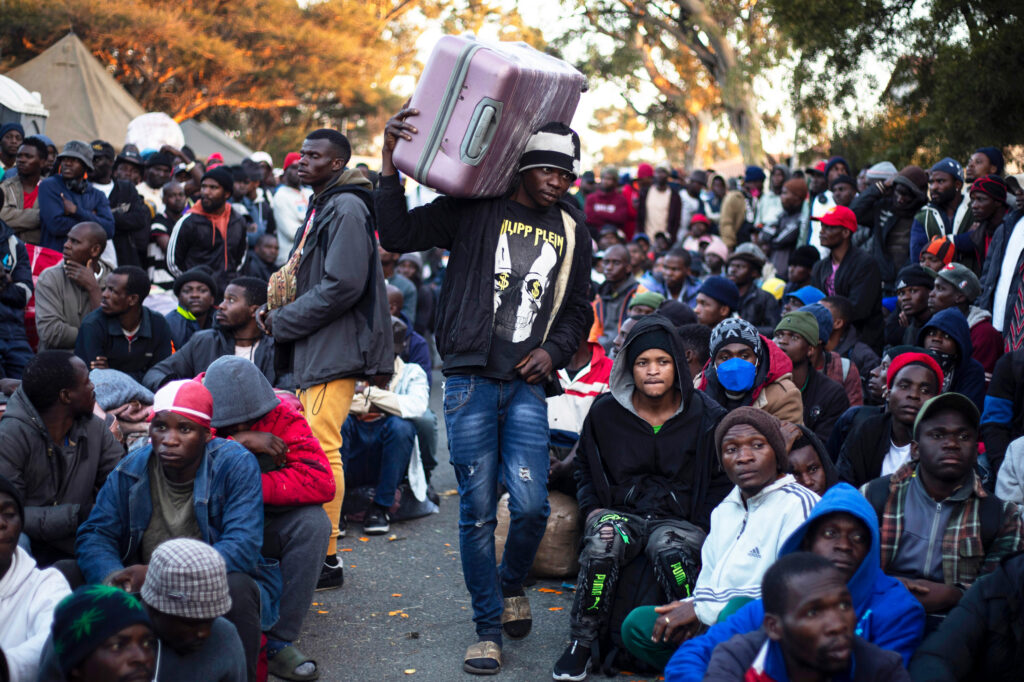
On June 30, 2026, an arbitrary deadline expired in South Africa that no law had set and no court would have enforced. A loose constellation of anti-migrant organizations had announced it: March and March, led by the Durban activist and former radio host Jacinta Ngobese-Zuma (no relation to the former president Jacob Zuma); Operation Dudula, a vigilante anti-migrant movement founded in 2021; and a scatter of local groups. Months prior they had circulated an ultimatum summoning undocumented foreigners to leave South Africa by the end of June. The declaration had no legal standing, but that didn’t stop it from sparking fear and inducing displacement.
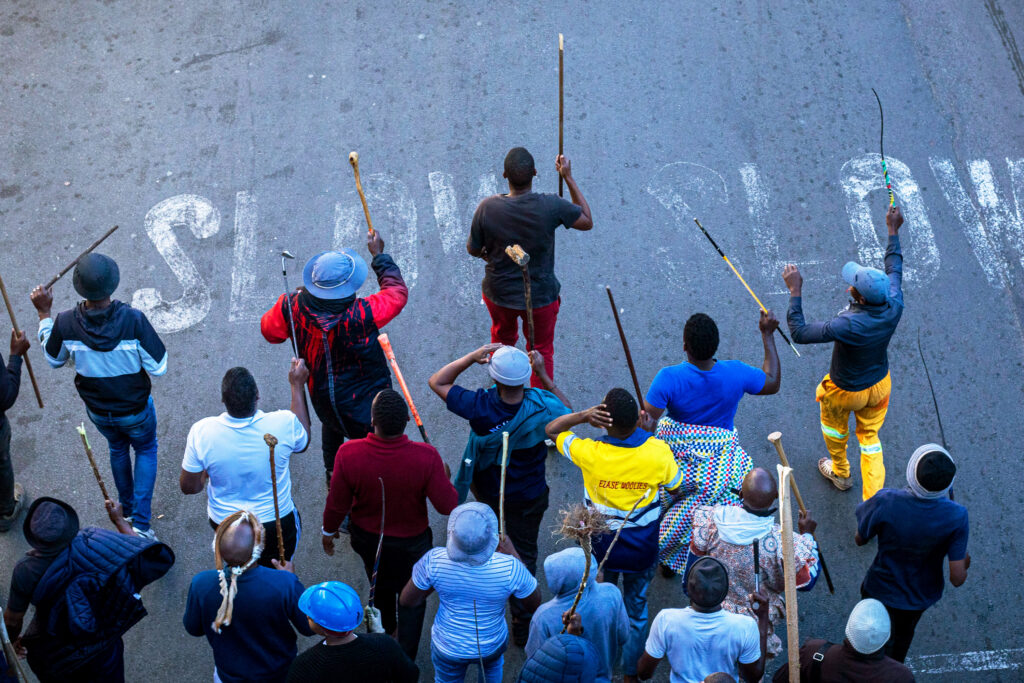
As the clock ticked, thousands of migrants from Zimbabwe, Malawi, Mozambique, Nigeria, and Ghana began leaving South Africa; more than 25,000 had done so by late June. With the deadline drawing nearer, foreign workers stayed in their homes or shuttered their shops. On the day itself, anti-migrant marchers moved through most of the country’s urban centers. In one haunting scene from Johannesburg, a breakaway group wound through Hillbrow, the high-rise inner-city district where many from around the continent have made a home, stoning the residential towers. By the end of the day, at least four people had been killed and thousands had been displaced.
Yet in the following days the commentariat’s overriding consensus went something like this: Things could have been much worse; thank goodness they weren’t. According to most post-mortems, the day actually had proved somewhat anticlimactic. The secretary general of the ruling African National Congress (ANC), Fikile Mbalula, called it a flop for the marches’ organizers, pointing to mostly normal economic activity despite calls for a total shutdown. The state—haunted by unrest (of a different kind) in July 2021 that killed an estimated 354 people—had prepared as if the rioting and the looting would repeat and had deployed thousands of police officers, at a cost of R600 million (about $37.5 million). President Cyril Ramaphosa had requested a late-night meeting on the eve of the marches with two of the movement’s Zulu nationalist figureheads, and the AmaZulu king, Misuzulu kaZwelithini, had issued a call for calm that visibly shifted the tone of the protests. Containment, by its own criteria, worked.
Still, the day belonged to its organizers, and they knew it. Routes had been negotiated and permits obtained, and a memorandum of demands had been handed over at Constitution Hill, the seat of South Africa’s apex court. Organizers broke up fights and stopped some would-be looters. Their street discipline matched their messaging discipline, with key leaders insisting at every microphone that their quarrel was with illegal immigration, not foreigners—with the undocumented, not other Africans. And when June 30 was over, they announced what effectively was, and is, a program of mass action. Ngobese-Zuma told a crowd in Durban that there would be protests every Thursday from then on, until the marchers’ demands are met (among them: a moratorium on refugee processing, mass deportations, a declaration that illegal immigration is a national disaster).
Alongside the post-mortems ran a second interpretive current, this one devoted to connecting the proverbial dots. A network analysis of nearly four million posts published by the Daily Maverick traced the online mobilization to an infrastructure six years in the making, dating it to the #PutSouthAfricansFirst hashtag that seemed to surge out of nowhere in April 2020. Others discerned the workings of a Jacob Zuma family front: March and March’s two lesser-known directors move within his relatives’ orbit. Or maybe it was Russian money. Or white nationalists: March and March has a working alliance with AfriForum, the Afrikaner rights lobby whose fellow-traveler movements have long courted the transnational far right.
The two currents (either June 30 was contained or it was manufactured) appear to point in opposite directions. In fact, they share the consoling premise that the protests do not represent a genuine political development. If the day was successfully policed, then the problem is about public order—and public order can be managed. If the movement was astroturfed, then the people do not really want what the movement wants—and the puppeteer should be exposed. A third reading completes the set: South Africa has been here before. The pogroms of May 2008—by far the most violent (followed by others in 2015 and 2019)—killed at least sixty-two people and displaced more than one hundred thousand.1
And yet all three readings deflate the same possibility: that what Ngobese-Zuma represents—whatever the shadows in her movement’s origins and financing—is an authentic and ascendant political tendency that is here to stay. And all three founder on the same fact, which is the form of this thing. Unlike June 30, the violence of 2008 and subsequent years was leaderless, a string of faceless spasms that left no institutional legacy. The quest for hidden hands never answers why the strings, if strings there are, find so much to pull; the historical analogy never answers why this time the mob is becoming a movement. Both approaches are better understood as symptoms: like a reflex of analysis that at every pogrom appeals to ubuntu (shared humanity) and modern South Africa’s self-definition as the Rainbow Nation, recoiling from the violence with some version of, “This is not really us; someone is doing this to us.” Taking June 30 seriously means declining these consolations and asking what new political order is being born and why now.
What June 30 tells us is that the political order built in 1994 has ended. Although apartheid remains the decisive formative process of modern South Africa and the foundation of its political economy and social geography, the legacy of apartheid is no longer the prism through which South Africans interpret their present and organize their lives. The South African political analyst Imraan Buccus, writing in The Ideas Letter last November about South Africa’s genocide case against Israel at the International Court of Justice, sharply described the chasm between the country’s domestic politics and its foreign policy, calling South Africa “a country still able to project the moral legacy of its liberation movement on the global stage” and “also increasingly unable to uphold that legacy at home.” In Bloomberg, Antony Sguazzin reported that the June 30 protests were being read across the continent as a new wave of “Afrophobia” and claimed that they were straining South Africa’s pan-African standing and its identification with the anti-apartheid struggle it once claimed to embody.
But all this gets the causality backward. Anti-immigrant politics has not destroyed the moral order of 1994; it is only moving into the space that order used to occupy. June 30 was the clearest evidence yet that South Africans have stopped living in it, and the phenomenon that might loosely be called anti-immigrant politics is the first mass politics native to the new period. This period needs a name, and the clumsiest one available is the most accurate: South Africa has become a post-post-apartheid society.
What 1994 Built
It’s easy to forget how ambitious the South African transition was, at least in theory. In today’s standard tellings, it largely represented a negotiated compromise stitched together through elite horse-trading and the deferral of economic transformation. And it was all of that. But it was also, as the Ugandan historian Mahmood Mamdani has argued, the one sustained attempt to escape the political logic embedded by colonialism nearly everywhere it ruled. Colonialism divided the population into “settlers” and “natives,” constituting in law two identities that would forever be defined against each other and joined so tightly that neither could exist alone.2 Where that logic survives, politics has become a contest between a permanent majority and a permanent minority. By treating apartheid’s violence as political rather than criminal, Mamdani argued, post-1994 South Africa could respond with political reform rather than trials, and it could reconstitute everyone who had lived through apartheid, victim and perpetrator, beneficiary and bystander, as members of a single new category: “survivors.”3 After all, the opening declaration of the 1955 Freedom Charter, adopted at the Congress of the People in Kliptown by the ANC and its allies after a nationwide canvass, declared, “That South Africa belongs to all who live in it, black and white, and that no government can justly claim authority unless it is based on the will of all the people.” Mamdani’s crucial point is that this vision was based on a wager: Political identities are neither natural nor permanent, and what has been made can, through political effort, be unmade.
It’s tempting to call South Africa’s post-apartheid design (often referred to as “the settlement”) an improvisation or—according to a critique that has grown louder because the arrangement’s economic failures have compounded since then—a Eurocentric template imposed on African realities as the price of peace and stability. Contrary to this view, the South African lawyer Tembeka Ngcukaitobi has argued: “Constitutionalism—meaning a system of government according to laws that are fair and informed by principles of justice—did not emerge as an alternative to political struggle. Instead, constitutionalism is an integral part of South Africa’s political struggle.”4 Ngcukaitobi’s excavation of this genealogy runs from the Freedom Charter, through the ANC’s Constitutional Guidelines of 1989, to the 1996 Constitution itself. The Bill of Rights, in other words, germinated from South African soil. What was born in 1994 was an inheritance of this tradition.
An inheritance, though, is not yet a settlement. What made the design politically possible happened elsewhere, in what Mamdani calls “the South African moment”: the period beginning in the 1970s, when initiative passed from the apartheid state to the forces arrayed against it and when the identities that the future constitution would later abolish were first abolished in practice. The breakthrough came from below and from two directions at once: in Durban’s ports and factories, where radical white students joined Black migrant workers to build the country’s nonracial unions; and in schools and townships, where the Black Consciousness Movement welded three legislated races into one political identity. Through the United Democratic Front of the 1980s, all this evolved into a politics that went beyond demanding an end to apartheid and demonstrated the alternative in practice. By the time the lawyers sat down in Kempton Park in the early 1990s to construct the arrangements for a new political order, “settler” and “native” were already dying as lived political identities. The new political community was constructed on the foundation that unions, students, and civic organizations had spent two decades building.
This new political community was nearly strangled in the cradle, though, and by a familiar hand. The years in which the settlement was negotiated were among the bloodiest in South African history. Between Mandela’s release in February 1990 and his election as president in April 1994, political violence killed an estimated 14,000 people.5 This period spoke the language of apartheid’s other invented identity: the tribe.Although the struggle worked to dissolve race as a political identity, the tribe—the identity apartheid had built for the countryside Bantustans (Black homelands) and what are known as “hostels” (single-sex, migrant-worker dormitories often organized along ethnic and regional lines)—survived the transition intact. Anyone who watched the Amabutho march through Durban on June 30, in the regalia of Zulu regiments, was looking at the part of decolonization that never happened.
The durability of the 1994 settlement had been tested before, early and often, and each episode was read as the moment when the post-apartheid order died. The Marikana massacre is the paradigm case. In August 2012, police shot dead thirty-four striking mineworkers at a platinum mine in the North West Province—widely believed to be the deadliest use of force by the democratic state against its own citizens until then.6 The moment, it was either hoped or feared, would finally break the masses’ attachment to the ANC. And something did open then. But look at what walked through. Julius Malema, a firebrand youth leader expelled from the ANC founded the Economic Freedom Fighters, a Black nationalist party, in 2013, at Marikana itself, and this was not a departure from the national liberation tradition but the birth of its most orthodox faction. The party’s program to nationalize mines and expropriate, without compensation, white- and foreign-owned land, is the Freedom Charter’s economic clauses recited back at the ANC, which has shelved them. The party’s very name promises the completion in our lifetime of the liberation the ANC left half-done.
That was the party-political half of the Marikana moment. Organized labor’s half of the rupture played out the same way. The National Union of Metalworkers of South Africa (NUMSA)—the country’s largest union and the bedrock of the workerist tradition that had built shop-floor democracy under apartheid—broke with the ANC over Marikana; it was expelled from the Congress of South African Trade Unions (COSATU), an ANC-aligned federation, for that, and in 2019 it put the Socialist Revolutionary Workers Party on the national ballot.7 The SRWP won roughly 25,000 votes, far fewer than the number of members NUMSA claims to have (the most widely circulated figure, dating to 2014, is about 339,000), and not enough to win a single seat in parliament.8 It was hard to avoid the conclusion that the workers whose union had left the liberation movement had not left the movement themselves. When they were offered, for the first time, a ballot-line alternative in their own class name, they did not take it.
Fallism—the student movement whose central demand was access to free, decolonized higher education—looked, for a season, like something else. When a student flung excrement at the statue of Cecil John Rhodes at the University of Cape Town in 2015 and campuses across the country shut down under #FeesMustFall, the born-free generation appeared to be burning the Rainbow Nation rather than petitioning it.9 But the appearance deceived. As the South African cultural critic Khanya Mtshali argued in a retrospective a decade on, the movement celebrated for desecrating the post-apartheid nation’s mythology was, at its core, seeking admission to it. In Mtshali’s phrasing, “If Fallism should be understood not as a rejection of the 1994 settlement, but as its final appeal, then it was a last effort to claim the inclusion that had long been deferred.”10
This pattern makes post-apartheid South Africa’s first two decades legible. Even the era’s signature charge against the constitutional settlement itself kept faith with the thing it attacked. To damn the settlement as an unkept promise, as a liberation codified into surrender, is still to hold it up to the measure of liberation.
A political order that can absorb its own crises this way looks eternal. But notice what the absorbed crises had in common. Each was a demand for more emancipation. The ANC’s real monopoly was over the horizon. What crystallized on June 30 is instead a mass politics whose demands are premised on the contraction of freedom. As the South African writer Benjamin Fogel summarized in an op-ed for The New Statesman, “This is a South Africa that no longer aspires to be the egalitarian multi-racial democracy envisioned in its constitution, a country that no longer cares about its international reputation.” Whether this is a passing fever or the shape of the period ahead is the question to contend with now. What can already be said is that national liberation is no longer the automatic horizon of South Africa’s politics—and that what for now has moved into its place does not speak the language of emancipation at all.
The Story Runs Out
The bitter pill to swallow is that if liberation has been the teleological motor of South Africa’s national story, then that liberation was always conceived, first and mostly, as liberation for South Africans. The universalism had a border running through it. Writing a dozen years before the June 30 deadline, Sisonke Msimang described that border from an unusual vantage. Raised in exile (including in Zambia, Kenya, and Ethiopia), she returned to South Africa in the mid-1990s to find that the African countries that had sheltered her family barely registered as places to her compatriots: “Africa” began beyond the Limpopo River, and to have grown up over there was a misfortune that called for condolence. The idea that the rest of the continent was a zone of chaos and dysfunction was constitutive of the idea of South Africa itself, which understood itself as orderly and modern by contrast—a self-conception, Msimang noted, that whites and Black South Africans turned out to share. What made South Africans a people, across the lines apartheid had drawn, was the shared experience of having lived through apartheid—in Msimang’s phrasing, “a kinship that is based on their connection to the apartheid project.”
The Truth and Reconciliation Commission consolidated this sentiment by converting a selective reading of the past into a national narrative in which belonging was indexed to apartheid’s wounds. The category of the “survivor”—which dissolved distinctions between “settler” and “native” into common citizenship—had a structural limit. If surviving apartheid is what confers membership, the person who was never subjected to it cannot be naturalized into the nation, whatever their legal status. African migrants are not overlooked in modern South Africa’s founding story; they are its constitutive outsiders, the figure to be defined against.
The new nation also inherited in 1994 a state that had been organized to regulate entry from the rest of the continent, and which, post-apartheid, continued to do so. South Africa’s borders were racial before they were national. European immigrants were weighted by their standing within white society while the movement of Africans was administered as a labor question. The 1937 Aliens Act defined desirable immigrants as those of “European” heritage. The Aliens Control Act of 1991 removed that racial language but retained the legal architecture. And, in Msimang’s reading, the immigration regime of the democratic era preserved the underlying orientation of before—treating migration as a security problem rather than a developmental one—through to the establishment of the Border Management Authority.
The significance of this history is that the anti-immigrant politics of the post-post-apartheid period has required no ideological innovation and it need only read the national story literally: Retain the boundary and discard the universalist commitments. When the grammar weakens, the exclusions written into its founding strengthen. The kinship of survival is a closed cohort that admits no new members, even though its heirs inherit an account of the experience rather than the experience itself. Most South Africans alive today were born after 1994.11 For thirty-year-olds born after the transition, schooled after the TRC, and unemployed in an economy that for the past decade has grown by just 0.7 percent a year—below population growth—appeals to the debt owed to the countries that sheltered South African exiles is a claim on resources they do not have, made in the name of a history they did not live, by a political class that has prospered while invoking it.
Suren Pillay, the director of the Centre for African Studies at the University of Cape Town, described this condition in the Mail & Guardian the day before the June 30 deadline expired. Appeals to non-racialism, he wrote, and reminders of the hospitality shown to exiles during the struggle “no longer have the persuasive force they once did.” He claims that a moral vocabulary has come apart under the experience it is supposed to organize. For people facing chronic unemployment and insecurity, the invocation of pan-African solidarity registers as moral nostalgia. Pillay supplies the material basis that the TRC’s narrative had deferred. The real reckoning between apartheid’s victims and its beneficiaries never actually took place—the millions who had voted for the system, occupied the houses, and inherited the land and the wealth entered the new nation on the same terms as everyone else—and anger that cannot travel upward is redirected downward and sideways.
The foreign migrant then, to borrow Pillay’s image, is a mirror. Expelling migrants will not fix unemployment, crime, or the state’s failures, and most South Africans know this. But the figure of the “undocumented migrant” gives an unbearable situation a face and a remedy, and in that sense, the campaign against him reflects the country’s real crises even as it deflects from them. Pillay also adds a warning. A politics of expulsion does not stop when the foreigners are gone. If the conditions that produced the anger remain, the anger simply moves inward: The question no longer is whether someone is foreign, but whether they are the right kind of insider—whether they speak the right language or belong to the right ethnic group. The men in Zulu regimental dress who marched on June 30 are a reminder of how readily the boundary can be redrawn.
To say that the old appeals have lost their persuasive force is to describe the change, not to account for it. Why have the words stopped working now, for this generation, and why has the failure taken this particular political form? The language of 1994 assumed a certain kind of economy whose injustices were apartheid’s and whose remedy was liberation. That economy no longer exists.
Today’s economy reproduces apartheid’s inequalities without apartheid’s instruments. No statute now reserves the skilled trades for whites, yet the occupational hierarchy remains racially ordered from top to bottom. No pass law confines non-whites to the townships and the former homelands, yet the residential geography of apartheid has scarcely shifted. Apartheid’s injustices had an author, and one could name the statute and the department or minister who signed its exclusions into effect. The injustices of the successor economy have no author. Suppose that racial prejudice had expired with the laws that codified it, then no employer, banker, or landlord ever again would have preferred white to Black. But the racial ordering of the class structure would have persisted regardless, since life chances in a capitalist economy follow inherited resources and that inheritance was apartheid’s. Suppose something stronger still, namely that the asset holdings themselves had been divided on the day of the election. The country then would have been more just and life at its bottom more survivable, and that is not nothing. But a generation on, the earlier hierarchy would have re-formed, because the one asset no decree could redistribute was the skills and the schooling that apartheid had given to some and withheld from the rest, and because in an economy that is shedding jobs, those with wages accumulate while those without are depleted.
The deepest deprivation of the new era—the permanent exclusion of roughly one-third of the workforce from employment of any kind—has hardly changed. The rate of expanded unemployment (which counts not only those actively job-hunting but also the discouraged who have stopped looking and those working part-time for lack of full-time work) was about 35 percent in both 1994 and 2014; today it is nearly 45 percent. Thirty years of policy—the Reconstruction and Development Programme; the Growth, Employment and Redistribution strategy; Black Economic Empowerment; the National Development Plan—have not shifted this number, because the problem is not a maldistribution that a transfer could correct but a structural fact about an economy that no longer needs the labor on offer. Redistribution changes who stands where in the queue and how bearable being at its far end is, but it does not change the fact of the queue’s existence. The vocabulary of 1994 was built for the problem of maldistribution—for restoring, to those it had been taken from, the wealth that apartheid had stripped away. It had no language for the problem of structural exclusion, the fact of an economy with no use for a permanent fraction of its workforce—a fact no transfer of existing wealth can undo.
The queue, moreover, has lengthened. In an essay late last year for New Left Review, the geographer Kevin Cox argued that South Africa’s deterioration owes less to the ANC’s choices than to the arithmetic of when freedom arrived. Liberation came to South Africa late in the world’s century of development. By 1994, China’s rise was underway, the export-led path was closing, and the middle-income countries that had walked it were already shedding their industry. South Africa’s shed faster than nearly any other. Manufacturing never recovered from the shock of 2008, when 300,000 jobs were lost. At the same time, the minerals-energy complex around which the economy had been organized began to stall amid failing rail networks and rationed power. The country’s position in the international division of labor became what economists politely call re-primarization: Digging things up and shipping them out. Growth in per capita terms barely registered, and by early 2026, the national unemployment rate stood at 32.7 percent—with people aged 15 to 24 facing the highest rate, at 60.9 percent, and those aged 25 to 34, 40.6 percent.
And yet Cox’s fatalism should be resisted, because more of what happened after 1994 was chosen than his account allows for. The sociologist and researcher Niall Reddy’s own take of the strategic dilemmas of South Africa’s labor movement in the early 1990s provides the counter-evidence. Back then, COSATU put a real alternative on the table: state-led industrial policy, capital controls, and a growth path built on rising wages rather than restrained ones. The ANC, however, dropped it within months of taking power, despite having the means to resist neoliberalization and, for a time, trying to. COSATU’s eventual acquiescence was as much an endogenous defeat as an automatic response to external and global pressures.
Still, Cox’s timing argument establishes something that the standard fare of moralized critiques of the ANC cannot. The crisis was never simply a failure of political will exercised freely against an open field of alternatives—the field was closing. The normative and economic vision of 1994 stopped working because the promise of belonging and the promise of redress were bound at the founding, and when the economic vehicle for the second was abandoned, the first was left to make good on a debt it no longer had the means to pay.
The lawyer and Marxist theorist Harold Wolpe identified the mechanism driving all this half a century ago. Apartheid was, at bottom, a system for keeping the African majority half-inside the capitalist economy: with wages in the mines and factories, and with just subsistence in the reserves—so that the countryside would bear the cost of sustaining the labor the cities consumed. The African worker was, by design, necessary and disposable at once; wanted as laborer, refused as member. Between 1960 and the early 1980s that arrangement was destroyed from the rural side, when more than three and a half million people were evicted from white farms and forcibly cleared from so-called “black spots”—pockets of Black-owned land the state’s racial map had stranded inside white-designated territory—and dumped into the resettlement camps of the homelands. The proletarianization that enclosure had performed elsewhere over centuries was now completed at gunpoint.
Laurine Platzky and Cherryl Walker, researchers with the Surplus People Project who spent three years documenting the scale of these removals, called their 1985 study The Surplus People, a title that has proved to also be a prophecy for the generation that followed, for the children who were delivered into a world economy that had just stopped creating jobs but were rendered fully dependent on wages and stripped of any rural fallback. Millions stood ready for employment that would never come, concentrated in settlements ringed around cities that cannot absorb them, their claims unorganized and waiting. An economy that cannot employ must find other ways to distribute. South Africa found one.
The Access Economy
These were found at opposite ends of the class structure. Beginning at the top, the settlement of 1994 transferred the state but not the economy. The conglomerates that had grown around the minerals-and-energy complex largely kept their owners and their commanding position, and the corporate restructuring of the following decade globalized white capital rather than dispersing it.12 Black Economic Empowerment was the instrument meant to correct this. A corporation sold a minority stake to politically connected partners, who financed the purchase with debt serviced by the very dividends the stake was supposed to generate, and in return the corporation received the empowerment rating that unlocked state contracts and regulatory goodwill.13 The Black partners rarely were mere fronts; many brought their own political capital and became genuine brokers between corporate boardrooms and the ANC, which is precisely what made the arrangement worth the debt.
The result was a real, if narrow, integration of Black elites into corporate power: About one-third of directors at JSE Top 50 companies are Black. But the class created was one of shareholders and intermediaries, not industrialists, because an economy shedding manufacturing and growing at less than one percent offered nothing for an industrial bourgeoisie to grow into. And this transformation stopped at the top: Across the broader economy, Black representation on corporate boards is under one-tenth. So the personal ambitions that the private economy could not accommodate migrated toward the one institution the democratic transition had actually delivered. The state was never one avenue of advancement among several; for most, it was the only one—which is what gives corruption in South Africa its systemic rather than episodic character.
The bottom rungs of the class structure tell the same story from the other direction. For the one-third of the workforce that the formal economy would never employ, the state likewise remained—by way of the grant that anchors the household, the public-works stint, the housing list, the municipal payroll. Public employment became the great engine of Black advancement, while procurement swelled into a kind of contract state, feeding a layer of unproductive capital whose business was tender competition. Karl von Holdt, the director of the Society, Work and Development Institute at Wits University, has named the resulting formation an “informal political-economic system” in its own right—the principal vehicle of class formation for an aspirant elite, with the party as its ladder and the public purse as its capital stock. Beneath the elite, the system reached down into whole constituencies: the branch that delivers the ward, the councilor who allocates sites, the faction whose conference victory decides which informal settlement gets water. What could not be distributed as wages was distributed as access.
The temptation is to call all this a pathology. But the patronage economy is the formal economy’s progeny, grown precisely where employment and enterprise failed to appear. For its first decade, the two lived in symbiosis, with rents securing the loyalty of constituencies the market had abandoned and with that loyalty stabilizing reforms to keep the market safe. Under Zuma, the president from 2009 to 2018, what had been symbiotic clashed. Extraction moved from the periphery of the state to its commanding heights, first by fastening on the enterprises without which formal accumulation cannot proceed and finally by reaching for the National Treasury, the last stronghold of the old fiscal order. The appointment of a little-known backbencher, Des van Rooyen, as finance minister in December 2015 lasted only days before capital’s counter-mobilization forced its reversal. The episode disclosed the underlying architecture of two economies with incompatible requirements contending for a single state. The machine defended itself in the language of liberation, restyling predation as “radical economic transformation” and its enemies as fronts for white monopoly capital. Reddy has also argued that this division—between those whose prospects run through the formal economy and those whose prospects run through the political allocation of what that economy leaves—is now “the primary contradiction in the South African social formation”: deeper than race, though it is racialized at every level, and deeper than the old contest over liberation legitimacy, though both camps claim the inheritance.
This, then, is what stands today where the economy of the liberation grammar once was. The political consequences of that follow with almost geometric necessity. An economy organized around production generates conflict over the terms of work—wages, hours, the ownership of what labor produces—and the identities such conflict requires are the worker, the boss, the union, and class. An economy organized around allocation generates conflict over access, and the first question in every allocative conflict, prior to quantity and prior to fairness, is eligibility. Using the earlier image: Before the queue can be shortened or the queuers’ rations can be enlarged, it must be decided who may queue up in the first place.
The political scientist Alexander Beresford calls this “gatekeeper politics”—political office matters because it commands allocation, and whoever holds the gate is besieged by rivals organizing the excluded against him. These conflicts are zero-sum. A road tarred in one place means a road not tarred in another. A politics of allocation sets claimant against claimant, and the advantage goes to whoever can shrink the pool of all eligible claims. Under these conditions, belonging becomes an economic fact, something close to a property right.
The sociologist Marcel Paret spent the better part of a decade doing fieldwork in the informal settlements of Gauteng Province, and his 2022 book Fractured Militancy shows how the sorting works at the street level. In his four field sites, xenophobic attacks were entangled with the ordinary politics of claims. They tended to flare up during protests about the delivery of public services, when residents petitioned the state for the basic provision of municipal utilities like water, sanitation, housing, or energy. Looting was used to discipline migrant traders who kept their shops open during a “stay-away” (a general strike), and some residents told Paret plainly that burning shops was a way of making the government pay attention to their marginalization.14 He is careful to note that the people who protest and the people who attack usually are not the same. But the two camps’ politics share a premise, which his interviewees stated without being asked: The state owes something to those who vote for it and a politician cannot go to Zimbabwe to campaign. The migrant is the one claimant in the queue whose expulsion costs nothing at the polls.
And so hostility was licensed from above long before it organized below. In the first parliament of the democratic era, the new home affairs minister—Mangosuthu Buthelezi, the Zulu nationalist leader whose Inkatha Freedom Party was partly responsible for violence during the transition years—warned that reconstruction could not survive competition from the aliens coming over the borders.15 When xenophobic attacks broke out in 2015, the government sent the army, and Operation Fiela, which had begun as a response to anti-migrant violence, became within weeks a program of mass deportation. According to Paret, nationalism “created a bridge, linking discourses and practices from above and below.” Frantz Fanon had described the sequence in 1961: When national consciousness stalls at the top, among elites contesting the spoils of the state, it turns downward into chauvinism against the stranger.16 The patronage economy rides on that stalled contest, and the street has kept its side of the sequence.
Which is why the standard reading of June 30 has the causality backward. Sguazzin’s version treats the hatred as an outside force destabilizing the social contract of 1994. It is truer to say that the settlement, and its inherent instability, produced the hatred. An economy that reproduces apartheid’s distribution without apartheid’s instruments wrongs people namelessly, and people do not sit with a nameless wrong for long. They look for someone to hold responsible, and the queue supplies a candidate who is visible and undefended. Seen from inside the queue, expulsion has the character of a program rather than an irrational spasm: a redistribution that requires no growth, asks nothing of capital, and can be carried out by the claimants themselves. Both the analysis and its representations are incorrect, since the queue was never the migrant’s making and it does not shorten when he leaves. As a politics, though, the idea coheres. There now exists a mass politics whose demand is that people be removed.
By June 30 and on days past, some descriptions of South African suffering cast foreigners as the cause and their removal as the remedy even though a more accurate account existed. The condition of the marchers—an economy with no use for the labor they have to sell and that depends on a state that distributes what the private sector no longer does—is a class condition, one expressing the plight of the surplus person trapped inside the system that made him surplus. But this truer description, when it is offered, hardly ever gains traction. People competing for a stand or a place on a list are calculating their prospects rationally within the environment they have been given, which means that what looks like ideological capture is more often, as the Marxist sociologist Vivek Chibber has argued, a reasonable response to a constrained situation. And if anti-migrant marchers are rational, the key question is no longer why they believed a false description but why no organization ever put the true one within reach. Who could have carried it, and where did they go?
The answer is not that South Africans stopped organizing. Judging by the frequency of protests throughout the 2010s, South Africa was among the most mobilized societies on earth.17 Nor are the townships and informal settlements disorganized. The scholar-activist Trevor Ngwane’s 2021 study of the shack settlements found them dense with committees—amakomiti—allocating resources, ensuring security, resolving disputes.18 What disappeared is narrower and more consequential. In the 1980s, the unions coupled South Africa’s associational world to a class politics, and the American sociologist Gay Seidman records labor activists bringing “an understanding of class relations” into township struggles, redefining rent and transport grievances as working-class grievances, and joining the shop floor to the street.19
The ledger of this decline is short. COSATU entered the governing alliance and was hollowed out by it, forcing its energies to be redirected from organizing toward managing its position—which the academic and higher-education administrator Sakhela Buhlungu has called “a paradox of victory.”20 The workers’ party started by NUMSA, the federation’s largest affiliate, couldn’t win a single seat in parliament in 2019. The independent left, meanwhile, settled into what Reddy calls “movementism”: a politics of episodic campaigns, and averse to the slow work of institution-building. Voter turnout fell from 86.9 percent in the elections of 1994 to about 58.6 percent in those of 2024;21 counted against the voting-eligible population rather than registered voters, participation fell to 41 percent.22 The largest political formation in South Africa today is the people who no longer see the point.
The deeper cause is the transformation that dissolved the organizational vehicles by the same motion that intensified what they existed to articulate. Unions organize the employed, and the employed are the shrinking share:23 One-third of the workforce cannot withdraw its labor since no one wants it in the first place. The Italian sociologist Franco Barchiesi saw the trap early, as soon as the post-apartheid order turned waged work into the premise of social citizenship at the precise moment that waged work ceased to be generalizable.24 The allocation economy, in contrast, breeds a different organizational subject. A claim in the queue is local by nature, concentrated in this ward or that site. The associational energy of the townships and the informal settlements pools in local vessels and stays there. The fragmentation that Paret documents is not a failure of will awaiting a better organizer but the form of collective life this kind of economy selects for.25 His fieldwork contains the emblem of the whole condition: During stay-away calls, unemployed residents beat up employed neighbors who were boarding taxis heading to work—a manifestation of the class relation present and intense but pointed sideways. The movements that organized June 30 grew from this same soil, though not by inheriting the old structures.
Operation Dudula, an anti-migrant vigilante organization, was born of a citizens’ patrol that its founder, Nhlanhla “Lux” Mohlauhi, had begun running in Soweto in June 2021, targeting foreign-owned shops he deemed illegal. The campaign gained a public face and a hero’s narrative when Mohlauhi filmed himself vowing to defend Maponya Mall, a landmark Black-owned shopping center, from the looting that engulfed the July 2021 unrest. Even as the citizens’ patrols then hardened, under an anti-crime banner, into a movement against foreigners, they remained an informal, membership-less network of self-described “affected community members”—until September 2023, when Operation Dudula registered as a political party. Then the movement gave real-world form to an online current that had been building since 2020:26 the #PutSouthAfricansFirst hashtag, an anonymous Twitter campaign—later traced to a former soldier—that pushed the same message (deport African migrants; blame them for lost jobs and crime) but never had a leader, a patrol, or a street presence to enact it.
Dudula had called for its founding march on June 16, 2021, the anniversary of the 1976 Soweto Uprising—when police killed students protesting apartheid education—a date that every South African recognizes as a national holiday. Its pamphlets promised to “clean” Soweto.27 On the back of this momentum, March and March assembled three years later around Ngobese-Zuma, then a Durban-based broadcaster.28 Neither Dudula nor March and March descend from the civic organizations or street committees of the anti-apartheid movement, but they perform in ways they did not have to invent. The negotiated march, the memorandum, the marshals, the stay-away enforced against traders who keep their shops open, the founding date lifted from the liberation calendar—this is the repertoire of South African mass politics, built by the struggle and kept in daily use by three decades of protest, and it belongs to no organization.2930 The novelty is that in five years, out of an anti-crime patrol and a hashtag, this latest politics built what class description has lacked for thirty years: a political instrument, with branches, by its own count, in seven provinces; a party registration; a weekly program; a signal date.31 The digital infrastructure has done for its locals what the unions once did for theirs, turning ward-scale grievances into a national cause. This is why dismissing these movements as astroturf keeps failing to land. The coordination is real, but it animates inherited forms and genuine self-activity, organized in the only vessels the allocation economy leaves standing.
The nationalist description supplies a reason to act. Chibber’s account of why subordinate classes tend to endure their condition is that endurance usually is the sensible course: Collective action against the structure is expensive, dangerous, and likely to fail, so people submit to the order even when they don’t believe it is legitimate.32 The conditions under which this situation changes are specific: The costs of acting must come down, people must believe action can succeed, and the solidarity required must already exist or be cheap to build.33 The class politics of the post-apartheid period met none of these conditions. Today’s politics of expulsion meet all three. The migrant is the only party with less power than the marchers—not defended by capital and defended only intermittently by the state. Nationality, unlike class, requires no organizational work to become a shared identity; it inherently is one. The marchers of June 30 organized the first collective action in years whose costs were low and whose success was visible by tapping a solidarity that was already in place.
The underlying sentiment is often described as “Afrophobia.” But if the term captures the hostility, it obscures the conditions that precede it. A phobia belongs to the realm of attitudes and presumes an object of fear. How did that object come to exist? Zimbabwean farmworkers, Somali traders, Congolese asylum seekers, Mozambican construction workers, Ethiopian shopkeepers, and Malawian domestic workers enter South Africa through different legal channels, occupy different sectors of the labor market, and inhabit different social worlds. And yet increasingly they appear in political discourse as a single population, collectively held responsible for unemployment, crime, collapsing services, and urban decline. What demands explanation is the creation of a category capable of bearing so many unrelated grievances.
South African history offers little reason to treat such a phenomenon as unusual. Few societies provide a clearer record of political identities being manufactured in public. The categories “Native,” “European,” “Coloured,” and “Indian” did not emerge because administrators discovered natural divisions. They were assembled through law, territorial administration, labor regulation, and differentiated rights, and then were presented as descriptions of permanent human kinds. Writing about the US, the American historian Barbara Fields described the sequence: Racial ideology arises to explain a social order already in operation, converting a position into a nature so that the position appears to follow from the nature.34
Something of the kind is now occurring in South Africa around the figure of the foreign African. Immigration law distinguishes citizens from non-citizens. The documentation regime makes papers hard to obtain and quick to lapse, which means that deportability is a standing condition.35 Employers convert that condition into a means of disciplining labor, since workers whose residence depends on employment are cheaper to hire and easier to control.36 The consequences of all this are then described as though they revealed something intrinsic: Foreigners work harder, complain less, possess an unusual commercial drive, and undercut wages. A system that regulates labor returns as a set of Othering personal traits. South Africa has run this conversion before—the pass system made the native’s urban presence revocable by default. As the sociologist Michael Neocosmos has put it, the foreign native of the old order has become the native foreigner of the new.37
The category that emerges is neither purely legal nor purely cultural; it is social, and ordinary encounters teach people to recognize it. Because phenotype offers no reliable distinction, recognition depends on continual testing. The South African linguist Zakeera Docrat has described Dudula members administering language examinations at hospital gates and in commercial streets, demanding of would-be users of those services to speak in isiZulu or Sepedi and treating any hesitation as a basis for determining who could enter, trade, stand in line.38 The test’s accuracy is nil. But its productive value is considerable, especially for a divided polis. Everyday speech had reached the same destination earlier, for example with makwerekwere, an onomatopoeic word meant to represent what sounds like unintelligible foreign gibberish to local ears. Such a heterogeneous population can be gathered under a single term only by race-craft. Meanwhile, no march has moved on the country’s white immigrants: The wealthy foreign professional is not asked for the isiZulu word for “elbow.”
The obvious objection is that none of this is new, in the sense that the papers, the raids, etc., all have apartheid precedents and that the hostility is older than the democratic state. But if the tools are old, the way they are being wielded is new. Apartheid’s categories were engineered for a labor-hungry capitalism. Today, the citizen/foreigner split is being drawn by a labor-shedding capitalism that is identifying and sorting the (surplus) population the economy cannot employ, so that that side absorbs the deprivation of all. None of this displaces the racial order apartheid left behind. White wealth and apartheid’s social geography continue to organize South African society. The new boundary forms within that inheritance and cuts across its central category, now dividing the population that once unified politically as Black. This is racialization in the strict sense—a different economy tooling a different race. And it has a paradoxical relation to the founding ambitions of the post-apartheid democratic project. Having set out to unmake the races that apartheid’s economy had required, its successor economy has made one, too.
The thing about a category designed to limit the number of claimants is that it is forever changing. Roughly one-third of the people killed during the 2008 xenophobic violence were South African citizens, attacked as if they had been outsiders because they were too dark or had the wrong accent. Language tests today misclassify Vendas, Shangaans, and Pedis.
Against all this, one reflex is to ask what is to be done. The question is legitimate but also, in the form it is usually asked, premature. The first task is diagnostic. What June 30 demands is the recognition that the assumptions on which South African politics has been conducted for thirty years no longer describe its terrain today. What recurred episodically in the post-apartheid era now organizes the politics of this era, and responses calibrated to the old order misfire in the new one.
This is why the question of how to contest the new racial ordering is harder to answer than it seems. Contesting this order presupposes organizations that carry an alternative description, coalitions that can be assembled, and a shared horizon to which appeals can be made. Those were features of a world that has now ended. What currently stands in for a response is, on one side, moral condemnation with no bearing on the material situation of the people marching, and on the other side, a left through which anti-migrant sentiment increasingly moves too. A politics that cannot offer the marchers anything actionable in the short- to medium-term will invariably lecture them or join them.
After the July 2021 unrest triggered by Zuma’s arrest, I argued that the disorder suggested a major breaking point and that a leftwing populism could tap the inchoate rage expressed to reclaim the narrative of national liberation from the ANC and bind community, workplace, and student struggles. Both premises were wrong. The liberation narrative was expiring, and no strategy could depend on an expiring thing. But the rage was truly available to whoever organized it first. Out of the patrols defending a Soweto mall that July came the movement that five years later, today, helped police the June 30 deadline. The disorder I took then to be raw material for a politics that did not yet exist became raw material for the one, a very different one, that now exists.
Local government elections are scheduled for later this year, and no party will contest them on behalf of “surplus” people. The ANC campaigns on enforcement, announcing deportation figures, in an attempt to win back its base from reactionary alternatives. The experience of the Economic Freedom Fighters, Malema’s self-described Marxist-Leninist-Fanonian grouping, is instructive in the grimmest way: The EFF’s refusal of xenophobia is its one sustained act of principle, and the party has seemingly paid for that electorally. MK, which Zuma founded in 2023 after his final break with the ANC, is the largest party most sympathetic to the anti-migrant cause and the natural vehicle of the new period: An idiom of authority, patriarchal order, and nationalist belonging fits a politics of patronage far more comfortably than any emancipatory vocabulary ever did, and the fit will tighten. The parties that claim the left’s inheritance are converging toward the politics that will end it.
There are no shortcuts out of this, and yet most of what presents itself as strategy is a shortcut. Populist channeling, unity conferences, campaigns to re-educate the marchers—all treat as a problem of messaging or coalition-building what the whole period since the end of apartheid shows to be another problem entirely. A description of suffering can only win when an organization carries it, and no such viable organization exists at the moment, nor can one be easily conjured. It must be built by people who understand what period they are in, which is the one thing analysis can supply. The precedents are not consoling. The identities that apartheid made were unmade once, but the unmaking took two decades of organizing in ports, factories, schools, and townships before a unifying political grammar cohered, and it began small. That is what the wager of 1994 actually rested on and what renewing the real promise of that moment will have to rest on again. The post-post-apartheid era has begun.
- United Nations High Commissioner for Refugees, cited in “South Africa’s Xenophobic Eruption,” in Institute for Security Studies, Paper 169 (October 2008), https://issafrica.org/research/papers/south-africas-xenophobic-eruption (reporting 62 deaths and roughly 35,000–100,000 displaced in 11–26 May 2008); see also “Documenting Violence Against Migrants in South Africa,” The Guardian, June 21, 2021, https://www.theguardian.com/world/2021/jun/21/documenting-violence-against-migrants-in-south-africa-a-photo-essay (reporting 62 dead, 1,700 injured, and 100,000 displaced). ↩︎
- Mahmood Mamdani, Neither Settler nor Native: The Making and Unmaking of Permanent Minorities (Belknap Press of Harvard University Press, 2020), 144–45. ↩︎
- Mamdani, Neither Settler nor Native, 16–17, 180–81. ↩︎
- Tembeka Ngcukaitobi, The Land Is Ours: South Africa’s First Black Lawyers and the Birth of Constitutionalism (Penguin Random House South Africa, 2018). ↩︎
- Truth and Reconciliation Commission of South Africa, “Political Violence in the Era of Negotiations and Transition, 1990–1994,” Truth and Reconciliation Commission of South Africa Report, vol. 2, chap. 7 (TRC, 1998), https://sabctrc.saha.org.za/reports/volume2/chapter7/subsection1.htm. ↩︎
- Marikana Commission of Inquiry (Farlam Commission), Report on Matters of Public, National and International Concern Arising Out of the Tragic Incidents at the Lonmin Mine in Marikana (Pretoria, 2015). https://www.gov.za/documents/notices/marikana-commission-inquiry-report-matters-public-national-and-international ↩︎
- Niall Reddy and William Shoki, “Metal That Will Bend,” Africa Is a Country, December 18, 2024, https://africasacountry.com/2024/12/metal-that-will-bend ↩︎
- Independent Electoral Commission of South Africa, 2019 National and Provincial Elections results; on the membership comparison, see Reddy and Shoki, “Metal That Will Bend.” ↩︎
- Adam Habib, “Maximalism Must Fall,” The Ideas Letter, April 15, 2026, https://www.theideasletter.org/essay/maximalism-must-fall/; Wahbie Long, “Postcolonial Theory and the Strong Arm of Identity,” Africa Is a Country, November 26, 2018, https://africasacountry.com/2018/11/postcolonial-theory-and-the-strong-arm-of-identity. ↩︎
- Khanya Mtshali, “Somewhere Over the Rainbow: After Rhodes Fell,” in “Revolution Deferred: 15 Years of Mass Protest in Africa,” Africa Is a Country, Special Issue No. 1 (June 2025). ↩︎
- Statistics South Africa, Mid-Year Population Estimates 2024, Statistical Release P0302 (Statistics South Africa, 2024), p. 37. ↩︎
- Sam Ashman, Ben Fine, and Susan Newman, “The Crisis in South Africa: Neoliberalism, Financialization and Uneven and Combined Development,” in “The Crisis This Time,” Socialist Register 47 (2011). ↩︎
- Niall Reddy, “Beyond ‘White Monopoly Capital,’” Development Southern Africa, vol. 42, no. 2 (2025). https://www.tandfonline.com/doi/full/10.1080/0376835X.2024.2351115#abstract ↩︎
- Marcel Paret, Fractured Militancy: Precarious Resistance in South Africa after Racial Inclusion (Cornell University Press, 2022), chap. 4. ↩︎
- Paret, Fractured Militancy, chap. 4. ↩︎
- Frantz Fanon, “The Pitfalls of National Consciousness,” The Wretched of the Earth, trans. Constance Farrington (Grove Press, 1963). ↩︎
- Peter Alexander, “Rebellion of the Poor: South Africa’s Service Delivery Protests—A Preliminary Analysis,” Review of African Political Economy, vol. 37, no. 123 (2010). ↩︎
- Trevor Ngwane, Amakomiti: Grassroots Democracy in South African Shack Settlements (Pluto Press, 2021). ↩︎
- Gay Seidman, Manufacturing Militance: Workers’ Movements in Brazil and South Africa, 1970–1985 (University of California Press, 1994). ↩︎
- Sakhela Buhlungu, A Paradox of Victory: COSATU and the Democratic Transformation in South Africa (University of KwaZulu-Natal Press, 2010). ↩︎
- Cox, “South Africa in History’s Shadow.” ↩︎
- Reddy, “Patronage Partitions.” ↩︎
- Department of Employment and Labour, “Falling Trade Union Membership in South Africa,” February 22, 2023, https://www.gov.za/news/media-statements/employment-and-labour-falling-trade-union-membership-south-africa-22-feb-2023 ↩︎
- Franco Barchiesi, Precarious Liberation: Workers, the State, and Contested Social Citizenship in Postapartheid South Africa (SUNY Press, 2011). ↩︎
- Paret, Fractured Militancy, chap. 3. ↩︎
- Thabi Myeni, “What Is Operation Dudula, South Africa’s Anti-Migration Vigilante?,” Al Jazeera, April 8, 2022, https://www.aljazeera.com/features/2022/4/8/what-is-operation-dudula-s-africas-anti-immigration-vigilante; Boitumelo Finger, “From Protection to Persecution: Exploring the Impact of Anti-Foreigner Mobilisation on Refugee Rights in South Africa” (MPhil diss., University of Cape Town, 2025), chap. 4. ↩︎
- Finger, “From Protection to Persecution,” chap. 4, fig. 3. ↩︎
- Silja Fröhlich, “South Africa’s Recurring Waves of Xenophobic Violence,” Deutsche Welle, May 7, 2026, https://www.dw.com/en/south-africa-a-timeline-of-recurring-waves-of-xenophobic-violence/a-77077874 ; Lerato Mutsila, “High Court Bans Dudula From Blocking Access to Hospitals, Clinics,” Daily Maverick, November 4, 2025, https://www.dailymaverick.co.za/article/2025-11-04-high-court-bans-dudula-from-blocking-access-to-hospitals-clinics-and-schools/ ↩︎
- Charles Tilly, Contentious Performances (Cambridge University Press, 2008). ↩︎
- Paret, Fractured Militancy, chap. 4, on the stay-away’s anti-migrant redeployment. ↩︎
- Operation Dudula registered with the Independent Electoral Commission in September 2023 (“IEC Slammed after Operation Dudula Registers as Party,” Daily Maverick, October 2, 2023, https://www.dailymaverick.co.za/article/2023-10-02-iec-slammed-after-operation-dudula-registers-as-party/ ). Its party status was confirmed in Operation Dudula v Electoral Commission of South Africa and Another (0017/24EC) [2024] ZAEC 9 (May 8, 2024). ↩︎
- Chibber, The Class Matrix, 19–20, 106–8. ↩︎
- Chibber, The Class Matrix, 155–57. ↩︎
- Barbara J. Fields, “Slavery, Race and Ideology in the United States of America,” New Left Review I/181 (1990), https://newleftreview.org/issues/i181/articles/barbara-jeanne-fields-slavery-race-and-ideology-in-the-united-states-of-america; Karen E. Fields and Barbara J. Fields, Racecraft: The Soul of Inequality in American Life (London: Verso, 2012). ↩︎
- Nicholas De Genova, “Migrant ‘Illegality’ and Deportability in Everyday Life,” Annual Review of Anthropology 31 (2002). ↩︎
- Greg Ruiters and Denys Uwimpuhwe, “Capital’s Preference for Foreign African Labour in South Africa: Reflections on Liberal Anti-Xenophobia Research,” Cosmopolitan Civil Societies, vol. 15, no. 3 (2023): 91–109. https://www.researchgate.net/publication/379413182_Capital’s_Preference_for_Foreign_African_Labour_in_South_Africa_Reflections_on_Liberal_Anti-xenophobia_Research ↩︎
- Michael Neocosmos, From “Foreign Natives” to “Native Foreigners”: Explaining Xenophobia in Post-apartheid South Africa (CODESRIA, 2010). ↩︎
- Zakeera Docrat, “The Discriminatory Practice of Language Testing for Authenticating Citizenship: An Analysis of Operation Dudula Through a Forensic Linguistics Lens,” Potchefstroom Electronic Law Journal / Potchefstroomse Elektroniese Regsblad, vol. 27, no. 1 (2024), 1–27, https://doi.org/10.17159/1727-3781/2023/v26i0a14692.uwcscholar.uwc+2 ↩︎