The Second Creation and the Destruction of Worlds

Anyone who believes recent pitches from tech start-ups might think the Earth has already been transformed into a gigantic techno-scientific laboratory in which young men are in charge of turning the planet into a brand-new synthetic reality. Reflective satellites will light up the Earth at night. Solar radiation experiments will inject massive amounts of sulphate particles into the atmosphere to reflect sunlight back into space. Autonomous flying taxies will be deployed in cities. Massive nuclear-powered data centers will be built across all continents and possibly soon in space. The list of reality-altering interventions that tech companies want to unleash seems endless. For now, fortunately, much of their bravado has been limited to investment brochures and flashy websites. But a direction of travel is being set.
Why do today’s tech elites assume that the world is theirs to transform? According to the twentieth-century German philosopher Hans Blumenberg, belief in the unlimited power of science and innovation to alter nature and create artificial realities is nothing new. In a series of essays written in the 1940s and 1950s, he argued that world-transforming technologies such as the atomic bomb were but the latest manifestation of a powerful set of ideas that have been central to Western culture for many centuries. These ideas can be traced back to the early modern vision of experimental science formulated in the sixteenth century, when philosophers like Francis Bacon first came up with the notion that science opens up reality to human intervention. This philosophy of experimentalism has since become a defining paradigm of modern-day economics, politics, and society. But Blumenberg went further back still and argued that faith in the world-transforming capacities of technology lies in medieval Christian theology.
Peter Thiel, a founder of the data-analysis company Palantir, and other well-known tech leaders often invoke Christian figures such as the Antichrist, and AI promotional materials frequently reference the image of God creating Adam. Perhaps partly in response to this, religious figures have become notable contributors to public debates about the tech revolution. In his recent encyclical, Magnifica Humanitas: On Safeguarding the Human Person in the Time of Artificial Intelligence, Pope Leo XIV takes aim at AI, in particular the powerful reasoning models developed by companies like OpenAI and Anthropic. In this long text, which was written based on advice from several Catholic scholars, the pope paints a compelling picture of Promethean technology gone too far: Contemporary AI presents a clear case of a God-defying quest for limitless innovation and is an undertaking that must be not just reined in but civilized by religion.
The wide and generally positive reception of the pope’s encyclical suggests there is a strongly felt need for an integrative perspective on the tech revolution. But the papal communiqué not only provides an inspiring call to reflection and action—it also raises some thorny intellectual questions. His text suggests that today’s tech revolution has ignited a wider ideological struggle opposing hubristic technoscience to the Church’s civilizing mission. Is that really the case, though? Should contemporary societal conflicts over revolutionary technology be understood through a lens that pits science against religion?
Blumenberg’s mid-century writings on nature and technology provide an important alternative perspective on precisely this question. In these essays, Blumenberg showed how Christian theology influenced the development of modern science and technology. The power of technology over Western culture does not imply a break from Christian religion, he wrote. Instead, the modern idea of technology was directly informed by medieval Christian thought, including ideas about God’s creation of the world and humanity, as in the story of Adam and Eve. From this angle, Pope Leo’s XIV intervention makes for a strange spectacle. While the pope must be admired for speaking out with clarity against tech elites and their hegemonic visions of a world and a human society dominated or superseded by artificial intelligence systems, he actually is critiquing an emanation of his own tradition. The conceptual schema that pitches secular technoscience against Christian civilization is too simplistic.
How then should relations between modern technology and Christian theology be understood? In this essay, I return to Blumenberg’s postwar writings to show how Christian ideas underpin today’s hegemonic belief in the power of tech to transform and, indeed, perhaps destroy the world. His work makes clear that ideological struggles over revolutionary technologies do not pit science against religion so much as bring into opposition two radically different metaphysical understandings of experimentalism—of what it means to live, act, and know in a contingent world.
Creating the World Anew
Where does the idea that scientists and engineers have the right to irreversibly transform the planet come from, and how did it become hegemonic today? One important answer lies in the speculative logics of the heavily financialized tech economy. Following the release of powerful AI-based systems such as language models in the early 2020s, tech firms eager to attract escalating levels of capital investment have been making ever more radical promises about the world-transforming capacities of data- and computation-intensive technologies. Another explanation is the active embrace of the AI revolution by powerful states across the world. Many have adopted a stubbornly relaxed approach to tech regulation, creating the impression that tech elites have been granted by fiat the authority to impose irreversible, world-altering interventions on society and nature.
But there is more. As Edmund Husserl and Martin Heidegger argued in the early twentieth century, the power of modern science and technology is anchored in the metaphysical notion that nature is freely available for human intervention. Which is also to say: It is not possible to explain the hegemonic power of contemporary technology by considering its political economy alone. Enter Blumenberg.
Extending the phenomenology of Husserl and Heidegger, he sought to understand the power of world destruction that modern technology had acquired with the invention of the atomic bomb. While many looked for the explanation in the scientific history of particle physics, which led to the discovery of nuclear fission, Blumenberg insisted that understanding the power of the bomb requires a broad, cultural, historical, and metaphysical perspective. For him, this power is rooted in the primacy of technology in Western culture and these roots reach back to at least the invention of the experimental sciences in the sixteenth century, when Francis Bacon famously argued that men can only truly know reality by intervening in it. According to Bacon, there was little point in merely observing nature, and one philosopher quotes him as enjoining, “twist the lion’s tail,” or manipulate the world to learn its secrets.1
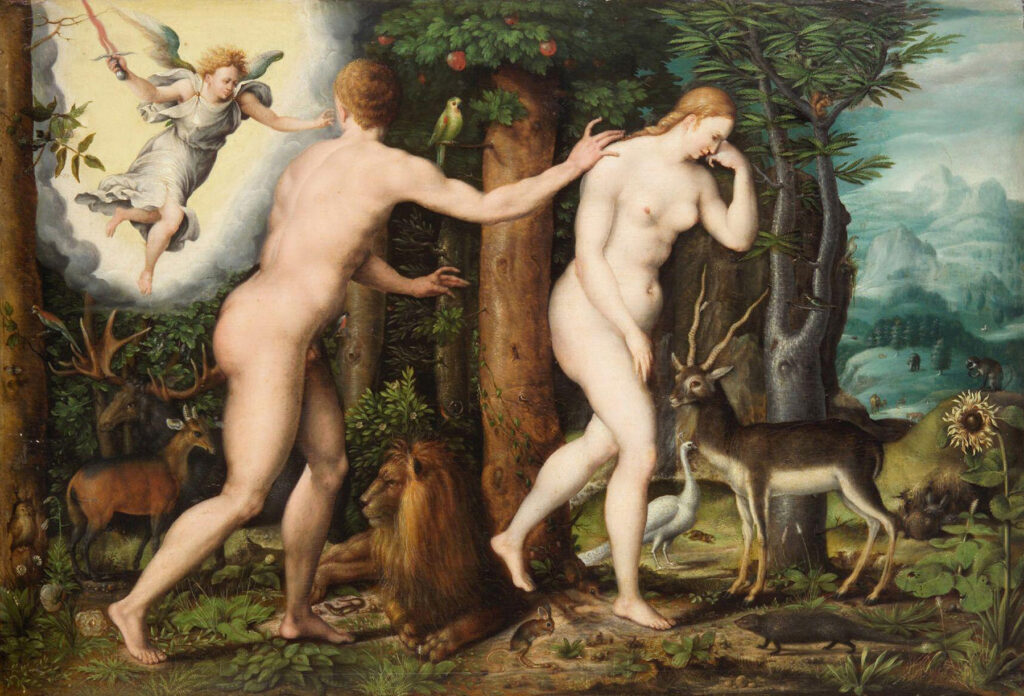
But Blumenberg went even further back, arguing that belief in the world-altering power of technology is not just an early modern idea but that it stretches to medieval philosophy and Christian theology. In the 1951 essay “The Relationship Between Nature and Technology as a Philosophical Problem,” he offered a concise formulation of an argument he would later develop into his momentous 1966 book Legitimacy of the Modern Age: The modern understanding of technology implements a uniquely Christian view of the relationship between humans and nature. Late medieval Christian thought exerted a latent but powerful influence on experimental science and its underlying assumptions, chief among them the notion that it is Man’s God-given right to dominate Nature. Technology places humans in an instrumental relation with the environment, compelling them to treat it as a resource for the development of new and synthetic realities. Blumenberg traced this core idea to Genesis, in particular the story of the Creation of Adam and his expulsion from the Garden of Eden. (Oddly, he did not mention Eve, nor that she was created from Adam’s rib.) In the Christian origin story, Blumenberg pointed out, humanity’s place on Earth is defined by Adam’s fall, and during the late medieval period, Man’s expulsion from Eden was translated into a particular understanding of human purpose: To make up for Adam’s banishment from the first Creation and redeem his fallen nature, humans must realize what Blumemberg called a “Second Creation,” an artificial reality that can replace Nature.
Other twentieth-century historians and philosophers—such as Lynn White, Evelyn Fox Keller, Simon Schaffer, and Akeel Bilgrami—have also discussed how medieval theology informed early modern, experimentalist understandings of nature. In his 1967 essay “The Historical Roots of Our Ecologic Crisis,” White argued that locating the roots of technology in Christian theology exposes the deep connections between technology and hostility to nature in Western culture. In a 2010 essay, Bilgrami drew special attention to a particular medieval Christian doctrine that placed God as the divine Creator who exists outside the world.2 This idea, captured by the rather poetic phrase “Deus absconditus,” implies that earthly reality is bereft of divinity, and it laid the groundwork for a mechanistic concept of nature as inert, brute, or even, according to Isaac Newton, stupid. When in the early seventeenth century experimental scientific communities in cities like London and Amsterdam forged alliances with a newly powerful merchant class, the medieval Christian notion of a world from which God has absconded opened the door for an instrumental understanding of nature. Now the natural world could be framed as a mere resource available for human control, manipulation, and enrichment.
But Blumenberg made a claim both more specific and more radical: He argued that the medieval conception of the Second Creation prefigured the revolutionary technoscientific project that came to define the twentieth century—namely, the creation of a new synthetic reality. “What a technician in an American laboratory has to say about the meaning of his work is likewise expressed from the projects propagated by the East: ‘Here the world is being created a second time!’” he wrote.3 When he described lab science as a form of creationism, Blumenberg was referring to the technoscientific arms race that defined the geopolitical contest of the Cold War, in the wake of the invention of atomic power during the first half of the twentieth century. Significant advances in particle physics had culminated in the synthesis of entirely new atomic elements—like plutonium (in 1940–41) and promethium (in 1945)—the discovery of nuclear fission, and the creation of atomic weapons in the form of the plutonium and uranium bombs. Blumenberg understood the ontological significance of that moment, of the advent of an artificial physical reality. Not only did the world now contain atomic particles that did not exist before; human-made artifacts could destroy life on Earth.
Blumenberg’s understanding of modern technology as instantiating the idea of the Second Creation is strongly marked by his concern with atomic power. In the case of nuclear fission, the link between the creation of a new synthetic phenomenon and the destruction of the world is both direct and obvious. But the notion of the “Second Creation” has also been invoked more recently to make sense of contemporary computational technologies. In The Earthly Community: Reflections on the Last Utopia (2022), the Cameroonian political theorist Achille Mbembe uses the very phrase when he describes, among other things, the “technologies that process and transport gigantic data sets,” that “we use in the hope of dominating nature.” He too, alludes to the determination of scientists and engineers to make up for humans’ alienation from nature by creating synthetic realities that could destroy the world. He links the creation of an additional technological layer around the Earth to the moderns’ contempt for traditional ways of inhabiting the Earth, which are grounded in a given nature, as opposed to the experimental notion of nature that is the foundation of modern science and technology.
Unoriginal Sin
The force of Blumenberg’s argument partly derives from the context in which he wrote, in Germany soon after the end of World War II. But his analysis has important wider implications for understanding modern technology: Its power cannot be grasped by remaining narrowly focused on the technical and physical capacities of artificial systems themselves. What should be considered foremost is the wider nexus of ideas from science, theology, philosophy, and art that lend technology its power.4 Tech elites themselves seem keenly aware of this.5 In his 2014 book Zero to One, Thiel put forward a creationist vision of innovation: It is not about competition but about making something “entirely new.”6 AI-industry insiders openly speak in eschatological terms. The computer scientist Geoffrey Hinton, the Nobel Prize laureate known as the “godfather of AI,” told the BBC in 2024 that there was a 10 percent to 20 percent chance AI would lead to human extinction in three decades. Jacob Coxon, an engineer who had previously worked at OpenAI and resigned from Anthropic earlier this month, merely shortened the time frame when he recently wrote on X, “The people building AI earnestly believe that it could kill us all by the end of the decade.” Sam Altman, the CEO of OpenAI, has called his company’s quest to create super intelligence a “Manhattan Project for AI” and has stated on his blog, “It will not all go well. The fear and anxiety about AI is justified; we are in the process of witnessing the largest change to society in a long time, and perhaps ever.”7
Blumenberg’s philosophical argument that the reality-transforming power of revolutionary technology partly derives from theology seems to belong to the cultural unconscious of AI discourse itself. Linking revolutionary technology with Christian Creation and destruction stories is not an original move; it follows a deeply familiar, culturally engrained script. In other words, tech-industry representatives are not, in fact, indicating a way of moving from zero to one. Their theological posturing does not signal the emergence of a new species of intellectuals—despite what Evgeny Morozov suggested in these pages last year. If anything, it rehashes old tropes while forgetting history opportunistically. Better instead to read Blumenberg’s essays and see precisely how he connects revolutionary technology and political theology.
Unlike the tech industry’s discourse, Blumenberg makes clear how deeply the investment in technology as an agent of history is informed by hostility to nature, in two ways in particular.
The first concerns the notion that humans are alienated from nature. After Marx, it might be tempting to attribute this estrangement to relatively recent technological developments, notably the industrial mode of production invented in the nineteenth century. But as Blumenberg argued, the Christian story of the creation of humankind is itself a story of alienation, of Man’s banishment from Eden. The human subject of Christianity is an estranged being by definition and condemned to make a life for himself outside nature.8 After Adam becomes a wandering soul, subduing nature through mastery and control is his only chance to secure a meaningful life. The notion that nature is an external force that needs subjugating, from which to extract resources, is thus a profoundly Christian idea.
Blumenberg’s other main argument is that technoscience endangers the world not just in a material way (e.g. as an empirical consequence of new types of physical processes like nuclear fission) but also in a metaphysical sense. For a new world to be created, the world as it is must be destroyed. Or, as Blumenberg put it, the Second Creation turns nature into a “world apparatus,” a mere resource for human creativity. Once the Earthly environment is instrumentalized this way, key features of that first nature can be transferred to the second so that the latter can usurp the former’s place. Most prized among these features, Blumenberg argues, is “autonomy,” which he described as an entity’s ability to sustain its own being. Creating autonomous machines implies dismantling the autonomy of nature and conferring self-sufficiency to other entities like humans or technology instead.
Unmaking Society
Blumenberg’s writings, with all their implications for the historico-philosophical origins of today’s tech revolution, offer important lessons about the type of interventions that could rein in its excesses and address its harms to human communities and natural habitats. If belief in the world-transforming power of technology is deeply cultural in nature, then narrow and technical approaches to address the negative impacts of technological innovation are insufficient. At least since the start of the colonial and industrial eras, revolutionary technology has unleashed environmental and social destruction on the world. Some pragmatic theories of the social implications of technology, which became dominant during the twentieth century, tend to present these effects as unintended consequences. In fact, the world-destroying power of technical systems is inscribed in the very idea of modern technology, not only in infrastructure but equally in cultural discourse and philosophical understanding. Revolutionary technology sows the seeds of destruction in multiple dimensions—technical and symbolic—at once.
Blumenberg’s work also helps identify the target of revolutionary technology’s destructive force. Is it liberal democracy? A recent manifesto by Palantir attracted significant attention for rejecting pluralism, and the post–Silicon Valley breed of tech industrialists often attacks the rights- and evidence-based liberal international order in place since World War II. But Blumenberg’s analysis suggests a more fundamental aim. The Catholic priest and theologian Paolo Benanti, an adviser to Pope Francis on the ethics of AI, has hinted at precisely what precisely what that might be. In a recent essay with the title “American Heresy: Should Peter Thiel be burned at the stake?,” Benanti argues that the true objective of the current generation of tech overlords is to undo existing conditions for reflexive self-governance. As he puts it: When liberal democracies adopt AI technologies, “they acquire more than only software: they import an ideology that considers transparency to be an obstacle and public debate to have become an unaffordable luxury,” and they imply that society “is incapable of governing itself.”9 The objective of tech companies like Palantir is to dismantle the infrastructural and discursive conditions for collective autonomy.
By drawing on Blumenberg’s philosophical understanding of technology, it becomes possible to further expand this important argument. Efforts to impose an ideological vision on society and government through the backdoor of technology adoption take shots at more than the political-legal arrangements of liberal democracy. They attempt to weaken the existing societal structures that support individual and communal autonomy, such as social rights, the welfare system, and local democracy. Crucially, these collective arrangements were realized during the nineteenth and twentieth centuries precisely to counter the destructive consequences of that other technological revolution: industrialization. The efforts of today’s tech elites to dismantle the conditions for self-governance amount to a wider attempt to turn back the clock on fundamental accomplishments of the solidarity movements of centuries past—namely, the invention of society and the social individual as autonomous entities, separate from the state, industry, and the family.
This insight can be expanded further still. Blumenberg singled out “autonomy” as a defining feature of modern technology. He pointed out that the origin story from Genesis, as interpreted in the late medieval take on the Second Creation, enables the transfer of autonomy as an attribute of nature via God to man and then to man-made machines. To clarify this point, Blumenberg returned to the ancient Greek understanding of nature as autonomous. He quoted Aristotle, who offered the brilliant definition of nature (fusein) as that which carries its purpose within itself. ancient Greeks understood nature to be self-sustaining. The story of the Christian Creation strips nature of its autonomy and confers it onto God the Creator, as God assumes the role of the ultimate cause of all things. Then in the early modern period, when the idea of the Second Creation enabled redefining nature in instrumental terms, autonomy was transferred to other beings, humans and human-made artifacts. Marvels of the Renaissance included self-moving machines such as da Vinci’s mechanical knight.10
Seen against the broad philosophical horizon sketched by Blumenberg, the tech and AI revolutions look like attempts to dismantle the conditions for collective autonomy. They target the fundamental capacity of both society and nature to be self-sustaining. Which is also to say that the conferral of autonomy onto technology is a metaphysical act and that the problems posed by contemporary tech and AI cannot be solved within a narrow, empirical frame that understands technology’s harms principally in terms of its negative consequences for specific communities and environments. Such impacts are a major threat, no doubt, but countering them will require more than challenging particular technological and infrastructural developments, such as the construction of gigantic data centers in vulnerable environments. They will also require challenging fundamental cultural assumptions about the relations between man, nature, and the world that the revolutionary framing of technology has mobilized.
Vibrant Experimentalism
Blumenberg offers another crucial insight that can help address this challenge. In his early writings on technology and nature, as well as in his later book Legitimacy of the Modern Age, he discussed not one single philosophical tradition of experimentalism but at least two. Well before Bacon and other revolutionary scientists made the case for transforming nature with technology, a related but very different experimental vision of nature had been formulated, Blumenberg pointed out. It held that improvisation—finding things out by trying things out—is an attribute not only of humans and possibly machines but of nature, too. Call this “vibrant experimentalism.” Blumenberg traced the idea all the way back to the ancient Greek philosophy of Epicureanism and its belief in the underdeterminacy of reality, the plurality of worlds, and the contingency of creation.
For Blumenberg, the crucial text in this tradition is Lucretius’s De Rerum Natura, an epic poem from the first century BCE that was long forgotten and then rediscovered in Italy during the early Renaissance. The text presents nature as being itself profoundly experimental, relatively autonomous, and with the capacity for self-determination. For Lucretius, the world did not come about through a sovereign act of divine creation but from an immanent worldly dynamic he called clinamen, or “the swerve.” This is a generative force that sparks creation through contingent deviation, emerging from events that might not have occurred. For an eternity, atoms followed their trajectory without touching, but then at one moment an unexplainable event took place that made them collide. Their unexpected encounter created the world. For Blumenberg, this ontology of generative contingency exemplified a path not taken in modernity. The scientific experimentalism of the controlling, Baconian, type became dominant in the West, but another kind of experimentalism is possible.
The vibrant Lucretian conception of nature, which defines it as both enchanted and underdetermined, appears in many different intellectual traditions. It was advocated by free-thinking scientists, philosophers, and theologians in the early modern period: Alchemists like Paracelsus and Dissenters in sixteenth-century England and the Low Countries put forward pantheistic conceptions of nature as endowed with, to use Bilgrami’s phrase, “an inner source of dynamism.” This approach can also be recognized in epistemic, spiritual, and aesthetic approaches as diverse as Chinese Daoist philosophy; the complexity science of Ilya Prigogine and Isabelle Stengers, Lynn Margulis, and Merlin Sheldrake; and the experimental musicology of John Cage and Pauline Oliveros. Each of these very different strands of work attaches central importance to improvisation, as a generative capacity of both humans and other-than-human entities. Put quickly: There is no divine plan, and everything that exists has come into being through contingent deviation, by trying things out and learning by doing. In the Lucretian creation story and other strands of vibrant experimentalism, experimentation is entirely compatible with worldly belonging, as well as with principles of collective autonomy and historical pluralism.
Indeed, the culture of improvisation is an important strand of radical and progressive movements for social and environmental change, as Sheila Rowbotham beautifully showed in her feminist history Dreamers of a New Day: Women Who Invented the Twentieth Century (2010). This other, vibrant, experimentalism makes clear that opposition to Baconian techno-experimentalism does not solely or primarily come from religion and that contemporary ideological struggles over technology are not singular. These cannot be reduced to a monolithic conflict between a God-defying technoscience versus a Christian civilizing mission. Rather, today’s tech revolutions pit against one another what are no less than opposing worldviews, perhaps most prominently two radically different kinds of experimentalism. On the one hand, there is Baconian domineering experimentalism, which asserts the unconditional right of science and engineering to intervene in nature and manipulate reality, accepting—or even flaunting—the destruction of the world as a possible consequence. On the other hand, there is Lucretian vibrant experimentalism, which affirms the generative contingency of human and other-than-human beings, communities, and worlds. To understand one of the defining ideological conflicts of our time in such Blumenbergian terms has a crucial implication: Successfully opposing modern technology will not require rejecting experimentalism; it will require expanding vibrant experimentalism to recover emancipatory politics in our technology-intensive, ecologically challenged age.
The media today bring daily news of the devastation wrought on communities and environments by not-quite-natural disasters—from heatwaves and forest fires in Europe to flash floods and the collapse of glaciers in Asia—all of which bear the hallmarks of human-induced environmental degradation and the legacy of scientific, industrial, and technological revolutions. It is tempting to blame the mind-boggling hubris of contemporary tech elites and their determination to double down on transforming reality for these overwhelming displays of technoscience’s destructive power. But a harder realization is called for: The destruction of habitual worlds by means of science and technology is historically irreversible and its aftermath will reverberate for decades, if not centuries.
In the face of this, vibrant experimentalism can easily look like a powerless proposition. What difference could it make to affirm the generative capacity of human and non-human beings when there is so much destruction and loss? But vibrant experimentalism also invites another type of response. Even in the presence of devastation and grief, improvisation remains available as a modality of existence—it is possible to go on in a different way, to continue in another register, another key. The twentieth-century Hungarian philosopher Ágnes Heller gives a compelling definition of emancipation as a form of experimentation. In Can Modernity Survive?, published in 1990, she defined emancipation as the continuous testing of “norms from everyday life.”11 This mode of experimentation—of learning to live otherwise by trying things out, of challenging oppressive habits by attempting to let go of them—directs attention to routines and the part they play in propping up the technological systems that today pose as, to return to Blumemberg, a new “world apparatus.” Shifting habitual dependencies on technology and transforming the underpinning architectures of everyday life that sustain these dependencies—one by one, patiently, and where possible playfully—is one of the surest ways to prevent Earth-altering technology from evacuating contingency from reality. For those who inhabit a world of vibrant experimentalism things could be otherwise, even as the tech proselytizers for the Second Creation do their best to make inevitable the destruction of the world.
- Bacon quoted by Ian Hacking in Representing and Intervening: Introductory Topics in the Philosophy of Natural Science. (Cambridge University Press, 1983) 246. The full quote reads: “He saw that observation of nature teaches us less than experiment. (‘The secrets of nature reveal themselves more readily under the vexation of art than when they go their own way.’) … He told us to experiment in order to ‘shake out the folds of nature.’ We must ‘twist the lion’s tale.’” ↩︎
- Akeel Bilgrami, “The Wider Significance of Naturalism: A Genealogical Essay,” in Naturalism and Normativity, eds.Mario de Caro andDavid Macarthur (Cambridge University Press, 2010). ↩︎
- Hans Blumenberg, “The Relationship between Nature and Technology as a Philosophical Problem,” History, Metaphor, Fables: A Hans Blumenberg Reader, eds. and trans. Hannes Bajohr, Florian Fuchs, and Joe Paul Kroll (Cornell University Press 2020 [1951]), 312. ↩︎
- In making this point, Blumenberg proposed to understand “the signature developments of the modern age—science, technology, art, and power—in terms of the unity of their origin in the historical process whereby meaning is imparted by being. ” He went on to note, “The problem of technology cannot be torn from this unity as something to be formulated or solved on its own.” This remains as true in the twenty-first century as it was in the twentieth. Blumenberg, “The Relationship between Nature and Technology,” 313. ↩︎
- Beth Singler, “The AI Creation Meme: A Case Study of the New Visibility of Religion in Artificial Intelligence Discourse,” Religions 11, no. 5 (2020), 253. ↩︎
- This is Thiel’s idea of vertical progress, according to which the defining feature of a successful company is creating completely novel things as opposed to sustaining inherited success. Senra, David, host. 2023. Founders Podcast. Episode 278, “Peter Thiel’s Ideas” December 19. Podcast, 56 min., 33 sec. https://www.youtube.com/watch?v=GmmuNVv4ehE&t=131s. ↩︎
- Altman’s emphasis on the earth-shattering powers of this new technology presumably serves to assert its world-historical significance and thereby consolidate its revolutionary credentials—as well as its worthiness for unprecedented investments. ↩︎
- Blumenberg wrote: “That man, according to his essence, should be capable of confronting and opposing nature—of relating to it through power and violation—is a possibility that can be understood only against the horizon of Christian ontology. […] Only a human being, who […] is placed into nature, rather than having emerged from it, […] can potentially be a ‘technical’ being, forced to live in confrontation with nature.” See “The Relationship between Nature and Technology,” 307. ↩︎
- My translation of the French. ↩︎
- Stefano Gulizia, “Automata, Renaissance,” Encyclopedia of Renaissance Philosophy (Springer, 2022) 269–270. ↩︎
- The full quote reads: “Norms of everyday life are opened up for rational scrutiny, testing, re-confirmation and rejection, not only in terms of extreme tension, but continuously.” Ágnes Heller, Can Modernity Survive? (Polity Press, 1990) 58. ↩︎