The Poison and the Cure
The Life and Afterlife of French Theory
The Frenchmen: Or, My Life in Theory by Emily Eakin
School of the South: The Colonial Roots of French Theory by Onur Erdur
In 2005, Alain Badiou argued that in the second half of the 20th century, there was a “French philosophical moment” comparable to the peaks of classical Greece and Enlightenment Germany. Badiou was not an impartial observer—he described himself as perhaps the era’s “last representative”—yet no one would seriously dispute that les trente glorieuses produced a blaze of intellectual activity that radiated around the world, transforming not only academic study but the wider cultural atmosphere. There, however, consensus stops.
Was this “moment” purely, or even primarily, a philosophical one? It was born with an anthropologist, Claude Lévi-Strauss, borrowing a framework from linguistics, and among the central aims of the resulting method, “structuralism,” was to topple a philosophical movement: the existentialism of Jean-Paul Sartre and others. And while many of the leading thinkers who embraced structuralism were educated, like Lévi-Strauss, in philosophy, they also worked in other areas of the humanities and social sciences. Roland Barthes was concerned with mass culture and canonical literature; Louis Althusser with interpretations of Marx; Jacques Lacan with Freudian psychoanalysis; and Michel Foucault with history, and excavating the logics underpinning a range of institutions and practices—medicine, psychiatry, prisons, sexuality. The writing of Jacques Derrida, meanwhile—for a time “the sexiest philosopher on the planet,” in the words of the literary critic Terry Eagleton—amounted less to a conventional contribution to philosophy than a thoroughgoing critique of its founding assumptions. “I never thought I had something to say philosophically,” Derrida reflected in 1991—and his example was chiefly followed by literary critics.
Such a range of interests and allegiances called for a broader rubric. As Fredric Jameson put it, considering the debate about whether Foucault was a philosopher or a historian, “Well, that is why we have the word ‘theory.’ We don’t have to decide.” The catch-all term helped to smooth over other terminological wrinkles. “Structuralism” was a label its putative exponents tended to reject, or outgrow. Foucault complained in the English edition of The Order of Things (1966), his “archeological inquiry” into the changing conditions of knowledge, that he had been unable to persuade the “tiny minds” of “certain half-witted ‘commentators’” that he had “used none of the methods, concepts or key terms that characterize structural analysis.” Barthes, having been a notably fastidious practitioner of the structuralist mode known as semiotics, developed into a representative of a free-spirited offshoot or usurper, “post-structuralism,” promoting readerly experiences of “plaisir” and “jouissance” (a near-sexual frisson).
“Theory” also encompasses a strikingly elastic pantheon of thinkers, as illustrated by a pair of recently published books. The New York Times editor Emily Eakin, in The Frenchmen, her convivial mixture of memoir and popular history, and the Berlin-based historian Onur Erdur, in his more scholarly and tendentious School of the South, both give space to Foucault, Derrida, and Barthes. Otherwise, their attentions diverge. Eakin, being concerned with “America’s theory craze,” writes about Lévi-Strauss, Althusser, Lacan, Gilles Deleuze, and the Belgian-born literary critic Paul de Man, whereas Erdur, exploring the formative impact of colonial experiences on postwar French thinkers, offers a different supporting cast, including Pierre Bourdieu, Jean-François Lyotard, and Hélène Cixous.
But the greatest divergence, or source of dissent, concerns whether the period constituted a golden age: one of the things that has always distinguished French theory is the extremity of its reception. Having achieved international prominence in the mid-1960s, theory underwent what the historian François Cusset describes as an “anarchic expansion” in the ’70s. Converts found it exhilaratingly radical and innovative, uncovering new techniques and areas of study, but Marxists, such as Jameson and Eagleton, were more skeptical. Others charged it with meretricious obscurity and dismissed its italicized neologisms and occasional quasi-mathematical formulae as a travesty of scientific inquiry. Theory was a favored target of conservative philosophers in polemical mode. Roger Scruton wrote of “a boiling tide of nonsense” that would “eliminate the possibility of rational argument” and “annihilate meaning.” Alan Bloom, in his bestselling broadside The Closing of the American Mind (1987), accused the French theorists of abetting “the suppression of reason and the denial of the possibility of truth.” The rehabilitative slant of Eakin’s and Erdur’s accounts indicates theory’s reputation has not recovered. To this day, Erdur writes, French theorists are accused of being “the intellectual originators of destructive social phenomena such as ‘fake news,’ ‘cancel culture,’ wokeness’ and ‘identity politics,’” suggesting that the record, more than two decades after the first postmortems began to appear, is still in need of straightening.
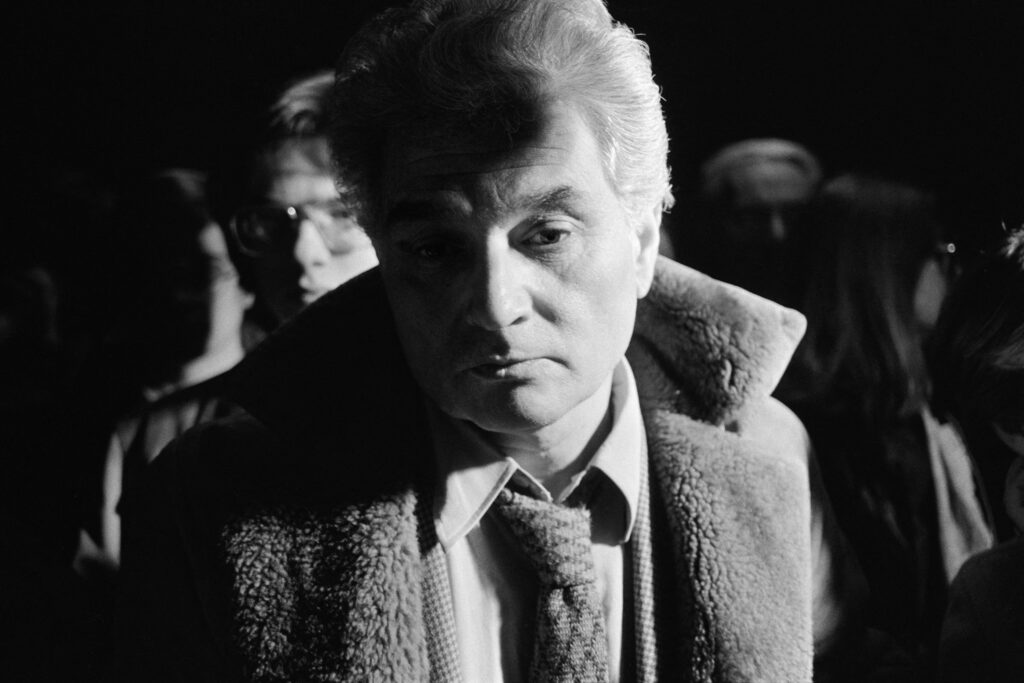
The origins of French theory are typically traced to Lévi-Strauss’s discovery in 1942 of Course in General Linguistics, a series of lectures delivered by the Swiss linguist Ferdinand de Saussure and published by his students in 1916 a few years after his death. Saussure studied language “synchronically”—not as it had evolved over time, or as it manifested in individual speech, but as a hermetic, structured system whose principal unit was the sign, composed of the “signifier” (sound-image) and the “signified” (denoted concept). The connection between these, he argued, was contingent and based in convention. Words do not have intrinsic meaning; sense is relational, an artifact of a word’s position in a system of differences: “cat” being distinct from “bat” and “mat” and so on.
Beginning with his technical tome The Elementary Structures of Kinship (1949),Lévi-Strauss turned this conception of language into a way of interpreting non-linguistic phenomena, such as marriage customs. Structuralism was akin to a kind of Copernican revolution. Language preceded, determined, and all but displaced the “subject”—the autonomous human being, the Cartesian cogito, the political actor, the intending author—in what amounted to a repudiation of Sartre’s stress on the idea of individual freedom. The goal of the human sciences, Lévi-Strauss declared in The Savage Mind (1962), was to “dissolve” Man––or as Althusser suggested in For Marx (1965), reduce the myth of man “to ashes.” Others transposed Saussure’s insights to their own specialisms, notably Barthes who, in a series of newspaper columns collected under the title Mythologies (1957), illustrated that everything from royal cruises to laundry detergent could be decoded as a sign-system.
But the authority of structuralism was soon thrown into question, when in 1966, Derrida, then a relatively unknown 36-year-old, derailed its launch party in the US—a splashy conference backed by the Ford Foundation and held at Johns Hopkins in 1966 to which he had been belatedly invited. His lecture “Structure, Sign, and Play in the Discourse of the Human Sciences,” which closed the conference, was a “demolition job,” in Eakin’s words, of the paradigm pioneered by Lévi-Strauss (who was apparently invited but couldn’t make it), later mythologized as the dawn of post-structuralism.
Trained in the predominantly German phenomenological tradition, Derrida was exercised by the notion that Western philosophy was beholden to what he called “a metaphysics of presence.” This involved positing a “privileged Origin that commands, guarantees, and perpetuates meaning,” as Edward Said explained, a telos toward which all thought aspired—truth, Being, reality, essence, substance. By showing that meaning was not pre-given but a shifting emanation of relationships, structuralism had successfully ruptured this illusion. Yet in his Johns Hopkins address, Derrida argued that its elevation of language was in danger of reinstating the first principles it had supposedly diffused into a network of differences.
It was in Baltimore that Derrida first met Paul de Man. Their friendship would become a key axis in theory’s post-structuralist phase—and in its conquest of the American academy. De Man arranged a visiting position for Derrida at Yale, where “deconstruction,” the philosophical mode of close—many would say myopic—reading that Derrida patented took particular hold. The Johns Hopkins paper was an early exhibition of this technique, which sought to show how the logic of a given text is not only underpinned by, but—the key difference from structuralism—undermined by relegating or excluding one term in a series of classic binaries: writing and speech, male and female, center and margin, or in Lévi-Strauss’s case, nature and culture. Taking The Elementary Structures of Kinship as an example, Derrida argued that Lévi-Strauss’s discussion of the incest prohibition undoes the opposition on which his text relies—the taboo, in Lévi-Strauss’s account, being at once norm-based (cultural) and universal (natural). Derrida used one of his notorious neologisms, différance, conjoining the ideas of “difference” and “deferral,” which he later deployed as a lever to wrench apart the binaries in which structuralism was still caught: to convey the idea that meaning was both produced by differences and unstably distributed among them, and could therefore never be firmly located, the relations between words constituting an infinite chain.
To Derrida, structuralism’s “nostalgia for origins” and residual “desire for a center” presented a limit to what he called “play,” and to embrace play would be truly to “pass beyond man.” A similar shift—from hermetic structures to the affirmation of what escapes them—can be seen in Barthes’s evolution in the years after the Johns Hopkins conference, from the technical analysis of The Fashion System (1967) (“nearly unreadable,” in Eakin’s view), via S/Z (1970), his painstaking and exorbitant book-length commentary on a Balzac novella, to the teasing fragments of The Pleasure of the Text (1973), which championed an “erotics” of reading, emphasizing bodily enjoyment over hermeneutic closure.
The mid-60s saw the publication of a volley of landmark books in France—Foucault’s The Order of Things and Lacan’s Écrits; two by Althusser (For Marx and Reading Capital); and three by Derrida, Writing and Difference (which collected the Johns Hopkins lecture), Speech and Phenomena, and Of Grammatology, the last containing commentaries on both Lévi-Strauss and Saussure. The explosive rise of this critique of reason seemed to prefigure the revolutionary unrest of May 1968, which in turn lent the ideas momentum, even though, unlike Sartre, many of the intellectuals associated with theory did not join the students and strikers.
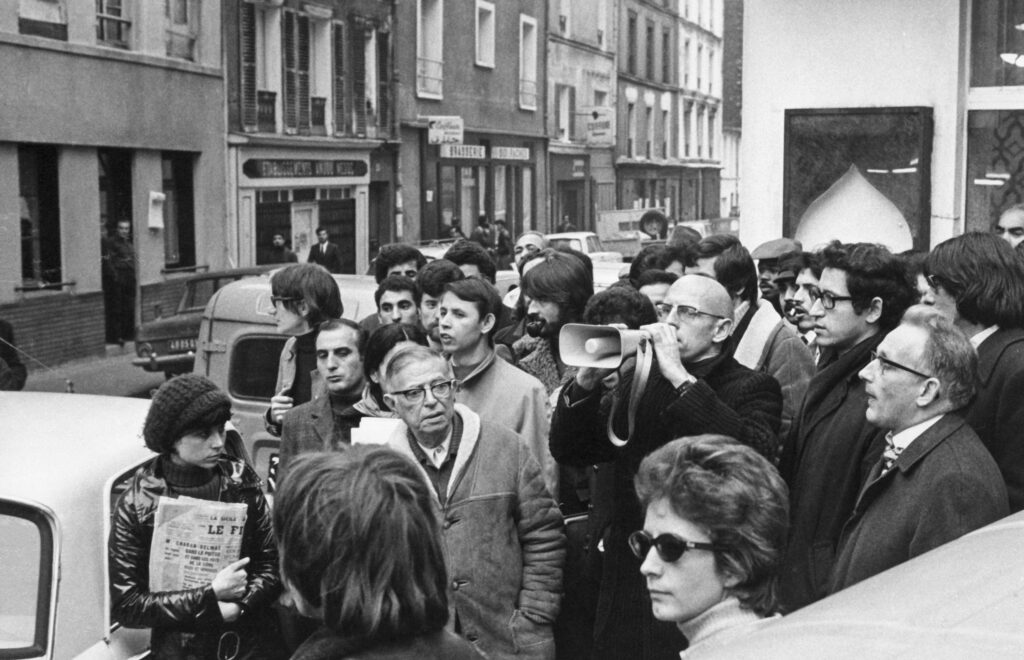
The novelty of Erdur’s School of the South is its suggestion that the decisive political context incubating this mode of thought was not les événements but decolonization, in particular the Algerian War (1958–62), which, Erdur writes, precipitated “the collapse of a certain political and cultural order in French society.” A striking number of French theorists spent time in French North Africa, serving in the army or teaching; several were born there, including Cixous, Jacques Rancière, and Derrida, who grew up in a French-speaking Sephardic family in Algiers.
Erdur’s objective is to show that such experiences shaped their thinking, but the details of his case are unevenly convincing, the connections more robust, or intimate, in some instances than others. Derrida was expelled from his school in Algiers at the age of 12 under the Vichy Jewish quotas and never felt at home in Paris, later describing himself as a “child in the margins of Europe.” It is easy to see how his background sharpened his philosophical sensitivity to what he called the “violent hierarchy” embedded in the binaries of Western thought. But the fact that Foucault taught in Tunisia for a couple of years, or that Barthes vacationed in Morocco and resolved to write an autobiographical novel while in Casablanca, is less persuasive evidence for the “colonial roots of French theory,” as Erdur’s subtitle has it. (Barthes’s “vision of a literary existence” was less a development of his theoretical work, which predated his visits to Morocco, than an expression of dissatisfaction with it.)
Eakin is the more skillful and ambitious storyteller, her 48 punchy chapters weaving intricately back and forth in time, lighting on key friendships and rivalries and critical exchanges—Derrida attacking Foucault’s reading of Rousseau, de Man later challenging Derrida’s. The resulting mosaic enlivens—if also simplifies—what Eakin admits can seem an “intentionally rebarbative” body of thought. Like Erdur, Eakin writes extensively about the theorists’ lives, including their personal lives, aiming to recover what she calls “the hidden human element beneath their often stringent antihumanism”—we learn that Barthes was “prone to a potbelly” and that Lacan was holding a “plate of coleslaw” when he had a run-in with Derrida at Johns Hopkins. Another leavening ingredient is the book’s autobiographical arc, which traces Eakin’s sophomore bewitchment with theory to postgraduate disenchantment, when she abandons her PhD in favor of a career in journalism.
Eakin’s memories of her student days are not exactly rife with dramatic incident—essay crises predominate, reaching a climax with her senior thesis (she fortunately earns “a generous magna cum laude plus,” despite some mixed feedback). But her trajectory is emblematic, a prism through which she surveys the wider story of the Anglosphere’s infatuation with French theory. Though individually notable in their native land, it was in the US, via popularizers such as Jonathan Culler and abettors such as de Man, that theory became a coherent and dominant force within the academy. (In Britain, the philosopher Christopher Norris and the contributors to the film journal Screen alsotook up the cause.) Why did American literature departments prove so hospitable, or susceptible? An affinity must have been suggested by theory’s exaltation of language, congenial to scholars who regarded words as their métier. Theory also promised to lend an aura of rigor to literary study, a congenitally insecure discipline which since its inception in the early 20th century had been scouring for ways of legitimizing itself via approximating scientific discourses, hoping to dismiss charges that it was too intuitive and hedonistic to be a serious subject.
In Cultural Capital: The Problem of Literary Canon Formation (1993), John Guillory argued that the embrace of French theory was the product of a larger crisis. The social value of a literary education was being eroded by the rise of a “professional-managerial class,” which was usurping the old bourgeoisie. Theory appeared to present solutions: the technical fastidiousness of deconstruction mimicked “the technobureaucratic labor” of the ascendant PMC. It not only added a philosophical luster to the measly scrutiny of poems, it licensed the study of any “text,” to use the vogueish term, enlarging the embattled category of literature to colonize other fields, to the degree that literary study could seem not the fusty means to an obsolete sentimental education but the Ur-discipline underlying all the others.
If these were some of the priming circumstances, what were the subjective attractions of this body of work? It provided a political outlet, a subversive enclave as neoliberalism and neoconservatism asserted themselves. “Politics had gone dormant,” Eakin reflects of the late 1980s. “Theory made thinking feel like doing.” It was also glamorously difficult and overtly heterodox, its Nietzschean dash an invigorating contrast to the staid temper of Anglo-Saxon rationality. The “essential” enemies, Barthes wrote in Mythologies, were “bourgeois norms,” and all the theorists were—at different scales and in different domains—leery of or hostile towards the givens of the social world, and of the seemingly natural or self-evident (“what-goes-without-saying,” in Barthes’s formulation). It was a mode of thought that traded in the exposure of hidden forces—from the silent workings of domination through institutions (what Althusser called “ideological state apparatuses”), to the unacknowledged partitions and exclusions that underlie thinking itself, the madness buried in the foundations of reason (the “rifts” disturbing “the deepest strata of Western culture,” as Foucault wrote in The Order of Things).
To identify as a theory-head “marked you as a member of the counterculture, different from—and critical of—the docile horde,” Eakin reflects. Semiotext(e), the small press founded by Columbia professor Sylvère Lotringer, did much to enhance theory’s punkish glow, extending its frontiers beyond elite universities. Its Foreign Agents series, launched in 1983, published English translations in sleek minimal editions—On the Line by Deleuze and Félix Guattari, and Simulations by Jean Baudrillard—which, as the cultural theorist McKenzie Wark noted, helped make theory “the lingua franca of creative workers, avant-garde artists, and downtown bohemians.” Eakin remembers feeling that she was “perched at the frontiers of thought.”
Education systems, Althusser, Bourdieu and Foucault stressed in different ways, are engines for reproducing inequalities and oppressive norms, and theory’s distance from the academic establishment conferred a dissident charge, as did its stylized insouciance toward disciplinary boundaries. In learning to “do” theory, one was not becoming a specialist but undergoing a holistic intellectual training, less acquiring knowledge than transforming one’s relation to it. Theory’s refreshment of perception—a classic aim of avant-garde art—and demystifying methods seemed applicable to virtually every aspect of modern life, including one’s inner life, its implications intimately existential: “What seemed merely an intellectual exercise was actually a way of being,” Eakin reflects.
But what seems to have seduced readers above all was theory’s style—the excitements of the prose itself, some of which resembled a species of experimental literature. Perry Anderson compared Lacan to the poet Mallarmé, Lévi-Strauss to Wagner, Foucault to Artaud and the theologian Bossuet. Introducing the collection Structuralism and Since (1979)—one of many introductory books published in these years—the critic John Sturrock stressed that Lévi-Strauss, Barthes, Foucault, Derrida, and Lacan were “also writers.” Dan Sperber, in the opening essay, is yet more emphatic: “Lévi-Strauss is not simply a scholar; he is also an artist.” The anthropologist’s memoir of his fieldwork in Brazil, Tristes Tropiques (1955), considered a literary masterpiece, concluded with a nearly page-long sentence of rising lyricism, clinched by a humorous swerve, summoning:
“the possibility, vital for life, of unhitching, which consists—Oh! fond farewell to savages and explorations!—in grasping, during the brief intervals in which our species can bring itself to interrupt its hive-like activity, the essence of what it was and continues to be, below the threshold of thought and over and above society: in the contemplation of a mineral more beautiful than all our creations; in the scent that can be smelt at the heart of a lily and is more imbued with learning than all our books; or in the brief glance, heavy with patience, serenity and mutual forgiveness, that, through some involuntary understanding, one can sometimes exchange with a cat.”
Foucault began The Order of Things with a reference to a Borges story and a bravura analysis of Velázquez’s Las Meninas, and concluded it with a sonorous peroration which looked ahead to “some event of which we can at the moment do no more than sense the possibility” that might erase man “like a face drawn in sand at the edge of the sea.” The closing words of Derrida’s “Structure, Sign, and Play” evoke an impending transformation with similarly heady foreboding: “the as yet unnamable which is proclaiming itself and which can do so, as is necessary whenever a birth is in the offing, only under the species of the nonspecies, in the formless, mute, infant, and terrifying form of monstrosity.”
But Theory’s style was also a source of revulsion. If the idiosyncratic demands of Derrida’s writing—with its coinages, convoluted syntax, and highly self-reflexive patterning—were a thrilling indication of intellectual rigor among his acolytes, they were merely proof of self-indulgence to the uncharmed. Like many of the theorists, unsurprisingly given their hyper-attentiveness to language, he used and made much of wordplay, ingeniously and fruitfully in some cases, but issuing in free-associative binges in others. Glas—his 1974 book that is printed in two columns, one devoted to Hegel, the other to Jean Genet—is a particular offender: “The phallic flower is cuttable-culpable. It is cut [se coupe], castrated, guillotined, decollared, unglued”; “Remain(s)—to (be) know(n)—what causes shitting” etc.
To lay even admiring emphasis on rhetorical skill tends to be double-edged. Jameson introduced Deleuze to his students by remarking, “He is a great writer, and this is a marvelous experience. I don’t care how true or false it is. . . . I would like you to feel the excitement of this stuff, even when you don’t necessarily understand it.” The enthusiastic recommendation entails bracketing the substance. Anderson made a similar point, in a more cautionary tone: “The potential cost of a literary conception of intellectual disciplines is obvious enough: arguments freed from logic, propositions from evidence.” And note the chilly thesis of Hayden White’s essay on Foucault in the Sturrock collection: “The authority of Foucault’s discourse derives primarily from its style (rather than from its ‘factual evidence’ or rigor of argument).”
A central tenet of deconstruction was that the suspicion of style implicit in these qualifications is rooted in philosophy’s age-old distrust of writing itself. In Derrida’s telling, since Plato, writing has been denigrated as an ambiguous, unreliable derivative of speech; in his reading of the Phaedrus, he lights on the Greek word pharmakon, which he glosses as both cure and poison. Philosophy’s diminishment of writing was a way of managing—by compartmentalizing—the disturbing instabilities of all communication, of language itself. The dry austerity of analytic philosophy could be seen as an expression of this defensive impulse, an effort to deny or overcome its status as writing.
If French theory’s rhetorical qualities dented its philosophical credentials in some quarters, in others, it was this very conjunction that seemed so original and freeing. For Jameson, it was the “possibility of writing philosophy in a wholly new way” (which he traced to the pathbreaking versatility of Sartre) which constituted a “liberation from philosophy, a liberation toward theory”: an écriture that vaults over the guardrails between discourses. Part of what distinguished Barthes, Sturrock noted, was that he “showed that criticism, too, could be written, could offer verbal and conceptual excitements of its own while still engaging with the chores of interpretation” (or while shirking them: “I am offered a text. The text bores me. It might be said to prattle,” Barthes writes in The Pleasure of the Text).
The literary pretensions of these theoretical texts didn’t only ignite their reception, they shaped and arguably distorted it. That the corpus was often filtered through literature departments meant that it was often read out of its original context. Reading Derrida without any firsthand exposure to the philosophical tradition he was attempting to dismantle meant lacking an informed vantage point from which to detect straw man arguments or exaggerated claims to novelty. The result, as the English philosopher Peter Dews noted in his critical study Logics of Disintegration (1987), was “an astonishingly casual and unquestioning acceptance of certainly extremely condensed—not to say sloganistic—characterizations of the history of Western thought, as if this history could be dismissed through its reduction to a set of perfunctory dualisms.” Eakin writes that she blushes at the memory of “my college-age self, earnestly parroting Derrida’s critique of Plato’s Phaedrus . . . despite having only a glancing familiarity with the ancient Greek text.” This was surely part of theory’s attraction for the literature student––it was a springboard to the forbidding world of philosophy, without having to trawl through years of specialized instruction.
However crucial to its appeal, the style of French theory also poses what might be called difficulties of inheritance. The work was often resistant to paraphrase. It is hard to describe deconstruction without recourse to bespoke vocabulary like différance (which Derrida helpfully explained was neither a word nor a concept). As Said noted, the “nearly maniacal complexity” of Derrida’s prose “defies translation and perhaps even description.” That left emulation. John Guillory argues that style was “the actual mechanism of [theory’s] replication,” not least because the “fortunes of theory” were closely linked to the “charismatic persona of the master theorist”—ironic, given the end of the “author” proclaimed by both Foucault and Barthes, as well as the anti-humanist bias and anti-authoritarian impetus of French theory as a whole. The historian Tamara Chaplin, in Turning On the Mind, emphasizes the transformative effect of television on postwar French culture, giving new prominence to the “physical image” of the writer, who was now being sold along with their books. The magnitude of Derrida’s and Foucault’s celebrity is remarkable. The biographical approach of Erdur’s and Eakin’s books is telling in this respect. Framed by both as an attempt to historicize and humanize their protagonists, the interest in their personal lives is also indicative of the fame that can make them seem intellectually untouchable. For Guillory, their prose style—an “imitable effect”—transmitted their charisma, which was key to producing “discipleship.” “I had disappeared into theory,” Eakin recalls, “crudely aping the Frenchmen rather than thinking for myself.” In the introduction to The Years of Theory, Jameson wrote that “Hegel would not have wanted me to theorize the end of this very rich and exciting period with the contingent deaths of its ‘master-thinkers’”—many were dead by 1990, including Foucault, Barthes, and de Man—but this logic seems hard to resist, given their personal magnetism, performing to packed lecture halls and photographed in magazines.
The Frenchmen records two key moments in Eakin’s deconversion: In 1996, she was working at Lingua Franca,the publication that broke the story of a hoax in which the scientist Alan Sokal successfully submitted a jargon-rich parody of theory to the journal Social Text. The final tie was cut with Derrida’s death in 2004, when Eakin, while on maternity leave from her job as an “ideas” reporter at the New York Times, greenlit a caricatural obituary, prompting an outraged letter signed by thousands of scholars. It is as though Eakin needed to betray theory in order to expel it and recover from her delirium—“a multiyear breakdown I hadn’t realized I was having,” one by which “the entire culture had been touched.” Eakin’s volte-face mirrors the wider cultural retaliation, emboldened by the discrediting of several star theorists. Althusser strangled his wife to death in 1980; in 1987 came the revelation of Paul de Man’s wartime journalism for Nazi-controlled Belgian newspapers, providing a symbolic denouement in The Frenchmen.
By this time, post-structuralism had been damaged by the culture wars, in which it was blamed for giving rise to identity politics and besieging the Western canon, or, in the more extreme neocon counterattacks, charged with a relativism and nihilism that threatened civilization. French theory also drew criticism from the left, which saw it as abetting the “culturalization” of politics and its splintering into micro-interest groups, occluding shared conditions of exploitation. The “synchronic” bent of Saussurean linguistics had likewise, critics charged, led to a neglect of historical processes. Deconstruction’s fixation on details of texts such as a single pair of words, meanwhile, could be seen as extractive, its methodical subversion of cherry-picked oppositions amounting to an all-purpose, unassailable maneuver that silkily placed itself beyond critique.
However intellectually galvanizing, the critique of reason and overthrow of the subject clearly had politically incapacitating consequences. “Prefer what is positive and multiple, difference over uniformity, flows over unities, mobile arrangements over systems,” Foucault wrote in his foreword to Deleuze and Guattari’s The Anti-Oedipus (“hands down the weirdest stuff in the French theory canon,” Eakin writes), with its anti-Freudian celebration of the creative, oppositional power of desire (or “desiring-machines”). The affirmative focus on multiplicity, dynamism, and proliferating differences could paradoxically evoke an undifferentiated, impregnable mass, lacking the contradictions or strategic focal points through which power could be breached.
Theory could seem to transgress everything without transforming anything. In this, Terry Eagleton argued, it bore the marks of the spectacular but unconsummated “insurrectionary élan” of May 1968. Iconoclastic in impulse but shrinking from presenting a positive alternative to the existing order, theory reflected the abortive uprising’s vertiginous “blend of euphoria and disillusionment, liberation and dissipation, carnival and catastrophe,” a “kind of intellectual backwash to a tumultuous political era.” Theory may have struck a chord precisely because it chimed with the emergent late-capitalist reality it was gesturally ranged against. Its dissolution of the subject matched the dispersal of the classical agent of collective struggle under the neoliberal assault, with no obvious successor. Perhaps there was also something constitutionally ephemeral about a body of thought resistant to structures, something unsustainable about its institutionalization. As Peter Dews reflected, “Totalizing anti-totalization is just too contradictory a stance to last for very long.”
In many ways, however, the “French philosophical moment” never ended. Far from being overthrown, theory—not unlike neoliberal common sense—has been so comprehensively metabolized, achieved so thoroughgoing a hegemony, that it has become invisible, its “influence no longer obvious because it is everywhere,” as Eakin writes. There are the substantive legacies within academic study—what Cusset calls theory’s “detachable concepts,” now in wide circulation, from Lacan’s “mirror stage” and Foucault’s “biopower” to Bourdieu’s “cultural capital,” as well as the new disciplines which drew inspiration from it, including postcolonialism and cultural studies; its underground influence, too, persisted into the 2000s in the UK blogosphere spearheaded by Mark Fisher. And it has left a mark on popular culture—at least two generations of prominent novelists, among them Jonathan Franzen and Ben Lerner, bear the imprint of their theoretical education.
Eakin has in mind a more pervasive if intangible footprint. “For better and for worse,” she argues, “we are in some ways all like the Frenchmen now, expert decoders of our tirelessly signifying universe.” The better, for Eakin, is that theory “taught us a new way to think. Be skeptical. Be alert. Pay very close attention.” Such imperatives are hardly unique to French theory; they are surely ingredients of virtually any form of thought that seeks to question—to “denaturalize”—what we take for granted. The self-scrutiny implied by post-structuralism’s interrogation of reason and “scrupulous attentiveness to language’s complexities and contradictions,” as Eakin puts it, is a more distinctive bequest. “The quality and fecundity of a discourse,” Derrida argued at Johns Hopkins, can be gauged by how rigorously it probes its “inherited concepts”—and by extension, its inherited authorities. White’s suggestion that “the authority of Foucault’s discourse derives primarily from its style” implied that rhetorical craft is an underhand or domineering means of producing authority—not as transparent to reason, and not as consensual as evidence or argument. But, whether or not they advertise or acknowledge it, all forms of discourse have a style from which their authority partly derives. In this sense, the élan of French theory radicalizes and encourages us to reflect on a general problem of how to relate to imposing predecessors.
The contagion of style has not secured theory’s long-term legacy, but the ebbing of its authority and the charged atmosphere surrounding it ought to make room for a more level-headed, realistic, discriminating approach. We no longer have to pick a side, and so can acknowledge that enthusiasm and aversion are not mutually exclusive reactions but may be warring impulses, and can explore the middle ground between dismissal and wholesale acceptance. As with artistic avant-gardes, theoretical traditions are inherited in part by being outgrown: selectively adopted, repurposed and rejected—all of which requires a degree of distance. Indeed, the practice of thinking outside an author’s terms and finding one’s own is necessary not only to criticize their work but to appreciate it.
Jameson was onto something in his 1972 book The Prison-House of Language: “A genuine critique of structuralism commits us to working our way completely through it so as to emerge, on the other side, into some wholly different and theoretically more satisfying philosophical perspective.” Theory, in this vision, would be more than a phase, less something you grow out of than grow through, parsing its contributions from its limitations and its insights from its distractions. By questioning one’s awe as well as one’s impatience, one can develop a more nuanced attitude, not only independent-minded but even overtly self-interested. You can find the energy and confidence and irreverence of this creative, controversial “moment” inspiring without needing to declare your allegiance to French theory as a whole, instead revisiting the still-fresh texts that can still help us think, and before which we need be neither cowed nor contemptuous but are free to be curious, and productively ambivalent.