Not Yet Tomorrow
A Response to William Shoki
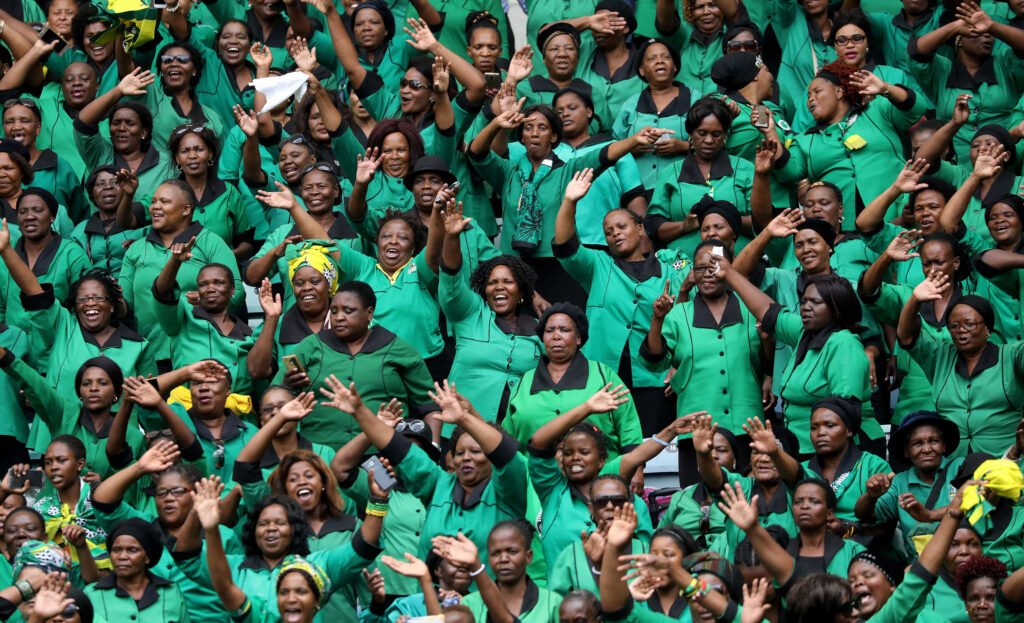
On June 30, as anti-immigrant marches began across Johannesburg, a few hundred men set out from a decaying compound in Diepkloof, Soweto, carrying sticks and knobkerries. At their head was a tall man wearing a black leather trench coat and a leopard skin headband—a hybrid martial style drawing on Zulu tradition, German uniforms, and The Matrix films. A brief clip posted by a local news station shows the marchers singing, full of theatrical menace. Were it not for that coat, the scene could have been shot at the height of the early-1990s violence that threatened to derail South Africa’s transition to democracy.
Back then, the Diepkloof compound and other grim men’s residences for mineworkers (aka “hostels”) were strongholds of the Zulu-nationalist Inkatha Freedom Party. The IFP wanted more regional autonomy for KwaZulu-Natal, and it tapped the workers as proxy soldiers for revanchists in the apartheid security establishment. The white generals wagered that the spectacle of “Black on Black” violence would give the ancien régime the upper hand in negotiations with Nelson Mandela’s African National Congress. And the hostel dwellers labored, bloodily, against the so-called “self-defense units” aligned with the ANC in the hope of resetting the balance of talks in their favor.
June 30 was not a sudden return to these old ways. More than three decades on, the hostels are squalid shells of the collapsed economy they once served, abandoned by the state and still ruled over by Indunas, the headmen who bossed the barracks on behalf of the white-owned mines. Diepkloof has for years been the scene of violent protests over a lack of water and electricity, stinking lavatories, and general decay. On May 19, 2025, apparently angered by the sale of hostel land and a possible setback to hoped-for renovations, residents stormed a nearby highway and began looting trucks. Khethokwakhe Ndawonde was one of two men killed that day. A 59-year-old father of four from KwaZulu-Natal, Ndawonde was caught under a truck in the chaos and crushed to death. His brother Bhungu told the Daily Maverick that Khethokwakhe had worked in construction before losing his job and becoming a recycler. One could not ask for a starker fable than this one about the violent and haphazard death of a skilled worker who had fallen out of the productive economy, surviving off of trash in the ruins of apartheid’s migrant labor system and its deindustrialized aftermath.
Ndawonde died amid a crowd raging against the failures of the post-apartheid years, demanding things that freedom was supposed to deliver: a hearing from city officials, decent housing, toilets not overflowing with feces, the stuff on that truck. Or perhaps he died in a melee provoked by an Induna with grievances of his own. Or on orders from his patrons. Or all of the above. Whatever the case, the hostel-dwellers were using violence to reset the terms of long-failed negotiations. A year later, this June 30, when other Diepkloof residents marched out of the hostel gates again, this time to demand the expulsion of foreigners from South Africa, had something fundamental changed?
William Shoki suggests so. June 30, he argues, represents a rupture between the post-apartheid period, when South African politics was organized around competing expressions of a demand for more and fuller freedom, and a new, bleaker age. If he is right, the recent marchers went forth not as men with local grievances demanding liberation’s dividend, nor even as the foot soldiers of their old political bosses, but for the first time as representatives of a new “mass politics whose demands are premised on the contraction of freedom.”
The protests that day were coordinated by March and March, a fledgling organization led by the Durban-based radio personality Jacinta Ngobese-Zuma. She and her social media amplifiers would of course say that, absolutely, they were marching for more freedom. Indeed, it is crucial to the self-packaging of March and March as a “civic movement” that it adopt the hollowed-out grammar of liberation and constitutionalism and insist that the promise of democracy can only be delivered by expelling “illegal” foreigners. That means dispensing with the Freedom Charter—the 1955 document that established the core aspirations of the anti-apartheid movement and declared that South Africa belongs to “all who live in it”—but not with the contours of the post-apartheid compact. The constitution of democratic South Africa embraces all native-born survivors of apartheid, Black and white, within the hard borders of the nation. Only legal migrants who have effectively been sanctioned by that founding order and welcomed in it may remain. Consider the language of the slick March and March website:
The movement has attracted support from civic groups and organizations who recognize the need for stronger border control and stricter enforcement of immigration laws, while also generating important conversations about how to balance national sovereignty with humanitarian concerns.
This rhetorical architecture could come from the department of home affairs or an ANC policy paper: It is stage scenery. The terror of the June 30 marches was directed, just like the vigilante violence that has sporadically erupted against immigrants (with and without documented status) and Xitsonga and Tshivenda-speaking South Africans since the first pogroms in 2008. As the project of building a purified South Africa behind strong borders fails to deliver prosperity, it will draw the circle of national belonging ever tighter, much as Trumpism and Modi-ism have.
In August, Ngobese-Zuma met with Kallie Kriel, the CEO of AfriForum, a lobby group that has been instrumental in popularizing across the US and European right the myth that a “white genocide” is unfolding in South Africa and in securing refugee status for Afrikaners. March and March, Ngobese-Zuma said, wanted to learn from AfriForum’s success in building institutions. The two sides agreed to consider collaborating on “organising communities and identifying lawful measures to improve community safety”—extremely uncoded language for vigilantism.
For much of the post-apartheid period, the ANC has faced demands from its parliamentary left and student activists for a much more extensive program to redistribute white-held land and other assets. Now, both parties in the governing coalition—a weakened ANC and the liberal white-led Democratic Alliance—are under pressure from a reconstituted axis of the Black and white right. And so in the hostels and on the streets of informal settlements, in parliament and on X, June 30 represents less a rupture than the gathering of continuities into something at once new and deeply familiar—and not just in South Africa, but in global anti-immigrant mobilization. In that sense, Shoki’s deliberate choice of an awkward name for this emergent moment, “post-post-apartheid,” is the right one, because it captures a stuttering sequence of incorporations.
“Anti-migrant politics has not destroyed the moral order of 1994,” he writes, “it is only moving into the space where that order used to be.” That recognition is what the moment, in all its shame, demands. How Shoki arrives at it and the tentative prescription he offers deserve more scrutiny, however. Shoki is writing in part to correct a media narrative suggesting that support for March and March is inauthentic. Coverage of the protests has stressed, for example, apparent financial and political connections to former President Jacob Zuma and his uMkhonto weSizwe (MK) Party, which is campaigning in forthcoming local elections in the hope of both consolidating its regional and ethnic support-base in KwaZulu-Natal and keeping Zuma himself out of jail. Others, including Justice Minister Mmamoloko Kubayi, have implied that the protests were egged on by pro-Israel actors angry at South Africa’s genocide case before the International Court of Justice.
Shoki registers that background but treats it as incidental. The proper locus of analysis, he argues, is the immiseration that has stacked dry tinder around the homes and shops of immigrants: “An economy that reproduces apartheid’s distribution without apartheid’s instruments wrongs people namelessly, and people do not sit with a nameless wrong for long. They look for someone to hold responsible…”
This, in its broad sweep, is incontestable, but it, too, blurs causality, and it risks a determinism that forecloses possibilities for the urgent response now required.
Shoki glosses the past 30 years as a journey from a radically imaginative transition that initially brought the settlers and the colonized within a shared national horizon and later, via the exigencies of fiscal and market orthodoxy, created a political economy of corruption so utterly unconstrained that it consumes its own conditions of possibility, slowly at first, then all at once.
“The patronage economy,” as Shoki puts it, “is the formal economy’s progeny, grown precisely where employment and enterprise failed to appear. For its first decade, the two lived in symbiosis, with rents securing the loyalty of constituencies the market had abandoned and with that loyalty stabilizing the reforms that kept the market safe.” Until things got out of hand. Under Zuma, “what had been symbiotic clashed,” and “extraction moved from the periphery of the state to its commanding heights, first by fastening on the enterprises without which formal accumulation cannot proceed and finally by reaching for the National Treasury, the last stronghold of the old fiscal order.”
If liberal accounts of this period treat corruption as a disease that beset an otherwise healthy economy and if materialist ones treat it as an ineluctable consequence of the deal between the ANC alliance and capital, what might an alternative analysis more responsive to the detail of the record tell?
To draw a plot through the scatter requires reading two things together: the actual economic record, as it exists in policy and outcomes, and the history of grand corruption post-apartheid. What emerges will not vitiate the argument that an allocative economy of patronage arises where the market fails or that some forms of patronage are its inevitable product. It may, however, relocate the original sin from the so-called “settlement” of racial and economic claims post-apartheid to specific and contingent choices made by the ANC leadership that militated against their own policy goals. It will also point back to the specific contemporary pressures that could yet produce from older elements exactly the new mass politics that Shoki warns of. And this is a story that starts before apartheid was truly post.
The new national flag was raised at 12 a.m. on April 27, 1994, and elections began a few hours later, but the transition had begun four years earlier and it would continue long afterward. Indeed, 1996 was perhaps the most intense period of state-making. The first public hearings of the Truth and Reconciliation Commission began on April 15, the final Constitution was adopted on May 8, and the Growth, Employment and Redistribution strategy (known as GEAR) was announced in June. If there are flaws in the foundation of South Africa’s emancipatory project here is where they are likely to be located, and, if it is to be recuperated, here, in the long morning of post-apartheid, is where one will have to begin.
Shoki mentions GEAR only in passing, but he doesn’t need to do more. So primary is the trauma associated with the adoption of macro-economic orthodoxy and the “1996 Class Project” of market-oriented reforms that it functions as a kind of ur-text for the South African left. Nothing has happened since that is not explained by the ANC’s supposed abandonment of its Reconstruction and Development Program and the adoption of an allegedly neoliberal framework in its place. And yet other enormously consequential things were happening that shaped the current conjunction. It is far from accidental, for example, that a “National Defence White Paper” was squeezed onto the parliamentary schedule at this foundational moment, even as the new constitution was being debated and adopted.
On the face of it, there were plenty of pressing national security questions to justify that white paper. Defense force personnel, doctrine, and equipment still reflected a decade of war in Angola and repression in township streets. Members of the security establishment had played a lead role in the violence of the transition. Liberation-movement guerillas, meanwhile, were increasingly frustrated by the pace of their integration into the standing force.
But in the background raged a very different battle over the opportunity to sell billions of dollars’ worth of hardware to the world’s newest democracy and draw it into a deeper alignment with the West. The wrangling was particularly intense within the Government of National Unity over the navy’s proposal to buy new warships from Spain, which some ANC ministers had blocked amid wheedling calls to Mandela from Germany and other European powers. The white paper and its progeny, South African Defence Review 1998, promised to assess both the structure of the new military and its kit.
All the delicate work of integration and restructuring was canvassed, but at the heart of the review was a shopping list: warships, submarines, fighter jets, combat-support helicopters, maritime patrol vessels and aircraft. The policy rationale was now in place, and the lobbying from Berlin, Paris, and London could resume.
It was then and there, long before the failures at job creation Shoki mentions had had a chance to manifest, that post-apartheid grand corruption began, as an elite collaboration between European capitals and the ANC high command. Its effects on South African institutions and political culture took time to manifest, but its impact on industrial policy was immediate.
Around the same time that the defense minister was planning his weapons purchases, the energy department produced a white paper of its own. This largely forgotten document predicted that South Africa would begin running short of electricity in 2007, and it called for investment in renewables, coal, and, potentially, nuclear energy. State-owned Eskom was the world’s fourth largest utility at the time, and it had built plenty of surplus capacity. Cheap, abundant electricity was the keystone of South Africa’s resource and industrial economy, essential to maintaining the cooling systems needed to dig for gold deep under Johannesburg and to powering new energy-hungry aluminum smelters.
Between funding reconstruction and paying down debts accumulated under apartheid, the 1999 cabinet, now under Thabo Mbeki, was strapped for cash. It faced a choice: Fund the core industrial priorities expressed in the government’s own energy-policy documents or buy 29 billion rand (about $6 billion) worth of European weaponry, in return for the arms brokers’ pledge to make offset investments in South Africa’s heavy industry and high-tech manufacturing. The government opted for the guns and the promises.
Mbeki himself drove, relentlessly, the acquisition of the biggest and costliest items on the defense ministry wish list, bulldozing objections from the National Treasury, trade unions, churches, and civil society groups: jets from the UK’s BAE-systems, helicopters from the Italian firm Augusta, frigates and submarines from the German industrial giants Thyssen Krupp and MAN-Ferrostaal, and naval combat suites supplied by Thales, of France.
Why? To be sure, Mbeki was committed to maintaining, even expanding, South Africa’s regional and continental hegemony, now recast in the language of African renewal and multilateralism. Military capability, diplomatic influence, and economic gravity were all essential to South Africa’s sponsorship of the New Partnership for African Development, alongside Nigeria and Algeria. Mbeki also believed that the racial transformation of the defense industrial base, which hinged on bringing Black-owned companies into weapons contracts, was a security priority.
None of that explains why he opted for buying prestige systems aimed at defending South Africa against external threats rather than for increasing the country’s wherewithal at peacekeeping (which soon became a crucial task for the armed forces as the Democratic Republic of Congo slid into civil war). Nor does it account for Mbeki’s eagerness to conclude a huge, one-off package of arms deals. South Africa’s own Cheetah jets, for example, still had more than a decade of useful life in them, and in its territorial waters poaching was a greater threat than invasion.
Of course the whole thing was deeply, consistently, corrupt at every level. The Germans paid bribes and tried to write them off as operational expenses; the British paid bribes and shut down their own investigation into them, saying it was not in the national interest; and the French agreed to pay off Zuma when he was deputy president. Barely any of the promised offset investments ever materialized, and the Department of Trade and Industry, which dedicated vast chunks of its slender capacity to developing and backing them, eventually gave up entirely.
This timeline, at once exhaustingly familiar and increasingly distant, is important because it makes plain that securing the loyalty of ANC barons and the financial health of the party itself was already a priority before fiscal austerity or even Black Economic Empowerment, formalized in 2003, had had a chance to succeed or fail. Tacitly or explicitly sanctioning payoffs to the party and its leaders took care of one constituency. Others, including Cyril Ramaphosa, who had been sidelined from presidential succession, were deployed to the boardrooms of Johannesburg’s resources and banking conglomerates and made fabulously wealthy. Through the period of austerity, from 1997 to around 2001, all manner of economic rents, whether derived from outright corruption or from dealmaking with capital holders, were spent on securing the loyalty of the National Executive Committee of the ANC rather than on serving the interests of the restive poor or the aspirant middle class. And that worked. The Mbeki leadership slate cruised to victory at the ANC’s 2002 elective conference. Less than a year later the party’s investment vehicle, Chancellor House, was established to formalize the capture of rents by the ANC itself.
It is crucial to Shoki’s argument that GEAR, as the most concrete manifestation of the new government’s pliant relationship with capital, be understood as a failure—and yet by the early 2000s, it was starting to work. It never quite delivered the 6 percent growth its authors had promised, but it succeeded in sharply cutting debt and creating a platform for more expansive budgets. Mbeki’s government had demonstrated to the bond markets that it could withstand pressure from the Congress of South African Trade Unions (COSATU) and its electoral base, and now, with real fiscal headroom, it began to spend.
Propelled by a tailwind from the same commodity super-cycle that supported social programs in Brazil under President Luiz Inácio Lula da Silva, expenditures in every category began to grow rapidly. Social grants and funding for free water and electricity began to grow first; then came infrastructure investment, including in the state-owned rail and ports company Transnet. Spending in the public sector accelerated rapidly, too, as more government workers were hired and their wages were increased. This was not neoliberalism by any measure, even though the budget remained in primary surplus. Growth averaged 4.2 percent from 2000 to 2008, a historic high, and unemployment fell steadily, briefly reaching a low of 21.6 percent in 2008. That happened even as labor market participation increased—in other words, as more people, particularly women, entered the job market.
As he announced the 2003 budget, Finance Minister Trevor Manuel delivered a speech that still reads as a declaration of victory, and as a rebuke of the unions and social movements that had accused him of surrendering the goals of liberation to the bond markets. He began with a quote from Amartya Sen, the leading theorist of the left-democratic technocracy that India, Brazil, and South Africa were all espousing at the time. Freedom “is the primary aim of development, and also the principal means of achieving it,” he said, referring to Sen. Manuel might have been speaking to Shoki when he insisted, “We have worked hard to push back the frontiers of poverty, to rebuild a tattered economy, to return pride to our people, to build confidence, to care for the poor and most vulnerable,” and, “We have chosen progress over stagnation. We have chosen inclusion over exclusion. We have chosen stability over chaos.”
Voters liked the results, and they returned the ANC to parliament in 2004 with its first two-thirds majority, enough to amend most provisions of the constitution. Liberal critics of the ANC often bemoan the failure of voters in this period to punish corruption. That puts them in strangely symmetrical company with people on the left who, like Shoki, take little account of South Africans’ very rational decision to reward a party that was materially improving their lives.
But by now the political architecture of the immediate post-liberation moment was already visibly breaking down. Evidence of the true scale and reach of corruption in the arms deals just kept piling up via whistleblowers, lawmakers from the ANC, journalists, activists, and investigative agencies. Mbeki was unmoved. Holier-than-thou critics of the deals were the real enemy, he insisted. Self-appointed “fishers of corrupt men,” he wrote, sought nothing less than to smother the democratic project in its cradle, to “engulf and suffocate the forces that fought for and lead our process of democratisation, reconstruction and development.”
Yet every accusation is also an admission. Mbeki and his allies had cowed parliament when it attempted to probe allegations of corruption in some of the weapons contracts, browbeaten the auditor general, and fractured the ruling alliance. Far from saving his project, he was now losing control. Mbeki’s decision to fire Zuma as deputy president in mid-2005, after Zuma’s corruption was finally detailed in court, threatened the provincial ANC barons who were already battening on rents of their own. A more expansionary budget was not enough to win back COSATU or the Communist Party, which were eager to regain control of economic policy. And the intelligence services were up to their all-seeing eyeballs in factional warfare. All that created the conditions that would usher Zuma into power, explode the budget, and drive close to ruin the already strained electricity and transport infrastructure that the productive economy relied on.
Hanging over everything was the shadow of HIV/AIDS. As the pandemic swept across South Africa, Mbeki had an opportunity to lead a global movement in battle against the iniquities of drug licensing, Big Pharma profiteering, and the World Trade Organization’s intellectual property regime. Had he seized it, he would have had the support of social movements, his own electoral base, and many governments. Instead, he sank deeper into conspiracy theory and denial, raging against the science of HIV/AIDS and promoting quack remedies. Hundreds of thousands died, a moral disaster and a scar that persists to this day.
Seen in this light, the “symbiosis” that Shoki describes between patronage and production under Mbeki looks very different. Zuma did not inherit a system of capitalist accumulation kept in political equipoise with payoffs to those it left out. He took over a party, a state with aggressively redistributive economic policies, and a fraught but credible path to reindustrialization that was being undermined from within. Mbeki may have believed that licensed corruption would ultimately secure his political project so long as he could retain enough power to keep it under control. Instead, he had already weakened the industrial economy and laid down the rails for state capture. By December 2007, when the first power cuts started, it was too late to change course.
The first major anti-immigrant pogroms began in the Alexandra township the following May, and Mbeki, who had put African solidarity at the heart of his politics, was gone by the end of September. This history matters because it is central to the relationship between elite competition and anti-immigrant mobilization that first revealed itself in 2008. Explanatory narratives for the violence eighteen years ago were much the same as the ones for this year’s violence: frustration over the delivery of services, a record spike in food prices, shadowy third-force provocateurs, criminal opportunism, and a looming election.
Researchers for the International Organization for Migration found evidence that actors in the violence at the time consistently identified leaders of hostels and so-called community business forums as the primary instigators. They also repeatedly heard that the unrest was linked to forthcoming elections—testimony that is borne out by more recent data-driven research suggesting that South African political violence is closely linked to the political calendar. The narrow version of how this plays out in 2026 is simple. March and March is indissociable from networks around Zuma and his MK party. And the group is activating the same hostel-based structures that the warlords of KwaZulu-Natal have relied on since the early 1990s, as well as the newer capacities of social media, to influence the next municipal elections, scheduled for November 4.
The stakes are higher than ever, in part because the fading electoral fortunes of the ANC, which is polling at only 18 percent in Johannesburg, mean that chances to win office and the earning opportunities that go with that are being reallocated. Those opportunities are also diminishing. The treasury is once again turning off the fiscal taps as the combined effects of servicing debt and paying large wage increases to government workers limit capital investment and spending on goods and services. Finally, civil service reforms threaten the system of unofficial political appointments that is at the heart of the patronage economy.
But looming elections are unlikely to be the only factor. Ramaphosa may have been reluctant to use the full force of the state against corruption, but with the help of robustly independent courts, he has built on the lessons of the Zondo Commission, which from 2018 to 2022 investigated charges of state capture, corruption, and fraud, resulting in billions of rands in asset recovery and multiple prosecutions. Zuma’s refusal to testify before the commission, and his sentencing to fifteen months in prison on related contempt charges, sparked riots in July 2021 and the worst violence post-apartheid South Africa has ever seen. More than 300 people were killed, thousands of stores were looted and burned, and vital infrastructure links were attacked. Duduzile Zuma-Sambudla, a daughter of the former president, is currently on trial on incitement charges related to multiple social media posts that appear to have encouraged the rioters.
And now the Madlanga Commission is detailing the war between two politically connected criminal networks, each of which appears to have procured influence at the highest levels of the police service. South Africans have heard for years about shadowy conspiracies involving criminal gangs, famous tenderpreneurs, taxi bosses, and officials. Today, all this is spilling out on live television, and clearly it is about far more than mere patronage. The tender economy and the criminal underworld, first linked in the Mbeki era by the rogue mining boss Brett Kebble and the police chief Jackie Selebi back, have completed their merger, and for the first time, names are being named. The costs of the state’s gangsterization are rising.
To the extent that Ramaphosa is the sponsor of all of these processes, he is in a very precarious position himself, subject to potential impeachment over the revelation that he kept $580,000 stashed in a couch on his ranch, procuring a hush-hush investigation when the money is thought to have been stolen, and never able to convincingly explain its origins.
South Africa is in an uneasy balance right now. The coalition government is barely coherent and struggling to find a way out of its fiscal vise, the courts are carrying a political load that they cannot bear indefinitely, and unemployment is at crisis levels. The security establishment, long deeply entangled in corruption and politics, is only slowly being brought back under control. The situation, in other words, is ripe for violent renegotiation, and those positioned to break it—in the hostels, the community business forums, and the taxi associations that stoked the violence of 2008 and 2021—are enmeshed with those in both politics and crime who stand to benefit from a destabilized state and the electoral success of Zuma’s party.
None of this means that an authentic mass politics is not emerging. On the contrary, evidence from around the world suggests that it may well be. If the people left behind in the American heartland, Uttar Pradesh, or post-Brexit Britain have embraced anti-immigrant politics, it is not because those countries lack their own emancipatory traditions nor because they have all experienced neoliberalism’s failures the same way.
Is Trumpism primarily an organic reaction to the first China shock and the hollowing out of industrial America, or is it the product of corporatist nationalism, with its own media operations, which deftly mobilizes the working class against both immigrants and cultural elites on its way to seizing the key levers of the economy? There is no reason it cannot be both—and South Africa may be vulnerable to a similar conjunction, abetted by some of the same people and the same practices. (Donald Trump’s vast accumulation of wealth in office puts Zuma to shame.) A third possibility, no more encouraging, is that support for March and March represents an anti-politics that, for now, is marshalling the inchoate energies of the post-apartheid wreckage without promising any chance of evolution into a coherent program.
What is to be done? Conditions are not propitious. A second China shock is developing, posing real risks to what remains of South African manufacturing. The pressures from climate change are mounting. A hollowed-out South African media, dominated by algorithmic social platforms, offers few controls on the propagation of hate. The criminal justice system is deeply damaged. Some basic emergency management is required if space is to be maintained for a democratic shaping of alternatives to the politics of primitive accumulation and nativism.
The South African state must more jealously guard its monopoly on violence, and both the ANC and the Democratic Alliance must understand that if they legitimize the June 30 marchers’ demands by continuing to ratchet up immigration enforcement, they will slowly be backed into a corner. Organized business, ushered by the electricity crisis into a pact with the government far more substantial than anything contemplated in the 1990s, is effectively the third partner in the Government of National Unity. It is already staring down a labor crunch and the risk of 2021-style destruction. It will have to play a very delicate role in efforts to prevent escalation.
The spark of a genuinely alternative political imagination will need to be found elsewhere, however, and as Shoki insists, it will not be scolded into being from the sidelines of a march. Nor will it be messaged into existence, not even by an opposition leader like Julius Malema, who has tried to blend Pan-Africanism into his platform of economic liberation. The resources do exist for a constitutional radicalism that would weave the kind of solidarity the marchers seek to negate. Recent judgments by the land court and the constitutional court—affirming the rights of cattle herders and coastal communities over commercial farmers and oil companies—show that South Africa’s founding document can still be a transformative instrument.
But that is not enough: A new liberatory impulse can only be given mass expression by those capable of summoning the potentiality of the post-apartheid vision and of living beyond its temporal and geographic horizon. The politics of immigrant expulsion, and the configuration that gave rise to it, is global. So, too, will be what comes next, whether its form rhymes with India’s Cockroach Janata Party, the Gen-Z anti-corruption movements of Nepal and Bangladesh, or democratic socialism in the US.
South Africa is stuttering into this new moment with its institutional and political fabric worn dangerously thin. A set of violent negotiating strategies pursued by corrupt elites and enacted among the poor may well congeal into a durable politics. But Shoki is not issuing a warning; he is describing the advent of something he argues has already happened, as a near-mathematical product of the dynamics of capitalism in the post-apartheid era. Identifying June 30 as the hinge in this history—rather than July 2021, the loss of the ANC’s parliamentary majority in 2024, or the cumulative drift of the past decade—is less a reflection of the evidence than an expression of the belief that the economic tradeoffs of the 1990s vitiated the liberatory potential of the 1994 social pact. It is under the burden of this monocausal logic that Shoki refuses any prescription beyond some yet-to-be imagined form of organizing. Forging a post-post-apartheid South Africa that marginalizes the politico-criminal gangs contending for control of the state, rebuilds the economy, and expands freedom on the constitutional foundation of freedom and equality is a popular project awaiting fuller expression.
The organizing to be done demands prosecuting the corrupt and asserting that it is they, not immigrants, who have stolen jobs, hospital beds, and clean water. Rather than simply promising “radical economic transformation,” as Zuma’s camp has done, this project insists on a state that can again invest in the foundations of productivity, employment, and decent living in safe communities. South Africa’s existing social movements and some of its unions, political parties, and civil society all have the capacity to contribute, and there are leaders with the imagination to advance all this electorally while forcing the hand of the current government. The task will be enormously difficult, but there is no need to wait, nor any time.