Give It Back
In February 1897, British forces laid siege to the kingdom of Benin. The military exercise remembered as the Benin Expedition was an act of retaliation for the ambush and execution, the previous month, of a British military delegation. Led by Sir Harry Rawson, the British ransacked Benin City, killing an unknown number of Bini people and looting the Benin Bronzes—thousands of ornate metal plaques and sculptures which decorated the royal palace of the Oba of Benin, the kingdom’s traditional ruler. The Oba, Ovonramwen, was forced into exile and the Benin Kingdom annexed into colonial Nigeria.
The looting of the Benin Bronzes would come to symbolize the destructive impact of colonialism not only on African economies but on the continent’s religious, social, and cultural life. The Bronzes conjure images of an almost utopian civilization, characterized by its military prowess, political sophistication, and elite craftsmanship—an empire whose artistic excellence has stood as a riposte to racist pronouncements that Africans lack history and culture. The Bronzes, desecrated by their removal from the Oba’s palace and residing permanently in the rooms of prestigious British, American, and European cultural institutions, have inspired activists, politicians, philanthropists, academics, students, and members of the Benin royal family to call for their return. Restitution, they argued, was a means of addressing colonialism’s indelible wounds.
Over the last decade, as the restitution movement made headway, with over 100 Bronzes returned to Nigeria in 2025, so too has a renewed interest in the region’s contemporary art. A new crop of galleries, art fairs, and museums have sought to position Nigeria as the vanguard of African art-making, attracting dealers, critics, and art professionals from around the world. This emergent scene has also venerated Nigeria’s artistic past—from the Benin Bronzes to the pioneering artists of the 1960s and 1970s such as Uche Okeke, Ben Enwonwu, and Demas Nwoko—as a clear example of the extraordinary heights the nation’s artists can attain if given enough support. But the perspective of the homegrown but essentially cosmopolitan art world would eventually clash with the cultural nationalism of the restitution movement and the nation’s frayed regional politics.
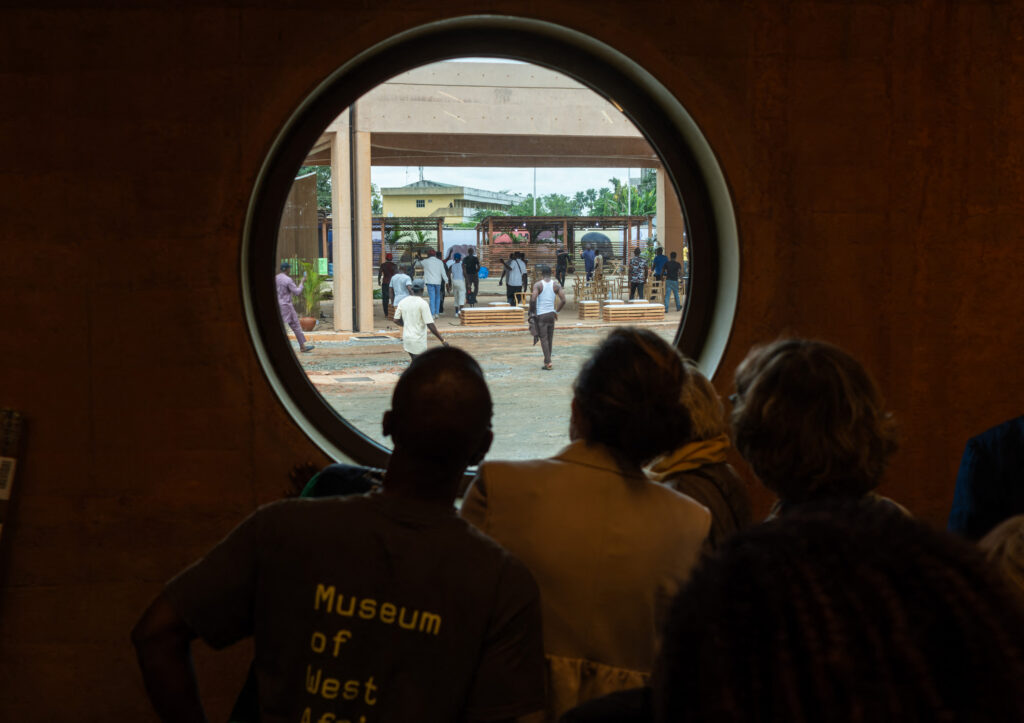
Nowhere was this tension clearer than in the events of last November. In Edo State, home to the Bini people and the descendants of the ransacked Oba, 250 Nigerian and international guests crowded Benin City’s modest arrival terminal—finely dressed donors, diplomats, and executives from numerous cultural agencies who had been invited to the opening of the Museum of West African Art (MOWAA). Their presence in the city signalled the millions in foreign donations to the project, which were undergirded by the belief that the museum would be “world-class,” a distinct and noteworthy addition to the West African art landscape.
On the first day of the opening preview, about an hour into the scheduled programme of talks and performances, protesters wearing red baseball caps began shouting from the gates: “No to MOWAA, this museum shall not open.” They eventually broke into the building, insulted guests, and accused MOWAA of usurping the rights of the Oba and of being in league with the governor of Edo State, Godwin Obaseki, who held public office from 2016 to 2024, and had been investigated as part of a probe into the improper use of state funds and assets. His party, the Peoples Democratic Party (PDP), has also been widely discredited for government corruption since entering national politics in 1999. The Western dignitaries had arrived in Benin with the conviction they were supporting the creation of a museum promoting West African heritage. But their conduct was recast by the protestors as a modern-day intrusion—colonialism in a different form, with cameras, notebooks, and briefcases instead of guns, but no less bent on undermining the Oba’s sovereignty. In response, Nigerians were launching an attack on the soil of the ancient Benin Kingdom.
I had been invited as a journalist to cover the opening. As we were corralled into a room to wait out the protesters, everyone was trying to make sense of what had happened. Rumors flew around that the protestors believed that the museum held the Benin Bronzes. Some saw it as the work of wayward, self-interested actors attempting to derail progress in Nigeria, citing the disruptions at Yemisi Shyllon Museum in Lagos in 2019 which have never been publicly confirmed. In short: Yet another example of Nigerians shooting themselves in the foot.
As visitors to the museums, we shared a kind of naivety that this opening would be no different from others, an assumption seemingly confirmed by the cheerfulness of the preview’s first hour and the insistence that “Nigeria can have world-class artistic centres.” But all the well-intentioned speeches ignored the ground we were standing on. Only later did the essential position, and its folly, become clear: that a museum could resolve a centuries-old crime, or contain or navigate the political conflicts between the Nigerian government, a variety of institutional and political actors, and the Edo State government in a society where references to “low trust” are a massive understatement.
Immediately after the protest, a deluge of opinion pieces and reports, from both within and outside Nigeria, sought to assign blame to the institution or to the protesters. Journalists and pundits across the country critiqued the protesters as agents of national deterioration—philistines probably paid by the Oba’s palace to act as his mouthpiece. Critics of MOWAA fixed on the organization’s foreign backing, including from the British, French, and German governments, and the millions of dollars involved in a nonprofit arrangement in a country where mismanagement of funds is as common as potholes. They saw MOWAA as just another Ponzi scheme, this time in the rarefied art and culture market rather than in the infrastructural projects—roads, bridges—that begin but are never completed. In response, MOWAA put out a statement absolving it of many of the charges leveled by the protestors. The museum denied any involvement with Governor Obaseki, any prior relationship to the Benin Bronzes, and stressed that the museum’s primary interest was with the safeguarding and celebration of West African art. Not only was this untrue, but it also risked blunting the purpose of a museum as a space for reflection and critique, and for engaging with the fractious history that gave rise to both the museum and the preview debacle.
MOWAA had evolved in direct conversation with the Benin Bronzes. The Benin Dialogue Group, composed of a wide range of national and international stakeholders, formed around the fate of Benin artworks held in Western museum collections—a formal gathering of major institutional heads from the UK, Germany, Austria, the Netherlands, and the US, alongside Nigerian stakeholders including family members of the Royal Court of Benin, members of the Edo State Government, and representatives of Nigeria’s National Commission for Museums and Monuments (NCMM). For many years the group was deadlocked by structural obstacles: The Benin Bronzes could not be subject to permanent restitution under laws such as the British Museum Act, which banned trustees from giving away objects held in their care, and negotiations dragged on to separate legal claims of ownership from the lack of secure infrastructure in Nigeria.
The inadequacies of Nigerian museums are well chronicled. In the travel memoir Looking for Transwonderland, Noo Saro-Wiwa describes a hilarious but also disappointing visit to the National Museum to see the car in which ex-military ruler Murtala Muhammed was assassinated by gunshot during a failed military coup in 1976. The building is dimly lit and poorly maintained, dust covers the vitrines, and many artifacts are misnamed or jumbled together. Similarly, in Teju Cole’s novel, Everyday Is for the Thief, a melancholy treatise on the diasporic flâneur, the unnamed narrator returns to Lagos after a 15-year self-exile in the United States. On a visit to the National Museum, he had hoped to learn more about the great works he had seen in New York, London, and Berlin, only to find a dismal state of affairs—the country’s violent dictatorships celebrated as an “achievement,” works of art missing, and a museum director convinced that the objects in his care possess a juju, ritual power capable of harming him and his loved ones. The indictment is not just of the country’s capacity to manage cultural artifacts, but of its inability to understand its own past. Dust covered vitrines, misplaced artifacts, and disorganized labels were not metaphors but representations of an ongoing act of self-inflicted “memoricide.” A decade after these books were written, the sentiment holds, as the MOWAA debacle illustrates.
After initial infrastructural challenges, the Benin Dialogue Group seemed to be making progress. A 2019 statement emphasized the group’s goal of founding a new Royal Museum to reunite in Benin City the most significant of Benin’s historical artifacts, currently scattered around the world. The museum would demonstrate the impressive culture of the Benin Kingdom, tracing the region’s history from the earliest archaeological evidence to the colonial and postcolonial eras, culminating in contemporary artistic expressions.
But the lofty ambitions of the group were thwarted by internal divisions between the Oba’s palace, the federal government, and private stakeholders. The following year, the Edo Museum of West African Art (EMOWAA) began its life as a private foundation, spearheaded by the financier Phillip Ihenacho with the support of the governor of Edo State, Godwin Obaseki. Both the 2019 statement and EMOWAA’s founding occurred against a backdrop of international reckoning with the legacies of slavery and colonialism, and of populist protest movements throughout the 2010s that put direct pressure on institutions to repatriate stolen artifacts. EMOWAA emerged alongside these wider institutional calls and acts of reckoning. The announcement of the project was initially met with widespread approval. Sir David Adjaye, the acclaimed Ghanaian-British architect responsible for the National Museum of African American History and Culture, was named the museum’s architect, and would construct a sprawling campus and museum on the grounds that once served as the home of the historic Benin Central Hospital, the oldest medical facility in the city.
But in 2021 and 2022, as funding poured in, the relationship between the Oba’s palace and the museum rapidly deteriorated. The Oba vehemently objected to any institution other than his own Royal Museum housing the bronzes. As Kate Fitz Gibbon, an expert in the field of art and cultural heritage law, has pointed out, EMOWAA was never recognized as the legitimate holder of Benin artifacts. Both the National Commission for Museums and Monuments and the Royal Court of the Oba were suspicious of EMOWAA’s non-federal and private status. NCMM feared that EMOWAA’s relationship to international donors would make it exempt from the national body’s authority and oversight.
Then in March 2023, President Muhammadu Buhari issued a presidential gazette vesting custody of repatriated Benin artifacts to the Oba of Benin, with the NCMM responsible for ensuring their secure housing. Following a quick and effective rebrand, EMOWAA became MOWAA, repositioning itself as a hub for celebrating and contextualizing Nigerian contemporary art, and acting as a mouthpiece for Nigerian art through the Nigerian Pavilion at the 2024 Venice Biennale—featuring some of the country’s leading artists, among them Yinka Shonibare, Ndidi Dike, Toyin Ojih Odutola, and Fatimah Tuggar.
The barrage of media attention given to the Nigerian Pavilion, curated by Aindrea Emelife, helped erase memories of MOWAA’s association with the bronzes. The “Nigeria Imaginary” was a nostalgic construction, a vehicle for exploring a rosy and romanticized past: one of the Mbari Clubs frequented by luminaries like Chinua Achebe and Wole Soyinka in the 1960s, before the Biafran civil war, which claimed millions of lives. By looking through the lens of these iconic if sanitized moments in Nigeria’s history, a new national idyll might be created. But the emphasis on an imagined future failed to capture the grit, violence, conflict, and ambivalence of the past and present.
The exhibition returned triumphantly to the MOWAA preview: filled with inspiring and beautiful art, yet in a sense it was symptomatic of MOWAA’s remoteness from the political realities on the ground. It reads as an attempt to build an unblemished cultural legacy. But whatever imaginary exists for Nigeria’s future must reckon with the uncomfortable elements of its history. While MOWAA tried to smooth over the rubble of the past in its quest to imagine the future, the protestors airing their grievances made it clear that the score was far from settled.
Given Buhari’s gazette, and MOWAA’s conscious distancing from the bronzes, the protest, strictly speaking, should not have occurred: the federal government had already declared the bronzes the Oba’s property, and MOWAA had pivoted away from its proposed role as their vestibule and safekeeper. But the broader message of the MOWAA debacle is that restitution would never spell the end of an old dispensation, only the beginning of an even more ambivalent and fractious discourse over cultural belonging and national identity. It simply relocated the colonial-era argument about ownership from Europe to Nigeria, and in doing so, exposed a set of unresolved disputes—between the Oba’s palace and the Edo State government, between Edo State and the federal government, between Bini particularism and Nigerian nationhood, between the diaspora and the homeland—which the proposed return of the bronzes only inflamed.
The value of MOWAA might lie precisely in this lesson, which should prompt a profound national reckoning about how the history of slavery and colonialism still functions in Nigeria today. History has been under attack as a subject in Nigerian schools since the 1970s. In the early 1980s, General Olusegun Obasanjo replaced it with civic education. As a result, Nigerians have never been able to understand the origins of the recurring crises of their own political culture. One example of this lacuna appears in the links between the bronzes and slavery: Benin’s rulers were themselves significant slave traders, known for ritual killings in which the blood of victims anointed royal bronzes; British accounts describe chipping dried blood from the objects they seized. That history does not excuse the theft, but it complicates any attempt to project innocence onto the precolonial kingdom—a complication which the Restitution Study Group has pressed hard on.
The Restitution Study Group’s argument deserves more attention than it usually receives. As products of the slave trade—manillas, the era’s metal currency, melted down into royal art—the bronzes are also part of the inheritance of enslaved people’s descendants now living in Brazil, the Caribbean, the UK, and the US. The RSG also argued that, because the Smithsonian is a public institution, its trustees had no right to give the pieces away without public consultation. The Supreme Court declined to hear the case, but the underlying question hasn’t gone away: If the Oba is the rightful owner, does that foreclose any wider claim—Nigerian, diasporic, or otherwise? Is this a matter for Bini people alone?
As a foil to MOWAA’s crisis-PR posture, the Oba chose to say nothing, and his silence served him better than any statement could. It shielded him from direct blame while also legitimizing the protesters—casting them as political agents rather than spontaneous actors, suggesting that the protest had grown out of a rift between what MOWAA had come to symbolize (international corporate looters profiting from Bini cultural history) and the Oba’s palace (the recognized owner of the Benin Bronzes, the official guardian of Bini cultural history). The bronzes helped define this rift, but the protests were not concerned solely with the bronzes; they were also about who has the right to present themselves as purveyors of cultural knowledge and history within Benin City.
Nigeria’s two major parties then turned the episode into opposing stories. According to the ruling APC, the protesters are not agitators but heroes, rising in “righteous indignation to defend our heritage,” with Edo State Governor Okpebholo cast as the leader finally aligning with the Oba and “restoring” the museum to its rightful purpose as a Benin Royal Museum. PDP surrogates, by contrast, minimize any link between the demonstrations and the throne. One camp downplays the palace’s role; the other emphasizes it, using loyalty to the Oba as a weapon against Ihenacho, Obaseki, and anyone associated with them.
A great deal has been written about MOWAA, but very little of it has reckoned with the two problems at stake: the unresolved legacy of colonialism, and the fragility of a postcolonial state trying and ultimately failing to transcend it. I keep returning to two smaller, telling details. First, a charge made by local observers on how few Bini people worked at MOWAA. Second, a comparison from an article on the website Africa Is a Country, which criticized the museum by comparing its international and Nigerian employees to a scenario in which the Louvre had no French workers. France is a unitary state, where someone from Marseille and someone from Normandy are equally French without qualification; Nigeria is a federation, and MOWAA’s staff were, in fact, Nigerian. The comparison elides the structure it claims to explain, and in defending the Oba’s exclusive claim, it stokes the narrative of ethnic takeover already hanging over the affair—a dangerous sentiment that deserves challenge, as an acceptance of ethnic particularism corrodes the slower and vital work of national cohesion.
Instead of bringing the nation together, and “healing” the rift caused by colonialism, the vexed questions of ownership and belonging have only revealed how divided we really are. Between 2022 and 2025, bronzes flowed back to the Oba from the Smithsonian, the University of Iowa, the Museum of Fine Arts Boston, and—in the largest single transfer, 119 pieces—the Dutch state collection and the City of Rotterdam. Why hasn’t that accumulating possession settled anything? Is the implicit argument that a Benin Royal Museum should be the only legitimate museum in Benin City? And if MOWAA has already renounced any claim on the bronzes themselves, should its origins still be disqualifying? On top of that, why has the entire controversy narrowed to the bronzes, when MOWAA’s stated ambition—celebrating West African art, living and working, right now—has never received a fraction of the same attention? Why do the bronzes matter more than the artists who are still here?
The Benin Bronzes eclipse the claims to attention of living artists not because their work has less value, but because the return of the bronzes seems to symbolize a repair of the psychic and material damage of colonialism. They represent a past that feels unambiguous because we were its perfect victims. The contemporary artist, born after independence from British rule in 1960, is not seen as a victim of those same wounds—Nigeria is an independent country now, and failings are the government’s responsibility alone. And yet the fallout over MOWAA suggests that the crimes of colonialism still visit the present, in the lack of infrastructure, the low trust, and the corruption allegations that marred the preview. The Benin Bronzes create a clear dividing line between oppressed and oppressors—but present-day artists muddy that boundary. They raise the responsibilities and failings of the Nigerian government in both its caretaking of national heritage and ongoing support for the arts.
The affair is emblematic of a phenomenon that the Ugandan political scientist Mahmood Mamdani described in his 1996 study of post-independent African states, Citizen and Subject. Mamdani argues that political independence deracialized the state without deracializing civil society. Historically accumulated privilege simply migrated into new arenas––the boardroom, the national assembly, government offices—and the struggle to dislodge it shifted from a contest between state and society into a contest within society itself. Equally useful here is his distinction between citizen and subject: Colonial rule governed urban centres through direct, civic authority while leaving the countryside under customary, chiefly power—a bifurcation which independence never fully resolved.
MOWAA sits almost exactly on that fault line. Is Bini identity, in this dispute, operating on a customary register, answerable to the Oba as subjects, or on a civic one, answerable to the Nigerian state as citizens? If Nigerians more broadly are absent from any ownership claim over both the bronzes and the MOWAA museum—which, being based in Benin City, should belong to the Bini people and the Oba—then what is the function of any museum in the first place, if not as the living room of a populace, the space in which the national question itself might be thought through and reformulated into ever more complex and urgent forms?
MOWAA is a mirror of the present moment, and of centuries past, bridging the divide between 1897 and 2026. Its tragedy isn’t simply corruption or bad faith; it’s the fundamental incoherence of post-independence state projects that set out to repair the damage of colonialism while reproducing its structure—another contest over land, provenance, and belonging. The lofty aims of MOWAA were structurally disarticulated from the politics and realities of contemporary Nigeria. Writing in the London Review of Books in 2021, Adewale Maja-Pearce made an impassioned argument that the bronzes should not be returned to Nigeria if the state lacked the capacity to look after them. When I first read the piece, I thought that his notion of state incapacity had connotations of colonial paternalism, and that the ideal of cultural sovereignty should surmount Nigeria’s obvious infrastructural challenges. But after the MOWAA incident, Maja-Pearce’s argument virtually makes itself. Even with the best intentions and the greatest of resources, a museum cannot absolve the intractable problems of the Nigerian state: a sluggish and inept government, beset by the strong men vying for power and influence. I would argue that instead of the protest and its aftermath constituting a total indictment of Nigeria’s right to the Bronzes, it opens up a path to consider how the politics of return cannot be understood as the sole preserve of cultural institutions like museums, but as embedded in a nation-wide struggle to form a coherent national identity through the reclamation of a troubled past. Too bad that all we have for now are empty vitrines, quietly collecting dust.