The Politics of the Planetary
The French philosopher Guy Debord and Danish painter Asger Jorn built their book Mémoires (1959) out of a collage of purloined material. Newspaper clippings, magazine advertisements, cartoons, cutups of maps of Paris and London, quotations from Karl Marx about work and from Johan Huizinga about play, all hijacked from their original contexts and reassembled under Jorn’s ink splashes and lithographic overlays. The pages are striking, but the book’s most famous feature is its cover. At the suggestion of its printer, Mémoires was wrapped in heavy sandpaper. By design, the book wears down whatever sits beside it on a shelf, grinding away at neighboring volumes and scoring the shelf itself.
Mémoires’ rough cover is more than just a piece of avant garde art-book trivia. It’s a metaphor for how some ideas operate. Some ideas are so caustic that when they enter a staid body of thought, they wear down their neighbors, forcing a reconsideration of the very idea of a cozy collection. The concept of the Planetary, as it has entered political theory over the last decade or so, works like that sandpaper cover. It doesn’t slot in simply as a nice addition to the existing bookshelf of political-theoretical concepts. Instead, it is a corrosive agent that is wearing down every one of these familiar concepts, demanding that each be rethought.
First articulated by literary theorist Gayatri Chakravorty Spivak at the turn of the millennium as a critique of globalization, the Planetary has emerged as a potent concept in the human sciences. Its core idea was developed by historian Dipesh Chakrabarty in 2019: “The word globe as it has appeared in the literature on globalization is not the same as the word globe in the expression global warming.” Where the global of globalization frames Earth in terms of the human, the global of global warming frames Earth without centering humans. This second sense of the Earth as a physical system existing long before us and persisting long after is what we call the Planetary.
The Earth is an immense, integrated system defined by physical and biogeochemical processes: the movement of matter and energy on and around the third celestial object from the Sun. Earth is not humanity’s. We are just one part of this vast planet, which we share with other living beings, nonliving matter, and forms of energy—all of which is interconnected.
The traditional categories of Western political theory were all built at a particular kind of scale: territorial, jurisdictional, and proudly anthropocentric. But Earth doesn’t operate at that scale. That is, our foundational political categories don’t align with the material reality in which we are embedded and on which we rely for our existence. The Earth, we now know, won’t bow to our will; we must bend to its. We must come to terms with the condition of planetarity, our term, following Spivak and Chakrabarty, for our inescapable embeddedness in an Earth-spanning biogeochemical system. Any hope we have of thriving on this planet requires a politics in attunement with this planet.
Planetary thought represents a foundational departure from Western thought and political practice, which views the Earth as a mere backdrop to the human story—both infinitely extractable and fundamentally forgettable. The Planetary presents an abrasive challenge to a tradition that extends from Aristotle and Machiavelli to Karl Marx and Carl Schmitt—political thinkers of vastly divergent casts of mind but nonetheless aligned in a pre-planetary concept of the political.
In our book Children of a Modest Star: Planetary Thinking for an Age of Crises (2024), we set out to deploy the sandpapering concept of the Planetary on one particularly hoary political idea: sovereignty. In this essay, we sketch what the Planetary does to five other foundational ideas in Western politics—the citizen, the nation, the state, freedom, and the political—and think through what rebuilding them from planetary foundations might look like.
The Citizen
“All citizens,” the Declaration of the Rights of Man and of the Citizen proclaimed in 1789, are “equal in the eyes of the law” and “equally eligible to all dignities.” In this revolutionary era, the citizen became the basic unit of modern political membership: a bounded legal and moral subject whose rights, obligations, and identities are constituted through participation in a particular political community. The Planetary unsettles this category in at least three ways.
First, citizenship is bounded. One is a citizen of a particular community, with obligations to specific others and rights against specific authorities within a particular jurisdiction. The Planetary cuts across the relevant boundaries. The atmosphere, the oceans, and viruses recognize no jurisdictions. The political obligations generated by our planetary embeddedness cannot be assigned to any single bounded community, because the systems that generate those obligations are themselves unbounded. (A rice farmer in the Ganges Delta whose paddies are being salted by rising seas has no vote in the countries whose emissions raised them.) One cannot demand that planetary systems respect your citizenship, but must instead learn how to accommodate them.
Second, citizenship is a status held by living people. The Planetary, operating on geological timescales, implies obligations toward future generations who do not yet exist—a point not exclusive to planetary thought, but emphasized by it, nonetheless. The standard mechanisms of democratic representation presuppose a relatively stable community of contemporaries. They have no obvious extension to parties distributed across deep time. This is a structural incompatibility between the temporal scope of the Planetary and the temporal assumptions built into citizenship itself.
Third, and most fundamentally, citizenship has always been understood as a strictly human affair. But the Planetary proposes that we treat our non-human companions as worthy not just of respect and dignity but of political voice. The Planetary insists that the non-human world deserves political power. It suggests, as Bruno Latour argued, a Parliament of Things—a space of political inclusion that goes beyond the human subject. The difficulty is that extending citizenship in this direction only exposes how much the idea of citizenship centers on the articulate adult political subject. While technological breakthroughs may eventually enable the non-humans to “speak” in ways we humans can understand, planetary systems cannot reciprocate obligations and therefore cannot enter into contracts. The modern idea of citizenship assumes that all humans are nominally created equal—but this idea cannot be plausibly extended to non-human species on an individualist basis, with every baboon and bumblebee granted an equal vote in the parliament of things.
One can declare that a river is a legal person with rights, as New Zealand did for the Whanganui, or that future generations have standing, as a growing number of constitutional courts have begun to do. These are significant political innovations. But they are innovations that work by analogizing non-human or not-yet-existing parties to living human citizens. What they reveal, in the end, is that the concept of citizenship will need to be replaced by something new.
The Nation
When citizens come together, they become a nation—the paramount social and political identity of modernity. The nation, in perhaps its most famous formulation, is an “imagined political community.” But, after a dash, Benedict Anderson specified what he meant: “– and imagined as both inherently limited and sovereign.” Most of us, in thinking about Anderson’s definition, focus on the nation as imagined, but it’s important to consider the role of limited. “The nation is imagined as limited,” he wrote in 1983, “because even the largest of them, encompassing perhaps a billion living human beings, has finite, if elastic, boundaries, beyond which lie other nations. No nation imagines itself as coterminous with mankind.” The nation is constituted by its exclusions.
The political imagination of the nation is limited in another way as well. Not only does each nation exclude most of humanity, it excludes the more-than-human world altogether. The nation, in Anderson’s words, “is always conceived as a deep, horizontal comradeship,” but only among its human members. Non-nationals and nonhumans sit outside the nation; they are not comrades.
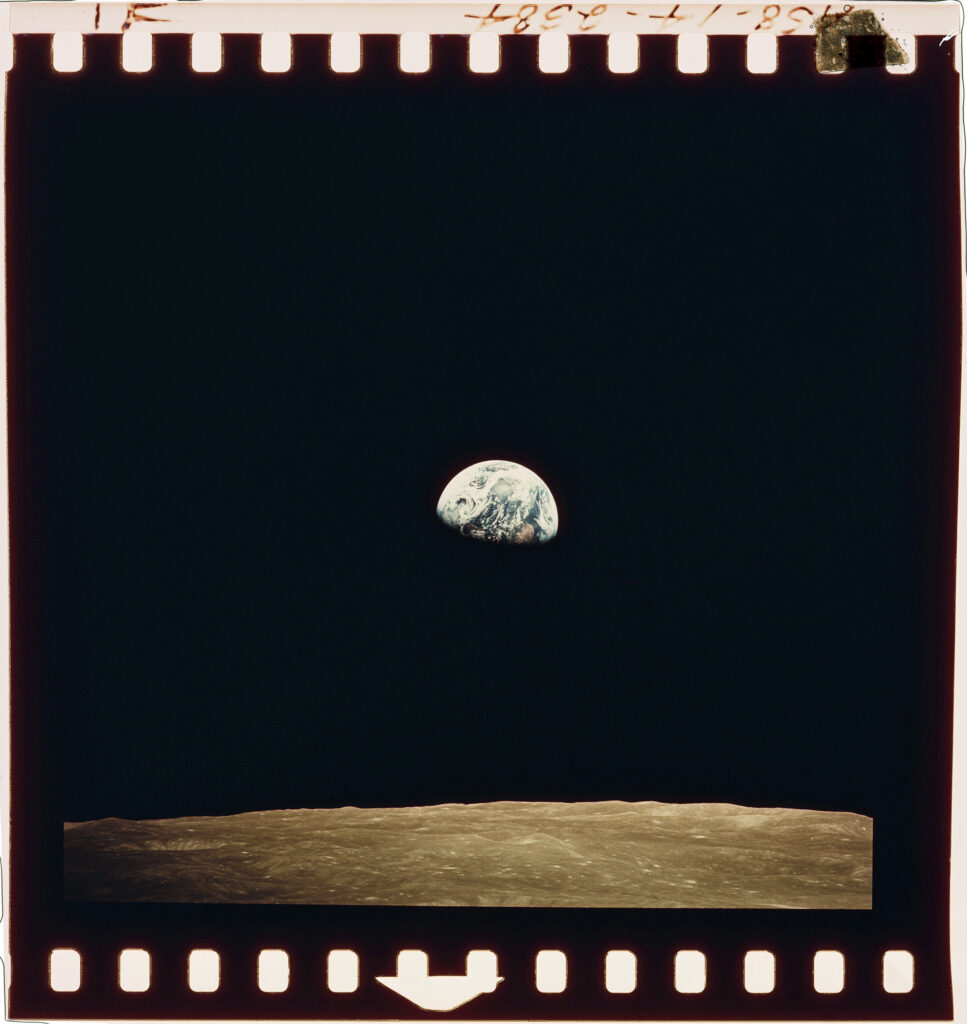
On Christmas Day, 1968, as the crew on Apollo 8 became the first humans to see the whole Earth with their own eyes, the poet Archibald MacLeish reflected on the meaning of this in The New York Times (in what is surely among its loveliest op-eds). He immediately understood that the photographs the mission sent down from space showing “the earth as it truly is, small and blue and beautiful in that eternal silence where it floats” could—and should—change “men’s conception of themselves and of each other.” The new vision that emerged from the publication of photos like the famous Earthrise that put a mirror up to our planet was, MacLeish believed, the truest, both empirically and ethically. We are no more nor less than “riders on the earth together, brothers on that bright loveliness in the eternal cold—brothers who know now they are truly brothers.”
MacLeish’s vision of brotherhood (dated in its midcentury use of “men”) gets us halfway there. But to truly “see the earth as it truly is” means looking beyond the human. Human beings are only 8 billion of the trillions of “riders on earth.” If humanity cannot survive on its own, a nation certainly can’t. The biosphere, not the nation, sustains us.
This doesn’t mean that the nation can’t continue to provide succor or enthusiasm (we write during the World Cup, which like other such comings together, shows nationalism at its very best). There are many ways that humans group themselves and identify collectively—gender, political party, religion—often to positive effect. But in a planetary age, the nation can’t remain the paramount social and political identity. Something else, something more inclusive, more ecological, more-than-human, must take its place. What that looks like is difficult to say. Imagining a politically potent identity without an opposing out-group is a tall order. But conjuring an “imagined political community” limited only by outer limits of the Earth system itself is a necessary task.
The Planetary suggests a vision of political identity that centers on two alternatives to a human out-group. The first is negative. Insofar as we accept that in-groups need to define themselves against an enemy, the enemy is not a fixed human group but rather a condition. The thing a planetary politics opposes is the disruption of the Earth system, and specifically the threat of extinction (human and non-human). But we can also define this vision of identity positively: It is about embracing the “condition of planetarity.” Just as nationalism can take the form of negative, hateful “jingoism” or a positive, agape-resonant form of “patriotism,” so the planetary vision of post-national identity can center on the commitment to a project.
The collective is defined by what it is building—that is, by a commitment to planetary sapience and building a mature technosphere. In this frame, (human) adversaries appear only insofar as they pose themselves as obstacles to that project. And of course, there will be people who oppose this project. But this doesn’t mean identification with the condition of planetarity, with the Earth system and all its beings, is not a viable identity, any more than the existence of traitors within a nation vitiates the identity of the nation.
The State
Bees and ants, observed Thomas Hobbes in Leviathan (1651), “live sociably one with another,” and so could be considered “amongst Politicall creatures.” But, he continued, these nonhuman animals have social and political lives completely different from “Man-kind.” Animals, he argued, can come to agreement naturally, but humans reach and sustain agreement among themselves “by Covenant only, which is Artificiall.”
Writing during the English Civil War, just two years after King Charles I’s beheading, Hobbes understood all too well that covenant among men alone did not maintain social order. “There is no wonder if there be somwhat else required (besides Covenant) to make their Agreement constant and lasting,” he wrote. That “somwhat else” was “a Common Power, to keep them in awe”: “that great Leviathan… that Mortall God, to which wee owe under the Immortall God, our peace and defence.” Political communities, according to Hobbes, required an overarching and forceful political structure to live in peace. Human beings, unlike bees and ants, require the state.
The state is the guarantor of citizens and the protector of nations. Stateless people and nations are always vulnerable to the predation of others. They suffer a pitiful existence “outside the pale of the law,” as Hannah Arendt explained, lacking even “the right to have rights.” Yet the state’s role as the creator of order, guardian of “our peace and defence,” and defender of collective and individual rights still leaves it circumscribed. The state, at its very best, is a mechanism for listening to human voices and then responsively and responsibly steering human affairs. Of course, it often doesn’t reach that standard. But even this ideal template still ignores most of the living planet. The state is a human institution in a more-than-human planet.
Human survival depends on the well-being of the planet’s biosphere. But the state lacks the ability to listen to the non-human world, and therefore to act on its behalf. There are plenty of conservation laws on the books and many states have a ministry of the environment, but they are thoroughly anthropocentric ventures. The state still treats the nonhuman world as a mere resource for use by humanity—after all, Western thought since Aristotle has understood the nonhuman world as existing “for the sake of human beings.”
There are exceptions, and they are growing. In 2008, Ecuador was the first to put rights of nature in its constitution, which “the State” must “enforce,” including, for instance, “the right to integral respect for its existence.” The Ecuadorian state has—imperfectly—followed through, most profoundly in a 2021 ruling by the Constitutional Court that a mining concession in the Los Cedros forest was unconstitutional. The judges explained that their decision was based on “the intrinsic value that the Constitution places on the existence of species and ecosystems through the rights of nature,” writing that their reasoning hinged not the mining’s likely “effects on human beings,” but “the extinction of species, destruction of ecosystems or permanent alteration of natural cycles or other types of serious or irreversible damage to nature.”
But these constitutional innovations are insufficiently transformational. The recognition that everything is connected in the Earth system and that many vital processes and systems operate at the planetary scale means that the state cannot be the primary political form. As the container for sovereignty, the state is too ambitious: It tries to do everything, but it sits at the middle level—neither planetary nor local. (As the sociologist Daniel Bell put it, in 1977, “the national state is too small for the big problems of life and too big for the small problems.”) The world’s largest state by population, India, is home to only 18 percent of the global human population. The world’s largest state by territory, Russia, covers only a thirtieth of the planet. Yet the governance of the planet has fallen to these and the other nearly 200 states. They have done a lackluster job because the state has been tasked with a job that it is ill-equipped to accomplish.
Freedom
Freedom today means individuals having absolute and autonomous choice. Choice, the historian Sophia Rosenfeld has recently shown, “is freedom” in the modern world. Constraints on individual choice, therefore, are understood as abrogations of freedom.
Isaiah Berlin, in his famous 1958 lecture, defined two concepts of liberty: positive and negative. Positive liberty, or “freedom to,” captures an individual’s capabilities to pursue their own ends. This is a vital tradition. But in modern Western politics, negative liberty, or “freedom from,” has reigned supreme. In this political tradition, what matters most is living, in Berlin’s words, “without interference by other persons.”
The modern imaginary upon which this vision of freedom is built stands on faulty foundations that the Planetary, like an acid test, erodes. The basic physics of life, including human life, is about interdependence, not independence. As the Soviet scientist, and early planetary thinker, Vladmir Vernadsky noted, in 1945, all living beings “are connected indissolubly and uninterruptedly” due to the exchange of matter and energy through eating and breathing. The conclusion he drew is that though “one used to speak of man as an individual, living and moving freely about our planet, freely building up his history,” the truth is that “no living organism exists on earth in a state of freedom.” Human beings and every other living thing on Earth are so enmeshed, so indissolubly interconnected that the concept of freedom is an illusion.
Rather than toss freedom entirely, however, we must reconsider it in light of our embeddedness in the Earth. What vision of freedom emerges from this understanding of the human place on the planet? Given our entanglement with living and nonliving systems on Earth, any concept of freedom must be paired with duty, obligation, and care.
To be free on planet Earth, then, is to act not just for the self, but with and for others. This rhymes with conceptions of freedom articulated by feminist scholars, like Nancy Hirschmann, who have long understood that individuals are embedded within communities. The community, however, must now be seen as more than merely human. Nonhuman beings and systems create the conditions for human life—providing oxygen and nutrients, recycling waste, and more. As a result, we owe them something.
These may seem like constraints on choice and, therefore, freedom. But they are not imposed by other agents; it is the condition of planetarity itself that imposes these constraints. That is to say, they are constraints in the same way that gravity is a constraint. As Berlin argued, the constraints of gravity are not constraints on freedom. “Mere incapacity to attain a goal is not a lack of political freedom,” he wrote. The Planetary, in this sense, is more incapacity than an attack on freedom. The addition of duty and care to our political constellation may seem a burden to some, but it is simply the cost of living with awareness of our existence on Earth.
The Political
The political, in the Western tradition, is the domain within which citizens act collectively: a space of deliberation, contestation, and sovereign decision-making distinguished from nature, economy, and private life. Each of the tradition’s canonical formulations of what makes this domain distinctive is upended by the Planetary.
Since antiquity, Western political thought has distinguished between physis—nature, the domain of necessity—and nomos—convention, the domain of freedom and politics. The political is precisely the space where human beings, who Aristotle called the zoon politikon or political animal, transcend the given and exercise collective self-determination. The Planetary collapses this distinction from both sides. Ecological conditions are now deeply and irreversibly shaped by political and economic decisions, while political and economic possibilities are increasingly constrained by those same ecological conditions. Nature is no longer a background condition for politics. It is simultaneously a product of politics and a constraint upon it.
Niccolò Machiavelli understood the political as the domain where virtù—skill, force, cunning—contends with fortuna—the contingency of circumstance. Machiavelli’s Prince engineers the conditions under which fortuna’s force can be partially directed and partially contained: This is the paradigm of political action. The Planetary forecloses this. As we saw during the Covid pandemic, pandemic risk is not contingency that can be directed or contained by clever political rhetoric or amoral political scheming. No exercise of virtù has purchase on a warming atmosphere.
Hobbes framed the political in terms of the “war of all against all” he had witnessed during the English Civil War. For Hobbes, the Leviathan, emerging from a social contract among present persons fearful of violent death at the hands of other humans, provides security within a bounded territory—the aforementioned state. But the Hobbesian sovereign can offer no security against harms that accumulate across centuries and respect no territorial limit. Yes, humans still present a threat to one another, but on Planetary timescales these threats pale compared to the existential risks of runaway climate change, technological rupture, or epidemiological catastrophe.
Karl Marx located politics in the superstructure conditioned by the economic base: The human relations of production determine, in the last instance, the forms of political life. The Planetary introduces a further term beneath even the economic base: the biophysical conditions that make any mode of production possible at all. Call it the metabolic sub-base. The deterioration of this sub-base reveals the base-superstructure relationship as historically contingent in ways Marx did not theorize and that his successors have only begun to reckon with.
The Nazi legal theorist Carl Schmitt’s definition of the political as exclusively rooted in the (human) friend-enemy distinction fares no better. The principal threats of the future—climate change, pandemics, space junk, and other planetary challenges—are not enemies. They cannot be deterred, nor negotiated with, nor, most crucially, defeated. They are conditions: systemic, impersonal, indifferent to sovereign decisionism. The planetary, in this sense, dethrones intra-human rivalries as the be-all and end-all of politics. Schmitt famously dismissed universal categories like humanity as a form of political “cheating,” but there is no cheating and can be no exception from the inexorable pressures brought by planetary forces.
What all these theorists had in common was a fundamentally anthropocentric concept of the political. Nature, in all these frameworks, appears as setting, resource, constraint, or metaphor—never as a party to politics, never as a bearer of interests that politics must answer to, never as a force that co-constitutes the political domain itself. But this is precisely what the Planetary demands. It insists that political life include all the residents of Earth’s biosphere as co-participants in the reproduction or destruction of any possible human order.

With these short sections, we’ve held the sandpaper of the Planetary against five key concepts of modern political theory—like rubbing Mémoires against other books. But this is only the beginning of the work. Each concept deserves a much more sustained exposure, and the conceptual bookshelf holds many more volumes waiting to be scrubbed. What does the Planetary do to democracy? To justice and legitimacy? To rights and law? To power and authority? Each will show the same sorts of abrasions once the concept of the Planetary is set against it.
The advent of Planetary thinking is not merely additive to the repertoire of the social sciences. One cannot append the Planetary to the existing table of contents, while leaving the existing chapters intact. The category doesn’t request a place on the bookshelf of political theory; it changes the shape of the bookshelf itself. What it is forcing is a revision of the ontology and epistemology of the social sciences: a rethinking of what the social is, what counts as a political actor, and across what spans of space and time political analysis has to reach. In Thomas Kuhn’s terms, the anomalies within traditional social science have piled up, and a paradigm shift is upon us.
When paradigm shifts occur, many old questions, concepts, and thinkers are disregarded. But it is often also an opportunity to rediscover old thinkers who didn’t receive much consideration under the previous paradigm. The renewed interest in Vernadsky as a planetary thinker is a case in point. Paradigm shifts are also moments of reappraisal, when we discover new things in old thinkers. In the same way that Marx claimed to take Hegel’s dialectic from “standing on its head” to “be turned right side up again,” we must now flip thinkers like Aristotle, Machiavelli, Hobbes, Arendt, and Berlin from their anthropocentric, individualist heads onto their feet, where they can stand firmly upon the Earth.